Are Vegetable Choppers Useful? What I’d Know Before Buying One

Quick Answer
Yes, vegetable choppers are useful if you regularly dice onions, peppers, potatoes, carrots, and similar produce. They can reduce repetitive knife work and make meal prep easier, although a good knife remains better for precision cuts and tiny jobs. A food chopper buying guide can also help you choose the right size and style.
When a vegetable chopper makes sense
- Batch prep: It handles repetitive dicing faster than making every cut individually.
- Uniform pieces: Grid-style models can produce consistent cubes for salads, soups, salsa, and meal prep.
- Less knife work: A chopper reduces the amount of freehand cutting required.
- Mess control: Models with containers collect chopped vegetables instead of scattering them across the board.
- Busy kitchens: They’re most worthwhile when vegetables appear in your meals several times each week.
Think twice if…
- You only chop one small ingredient, need delicate knife cuts, or dislike cleaning several small parts.
I like kitchen gadgets that solve a repeated problem, not gadgets that simply take up drawer space. Vegetable choppers fall squarely into that test.
If chopping onions, peppers, potatoes, or salad vegetables slows down dinner, a good chopper can earn its place. This guide explains where these tools shine, where they disappoint, and what type makes sense for your kitchen in 2026.
What is a vegetable chopper?
A vegetable chopper is a manual or powered kitchen tool designed to cut produce into smaller pieces with less freehand knife work. Depending on the design, it may dice, chop, slice, julienne, grate, or mince.
The important detail is that “vegetable chopper” describes several different tools. They don’t all produce the same result.
- Grid dicers: Push vegetables through square blades to create cubes.
- Plunger choppers: Use repeated downward presses to rotate or move a blade.
- Pull-cord choppers: Spin blades inside a bowl when you pull a cord.
- Electric mini choppers: Use a motor for chopping, mincing, or puréeing.
- Multi-function choppers: Add interchangeable slicers, graters, julienne blades, and other inserts.
A chef’s knife can perform nearly all these jobs. The chopper’s advantage is convenience and repetition rather than superior culinary technique.
Are vegetable choppers actually useful?
Vegetable choppers are useful when they replace a repetitive prep task you already do frequently. They’re much harder to justify when you only need a few cuts.
I judge them by the entire workflow. Chopping speed matters, but setup, cleanup, storage, and blade handling matter too.
- For one tomato: I’d reach for a knife.
- For six onions: A grid chopper becomes much more appealing.
- For herbs and garlic: A small pull-cord or plunger chopper can work well.
- For precise julienne: A knife or dedicated slicer usually provides more control.
- For weekly meal prep: A container-style dicer can save repetitive work.
This is why I wouldn’t call a vegetable chopper essential for every cook. It’s a convenience tool whose value grows with the amount of produce you prepare.
What are the biggest advantages of a vegetable chopper?
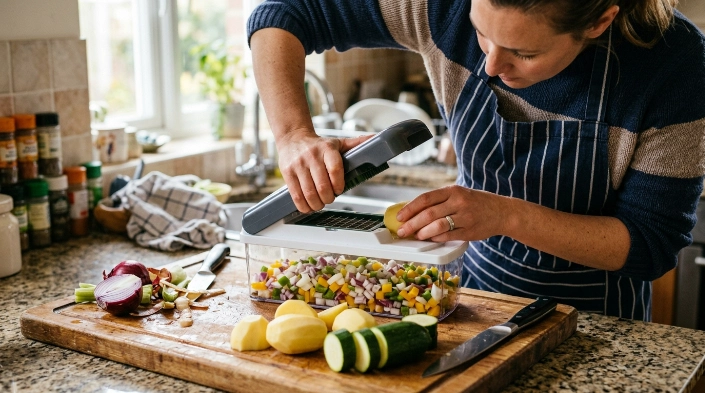
The main advantages are speed during repetitive prep, consistent sizing, easier collection, and reduced freehand cutting. These benefits become more noticeable as your batch gets larger.
Faster repetitive chopping
Dicing several vegetables requires many individual knife strokes. A grid-style chopper can push a prepared piece through multiple cutting edges at once.
You’ll still need preliminary cuts for vegetables that are too large. The chopper simply handles much of the repetitive finishing work.
More consistent pieces
Uniform vegetable pieces aren’t just prettier. Similar sizes tend to cook at similar rates.
That matters in stir-fries, soups, roasted vegetables, omelets, and sheet-pan meals. My guide to cooking food evenly explains why consistent ingredient size can make cooking more predictable.
Less mess during meal prep
Container-style choppers drop the cut food directly into a catch bin. That can be convenient when you’re preparing several cups of onions, peppers, potatoes, or zucchini.
You still create dishes to wash. However, you may spend less time collecting little pieces from the cutting board and counter.
Useful for cooks who dislike repetitive knife work
Not everyone enjoys dicing a pile of vegetables. A chopper can make that part of cooking feel less tedious.
It doesn’t replace basic kitchen skills, though. Learning safe knife and food-preparation skills remains valuable because many foods won’t fit neatly into a chopper.
What are the disadvantages of vegetable choppers?
The main drawbacks are cleanup, storage, limited precision, pressure requirements, and blades that still need careful handling. These can outweigh the time savings for small meals.
Cleaning can cancel out the time savings
This is my biggest test for any prep gadget. If I spend longer digging onion pieces from a cutting grid than I would have spent using a knife, the convenience disappears.
Models with removable grids and cleaning tools are easier to live with. Rinsing parts soon after use also prevents food from drying inside narrow spaces.
Soft foods can become messy
Firm onions, peppers, potatoes, celery, and similar vegetables generally suit grid-style choppers better than delicate produce. Very ripe tomatoes can crush instead of forming neat cubes.
Consumer Reports has also found that softer foods can become mashed rather than cleanly cut in some veggie dicers. That limitation is worth remembering if tomatoes or soft fruit are your main reason for buying one.
You still need some knife work
A large onion, sweet potato, cabbage, or zucchini may need to be cut into manageable sections first. A chopper reduces knife work rather than eliminating it.
That distinction matters. Marketing photos sometimes make these gadgets look like complete replacements for ordinary prep tools.
Extra parts need storage
Multi-function models may include several grids, slicers, graters, brushes, holders, and containers. Those accessories are useful only when you can find them.
I prefer models that store unused blades securely. Loose sharp inserts floating around a kitchen drawer are something I avoid.
Vegetable chopper vs knife: which is better?
A vegetable chopper is better for repetitive, standardized cuts, while a knife is better for precision, flexibility, and quick small jobs. Most active home cooks can benefit from using both rather than treating them as competitors.
| Task | Vegetable Chopper | Chef’s Knife | Better Choice |
|---|---|---|---|
| Dicing several onions | Fast, repeatable cubes | Flexible but more repetitive | Chopper |
| Cutting one small vegetable | Extra setup and cleanup | Quick and simple | Knife |
| Uniform cubes | Consistent grid size | Depends on knife skill | Chopper |
| Fine or decorative cuts | Limited by attachments | Excellent control | Knife |
| Cleanup | Several surfaces and parts | Knife and board | Knife |
| Large meal-prep batch | Efficient repetitive cutting | More manual work | Chopper |
Think of the knife as the versatile everyday tool. Think of the chopper as a shortcut for specific high-volume jobs.
Which vegetables work best in a vegetable chopper?
Firm vegetables that can be cut into flat, manageable sections usually work best. Extremely soft, fibrous, oversized, or very hard ingredients can be more difficult.
- Onions: One of the most practical uses, especially for soups, salsa, and meal prep.
- Bell peppers: Easy to flatten into sections before pushing through a dicing grid.
- Potatoes: Useful for cubes, although firm potatoes may require substantial pressure.
- Zucchini: Works well when the diameter fits the cutting area.
- Celery: Convenient for soup bases and salads.
- Carrots: Possible with sturdy choppers, but large hard carrots should be reduced first.
- Cucumber: Good when firm; very soft centers may crush.
- Tomatoes: Best when firm rather than overripe.
Don’t force food through a blade when it clearly resists. Cutting the ingredient into a smaller section first usually gives you better control.
Are vegetable choppers safe?
Vegetable choppers can reduce some freehand knife cutting, but their blades are still extremely sharp. Safe handling, stable placement, proper cleaning, and careful storage remain important.
The most dangerous moment can be cleanup because small cutting grids invite fingers into tight spaces. I use the supplied brush or cleaning tool instead of pushing scraps out with fingertips.
- Place the chopper on a stable, dry counter.
- Keep fingers away from exposed cutting grids.
- Use food holders when supplied with slicing attachments.
- Store removable blades in a holder or protected compartment.
- Never catch a falling blade or chopper.
- Follow the manufacturer’s dishwasher and cleaning instructions.
Food hygiene matters too. The FDA’s produce-safety guidance recommends clean hands and clean utensils when preparing fresh produce.
If you prepare raw meat in the same kitchen, avoid cross-contamination. USDA guidance also recommends keeping produce away from boards and utensils contaminated by raw meat, poultry, or seafood.
How should you clean a vegetable chopper?
Wash removable parts promptly so fragments don’t dry inside the grid. Use a brush or cleaning pick for narrow spaces rather than your fingers.
For general kitchen hygiene, the USDA recommends washing cutting boards and food-contact equipment appropriately after use. Its cutting-board safety guidance also explains how to reduce cross-contamination during food prep.
What should you look for when buying a vegetable chopper?
Prioritize blade quality, stability, useful cutting sizes, straightforward cleaning, and safe storage. A huge accessory count means little if you use only one blade.
I’d rather own four useful attachments than fourteen awkward ones. Simpler tools are often the ones that stay in regular rotation.
- Stable base: The tool should resist sliding when you apply downward pressure.
- Useful blade sizes: Small and large dicing grids cover many everyday recipes.
- Comfortable leverage: A solid lid or handle makes firm produce easier to push through.
- Catch container: Helpful for batch preparation and less countertop mess.
- Cleaning tool: Valuable for removing food trapped in the grid.
- Protected storage: Sharp attachments should have a secure place when not in use.
- Reasonable capacity: Match the container to the amount of food you normally prepare.
Also think about the cooking mistakes you’re trying to solve. If uneven cutting is causing food to cook at different rates, my guide to common cooking mistakes covers that problem in more detail.
Who should buy a vegetable chopper?
A vegetable chopper makes the most sense for frequent home cooks, meal preppers, families, salad lovers, and anyone who regularly dices several cups of produce. Occasional cooks may get less value from it.
- Meal preppers: Useful for preparing containers of onions, peppers, carrots, and other vegetables at once.
- Busy households: Reduces repetitive prep before weeknight meals.
- Soup and salsa makers: Helpful when recipes call for several diced ingredients.
- People building knife confidence: Can reduce some freehand cutting while skills improve.
- Batch cooks: Makes more sense when the same cut must be repeated many times.
Who probably doesn’t need one?
You may not need a vegetable chopper if you enjoy knife work, usually cook small portions, or have very limited storage. A chef’s knife and cutting board will handle more tasks with fewer parts.
I’d also skip a large multi-blade kit when you know you’ll use only one dicing grid. Buy for your real cooking habits, not the accessory count printed on the box.
Which type of vegetable chopper is most useful?
For most batch vegetable prep, I find the push-grid container style the most practical. It gives you repeatable cubes and collects them in one place.
| Chopper Type | Best For | Main Limitation |
|---|---|---|
| Push-grid dicer | Onions, peppers, potatoes, meal prep | Grid can take time to clean |
| Plunger chopper | Small batches, onions, herbs, nuts | Less control over exact shape |
| Pull-cord chopper | Salsa, herbs, aromatics, rough chopping | Doesn’t make clean cubes |
| Multi-function set | Dicing, slicing, grating, julienne cuts | More parts to clean and store |
Choose the mechanism around the food you prepare most. That gives you a much better chance of using the gadget after the novelty wears off.
Vegetable choppers I’d consider for everyday prep
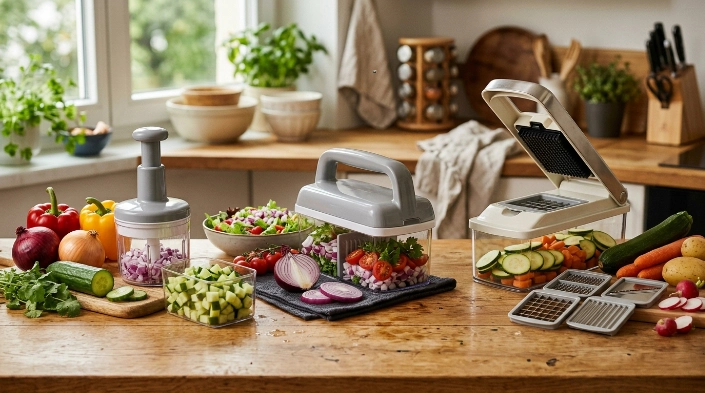
If you’re ready to pick one, these three styles cover different priorities rather than simply adding more attachments.
🏆 Best Compact Pick
OXO Good Grips Vegetable Chopper with Easy-Pour Opening
★★★★☆
This is a straightforward push-down chopper aimed at common jobs such as onions and peppers. I like this style for cooks who want a focused tool without storing a large collection of attachments.
🥗 Best For Meal Prep
Fullstar Original 4-in-1 Vegetable Chopper
★★★★★
The 4-in-1 format combines a container-based chopper with several prep options while staying more manageable than oversized kits. It’s the style I’d look at for salads, salsa, stir-fries, and weekly vegetable prep.
🔪 Best Multi-Function Pick
Mueller 8-Blade Stainless Steel 10-in-1 Vegetable Chopper
★★★★☆
This model adds multiple chopping, slicing, grating, and julienne options around a large catch container. I’d consider it when several attachments will genuinely replace separate prep tools in your kitchen.
Frequently asked questions
Do vegetable choppers really save time?
Vegetable choppers can save time when you’re preparing several servings of ingredients that need similar cuts. The advantage shrinks for one small onion or tomato because assembling and washing the chopper can take longer than using a knife.
Can a vegetable chopper replace a knife?
No. Most vegetable choppers still require you to trim, peel, halve, or section large ingredients before chopping them. A knife is also better for precision work, irregular shapes, herbs, trimming, and cuts that don’t match the chopper’s blade inserts.
Are vegetable choppers good for onions?
Yes. Onions are one of the strongest reasons to use a grid-style vegetable chopper because they can be quartered or sectioned and pushed through a dicing blade. The catch container also keeps most of the diced onion together for easy transfer.
Can you put tomatoes in a vegetable chopper?
Firm tomatoes can work in some choppers, but soft or overripe tomatoes may crush and release juice instead of producing clean pieces. Use a sharp grid, avoid excessive force, and choose firmer tomatoes when neat cubes matter.
Is an expensive vegetable chopper worth it?
A more expensive model can be worthwhile if it improves blade quality, stability, cleaning, storage, and durability. I wouldn’t pay extra only for a larger attachment count. The best value comes from a chopper that handles the two or three tasks you perform repeatedly.
So, are vegetable choppers worth it?
Yes, a vegetable chopper can be worth buying when repetitive vegetable prep is one of the slowest parts of your cooking routine. It’s especially useful for batch dicing onions, peppers, potatoes, zucchini, and other firm produce.
It isn’t a magic replacement for a chef’s knife. You’ll still need basic cutting skills, and the tool only saves time when its cleanup is easier than the work it replaces.
- Choose a grid chopper for repeatable cubes and meal prep.
- Choose a pull-cord chopper for herbs, salsa, and rough chopping.
- Choose a multi-function model only when you’ll use the extra attachments.
- Stick with a chef’s knife for precision cuts and small jobs.
My simplest rule is this: buy a chopper when you already know which recurring prep job it will replace. When that answer comes immediately, the tool is far more likely to become useful kitchen equipment instead of another forgotten gadget.
