
Kitsure Expandable Dish Rack Review: Worth It?

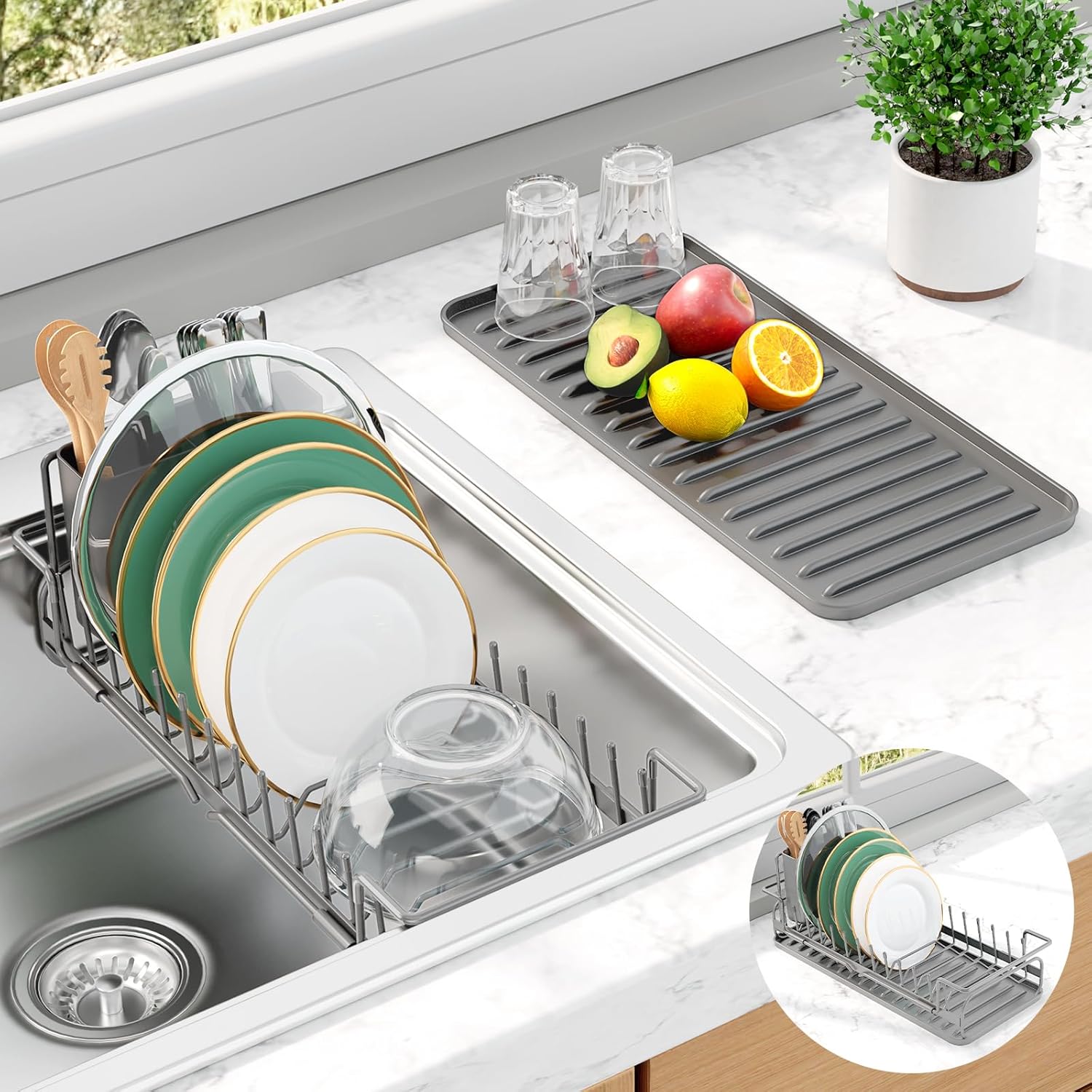
The Kitsure Expandable Dish Rack (model LSJ434) is built around one clear idea: preserve sink and counter space without giving up a structured place for plates and cutlery. Its 14.0-inch frame extends to 20.9 inches, while the rack stays just 6.3 inches wide and can sit on the counter, bridge the sink, or rest inside it. That flexibility makes it unusually adaptable for apartments, small kitchens, and light daily dish loads, although the slim layout is not meant to replace a large family-size drainer.
Quick Overview and Specifications
| Feature | Details |
|---|---|
| Product | Kitsure Expandable Dish Rack, Medium, Gray |
| Model | LSJ434 |
| Dimensions | 14.0–20.9 in L × 6.3 in W × 8.0 in H |
| Materials | Metal and plastic |
| Placement | Countertop with tray, over sink, or in sink |
| Organization | Raised plate rack, side anti-slip posts, removable dual-slot cutlery holder |
| Support | Anti-slip wrapped handles extending 1.8 in over the counter edge |
| Amazon rating checked | 4.3/5 from 175 ratings |
First Impressions
The first thing that stands out is how narrow the rack is. At 6.3 inches wide, it takes up much less counter depth than a conventional full-size dish rack. That is the main reason to consider it. The trade-off is obvious too: bowls, large pans, and oversized cookware have less room to spread out.
Assembly is tool-free, and the rack and tray can be used together or separately. The raised plate section keeps dishes upright, while the removable two-slot utensil holder prevents forks and spoons from consuming the main drying area. Before buying, compare your space with a standard dish rack size guide; this Kitsure is unusually slim even though its length can expand.
Performance and Feel
For plates, side dishes, cups, and flatware, the design makes sense. Plates stand vertically rather than leaning into a wet pile, and the side anti-slip posts help keep items from sliding outward. The anti-slip wrapping on the extending handles also matters when the rack is positioned across a sink.
The strongest performance feature is flexibility rather than raw capacity. You can keep it compact for a few breakfast dishes, extend it for more plate space, move it over the basin so drips fall directly into the sink, or use the tray on the counter. The separate rack-and-tray arrangement can even create two drying zones. Loading technique still matters; this guide on how to properly use a dish rack covers spacing plates, angling bowls, and maintaining airflow.
Drainage and Sink Fit
This is the most important secondary performance area. In over-sink mode, water can drip directly into the basin, which reduces tray cleanup and helps keep the counter clearer. On the counter, the included bottom tray catches runoff. Unlike premium countertop racks with a directional drain spout, however, this design relies on the tray rather than actively channeling water back to the sink.
The 14.0–20.9-inch measurement describes the rack’s adjustable overall length; it should not be treated automatically as a guaranteed supported sink-opening range. Measure the actual ledges or countertop contact points that will hold the handles, and make sure both sides have secure overlap. If you use it permanently on the counter, this guide to what to put under a dish rack is useful for preventing trapped moisture around the tray.
Durability
Amazon lists the construction as metal and plastic and labels the rack rust resistant, but the exact metal grade and any formal corrosion-test standard are not published for this model. That limits how confidently anyone can predict long-term resistance to wet-kitchen wear. The anti-slip handle wrapping, removable tray, and removable cutlery holder are practical because the pieces that collect water or grime can be accessed for cleaning.
Owner data is encouraging but not deep enough to prove multi-year durability. Amazon shows a 4.3-star average from 175 ratings, and verified feedback for the same design in another color repeatedly praises its compact fit and adjustable length. I would still keep the tray clean, avoid leaving mineral-heavy water sitting for long periods, and inspect coated metal areas for damage over time.
Value for Money
Value is strongest when the three placement modes solve a real space problem. Kitsure’s own store has listed the same design around the budget-to-midrange level, while premium alternatives cost substantially more. You are paying for adjustability, a tray, upright plate support, anti-slip handles, and a removable utensil holder rather than for premium metal specifications or a sophisticated drainage system.
That makes the rack sensible for renters, couples, and small households. If you only need a flat surface across the sink, a roll-up rack can be simpler and easier to store. If you want premium materials, a dedicated drainage spout, or a longer warranty, spending more can make sense. A useful checklist is this guide to what makes a good-quality dish rack.
Comparison to Similar Competing Products
| Model | How It Differs |
|---|---|
| Kitsure LSJ434 | 14.0–20.9 in adjustable length, 6.3 in narrow width, tray, plate rack, utensil holder, three placement modes. |
| OXO Good Grips Aluminum Fold Flat | Rustproof aluminum frame, two-layer design, folds flat for storage, about 16.4 × 14.6 in; much wider on the counter. |
| Surpahs Roll-Up Rack | Silicone-wrapped steel rods, rolls up for storage and can act as a trivet, but lacks upright plate slots and a utensil caddy. |
| Simplehuman Compact Steel Frame | Premium countertop design with swivel drain spout, hydrophilic tray, anti-slip feet, and a 5-year warranty; far more expensive. |
Kitsure sits between a minimal roll-up rack and a full premium countertop station. It offers more dish organization than Surpahs and uses less counter depth than OXO, but OXO has explicitly rustproof aluminum and Simplehuman offers stronger drainage engineering and warranty coverage.
Pros and Cons
Pros
- Three usable placement modes
- Very narrow 6.3-inch footprint
- Adjustable 14.0–20.9-inch length
- Removable dual-slot cutlery holder
- Tool-free assembly and separable tray
Cons
- Not ideal for pots, pans, or family-size loads
- No directional drain spout in countertop mode
- Metal grade is not specified
- Sink fit requires careful measuring
Who Should Buy This?
Buy the Kitsure LSJ434 if you live with limited counter space, usually wash dishes for one or two people, and want the freedom to move the rack between the counter and sink. It is especially useful when a full-size rack feels too bulky but a flat drying mat or roll-up rack does not provide enough plate organization.
Skip it if you regularly hand-wash large pots, multiple mixing bowls, baking trays, or a full family’s dinnerware at once. In that case, a wider or two-tier rack will be easier to load without crowding.
Extended FAQ
How large is the Kitsure LSJ434?
It measures about 14.0 inches long in compact form, extends to 20.9 inches, is 6.3 inches wide, and stands 8.0 inches high.
Can it be used over the sink?
Yes. The design supports countertop, over-sink, and in-sink placement. Measure the actual support surfaces around your sink before relying on the adjustable length.
Does it include a drain tray?
Yes. A bottom tray is included for countertop use, and the tray can be separated from the rack when you want a second drying area.
Is it rustproof?
The listing describes it as rust resistant, but it does not identify the metal grade or provide a formal rustproof guarantee. Regular cleaning and drying are still sensible.
Is it good for a family of four?
It can handle small batches, but its narrow 6.3-inch width makes it better suited to singles, couples, or households that wash dishes in stages.
Does it need tools to assemble?
No. Kitsure describes the structure as stackable and tool-free, so setup is simple and the main components can be separated for cleaning or alternate use.
Final Verdict
The Kitsure Expandable Dish Rack succeeds by being narrow, adjustable, and flexible. Its 14.0–20.9-inch span and three placement modes solve a genuine small-kitchen problem, and the plate rack, anti-slip supports, utensil holder, and tray make it more organized than a basic over-sink mat. The limits are equally clear: capacity is modest, countertop drainage is passive, and long-term material documentation is thinner than on premium rivals.
For light everyday loads in a tight kitchen, the balance is convincing. If maximum cookware capacity or premium corrosion guarantees matter more than saving space, choose a larger rack instead.
As an Amazon Associate, we earn from qualifying purchases…
