Does a Vegetable Chopper Save Effort? A Practical 2026 Guide

Quick Answer
Yes, a vegetable chopper can save effort when you’re dicing several vegetables, meal prepping, or making recipes that require lots of uniform pieces. It reduces repeated knife strokes and collects the food in one place, although small jobs may still be faster with a knife and the right time-saving kitchen prep techniques.
When a chopper saves the most effort
- Batch preparation: Dice several onions, peppers, potatoes, or similar vegetables with fewer repetitive movements.
- Uniform pieces: Grid blades produce consistent pieces without repeated precision cutting.
- Less knife work: You still pre-cut large vegetables, but the final dicing requires fewer individual cuts.
- Contained prep: A catch container keeps chopped food together and reduces transferring between board and bowl.
- Meal prep: The effort savings become more noticeable when preparing several servings at once.
When a knife may be easier
- For one tomato, half an onion, or a few herbs, washing a multi-part chopper can take longer than the chopping itself.
I don’t judge a kitchen tool by chopping speed alone. I count the entire job: setup, pre-cutting, chopping, transferring food, and cleanup.
That matters with vegetable choppers because their biggest advantage appears during repetitive prep. For a tiny task, the extra parts can become the work you’re trying to avoid.
Does a vegetable chopper really save effort?
Yes, in the right situation. A vegetable chopper replaces many repeated knife strokes with a smaller number of larger pressing, pulling, or pushing movements.
The benefit becomes more noticeable as the quantity of vegetables increases. Preparing one onion is different from preparing onions, peppers, zucchini, carrots, and potatoes for several meals.
A vegetable chopper is a manual kitchen tool that cuts produce using a blade grid, rotating blade, or similar mechanism. Its main purpose is to reduce repetitive cutting and create more consistent pieces.
The effort also changes rather than disappearing completely. A grid-style model may require firm downward pressure, especially with dense vegetables.
That distinction matters. The goal is fewer repetitive motions, not zero physical effort.
The CDC’s NIOSH ergonomics guidance identifies force and repetition as important physical risk factors in repetitive work. Kitchen prep isn’t the same as industrial work, but the principle explains why reducing repeated hand movements can feel more comfortable during a long prep session.
When does a vegetable chopper save the most effort?
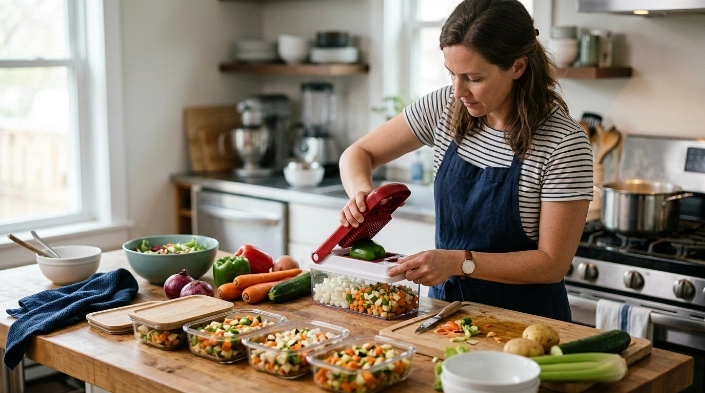
A chopper earns its counter space when the recipe requires quantity and consistency. The more repeated dicing you would otherwise do, the more useful the tool becomes.
I find it most sensible to compare tasks rather than individual vegetables. A chopper isn’t automatically better just because an onion is involved.
- Meal prep: Chopping vegetables for several lunches or dinners makes the setup and cleanup worthwhile.
- Salsa and pico-style mixtures: Uniform tomato, onion, and pepper pieces are easier to produce in batches.
- Soups and stews: Carrots, celery, onions, and similar ingredients often require lots of repetitive cutting.
- Curries: Several vegetables can be reduced to similar sizes before cooking.
- Salads: Cucumbers, peppers, onions, and firmer ingredients can be prepared quickly in larger quantities.
- Freezer prep: Batch chopping before portioning vegetables can reduce repeated work later.
If you regularly organize ingredients before cooking, a chopper can fit naturally into a good mise en place routine. My guide to essential cooking skills and kitchen workflow explains why organized preparation can make the whole cooking process smoother.
Does it help when cooking large vegetable-based meals?
Usually, yes. Recipes containing several vegetables create exactly the kind of repeated preparation where a chopper becomes useful.
For example, an easy vegetable curry may involve onions, carrots, potatoes, peppers, or other vegetables that need reasonably even pieces. A chopper can reduce the repeated dicing stage before everything reaches the pan.
When does a vegetable chopper not save much effort?
Small chopping jobs are the main exception. If you only need a few cuts, a sharp chef’s knife normally has less setup and cleanup.
This is where marketing claims about effortless chopping can be misleading. The machine or gadget still needs to be assembled, loaded, emptied, and washed.
- One small ingredient: A knife can be faster for half an onion or a single tomato.
- Fresh herbs: A knife often gives better control over parsley, cilantro, basil, and similar delicate ingredients.
- Large hard vegetables: Potatoes, sweet potatoes, or thick carrots may need to be cut smaller before reaching the chopper.
- Fibrous produce: Long celery fibers or similar ingredients can occasionally catch around some blade designs.
- Irregular cuts: A knife offers more flexibility when you need wedges, angled pieces, rough chops, or decorative cuts.
Cleanup is the biggest hidden cost. A knife and cutting board can be rinsed quickly, while a chopper may include a lid, blade insert, container, cleaning tool, and several attachments.
For me, that’s the simplest decision rule. If cleaning the gadget takes longer than the knife work it replaces, I use the knife.
Is a vegetable chopper easier on your hands?
It can reduce repeated cutting motions, but it isn’t automatically effortless. The amount of force depends on the chopper design, vegetable hardness, blade sharpness, and piece size.
A grid chopper normally works best when vegetables are already cut into sections that fit comfortably over the blade. Trying to force an oversized potato through a grid defeats the purpose.
- Cut large vegetables into manageable sections first.
- Place the chopper on a dry, stable counter.
- Center the food over the blade instead of loading one edge.
- Use a controlled, confident motion rather than repeated weak presses.
- Stop if a vegetable requires excessive force.
- Keep the cutting grid clean so food isn’t blocking the blades.
People with painful hands, limited grip, or other mobility concerns should choose tools according to their own abilities. A push-down model that feels easy for one cook may be uncomfortable for another.
Vegetable chopper vs knife vs food processor: which takes less effort?
Each tool saves effort in a different way. The best option depends on quantity, desired texture, setup, and cleanup.
| Factor | Vegetable chopper | Chef’s knife | Food processor |
|---|---|---|---|
| Setup | Low to moderate | Very low | Moderate |
| Repeated hand cutting | Low | High for large batches | Very low |
| Uniform dice | Excellent with grid blades | Depends on knife skill | Usually less precise |
| Small jobs | Fair | Excellent | Poor |
| Large batches | Excellent | More repetitive | Excellent |
| Cleanup | Several parts | Knife plus board | Several large parts |
A knife wins for flexibility and tiny jobs. A food processor wins when you need to process a large volume without caring about perfect cubes.
The vegetable chopper sits between them. It offers more uniformity than most food processors while requiring less repetitive cutting than a knife.
That middle ground works well for dishes such as homemade chicken soup with chopped vegetables, where evenly sized onions, carrots, and celery help ingredients cook more consistently.
What should you look for if reducing effort is the goal?
Blade sharpness, stability, simple cleaning, and the right attachment matter more than having dozens of accessories. A complicated chopper can create more work instead of less.
- Sharp stainless steel blades: Dull blades require more force and can crush food instead of cutting cleanly.
- Non-slip base: Stability keeps the unit from moving while you press.
- Comfortable handle: A wider pressing surface can spread pressure across the hand.
- Useful blade sizes: Fine and medium dicing grids cover most everyday meal-prep jobs.
- Catch container: Food drops directly below the blade instead of scattering across the board.
- Easy disassembly: Fewer awkward crevices mean less work after cooking.
- Cleaning tool: A small brush or pick helps remove pieces trapped in a grid.
How much difference does the chopper design make?
Quite a lot. Current models range from simple one-function designs to multi-blade systems with slicers, graters, and julienne attachments.
| Model | Cutting system | Published size | Best effort-saving use |
|---|---|---|---|
| Fullstar Original Chopper 4-in-1 | Interchangeable stainless-steel inserts | Approx. 7.99 × 2.99 × 4.49 in. | Batch dicing with several cut options |
| OXO Good Grips Vegetable Chopper | Fixed stainless-steel grid | 3.7 × 11.3 × 5.2 in. | Simple everyday chopping |
| Mueller Pro-Series 10-in-1 | Eight interchangeable blades | Approx. 11.18 × 5.47 × 5.2 in. | Multi-function batch preparation |
How can you use a vegetable chopper with less effort and mess?
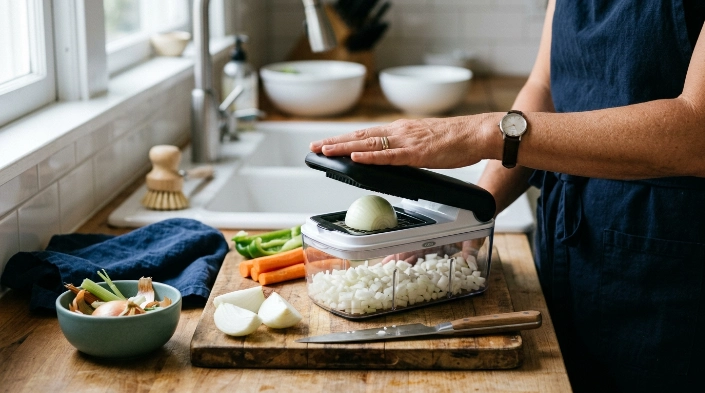
Prepare the food for the tool instead of forcing the tool to handle oversized pieces. This produces cleaner cuts and makes the chopping motion easier.
- Wash produce first. Clean fruits and vegetables under running water before cutting.
- Trim unwanted sections. Remove stems, damaged areas, seeds, or tough ends as needed.
- Pre-cut large items. Make pieces small enough to sit comfortably over the blade grid.
- Keep the base stable. Use a clean, dry counter and make sure non-slip feet have good contact.
- Load one manageable layer. Avoid stacking too much food across the cutting grid.
- Press firmly and evenly. Controlled pressure usually works better than repeated partial presses.
- Empty the container before it overfills. Extra food underneath can interfere with smooth chopping.
- Clean the blades promptly. Fresh vegetable pieces are easier to remove before they dry.
The FDA recommends washing produce before cutting and keeping utensils and food-contact surfaces clean. Its produce safety guidance also advises refrigerating produce that has been cut or purchased pre-cut.
Cleaning matters because chopped vegetables have more exposed surface area than intact produce. The USDA also recommends cleaning food-contact surfaces and provides guidance on washing produce and preventing cross-contamination.
So, is a vegetable chopper worth using in 2026?
It is worth using if repetitive vegetable prep is one of the chores that slows you down. Batch cooks, families, salad makers, and people who prepare several vegetables at once are the clearest candidates.
I wouldn’t buy one expecting every cutting job to become easier. A good knife remains simpler for tiny portions, herbs, irregular cuts, and recipes requiring close control.
The most useful way to judge a chopper is total effort. Count preparation, pressing, transferring, washing, and storage rather than focusing only on how quickly the blade moves through an onion.
If that full workflow becomes easier, the chopper is doing its job.
If you’re ready to pick one, these are the three styles I’d consider first:
🏆 Best overall
Fullstar Original Vegetable Chopper 4-in-1
★★★★★ 4.7/5 editor fit
The 4-in-1 configuration uses interchangeable stainless-steel inserts and a catch container for dicing, slicing, and other prep. I like this format for cooks who want one manual tool to handle several common vegetable-prep jobs.
👌 Best simple design
OXO Good Grips Vegetable Chopper with Easy-Pour Opening
★★★★☆ 4.5/5 editor fit
OXO uses a stainless-steel blade grid, recessed cutting area, and easy-pour container in a relatively straightforward design. I’d choose it when reducing setup complexity matters more than owning many interchangeable attachments.
🥕 Best for multi-function prep
Mueller Pro-Series 10-in-1 Vegetable Chopper
★★★★★ 4.6/5 editor fit
This system combines eight interchangeable stainless-steel blades with chopping, slicing, grating, and julienne functions. I see the strongest value for batch cooks who would otherwise reach for several different prep tools.
Frequently Asked Questions
Does a vegetable chopper save time as well as effort?
Yes, especially when you’re preparing several vegetables or repeating the same dice size. For one small ingredient, however, a knife may be faster because it has almost no setup and fewer parts to wash afterward.
Do you have to cut vegetables before putting them in a chopper?
Large vegetables usually need some pre-cutting so the pieces fit the chopping grid. Cutting an onion into halves or quarters, for example, can make the final chopping motion easier and reduce the force needed.
Are vegetable choppers good for hard vegetables?
Many can handle carrots, potatoes, and similar firm vegetables when the pieces are reasonably sized and the blades are sharp. Don’t force an oversized or unusually hard piece through the grid, because excessive pressure makes the tool harder to control.
Is a vegetable chopper easier than a food processor?
A manual chopper is often easier to set up and store, while a food processor requires less physical chopping during large-volume preparation. A chopper is usually better when you want defined cubes rather than the rougher chopped texture produced by many processor blades.
Is a vegetable chopper worth buying for one person?
It can be if you batch-cook several meals at once. If you normally prepare single portions with only one or two vegetables, a sharp knife may provide the same convenience without the extra storage and cleaning.
Final Takeaway
A vegetable chopper can genuinely save effort, but quantity determines most of its value. The benefit is strongest when you replace dozens of repetitive knife cuts with a few controlled chopping motions.
Choose a stable design with sharp blades and easy cleanup, then use it for the jobs where it earns its place. Keep your knife for the small tasks, and you’ll get the best of both approaches.
