Vegetable Chopper Explained: How It Works, Types & Uses

Quick Answer
A vegetable chopper is a manual or electric kitchen tool that cuts vegetables into smaller, more consistent pieces with less repetitive knife work. Most manual models use a sharp blade grid or rotating blade, while electric versions work more like compact food processors. Always start with properly washed produce and follow FDA produce-handling guidance before chopping.
What a vegetable chopper does
- Saves prep time: It can reduce repetitive dicing when preparing onions, peppers, zucchini, potatoes, and similar foods.
- Makes even pieces: Grid-style models create pieces that are more uniform than rough hand chopping.
- Contains the food: Many models drop chopped ingredients directly into an attached container.
- Offers several cuts: Multi-blade models may dice, slice, julienne, grate, or spiralize.
- Reduces knife work: You still need some pre-cutting, but the chopper handles much of the repetitive work.
Best results
- Cut oversized vegetables into manageable pieces before placing them against the blade.
- Use firm downward pressure instead of repeatedly forcing an overloaded chopper.
I like vegetable choppers because they solve a simple kitchen problem: repetitive prep work. They won’t completely replace a good knife, but they can make salads, soups, stir-fries, salsa, and meal prep much faster.
As of 2026, you’ll find everything from basic push choppers to multi-blade systems with slicing and grating attachments. Here’s how each type works and where each one makes sense.
What Is a Vegetable Chopper and How Does It Work?
A vegetable chopper is a food-preparation tool designed to cut produce into smaller pieces using a fixed grid, moving blade, or powered cutting mechanism. The exact action depends on the type you choose.
Simple definition: A vegetable chopper applies controlled force to sharp blades so vegetables can be diced, sliced, minced, or shredded with less repeated knife work.
Grid-style manual choppers
A grid chopper places the vegetable between a pushing plate and a grid of sharpened metal blades. Closing the lid forces the food through that grid and into the container below.
- Fine grids: Useful for onions, peppers, salsa ingredients, and small diced vegetables.
- Larger grids: Better for chunky salads, potatoes, fruit, and soup vegetables.
- Collection containers: Catch food immediately and reduce pieces scattering across the counter.
I find this design easiest to understand because one press produces a predictable shape. The main limitation is that oversized or extremely hard food still needs pre-cutting.
Push choppers with rotating blades
A push chopper usually contains a curved or straight blade that rotates each time you press the handle. Repeated pushes gradually make the pieces smaller.
- One or two pushes create a coarse chop.
- More pushes produce smaller pieces.
- The enclosed cup works well for herbs, nuts, onions, and small batches.
This style gives you more control over texture. However, it usually won’t create the perfectly square dice you get from a fixed grid.
Electric vegetable choppers
Electric choppers use a small motor to spin blades inside a work bowl. They’re closely related to mini food processors, and some manufacturers use both terms for similar appliances.
They’re useful when you want minced ingredients, finely chopped vegetables, sauces, or larger batches without applying manual pressure.
- Best for: Rapid chopping, herbs, onions, sauces, and mixed ingredients.
- Less suitable for: Precise square dice.
- Main tradeoff: You gain power but add a motor, cord, and more parts to store.
What Can You Use a Vegetable Chopper For?
A vegetable chopper works best with firm produce that can pass cleanly through its blade system. Freshness matters because firm vegetables normally cut more cleanly than limp ones.
If you’re shopping first, my guide to choosing fresh vegetables at the market explains the color, firmness, and texture signs worth checking.
- Onions: One of the most practical uses because a grid chopper produces quick, consistent pieces.
- Bell peppers: Remove the stem and seeds, then cut larger panels to fit the blade.
- Zucchini: Works well for dice, half-moons, or julienne cuts depending on the attachments.
- Cucumbers: Useful for salads, salsa, and meal-prep bowls.
- Potatoes: Possible with sturdy choppers, though large potatoes should be cut into smaller sections first.
- Carrots: Thin carrots are manageable, while thick pieces may require substantial pressure.
- Tomatoes: Firm tomatoes work better than very soft, overripe ones.
- Fruit: Apples, pears, strawberries, pineapple, and similar firm fruits can work well.
Frozen vegetables are different because freezing changes texture. If you’re deciding which form works better for a recipe, see my fresh vs frozen vegetables comparison.
Vegetable Chopper vs Food Processor vs Knife: Which Is Better?
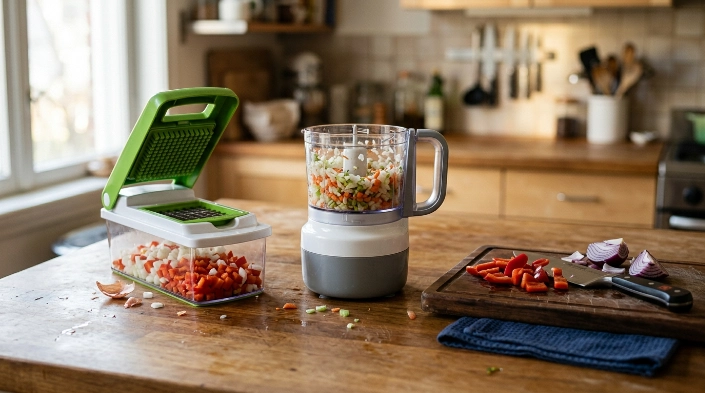
A vegetable chopper is strongest when you want repeated, predictable cuts without setting up a full food processor. A knife remains more flexible, while a food processor handles larger or finer jobs.
| Tool | Best For | Cut Control | Power Needed | Typical Cleanup |
|---|---|---|---|---|
| Grid vegetable chopper | Uniform dice and batch prep | Fixed by blade grid | Manual | Blade grid, lid, container |
| Push chopper | Herbs, nuts, onions, small batches | Controlled by number of pushes | Manual | Blade, cup, handle assembly |
| Food processor | Large batches, shredding, puréeing | High, but easy to over-process | Electric | Bowl, lid, blade, motor base |
| Chef’s knife | Maximum flexibility and precision | Depends on knife skill | Manual | Knife and cutting board |
I wouldn’t buy a chopper because I dislike knives. I’d buy one when the same dicing task appears repeatedly in my weekly cooking.
That distinction prevents another gadget from becoming clutter. It’s the same practical approach I use when avoiding other common cooking mistakes.
How Do You Use a Vegetable Chopper Safely?
Vegetable chopper blades are sharp enough to cut food with limited movement, so treat every exposed blade like a knife. Keep your fingers away from cutting edges during assembly, use, and cleaning.
- Wash your hands and produce. Begin with a clean preparation area and properly rinsed vegetables.
- Place the chopper on a stable counter. A non-slip base should sit flat before you apply pressure.
- Pre-cut oversized ingredients. Never force a whole vegetable into an opening that is too small.
- Position food centrally. Uneven placement can require more force and produce incomplete cuts.
- Press using the handle. Keep fingers outside the cutting area.
- Stop if the lid won’t close. Remove some food or cut it smaller instead of striking the tool.
- Remove blades by their safe edges. Don’t press fingers through a blade grid to clear stuck food.
The FDA recommends washing hands, utensils, cutting boards, and food-contact surfaces as part of safe food handling. Separate equipment that touched raw meat from tools used for produce unless everything has been properly washed.
Chopping ingredients is only one part of food preparation. When meat, poultry, seafood, eggs, or leftovers are involved, use the appropriate cooking temperatures described in my beginner cooking temperature guide.
How Do You Clean a Vegetable Chopper?
Clean the chopper soon after use because onion, carrot, potato, and herb pieces can dry inside small blade openings. Dried residue usually takes more effort to remove later.
- Empty the container. Transfer chopped food before residue starts drying.
- Disassemble removable parts. Follow the manufacturer’s directions because blade systems differ.
- Use the supplied cleaning tool. A brush, scraper, or cleaning fork is safer than your fingers.
- Wash food-contact surfaces. Use warm soapy water when hand washing.
- Check dishwasher instructions. Some parts are dishwasher safe only on a specific rack.
- Dry everything completely. Moisture trapped around removable blades makes storage messy.
The USDA recommends cleaning utensils, cutting boards, kitchen surfaces, and sinks before sanitizing them. Its guide to cleaning food-preparation equipment and surfaces explains why cleaning comes first.
What Should You Look for Before Buying a Vegetable Chopper?
The number of attachments isn’t the first thing I check. Blade design, stability, useful capacity, and safe cleaning matter more in everyday use.
- Sharp stainless steel blades: A clean blade needs less forcing than a poorly cutting grid.
- Stable base: Look for non-slip feet or a broad base that remains steady while pressing.
- Useful container: Larger containers help when preparing several servings.
- Blade choices: Fine and coarse dicing grids are more useful than attachments you’ll rarely use.
- Safe storage: Loose blade inserts should have a holder or protected storage area.
- Cleaning tools: A proper scraper or brush keeps fingers away from sharp edges.
- Replacement parts: Replaceable inserts can extend the useful life of the main chopper.
How do current manual vegetable choppers compare?
Specs vary considerably even among manual models. These three current designs show how different a vegetable chopper can be.
| Model | Verified Feature | Best Fit |
|---|---|---|
| Fullstar Original Chopper 4-in-1 | Four-blade system with 420J stainless steel blades and catch container | Regular meal prep and multiple cutting styles |
| OXO Good Grips Vegetable Chopper | Stainless steel blade pattern, recessed cutting area, and easy-pour opening | Simple dicing with fewer accessories |
| Mueller Original Chopper Pro | Eight interchangeable blades, 7.5-cup container, plus 1/4-inch and 1/2-inch chopping grids | Users wanting slicing, dicing, grating, and julienne options |
Which Vegetables Are Hardest to Chop?
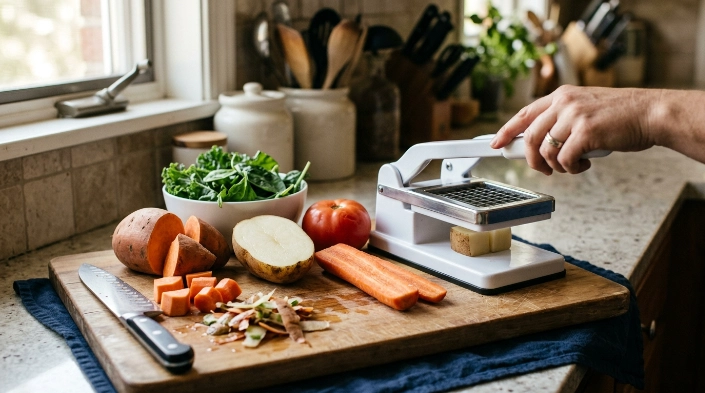
Hard, dense, oversized, or unusually soft produce creates the most trouble. The solution is usually better preparation rather than more force.
- Sweet potatoes: Dense flesh can demand excessive pressure, so cut them into smaller pieces first.
- Large potatoes: A section wider than the grid should be divided before chopping.
- Thick carrots: Split wide carrots lengthwise before using a small grid.
- Very ripe tomatoes: Soft flesh may crush instead of forming a clean dice.
- Leafy greens: Loose leaves often work better with a knife or rotating chopper than a dicing grid.
My simple rule is to stop when a tool needs uncomfortable force. Cutting the ingredient smaller takes seconds and gives the blade a much easier job.
Is a Vegetable Chopper Worth It?
A vegetable chopper is worth considering when you regularly dice several vegetables at once or prepare ingredients in batches. It’s less useful if you cook small portions and already enjoy quick knife work.
- Worth it for: Meal prep, large salads, soup vegetables, salsa, stir-fries, and family-size cooking.
- Less useful for: Occasional chopping, tiny kitchens, or cooks who prefer one chef’s knife for everything.
- Biggest advantage: Consistent pieces with less repetitive cutting.
- Biggest drawback: Extra parts require cleaning and storage.
Before buying, imagine the last three meals you cooked. If the same chopping job appeared repeatedly, a chopper may earn its storage space.
If you’re ready to choose one, these are three practical designs I’d consider for different kitchen needs:
🏆 Best for Meal Prep
Fullstar Original Pro Vegetable Chopper
★★★★☆
The multi-blade design uses stainless steel inserts and catches chopped food below the cutting surface. I’d choose this style when onions, peppers, zucchini, and other meal-prep vegetables appear regularly on the same cutting list.
✨ Simplest Design
OXO Good Grips Vegetable Chopper
★★★★☆
OXO uses a stainless steel blade pattern, recessed cutting area, and an easy-pour opening in a straightforward design. I’d look at this one if you want basic chopping without storing a large collection of attachments.
🧰 Most Versatile
Mueller Original Chopper Pro 8-Blade
★★★★★
This model combines eight interchangeable blades with a 7.5-cup container and separate 1/4-inch and 1/2-inch chopping grids. I’d consider it when slicing, julienne cuts, grating, and dicing all need to come from one prep tool.
Frequently Asked Questions
Does a vegetable chopper completely replace a knife?
No. Most choppers still require you to remove stems, peel ingredients when necessary, and cut oversized vegetables into sections that fit the blade. A chopper is better viewed as a time-saving companion to a knife rather than a complete replacement.
Can you put potatoes in a vegetable chopper?
Yes, many sturdy grid choppers can dice potatoes. Cut large potatoes into smaller sections first, place one manageable piece over the blade, and stop if the lid requires excessive force to close.
Can a vegetable chopper chop onions?
Yes. Onions are one of the most practical foods for a manual grid chopper because the layers pass through the blade into relatively uniform pieces. Cut the onion into sections that fit the chopping grid before pressing.
Are vegetable choppers dishwasher safe?
Some are, but dishwasher instructions vary by model and part. Check the manufacturer’s care instructions before washing blades, containers, lids, or accessories, because some components may require hand washing or top-rack placement.
Why does food get stuck in my vegetable chopper?
Food usually sticks because the piece is too large, the grid is overloaded, residue has collected between blades, or the ingredient is too soft or dense for that attachment. Reduce the food size and clean the blade openings before trying again.
Final Takeaway
A vegetable chopper is a simple prep tool, but the right design can remove a surprising amount of repetitive kitchen work. Grid choppers excel at uniform dice, push choppers offer flexible texture, and electric versions handle fast, fine chopping.
Choose the type that matches food you already prepare instead of chasing the model with the most attachments. A chopper earns its place when it makes your normal cooking routine faster, cleaner, and easier to repeat.