
Types of Vegetable Choppers: 7 Styles and How to Choose

Quick Answer
The main types of vegetable choppers are push-down grid choppers, pull-cord choppers, pump choppers, rotary choppers, mandoline-style choppers, electric mini choppers, and rocking choppers. The best choice depends on whether you want uniform cubes, quick rough chopping, thin slices, or powered processing. Whatever design you use, follow basic food safety practices when preparing fresh produce.
Choose a chopper by the job
- Uniform cubes: A push-down grid chopper gives the most predictable dice.
- Quick mincing: A pull-cord or pump chopper works well for onions, garlic, herbs, and nuts.
- Thin slices: A mandoline-style model is better for potatoes, cucumbers, and zucchini.
- Large batches: An electric mini chopper reduces repetitive hand effort.
- Small herb jobs: A rocking chopper gives direct control on a cutting board.
My simplest rule
- Choose the cutting mechanism first, then compare capacity, blade options, stability, and cleanup.
Vegetable choppers look simple, but the designs work in surprisingly different ways. A model that makes neat onion cubes may be frustrating when you want finely minced herbs.
I find it easier to choose one after deciding what finished cut I need. This guide breaks down the seven most useful types of vegetable choppers in 2026 and explains where each style fits.
What Is a Vegetable Chopper?
A vegetable chopper is a manual or powered kitchen tool that cuts produce using fixed, rotating, sliding, or rocking blades. Depending on the design, it can dice, mince, chop, slice, shred, or create julienne strips.
Simple definition: A vegetable chopper replaces some repetitive knife work by moving the food through a blade or moving a blade through the food.
The important point is that “vegetable chopper” describes a category, not one mechanism. Some produce exact cubes, while others create a rough mince that becomes finer with additional chopping.
What Are the Different Types of Vegetable Choppers?
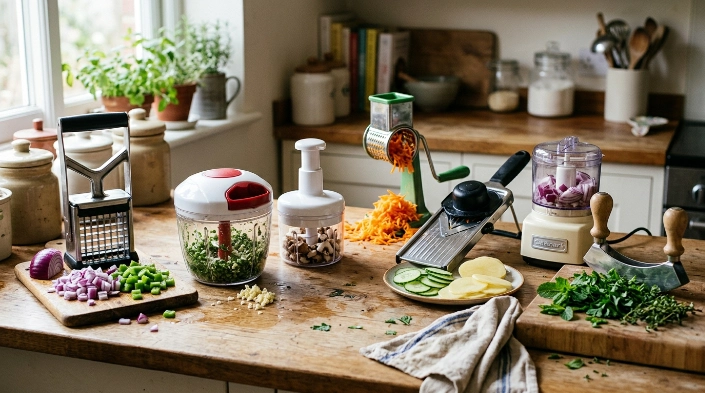
Most home-kitchen vegetable choppers fit into seven practical groups. The differences come from how the blade moves and how much control you have over the final cut.
1. Push-Down Grid Vegetable Choppers
A push-down chopper forces produce through a fixed metal blade grid. The pieces drop into a container underneath, so the grid determines their general shape and size.
- Best for: onions, bell peppers, cucumbers, zucchini, potatoes, and salad vegetables
- Cut style: uniform cubes or strips
- Power: manual downward pressure
- Main advantage: consistent results without advanced knife skills
- Main limitation: dense produce can require significant pressure
This is the style I prefer when appearance matters. For taco prep, for example, similarly sized onion and pepper pieces cook more evenly and look cleaner at serving time.
Cut large vegetables into manageable sections first. Trying to force an oversized potato or thick carrot through the grid can make the tool harder to control.
2. Pull-Cord Vegetable Choppers
A pull-cord chopper has curved blades inside a covered bowl. Pulling the cord spins those blades rapidly through the ingredients.
- Best for: onions, garlic, herbs, nuts, salsa ingredients, and softer vegetables
- Cut style: rough chop to fine mince
- Power: repeated cord pulls
- Main advantage: compact and electricity-free
- Main limitation: pieces are less uniform than grid-cut cubes
The number of pulls gives you useful texture control. A few pulls can leave ingredients chunky, while repeated pulls move them toward a finer mince.
A pull model makes sense when exact cube size does not matter. I especially like this mechanism for salsa-style mixtures where a slightly irregular texture feels natural.
3. Pump or Press Vegetable Choppers
Pump choppers spin or move an internal blade when you repeatedly press a top handle. They provide the enclosed convenience of a pull chopper without a cord extending from the lid.
- Best for: garlic, onions, mushrooms, nuts, herbs, and small batches
- Cut style: chopped or minced
- Power: repeated downward presses
- Main advantage: straightforward one-handed chopping motion
- Main limitation: they do not create true grid-style cubes
This design can feel natural if pulling a cord seems awkward. The repeated press also lets you stop as soon as the texture looks right.
4. Rotary and Hand-Crank Vegetable Choppers
A rotary chopper uses a hand crank or rotating handle to move blades, drums, or cutting surfaces. Some versions chop inside a bowl, while others shred or grate food through a rotary drum.
- Best for: vegetables, cheese, carrots, cabbage, nuts, and ingredients needing repeated processing
- Cut style: chop, grate, shred, or slice depending on the attachment
- Power: hand-crank rotation
- Main advantage: continuous motion with good user control
- Main limitation: more components can mean more cleanup
Rotary designs are worth considering when you dislike repeated pressing. They can also be easier to keep moving during longer preparation sessions.
5. Mandoline-Style and Multi-Blade Choppers
Mandoline-style choppers move vegetables across stationary blades instead of chopping them inside a bowl. Multi-function models may include slicing, julienne, grating, spiralizing, or dicing attachments.
- Best for: potatoes, cucumbers, carrots, zucchini, onions, cabbage, and firm fruits
- Cut style: slices, strips, julienne, shreds, and sometimes cubes
- Power: manual sliding or pressing
- Main advantage: several cut styles from one tool
- Main limitation: exposed blades demand careful handling
I would choose this style for scalloped potatoes before choosing a bowl chopper. Thin, similar slices matter more in that recipe than a rough chopped texture.
Always use the supplied food holder or hand guard when the design includes one. Keep fingers clear of the cutting surface during both use and cleaning.
6. Electric Mini Vegetable Choppers
Electric mini choppers use a motor to spin a blade inside a work bowl. Short pulses can create a coarse chop, while longer processing usually produces a finer texture.
- Best for: repeated prep, onions, herbs, nuts, sauces, dips, and larger chopping jobs
- Cut style: coarse chop through fine mince or purée, depending on the model
- Power: electric motor
- Main advantage: less repetitive hand effort
- Main limitation: extra appliance parts, storage needs, and less precise cube shape
Electric choppers work differently from fixed-grid dicers. They are usually better at speed and texture changes than producing identical square pieces.
Use brief pulses when you want chopped vegetables. Continuous processing can quickly take soft produce past chopped and toward a puréed texture.
7. Rocking and Mezzaluna-Style Choppers
A rocking chopper uses a curved blade that moves back and forth over food on a cutting board. A traditional mezzaluna follows this idea with one or more curved blades and handles.
- Best for: fresh herbs, garlic, nuts, leafy vegetables, and small chopping jobs
- Cut style: coarse to fine mince
- Power: manual rocking motion
- Main advantage: direct visual control over texture
- Main limitation: it does not contain ingredients like a bowl chopper
This style gives you more of the feel of knife chopping. It suits cooks who want control but prefer a rocking motion instead of repeated straight knife cuts.
How Do the Main Vegetable Chopper Types Compare?
The best design depends more on the cut you want than the number of attachments in the box. This comparison makes those differences easier to see.
| Chopper Type | How It Works | Typical Result | Best Use | Texture Control |
|---|---|---|---|---|
| Push-down grid | Food passes through fixed blade openings | Uniform dice or strips | Salads, tacos, soups | Determined by blade grid |
| Pull-cord | Cord spins internal blades | Coarse to fine chop | Salsa, herbs, garlic | Controlled by number of pulls |
| Pump/press | Repeated presses move or spin blades | Chopped or minced | Small everyday jobs | Controlled by number of presses |
| Rotary | Handle turns blades or drums | Chopped, grated, or shredded | Continuous prep | Varies by attachment |
| Mandoline | Food slides across fixed blades | Slices and strips | Potatoes, cucumbers | High with adjustable blades |
| Electric mini | Motor spins bowl blade | Coarse chop to fine texture | Frequent or larger prep | Controlled with pulsing |
| Rocking | Curved blade rocks over food | Coarse to fine mince | Herbs and garlic | Direct visual control |
Which Vegetable Chopper Is Best for Different Foods?
Match the tool to the ingredient’s texture and the finished shape you need. No single mechanism is ideal for every vegetable.
- Onions: Use a grid chopper for cubes or a pull-cord model for a quick mince.
- Potatoes: Choose a sturdy grid for cubes or a mandoline for thin slices.
- Carrots: A mandoline or strong grid model works best after cutting large carrots into shorter sections.
- Garlic: Pull-cord, pump, rocking, and electric mini choppers all work well for mincing.
- Fresh herbs: Choose a rocking blade or bowl-style spinning chopper and avoid excessive processing.
- Cucumbers: Use a grid for cubes and a mandoline for consistent rounds.
- Bell peppers: Grid choppers make convenient dice after the stem, seeds, and membrane are removed.
For a basic salad with cucumber, peppers, and onion, I usually favor a grid mechanism. When I want those same ingredients finely mixed into salsa, a spinning bowl design makes more sense.
Is a Manual or Electric Vegetable Chopper Better?
A manual chopper is usually better for simple cuts, portability, and kitchens where you want fewer appliances. An electric chopper makes more sense when speed and reduced hand effort matter more than perfectly shaped pieces.
Choose a manual chopper when:
- You mainly prepare small or medium batches.
- You want uniform grid-cut cubes.
- You do not want to use an outlet.
- Compact storage matters.
- You prefer direct control over each chopping action.
Choose an electric chopper when:
- You chop ingredients frequently.
- You want to reduce repetitive hand work.
- You also make dips, sauces, or finely processed mixtures.
- You value rapid pulsing more than exact square dice.
- You have space for a small countertop appliance.
A food chopper also should not automatically be treated as a full-size food processor. Larger processors may offer feed tubes, slicing discs, shredding discs, dough functions, and larger bowls that compact choppers often lack.
What Should You Look for When Choosing a Vegetable Chopper?
Start with the mechanism, then look at the everyday details that decide whether you will keep using the tool. Ease of cleaning matters almost as much as chopping speed.
- Blade style: Match a grid to dicing, rotating blades to mincing, and a slicing blade to thin cuts.
- Container size: Choose enough capacity for your usual batch without constantly emptying the bowl.
- Stable base: Non-slip feet or a secure bowl help reduce movement during use.
- Blade removal: Removable components can make trapped vegetable pieces easier to clear.
- Hand comfort: Think about whether pressing, pulling, turning, or using an electric button suits you best.
- Storage: Multi-blade sets need more cabinet space than a compact pull chopper.
- Cleaning: Check the manufacturer’s instructions before placing blades or containers in a dishwasher.
I also check whether replacement pieces are available before buying a complicated model. A tool with several proprietary inserts becomes much less useful if an important piece disappears or breaks.
How Do You Use a Vegetable Chopper Safely?
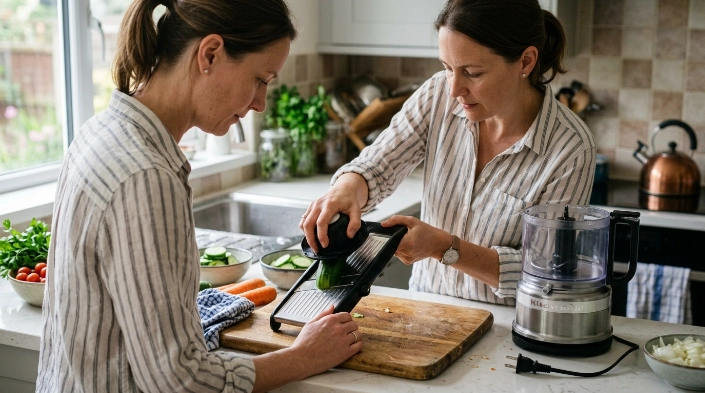
Vegetable chopper blades are sharp even when they are partly enclosed. Treat removable blade grids, rotating blades, and mandoline surfaces with the same attention you would give a kitchen knife.
- Wash the produce and prepare it according to current FDA food guidance.
- Trim oversized ingredients into pieces that fit the cutting area without forcing them.
- Lock the tool together as directed before applying pressure or starting the motor.
- Use guards and holders whenever the manufacturer supplies them.
- Keep fingers away from blades while removing food caught around the cutting surface.
- Disconnect electric models before removing blades or cleaning the bowl.
- Wash and dry components thoroughly after food preparation.
Clean preparation surfaces also matter. The USDA Food Safety and Inspection Service provides broader food-handling guidance that can help when you are preparing several ingredients together.
Are Vegetable Choppers Worth It?
A vegetable chopper is worth considering when repetitive preparation slows you down or when you regularly need a particular cut. It is less useful when you already work comfortably with a knife and only chop tiny amounts.
- Worth it for: meal prep, salads, tacos, soups, salsa, stir-fries, and repeated vegetable dicing
- Less necessary for: occasional single-ingredient chopping
- Biggest benefit: repeatable preparation with less individual knife work
- Biggest tradeoff: another tool to assemble, clean, dry, and store
The mistake I would avoid is buying the model with the longest attachment list simply because it looks versatile. A simpler tool that matches your most common recipe can be much more useful.
If you’re ready to pick one, here are three different styles I would consider based on the job you need to do:
🏆 Best for Uniform Dice
Fullstar Original Vegetable Chopper
★★★★½
This grid-style chopper uses stainless-steel cutting surfaces and a collection container for practical everyday vegetable prep. I would choose this style when consistent onion, pepper, or cucumber pieces matter more than a finely minced texture.
🥗 Best Manual Spinner
OXO Good Grips One Stop Chop Manual Food Processor
★★★★☆
The turning handle drives internal blades, letting you keep chopping until ingredients reach the texture you want. I like this format for salsa, nuts, vegetables, and mixtures where texture control matters more than identical cubes.
⚡ Best Electric Option
Cuisinart Mini-Prep Plus 24-Ounce Processor
★★★★½
This compact processor pairs a 24-ounce work bowl with a 250-watt motor and an auto-reversing blade system. I would pick it for cooks who want powered chopping and grinding without giving a full-size food processor permanent counter space.
Frequently Asked Questions
What is the most versatile type of vegetable chopper?
A multi-blade manual chopper is one of the most versatile choices when you need dicing, slicing, and julienne cuts from one compact tool. A small electric chopper is more versatile for chopping, mincing, grinding, sauces, and soft mixtures, so the better choice depends on your recipes.
Which vegetable chopper makes the most even cubes?
A push-down chopper with a fixed blade grid generally produces the most consistent cube shape because every piece passes through the same openings. Spinning pull-cord, pump, and electric models create a chopped texture instead, so individual pieces naturally vary more in size and shape.
Can a vegetable chopper cut potatoes and carrots?
Many sturdy grid and mandoline-style vegetable choppers can handle potatoes and carrots when the produce is trimmed to an appropriate size first. Dense vegetables require more force than onions or cucumbers, so never overload the cutting surface or force a piece that does not fit correctly.
Is a vegetable chopper better than a knife?
Neither tool is better for every job. A chopper can speed up repetitive dicing, slicing, or mincing, while a sharp chef’s knife gives greater flexibility over cut shape and ingredient size. Many home cooks get the best results by keeping both available.
What type of vegetable chopper is easiest to clean?
Simple models with fewer removable parts are usually easier to clean than large multi-function sets. Look for blades that can be safely accessed without putting fingers near sharp edges, and always follow the manufacturer’s instructions because dishwasher compatibility varies between products and components.
Final Takeaway
The seven main types of vegetable choppers solve different preparation problems. Grid choppers excel at uniform dice, spinning models handle fast mincing, mandolines create slices, and electric choppers reduce repetitive hand work.
Start with the food you prepare most often and the shape you want on the plate. Once you match the mechanism to that job, choosing the right vegetable chopper becomes much simpler.
