Multi-Function Vegetable Chopper Types: A Practical Guide for Home Kitchens

A multi-function vegetable chopper is more than a basic dicer. It is a kitchen tool designed to do several prep jobs with the same unit, such as chopping onions, slicing cucumbers, grating carrots, or shredding cabbage. Some models stay fully manual. Others use a motor. Some rely on a pull cord or push-down mechanism. The useful part is not the label on the box, but how the design fits the way you cook.
For home cooks, busy parents, and meal preppers, the main decision is usually not whether a chopper can cut vegetables. It is whether the chopper can handle the kind of prep you do most often without becoming annoying to clean, awkward to store, or unsafe to use. That is where the different multi function vegetable chopper types matter.
What a Multi-Function Vegetable Chopper Is
A multi-function vegetable chopper combines several cutting actions in one tool. Depending on the model, it may chop, slice, dice, grate, shred, mince, julienne, or even spiralize vegetables. Some versions use interchangeable blades. Others use a fixed blade system with a few built-in functions.
That is different from a basic vegetable chopper, which usually does one job well and stops there. A simple chopper may be best if you only want to dice onions or herbs. A multi-function model makes more sense if you want one tool for salad prep, stir-fry vegetables, garnishes, and meal-prep containers.
The trade-off is straightforward: more functions usually mean more parts, more blade handling, and more cleaning. If you only need one or two tasks, extra attachments can become clutter instead of convenience.
Main Types of Multi-Function Vegetable Choppers
Multi-function choppers usually fall into a few broad categories. The names vary by brand, but the operating styles are fairly consistent.
Quick comparison of the main chopper styles
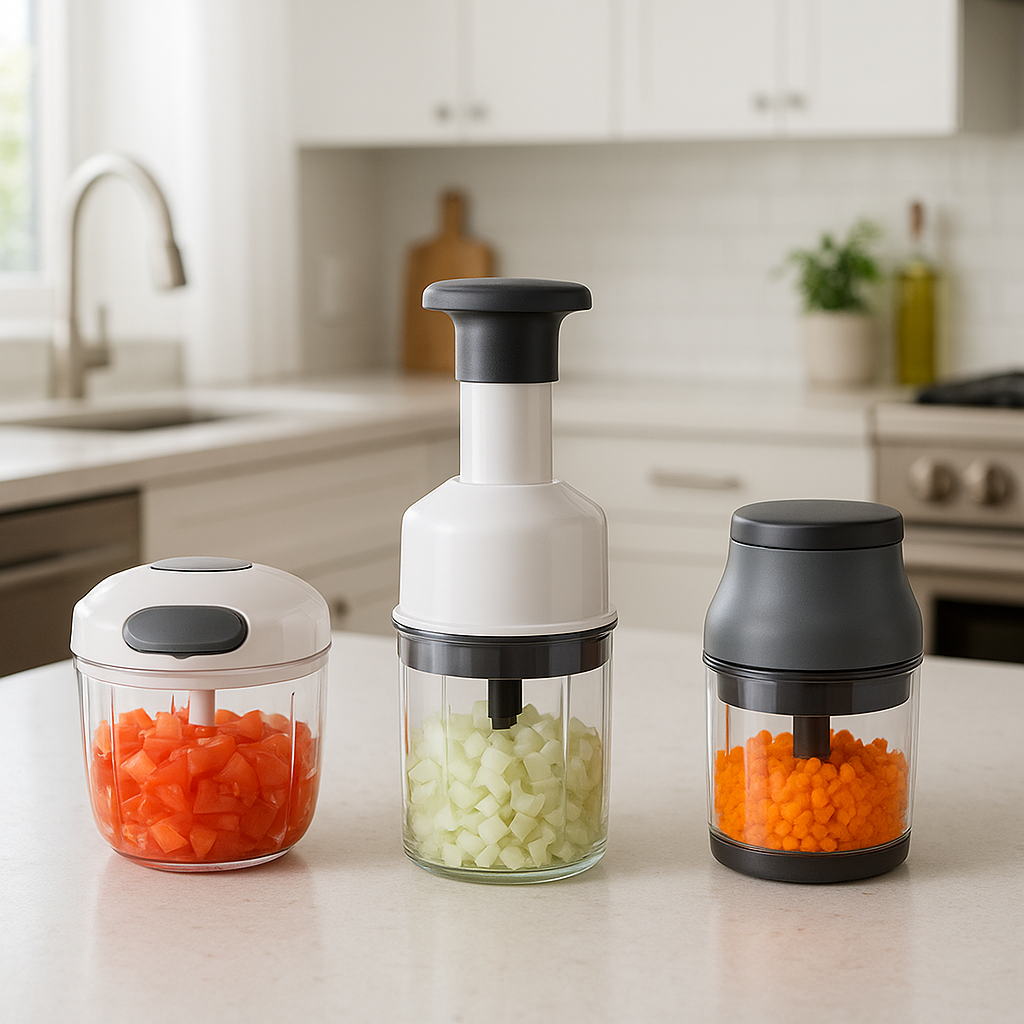
- Manual choppers: Best for quick, small prep jobs; usually compact; capacity is limited to the bowl size; cleanup is often simpler; space needs are low.
- Electric choppers: Best for frequent use and larger batches; capacity varies by model but is often better for repeated prep; cleanup is moderate to more involved; space needs are medium to high.
- Pull-string choppers: Best for small batches of onions, herbs, garlic, and soft vegetables; capacity is usually modest; cleanup is simple; space needs are very low.
- Push-down choppers: Best for neat dice and more uniform pieces; capacity is usually small to medium; cleanup can be simple, though grid parts may need attention; space needs are low to medium.
- Rotary choppers: Best for repetitive slicing or grating tasks; capacity is usually modest; cleanup depends on the drum or blade design; space needs are low to medium.
- Food-processor-style choppers: Best for cooks who want the widest range of functions; capacity is usually the largest in this group; cleanup is more involved; space needs are the highest.
Manual choppers
Manual choppers use your hand rather than electricity. This group includes pull-string models, push-down dicers, hand-crank choppers, and some compact press-style units. They are popular because they are portable, compact, and often easier to store than larger appliances.
Manual models work well for small to medium prep jobs. If you need a quick dice of onions, celery, or herbs, a manual unit can be faster than setting up a larger machine. The downside is that harder vegetables may take more effort, and repeated batch prep can get tiring.
Electric choppers
Electric choppers use a motor to spin blades or drive cutting action. They are typically better for repeated prep, larger volumes, or users who want less physical effort. Many electric models resemble mini food processors, with a bowl, lid, and blade assembly.
These are useful when you are preparing several vegetables at once, such as carrots, onions, potatoes, or a slaw mix. The trade-off is that they usually take more storage space and have more parts to clean.
If you want a deeper breakdown of motorized options, see our guide to electric vegetable chopper types.
Pull-string choppers
Pull-string choppers use a cord that spins the blade when you pull it. They are compact and easy to understand. Many home cooks like them for onions, garlic, nuts, herbs, and soft vegetables.
They are usually a good fit for quick everyday prep, but they are not ideal for large batches or very firm vegetables. The cord mechanism also means you need a secure lid and a stable bowl.
Push-down choppers
Push-down choppers use downward pressure to activate a blade mechanism. These are often associated with grid-style dice systems. They can produce fairly uniform pieces, which is useful for salads, salsas, and meal prep.
They are appealing because they feel simple to use, but they can be less versatile than attachment-based models. If you want one tool for multiple cut styles, check whether the blades are actually interchangeable or whether the unit is mostly a dicers-only design.
Rotary choppers
Rotary choppers use a hand-crank or rotating mechanism to move food past blades. They are less common than pull-string or push-down styles, but they can be useful when you want a more controlled, repetitive cutting motion.
These are often chosen for specific tasks rather than all-purpose use. If you are comparing them, pay attention to whether the rotation is meant for slicing, grating, or shredding, because that determines how useful the tool will be in daily cooking.
Food-processor-style units
Food-processor-style choppers are the most versatile category. They usually come with a bowl, motor base, and several blade or disc options. Depending on the model, they may chop, slice, shred, grate, or puree.
These are the closest thing to an all-in-one prep appliance. They suit cooks who want broad functionality and are willing to trade counter space and cleanup time for flexibility. For some households, this is the best long-term choice. For others, it is more machine than they need.
Manual vs. Electric: Which Style Fits Your Cooking Habits?
The biggest decision is usually manual versus electric. That choice affects cost, effort, cleanup, and how often you will actually use the tool.
Choose manual if you want speed for small jobs
Manual choppers work well when your prep is short and focused. A pull-string model is often a good fit for a few onions for soup, a handful of herbs for sauce, minced garlic, or a quick salsa-style mix. A push-down model is often better when you want neat, even cubes from firmer ingredients such as onions, carrots, or potatoes for salads, soups, or roasted vegetables.
Manual tools make sense if you cook in smaller amounts, have limited storage, or prefer something that is simple to rinse and put away.
Choose electric if you prep in batches
Electric models are better when you cook often and prepare several ingredients at once. Meal preppers, larger households, and anyone who makes chopped vegetables in repeated batches usually benefit more from powered convenience.
The trade-off is that electric choppers are not always the best choice for a tiny task. If all you need is a small onion or a few herbs, plugging in a machine can be slower than using a manual unit.
A practical rule of thumb
If your usual prep fits in one small bowl, manual is often enough. If you regularly fill multiple containers, make slaws, or prep vegetables for several meals at once, electric is usually more efficient.
How Each Chopper Type Performs in Real Kitchen Tasks
Different choppers handle different foods and cuts better. That matters more than the marketing language on the package.
Chopping onions, celery, and herbs
For quick chopping, pull-string and push-down models are often the most convenient. Pull-string choppers are especially handy for soft ingredients like onions, garlic, and herbs when you want a fast mince or rough chop. Push-down models are often better when you want more even onion or celery pieces for soup bases, salads, or roasted vegetable mixes. Electric choppers also work well here, especially if you are making larger quantities.
Slicing cucumbers, zucchini, and potatoes
Slicing is usually better handled by models with slicing discs, mandoline-style attachments, or food-processor-style systems. A basic manual chopper may not give you clean slices unless it is designed for that purpose.
Dicing carrots, onions, and potatoes
Dicing is where grid choppers and some push-down systems stand out. If uniform cubes matter—for example, for soups, stir-fries, or roasted vegetables—look for a dicing grid rather than a generic chopping blade. Push-down dicers are often a practical match for carrots and potatoes, while electric models can be better if you are processing a larger amount at once.
Grating and shredding cabbage, cheese, or carrots
Grater and shredder blades are common in multi-function units, especially food-processor-style models. These are useful for coleslaw, carrot salad, hash browns, and toppings. If you want this function often, make sure the blade is designed for the texture you need, not just “multi-purpose” in name.
Julienne and spiralizing
Julienne blades and spiralizing attachments are more specialized. They are useful for garnish work, salads, and vegetable noodles, but they are not essential for most kitchens. If you will use them only occasionally, it may be better to choose a simpler model and avoid extra parts.
Mincing garlic and herbs
Smaller manual choppers and compact electric bowls are usually the easiest option for mincing. A large-capacity machine can work, but it may be overkill if you mostly prep tiny amounts.
Pull-String vs. Push-Down Choppers: Which One Fits Better?
Pull-string and push-down choppers are both popular manual options, but they solve slightly different problems.
Pull-string models are usually the better choice when you want quick, repeated chopping for softer foods. They tend to work well for onions, garlic, parsley, cilantro, and small salsa-style mixes. If you are making taco toppings, a quick pasta sauce base, or a handful of chopped herbs, the pull cord format is often simple and fast.
Push-down models are usually better when you want a more uniform dice from firmer ingredients. They can be a better fit for carrots in soup prep, potatoes for salads or roasting, and onions for recipes where a cleaner cube matters. They are also useful when you want to prep a slightly larger pile of vegetables with less repetitive pulling.
In short: choose pull-string for fast mincing and soft ingredients; choose push-down for neater cubes and firmer vegetables.
Blade and Attachment Options That Actually Matter
Not every blade set is worth paying for. The useful question is whether the attachment matches the food you prepare most often.
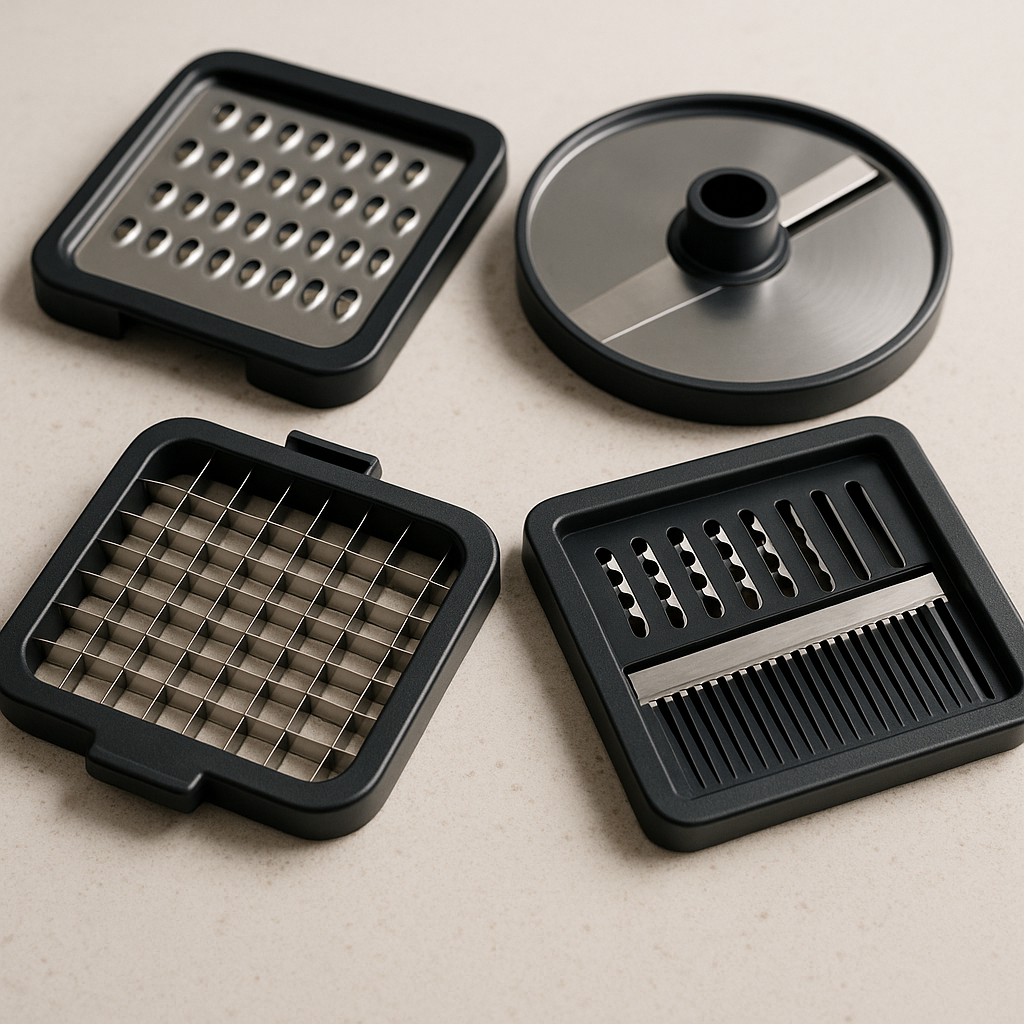
Dicing grid
A dicing grid is valuable if you want consistent cubes for salads, soups, salsa, or meal prep containers. It is one of the most practical upgrades because it solves a common task cleanly.
Julienne blade
A julienne blade is useful if you make vegetable strips for salads, garnishes, or stir-fry. It is less essential than a dicing grid, but helpful if you regularly want fine matchstick cuts.
Grater and shredder blade
This is one of the best attachments for everyday use. It helps with carrots, cabbage, potatoes, and some cheeses. If your cooking includes slaws or shredded toppings, this blade earns its space.
Slicing disc
A slicing disc is worth considering if you want faster prep for cucumbers, zucchini, potatoes, or onions. It is especially useful in food-processor-style units.
Fixed-blade versus attachment-based models
Fixed-blade models are simpler to clean and usually easier to store. Attachment-based models are more versatile but can become messy if you do not use the extra pieces often. If you hate washing parts, simplicity may matter more than blade count.
Which features are worth paying extra for?
Essential features:
– a stable, non-slip base
– a secure locking lid
– stainless steel blades
– easy disassembly for cleaning
– dishwasher-safe parts where appropriate
– clear blade storage or blade guards
– replacement parts, if the brand offers them
Nice-to-have extras:
– spiralizing attachments
– specialty julienne inserts
– extra decorative cut patterns
– oversized attachment sets you may rarely use
– premium finishes that do not improve performance
A good rule is to pay more for features that improve safety, cleaning, and the cuts you use weekly. Pay less attention to add-ons that sound impressive but do not match your cooking habits.
Capacity, Bowl Size, and Counter Space Considerations
Capacity is one of the easiest things to overlook and one of the most important in daily use.
A compact chopper is easier to store and often quicker to pull out for small jobs. It makes sense for apartments, small kitchens, and occasional use. The downside is that you may need several rounds of chopping if you are prepping dinner for a family.
A larger-capacity model can be more efficient for meal prep, batch cooking, and households that use a lot of produce, but only if the bowl size and blade system fit the way you work. Bigger is not automatically better if you mostly chop one onion or a few herbs at a time.
A good question to ask is this: do you usually prep one ingredient at a time, or do you prep enough for several meals? If it is the second, a larger bowl is worth it. If not, compact often wins.
Cleaning, Maintenance, and Replacement Parts
Cleaning affects whether a chopper gets used regularly or sits in a cabinet.
Models with fewer parts are usually easier to clean. Dishwasher-safe parts can reduce effort, but blades still need careful handling when loading and unloading. If a unit has several attachments, check whether they disassemble easily and whether food tends to get trapped around the blade housing.
Replacement parts matter more than many shoppers expect. A blade that dulls or a container that cracks should not mean replacing the whole unit if the brand offers parts separately. If you are comparing two similar models, availability of replacement blades can be a practical tie-breaker.
For long-term use, look for:
– easy disassembly
– blade covers or safe storage for extras
– dishwasher-safe parts where appropriate
– simple reassembly without forcing components
Safety and Durability Features to Look For
Sharp blades are the main risk in any chopper, so safety design matters.
A non-slip base helps keep the unit stable on the counter. A secure locking lid reduces the chance of the bowl shifting during use. Blade guards are helpful when storing spare attachments. These are not flashy features, but they make the tool easier to use with confidence.
For durability, stainless steel blades are generally the standard to look for, and BPA-free plastic is common for bowls and housings. Material quality matters because thin plastic and loose-fitting lids tend to wear out faster. If the unit feels flimsy in the hand, it may not hold up well to regular use.
A practical test: if the lid, bowl, and blade assembly do not feel secure before you even add food, that is a warning sign.
Which Type Is Best for Common Kitchen Scenarios
Busy parents
A pull-string or compact push-down chopper is often the most practical choice for fast, repeatable prep. It handles onions, carrots, and herbs without much setup.
Meal preppers
A larger electric or food-processor-style model is usually better. Repeated batches are easier when the machine does most of the work and the bowl can handle more at once.
Small kitchens
Compact manual models are easier to store and clean. If space is tight, a multi-attachment system may create more clutter than value.
Occasional home cooks
A simple manual chopper with one or two useful functions is often enough. If you cook only a few times a week, a large multi-function setup may not earn its keep.
Cooks who want one tool for several jobs
A food-processor-style chopper is the closest match. It makes sense if you want slicing, shredding, and chopping in one appliance and do not mind the extra cleanup.
Budget Guidance: What to Prioritize at Different Price Levels
If you are shopping on a tight budget, focus on the basics: a sturdy manual chopper, a secure lid, a stable base, and one or two blades you will actually use. Entry-level buyers usually get the best value by choosing simplicity over a long attachment list.
In the mid-range, look for better build quality, more reliable blade performance, dishwasher-safe parts, and at least one genuinely useful specialty function such as a dicing grid or slicing disc. This is often the sweet spot for most home kitchens.
Premium buyers should prioritize versatility, sturdier materials, smoother operation, and replacement-part availability. At higher prices, it is worth paying for durability and convenience features only if they improve how often you will use the chopper, not just how impressive it looks on paper.
Common Mistakes When Buying a Multi-Function Vegetable Chopper
One common mistake is buying the model with the most attachments, then using only one or two. Extra parts take space and add cleaning work.
Another mistake is choosing a chopper that is too small. If you cook for a family, a compact bowl may force multiple rounds of prep and cancel out the time savings.
Some buyers focus on blade count and ignore cleaning. A chopper that is hard to disassemble or rinse can become frustrating very quickly.
It is also easy to overlook replacement parts. If the blade dulls or the bowl cracks and nothing is available separately, the unit may have a short useful life.
Finally, some shoppers choose an electric model for convenience when a manual one would be faster for their actual use. If your prep is small and occasional, simpler is often better.
How to Choose the Right Multi-Function Vegetable Chopper
Use this short framework:
- Match the tool to your cooking volume. Small batches favor manual models. Larger batches favor electric or food-processor-style units.
- List the functions you will actually use. If you mainly chop and slice, do not pay extra for spiralizing attachments you may never touch.
- Check your storage space. If cabinet space is limited, compact designs are easier to live with.
- Look at cleanup before features. A slightly simpler model that is easy to wash may be more useful than a feature-heavy one.
- Inspect the safety details. A stable base, secure lid, and safe blade storage matter more than marketing language.
- Think about durability and replacement parts. A well-built chopper with available parts is often the better long-term buy, all else being equal.
If you want a quick decision map: choose a pull-string chopper for fast small-batch prep, a push-down chopper for cleaner dice, an electric chopper for repeated batches, a rotary chopper for controlled slicing or grating, and a food-processor-style unit if you want the widest range of functions in one appliance.
The best choice is not always the most advanced one. It is the one you will use regularly without dreading setup or cleanup.
Frequently Asked Questions
What is the difference between a multi-function chopper and a regular vegetable chopper?
A regular vegetable chopper usually focuses on one main task, such as dicing. A multi-function model adds other cutting styles, such as slicing, grating, shredding, or julienne cuts.
Are electric choppers better than manual ones?
Not always. Electric models are better for larger batches and repeated prep. Manual models are often better for quick jobs, smaller kitchens, and easier cleanup.
Which blade matters most in a multi-function chopper?
For most home kitchens, the most useful blades are the dicing grid, grater/shredder blade, and slicing disc. Those cover the widest range of everyday prep.
Can one chopper replace a food processor?
Sometimes, but not completely. A food-processor-style chopper can cover many prep tasks, but a true food processor may still offer broader capacity and more processing options.
How do I know if a chopper is easy to clean?
Look for fewer parts, simple disassembly, and dishwasher-safe components where appropriate. Also check whether food is likely to get trapped around the blade or lid.
What should I avoid when buying one?
Avoid models with too many unused attachments, weak-looking plastic, unclear replacement-part options, or a design that seems difficult to wash and store.
Which type is best if I mainly chop onions and herbs?
A pull-string chopper is often the easiest choice for onions, garlic, and herbs. If you want more uniform cubes for onions or firmer vegetables, a push-down model may be a better fit.
Is a food-processor-style chopper worth it for a small kitchen?
Sometimes, but only if you will use the extra functions often enough to justify the space and cleanup. If your prep is usually small and simple, a compact manual chopper may be the better choice.
If you want a broader overview of manual styles, our guide to hand vegetable chopper types is a useful next step, and our comparison of different types of vegetable choppers can help you narrow the field further.
