Hand Vegetable Chopper Types: 7 Manual Styles Explained

Quick Answer
The main hand vegetable chopper types are pull-cord choppers, push-down grid dicers, pump choppers, hand-crank choppers, mandoline-style cutters, rocking choppers, and compact press choppers. The right choice depends on whether you want uniform cubes, a rough chop, fine mincing, slices, or several cutting options in one tool. For tiny ingredients, it is also worth comparing a chopper with tools such as a garlic press for ginger and other aromatics.
Which hand chopper type does what?
- Pull-cord: Best for quickly chopping onions, herbs, garlic, nuts, and salsa ingredients.
- Grid dicer: Best when you want neat, consistent vegetable cubes.
- Pump chopper: Uses repeated downward presses to spin an internal blade.
- Hand crank: Gives steady control through a rotating handle.
- Mandoline combo: Useful for slicing, shredding, julienne cuts, and sometimes dicing.
- Rocking chopper: Works especially well for herbs, garlic, and small quantities.
My simplest rule
- Choose a grid dicer for uniform cubes and a rotating-blade model when texture matters more than perfect shape.
A hand chopper looks like a simple kitchen gadget until you compare the different mechanisms. Some make tidy cubes, while others mince ingredients by spinning sharp blades inside a bowl.
I find that understanding the mechanism first makes choosing one much easier. This guide explains the major manual vegetable chopper types and where each one makes the most sense in everyday cooking.
What Is a Hand Vegetable Chopper?
A hand vegetable chopper is a manually operated kitchen tool that cuts, dices, slices, or minces vegetables without an electric motor. Your hand supplies the force through a cord, lever, plunger, crank, or rocking motion.
That distinction matters because two products labeled “manual vegetable chopper” can produce completely different results.
- Rotating blades usually create a chopped or minced texture.
- Fixed grids create more consistent cubes.
- Flat blades create slices, shreds, or julienne strips.
- Rocking blades work more like specialized knives.
Manual models can also be useful in kitchens where storage space is limited. They don’t need an outlet and are usually compact enough for a cabinet or drawer.
What Are the Different Hand Vegetable Chopper Types?
Most manual vegetable choppers fall into seven practical categories. The mechanism tells you more about performance than the product name printed on the box.
| Chopper Type | How It Works | Best Uses | Cut Style |
|---|---|---|---|
| Pull-cord chopper | Pulling a cord spins internal blades | Onions, garlic, herbs, nuts | Rough to fine chop |
| Push-down grid dicer | Lever pushes food through a blade grid | Potatoes, peppers, onions, cucumbers | Uniform cubes |
| Pump chopper | Repeated presses rotate a blade | Herbs, onions, vegetables | Chopped or minced |
| Hand-crank chopper | Turning a handle rotates the blades | Vegetables, nuts, mixtures | Controlled chop |
| Mandoline combination chopper | Food moves across interchangeable blades | Potatoes, carrots, cucumbers | Slice, julienne, grate |
| Rocking chopper | Curved blade rocks across a board | Herbs, garlic, nuts | Fine mince |
| Compact press chopper | Pressing the top drives blades downward | Garlic, onions, small portions | Small chop |
1. How Does a Pull-Cord Vegetable Chopper Work?

A pull-cord chopper uses a retractable cord connected to rotating blades. Each pull turns the blade assembly several times inside the covered bowl.
The biggest advantage is texture control. A few pulls leave ingredients coarse, while more pulls usually make the pieces progressively finer.
- Best for: onions, garlic, herbs, peppers, nuts, salsa, and small batches.
- Main advantage: quick chopping without electricity.
- Main limitation: it does not create true, evenly shaped cubes.
- Storage: usually compact and easy to fit into a cabinet.
I prefer this style when the final recipe doesn’t depend on identical pieces. For salsa, sauces, fillings, and aromatics, perfect cubes often aren’t necessary.
Don’t cram the bowl completely full. Smaller batches let the ingredients move around the blades more freely.
2. What Is a Push-Down Grid Vegetable Chopper?
A push-down grid chopper forces vegetables through fixed metal blades. The receiving container underneath catches the cut pieces.
This is the style I would consider first when consistent dice size matters.
- Good choices: onions, bell peppers, zucchini, cucumbers, and potatoes.
- Cut shape: square or rectangular pieces based on the installed grid.
- Useful feature: interchangeable coarse and fine dicing grids.
- Potential drawback: hard or oversized ingredients can require considerable downward force.
Cut large vegetables into manageable sections before using the grid. Trying to force an oversized potato through at once makes the job harder.
This style is particularly useful for recipes requiring lots of diced vegetables. For example, evenly sized onion and vegetables are helpful when preparing an easy vegetable curry.
3. Is a Pump Chopper Different From a Pull Chopper?
Yes. A pump chopper spins its internal blade when you repeatedly press a spring-loaded handle instead of pulling a cord.
You may also see this design described as a push chopper, plunger chopper, or press-down rotating chopper.
- Good for: onions, mushrooms, herbs, garlic, and softer vegetables.
- Control: more presses generally produce smaller pieces.
- Benefit: no pull cord extends from the side.
- Result: chopped pieces rather than precise cubes.
The repeated vertical motion feels different from using a pull cord. Which one feels easier often comes down to hand movement and countertop setup.
For soup preparation, either mechanism can handle many of the onions, celery, and herbs used in an easy homemade chicken soup.
4. What Is a Hand-Crank Vegetable Chopper?
A hand-crank vegetable chopper rotates its cutting mechanism when you turn a handle. Many designs resemble a small manual food processor.
The steady rotary motion gives you more predictable control than an aggressive slap-style mechanism.
- Best for: repeated chopping jobs and mixed ingredients.
- Operation: turn the crank until the texture looks right.
- Benefit: controlled, continuous rotation.
- Trade-off: crank assemblies can make the lid bulkier.
Check the base before buying this type. A nonslip bottom helps keep the bowl from turning while you rotate the handle.
5. When Is a Mandoline-Style Chopper Better?
A mandoline-style vegetable chopper is better when you need slices, strips, or several different cuts. It uses fixed or interchangeable blades rather than freely spinning blades.
Many combination models include slicing, julienne, grating, and dicing attachments.
- Slicing blade: creates flat pieces of cucumber, potato, zucchini, or onion.
- Julienne blade: creates narrow strips of carrots and other firm vegetables.
- Grating insert: handles foods such as carrots and cheese.
- Dicing grid: creates cubes when included with the system.
The downside is extra parts. A model with eight attachments isn’t automatically better if you regularly use only two.
Blade safety also deserves attention. Use the supplied hand guard or food holder whenever the design includes one.
6. What Is a Rocking Vegetable Chopper?
A rocking chopper uses a curved blade that moves back and forth across a cutting board. A traditional mezzaluna is the classic example.
This design feels closer to knife work than a bowl-style vegetable chopper.
- Excellent for: parsley, basil, cilantro, garlic, and nuts.
- Control: you can see the ingredients throughout chopping.
- Advantage: simple construction with few moving parts.
- Limitation: ingredients aren’t contained inside a bowl.
If I only needed to mince fresh herbs, I wouldn’t automatically buy a complex multi-blade system. A simple rocking blade can be the more focused tool.
7. What Is a Compact Press or Slap Chopper?
A compact press chopper drives blades downward when you push or slap the top. Some versions also rotate the blades slightly between presses.
It’s designed for small quantities rather than large-scale vegetable preparation.
- Best for: garlic, small onions, herbs, mushrooms, and garnishes.
- Fast operation: repeated presses chop ingredients quickly.
- Small footprint: convenient for kitchens with limited storage.
- Batch limit: usually better for small portions.
For a single garlic clove, an even simpler tool may work. My guide to pressing garlic without a garlic press shows several other options.
Which Type of Hand Vegetable Chopper Is Best for Onions?
A grid dicer is a strong choice when you need uniform diced onion. A pull-cord or pump model works better when a rough or fine chop is acceptable.
Think about your recipe before choosing the tool.
- Uniform taco or salad dice: push-down grid.
- Salsa: pull-cord chopper.
- Soup base: grid, pull-cord, or pump model.
- Very fine aromatic mixture: rotating-blade chopper.
Rotating blades keep reducing the same ingredients as you continue operating them. Stop early and check the texture if you want visible onion pieces.
Which Hand Chopper Is Best for Hard Vegetables?
Firm produce such as carrots and potatoes can require more force than herbs, tomatoes, or mushrooms. A sturdy grid dicer can work well when the produce is first cut into manageable sections.
Never force a mechanism that has jammed.
- Cut large vegetables into smaller sections first.
- Keep pieces below the manufacturer’s recommended size.
- Make sure the blade insert is seated correctly.
- Keep fingers away from exposed cutting edges.
- Stop if the lid, crank, or mechanism begins flexing abnormally.
A manual chopper shouldn’t become a contest of strength. If a particular ingredient repeatedly overwhelms the mechanism, another cutting tool may be more appropriate.
How Do You Choose the Right Manual Vegetable Chopper?
Start with the cut you want, then consider capacity and cleanup. That approach is more useful than simply buying the model with the most attachments.
Choose by cutting style
- Neat cubes: push-down grid dicer.
- Rough or fine chopping: pull-cord, pump, or crank chopper.
- Thin slices: mandoline-style tool.
- Herb mincing: rocking chopper.
Check the bowl capacity
A tiny container can be frustrating when you’re preparing dinner for several people. An oversized model may be unnecessary if you normally chop one small onion.
I prefer enough room for ingredients to move without packing the bowl tightly.
Look closely at cleanup
Vegetable bits can collect around grids, blade hubs, lid mechanisms, and narrow corners. Fewer inaccessible spaces usually make routine cleanup easier.
Follow the manufacturer’s directions for dishwasher use because lids containing gears or retracting cords may require different care from the bowl.
Check stability
A nonslip base matters most with crank and press-operated choppers. The tool should remain planted while you apply force.
Consider replacement parts
Interchangeable blade systems contain more individual pieces to store. Before choosing one, consider whether you’ll realistically keep track of every insert.
How Should You Prepare Vegetables Before Chopping?
Wash fresh produce before cutting it. The FDA’s produce safety guidance recommends rinsing fruits and vegetables thoroughly under running water rather than using soap.
Clean hands and utensils matter too. The FDA’s safe food handling guidance emphasizes cleaning surfaces and keeping produce away from cross-contamination.
- Wash your hands before food preparation.
- Rinse the whole vegetable under running water.
- Remove damaged or bruised areas.
- Trim the vegetable into pieces suitable for your chopper.
- Use a clean chopper and preparation surface.
- Clean the tool after use according to its instructions.
FoodSafety.gov’s four food-safety steps are also a useful kitchen reference for cleaning and preventing cross-contamination.
Manual Vegetable Chopper vs Knife: Which Is Better?
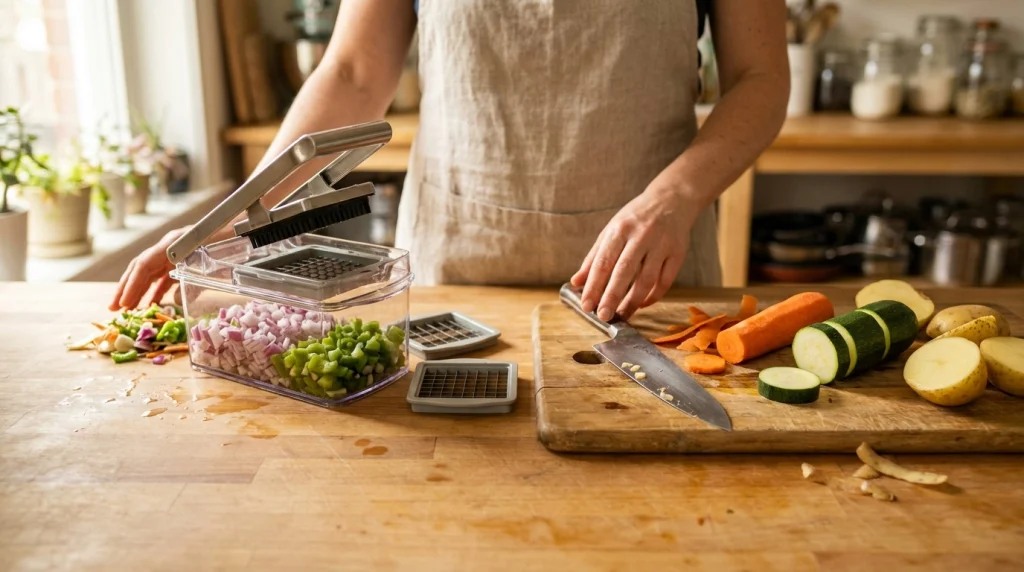
Neither tool replaces the other completely. A manual chopper excels at repetitive cuts, while a knife offers maximum flexibility.
| Task | Hand Chopper | Knife |
|---|---|---|
| Repeated uniform dice | Excellent with a grid | Depends on knife skill |
| Rough chopping | Fast | Fast with practice |
| Large vegetables | Usually needs pre-cutting | More flexible |
| Cleaning | Several parts possible | Usually simple |
| Multiple cutting styles | Depends on attachments | Highly versatile |
In my kitchen, I would still keep a good knife even after buying a vegetable chopper. The chopper handles repetitive prep, while the knife handles trimming and unusual shapes.
Hand Vegetable Choppers I Would Consider
If you’re ready to choose one, these three designs cover different cutting styles rather than repeating the same basic tool.
🏆 Best for Uniform Dicing
Fullstar Vegetable Chopper
★★★★☆
This popular grid-style design is built around interchangeable cutting inserts and a catch container. I would choose this style when consistent onion, pepper, or potato pieces matter more than a minced texture.
🌿 Best for Herbs & Small Batches
Kuhn Rikon Pull Chop
★★★★½
The pull-cord mechanism spins blades inside a covered container, making it suited to herbs, garlic, onions, nuts, and mixtures. I like this mechanism when controlling coarse versus fine texture matters more than making exact cubes.
👍 Best Push-Top Design
OXO Good Grips Vegetable Chopper
★★★★☆
OXO’s manual chopper format suits cooks who prefer pushing rather than pulling a cord. I would consider this approach for everyday small-batch chopping when simple operation and controlled countertop use are priorities.
Frequently Asked Questions
What is the best type of hand vegetable chopper?
A push-down grid chopper is useful for uniform cubes, while a pull-cord or pump chopper is better for rough chopping and mincing. The best type depends on the cut you need most often rather than one design being ideal for every task.
What is the difference between a vegetable chopper and a vegetable dicer?
A vegetable chopper is a broad category covering tools that cut food into smaller pieces. A dicer usually uses a fixed grid to create more consistently shaped cubes, making it better when even piece size matters.
Are pull-cord vegetable choppers good for onions?
Yes. Pull-cord choppers are useful for quickly reducing onions from coarse pieces to a finer chop. They aren’t ideal when a recipe requires perfectly uniform cubes because rotating blades cut ingredients randomly as they move around the bowl.
Can a manual vegetable chopper cut carrots and potatoes?
Many sturdy manual choppers can handle carrots and potatoes when the vegetables are first cut into smaller sections. Avoid forcing oversized pieces through a blade grid, and always follow the size and use limits supplied by the manufacturer.
Is a manual vegetable chopper worth buying?
A manual chopper can be worthwhile if you frequently dice onions, peppers, vegetables, herbs, or similar ingredients. It offers the most value when its cutting mechanism matches your normal recipes and the parts are easy enough to clean after regular use.
Final Takeaway
The biggest difference between hand vegetable chopper types is the cutting mechanism. Grid choppers make defined cubes, while pull-cord, pump, and crank designs create a progressively finer chop.
Choose the simplest tool that handles the cuts you make most often. You’ll usually get more value from one well-matched chopper than a complicated gadget packed with attachments you rarely use.
