
Pull Cord Chopper Blade Mechanism: How It Works and What to Know

Quick Answer
A pull cord chopper blade mechanism converts the straight pulling motion of a cord into rotational movement that spins the blades inside a bowl. In most designs, a cord reel, internal drive parts, and a return spring work together so the cord retracts after each pull. Repeated pulls rotate the blades and chop ingredients into smaller pieces, as explained in the manufacturer’s pull chopper product information.
Main parts of the mechanism
- Pull cord: Transfers your hand movement into the lid.
- Cord reel: Winds and unwinds the cord during operation.
- Drive assembly: Transfers the reel’s movement to the blade shaft.
- Return spring: Helps retract the cord when you release it.
- Blade assembly: Rotates through the ingredients to cut them into smaller pieces.
How to protect it
- Pull smoothly: Avoid jerking the cord or forcing it when resistance increases.
- Load carefully: Cut large ingredients into manageable pieces and follow the fill limit.
- Keep it safe: Never reach into the bowl while the blades remain installed.
A manual pull cord chopper can make everyday food preparation easier without electricity or batteries. Its simple exterior hides a small mechanical system that transfers your pulling force to a rotating blade assembly.
In this guide, I’ll explain how the pull cord chopper blade mechanism works, what each part does, and why the blades sometimes stop turning. I’ll also cover practical maintenance tips and what to look for when choosing a replacement chopper.
What Is a Pull Cord Chopper Blade Mechanism?
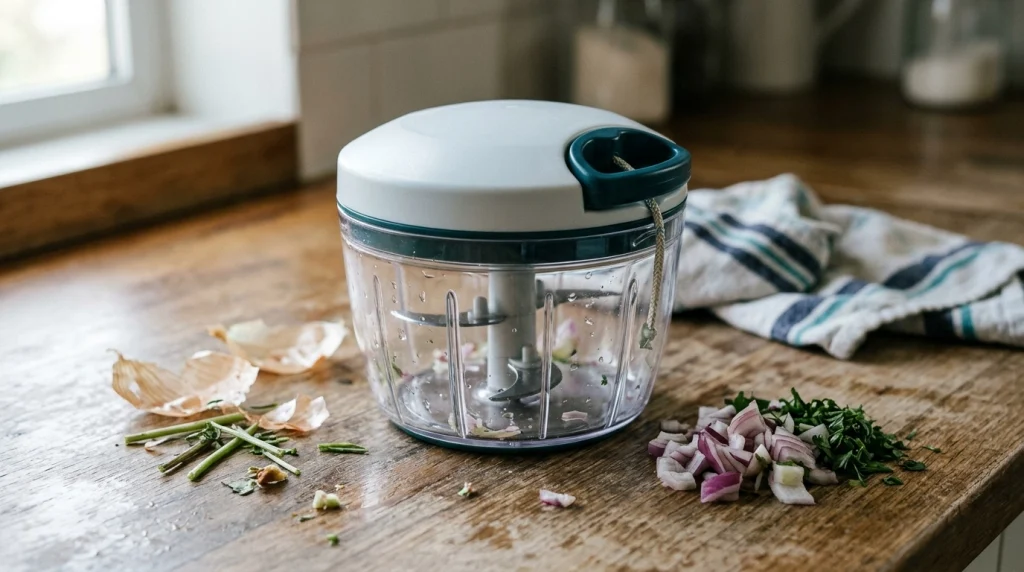
A pull cord chopper blade mechanism is a manual drive system that uses a retractable cord to rotate cutting blades inside a food container. It allows you to chop ingredients by hand instead of operating an electric motor.
The mechanism usually sits inside the lid, while a removable blade assembly fits onto a central spindle in the bowl. The exact internal design varies between manufacturers, so not every model contains the same gears, springs, or connecting parts.
- Input: Your hand pulls the cord outward.
- Motion conversion: The cord turns an internal reel and drive assembly.
- Output: The drive assembly rotates the blade shaft.
- Reset: A return mechanism retracts the cord for another pull.
That sequence is the heart of the system. The blades then cut through the food as they rotate, and repeated pulls gradually change the texture from chunky pieces to finer chopped ingredients.
How Does the Pull Cord Chopper Blade Mechanism Work?
The mechanism works by converting linear movement into rotational movement. When you pull the handle, the cord unwinds from an internal reel, which drives the components connected to the blade shaft.
Here’s how a typical spring-return, one-way drive design operates.
- You pull the handle. The cord unwinds and turns the reel inside the lid.
- The drive engages. A coupling, pawl-and-ratchet arrangement, or another one-way mechanism transfers rotation to the blade shaft.
- The blades spin. The shaft rotates the blade assembly through the ingredients in the bowl.
- The spring stores energy. In spring-return designs, the pull winds or tensions the return spring.
- You release the handle. The spring turns the reel back and rewinds the cord, while the one-way drive may disengage to prevent reverse blade rotation.
- You pull again. Each additional pull provides another chopping cycle.
Not every pull chopper uses precisely this arrangement. Some models have different drive couplings, and the number of blade rotations per pull depends on the specific design.
For example, Starfrit states that its Pull Chopper blades turn eight times with each pull. That figure applies to its specified product, not every manual chopper on the market.
Which Parts Make the Blade Mechanism Work?
Several components work together to produce a smooth chopping action. Understanding their roles makes it easier to spot problems without dismantling a lid that the manufacturer intends to keep closed.
| Part | Main function | Possible problem |
|---|---|---|
| Pull cord | Carries pulling force to the reel. | Fraying, tangling, or failure to retract. |
| Cord reel | Winds the cord and turns the drive. | Jamming or irregular movement. |
| Return spring | Retracts the cord after release. | The cord stays extended or retracts weakly. |
| Drive coupling or gear | Transfers reel rotation to the blade shaft. | The cord moves but the blades do not. |
| Blade shaft | Connects the drive to the cutting assembly. | Misalignment or obstruction prevents rotation. |
| Blade assembly | Cuts the ingredients as it rotates. | Food buildup, damage, or incorrect seating. |
How does the pull cord create rotation?
The cord wraps around a reel inside the lid. Pulling the handle unwinds that cord and turns the reel around its central axis.
The internal drive then transfers the reel’s rotation to the blade shaft. In a one-way ratchet design, small engagement parts allow the shaft to turn during the pull while reducing reverse rotation during cord retraction.
This arrangement makes repeated pulls useful. You don’t need to turn a crank continuously or supply electricity to keep preparing ingredients.
What does the return spring do?
The return spring provides the force that rewinds the cord after you release the handle. In a typical spring-return mechanism, pulling the cord stores energy in the spring, and releasing it lets the spring turn the reel back.
The spring doesn’t directly chop the vegetables. Its main job is to reset the cord so the chopper is ready for another pull.
Why do pull choppers use a one-way drive?
A one-way drive can let the blade shaft rotate during the pulling stroke without forcing it to reverse during the return stroke. This helps produce repeated chopping cycles with a simple pull-and-release action.
Some designs use pawls and ratchet teeth, while others use different coupling arrangements. If you need to identify the mechanism in a particular chopper, check its manual or manufacturer’s parts diagram rather than assuming every lid works identically.
Why Do Pull Cord Chopper Blades Rotate More Than Once per Pull?
Many pull choppers use a reel-and-drive ratio that produces several blade rotations from one cord pull. The cord travels outward once, but the internal reel can turn the blade shaft multiple times through the mechanism’s design.
The exact ratio depends on the model. For instance, Starfrit advertises eight blade rotations per pull for its Pull Chopper, but that specification shouldn’t be applied to other brands.
Three factors influence how the mechanism performs:
- Pull distance: A longer permitted pull can turn the reel farther.
- Drive ratio: The internal components determine how reel movement translates into blade rotation.
- Resistance: Dense or oversized ingredients can make the blades harder to turn.
More rotations don’t automatically guarantee evenly chopped vegetables. Ingredient size, bowl loading, blade arrangement, and the number of pulls all affect the final texture.
How Does Blade Rotation Affect Chopping Results?
The blades cut ingredients as they pass through the bowl, and repeated rotations expose the food to additional cutting edges. A few pulls usually produce a coarser texture than many repeated pulls, although the result varies by ingredient and chopper design.
I recommend starting with a small number of gentle pulls and checking the texture before continuing. This approach helps prevent onions, herbs, or other ingredients from becoming wetter and finer than the recipe requires.
| Chopping goal | Suggested approach | What to watch for |
|---|---|---|
| Coarse onion pieces | Begin with a few controlled pulls. | Stop before the pieces become too small. |
| Finely chopped garlic | Use small pieces and check frequently. | Excessive chopping can create a paste. |
| Chopped fresh herbs | Use short chopping cycles. | Too many pulls can bruise the leaves. |
| Chunkier salsa ingredients | Use manageable pieces and inspect between pulls. | Juicy ingredients may release liquid quickly. |
These are starting approaches, not guaranteed results for every model. Follow the manufacturer’s instructions, especially when working with firm vegetables or ingredients that produce substantial liquid.
What Causes a Pull Cord Chopper Blade Mechanism to Stop Working?
A chopper that stops rotating doesn’t always have a broken internal mechanism. Food obstructions, a poorly seated blade assembly, an overloaded bowl, or a damaged cord can all interfere with normal operation.
Before troubleshooting, stop pulling the cord and keep your hands away from the cutting edges.
- The cord pulls, but the blades stay still: Check whether the blade assembly sits correctly on its central spindle and whether food blocks its movement.
- The cord won’t extend: The reel may have jammed, the cord may have tangled, or the drive may be under excessive resistance.
- The cord stays extended: The return spring or cord-rewinding assembly may have a problem.
- The blades turn unevenly: Check for trapped food, an incorrectly seated assembly, or damage to the shaft.
- The mechanism makes unusual noises: Stop using it and inspect only the parts the manufacturer allows you to remove.
How can you check the mechanism without damaging it?
A careful external inspection is safer than opening a sealed lid. Many lids contain spring-loaded components that can release unexpectedly when dismantled.
- Remove the chopper from use and place it on a stable surface.
- Follow the manufacturer’s instructions to remove the lid and blade assembly safely.
- Check for food lodged around the blade shaft or bowl’s central post.
- Confirm that removable components fit correctly and that the bowl isn’t overloaded.
- Clean and dry the permitted parts, then reassemble the chopper according to its manual.
- Test it with a small amount of suitable food, using gentle pulls.
If the cord remains stuck or the drive slips after these checks, stop using the chopper. Contact the manufacturer about replacement parts or consider replacing the unit if the lid mechanism isn’t serviceable.
Never cut open a sealed lid, stretch a return spring, or force the cord to free a jam. These actions can damage the drive or cause an injury.
How Can You Maintain the Pull Cord and Blade Assembly?
Regular cleaning and sensible loading help preserve the mechanism. You don’t need to dismantle the lid after every use, and you shouldn’t immerse a lid unless its instructions explicitly permit it.
- Clean the bowl promptly: Remove food residue before it dries around the central spindle.
- Handle blades carefully: Hold the assembly by its designated plastic hub or handle, not the cutting edges.
- Keep the lid dry: Follow the specified cleaning method to protect internal components from water damage.
- Avoid overfilling: Leave enough room for ingredients to move around the blades.
- Use suitable ingredients: Cut large vegetables into smaller pieces and avoid forcing foods the manufacturer doesn’t recommend.
- Store it correctly: Keep the blade assembly protected and away from children.
For general kitchen blade safety, the OSHA kitchen equipment safety guidance emphasizes safe handling and storage of sharp utensils. Although its guidance addresses workplace kitchens, the basic precautions are relevant when handling removable chopper blades at home.
Pull Cord Chopper vs. Push-Down and Electric Choppers
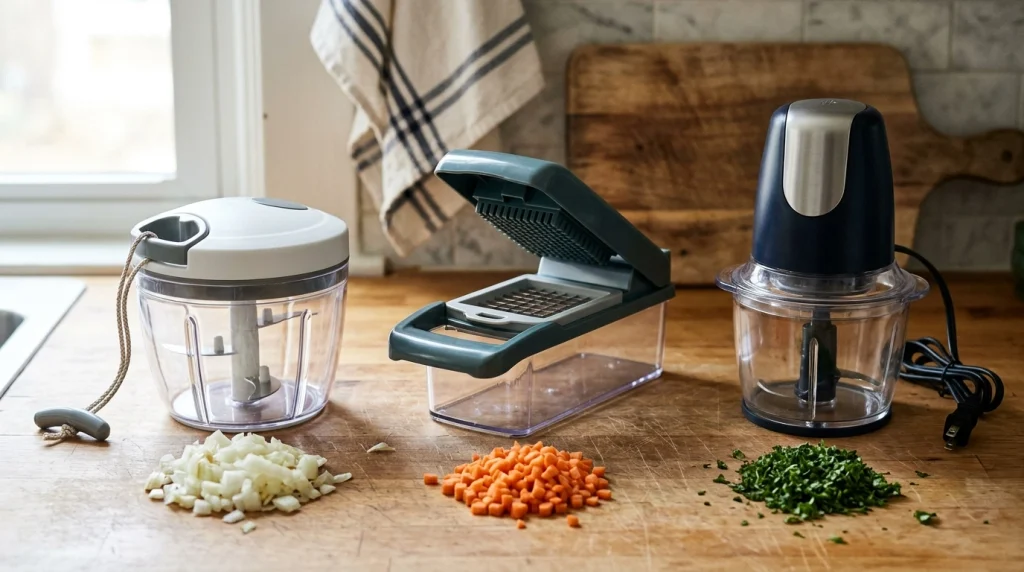
A pull cord chopper uses your hand to drive a rotating blade assembly. Push-down choppers use downward pressure, while electric models rely on a motor, so their operating mechanisms and maintenance needs differ.
| Feature | Pull cord | Push-down | Electric |
|---|---|---|---|
| Power source | Hand-pulled cord | Downward hand pressure | Electric motor |
| Main mechanism | Cord reel and drive assembly | Pressing mechanism or fixed cutting grid | Motor and drive coupling |
| Control over texture | Adjust by pull count | Depends on grid and food size | Depends on speed and operating time |
| Main maintenance concern | Cord, spring, and lid drive | Cutting grid and pusher | Motor, coupling, and electrical parts |
For small batches of onions, garlic, herbs, or similar ingredients, a manual pull chopper can be a practical choice. An electric processor may suit larger workloads, while a push-down model can be useful when you want a specific cut from a compatible grid.
There isn’t one best mechanism for every kitchen. Choose according to the ingredients you prepare, the amount you chop, and how much cleaning you’re willing to do.
What Should You Look for When Buying a Pull Cord Chopper?
When shopping for a manual chopper, look beyond the blade count or promotional claims. A well-designed lid, a secure blade mount, and clear cleaning instructions matter just as much for everyday use.
- Blade construction: Look for a securely mounted blade assembly made from materials identified by the manufacturer.
- Cord action: Choose a design with a comfortable handle and a cord that retracts smoothly during normal operation.
- Bowl capacity: Match the bowl to your usual preparation volume instead of assuming a larger bowl always works better.
- Replacement support: Check whether the manufacturer offers replacement blades or other serviceable components.
- Cleaning instructions: Confirm which components can be washed or placed in a dishwasher.
- Safety details: Look for a secure lid fit, a stable base, and clear guidance for handling the blades.
As of 2026, manufacturer documentation remains the best starting point for confirming a model’s actual blade count, cord mechanism, cleaning requirements, and replacement-part availability.
Don’t assume that a chopper with more blades will always chop faster or last longer. The design of the drive system, the quality of the assembly, and the way you use it all matter.
Recommended Pull Cord Choppers and Manual Alternatives
If you’re choosing a chopper after learning how its mechanism works, I’d prioritize a clearly documented design and easy maintenance over unverified performance claims. These options provide useful starting points for comparing manual choppers.
BEST DOCUMENTED PULL-CORD DESIGN
Starfrit Pull Chopper
★★★★☆
Starfrit specifies a three-blade cutting system, a self-retracting cord, and eight blade rotations per pull for its listed model. I’d consider it when comparing documented mechanism features and manufacturer care instructions.
BEST FOR COMPARING ATTACHMENTS
Brieftons Manual Food Chopper
★★★½☆
Brieftons publishes guidance for its manual food-preparation system, including pull-cord operation and separate attachments on compatible configurations. I’d verify the exact model and included components before purchasing because attachment sets vary.
BEST SIMPLE ALTERNATIVE
Manual Push-Down Vegetable Chopper
★★★½☆
A push-down chopper uses a pressing mechanism or cutting grid instead of a retractable cord and spring. I’d compare this style if you prefer a simpler operating action and need a particular cut size from a compatible grid.
Recommendation note: The star ratings above are editorial assessments for this comparison, not verified customer-review averages or results from hands-on testing. Confirm the current model, specifications, included parts, and seller details before ordering.
Frequently Asked Questions
1. How does a pull cord chopper blade mechanism work?
A pull cord chopper uses a retractable cord and an internal drive assembly to rotate its blades. Pulling the cord turns a reel, which transfers movement to the blade shaft; a return mechanism then rewinds the cord so you can repeat the chopping cycle.
2. Why does my pull cord chopper spin but not chop?
The blade assembly may be disconnected from its drive shaft, incorrectly seated, or obstructed by food. Stop using the chopper, remove the lid and blades according to the manufacturer’s instructions, and check for visible obstructions or misalignment before testing it again.
3. Why won’t the pull cord retract?
A cord that stays extended may indicate a tangled cord, a jammed reel, or a damaged return spring. Avoid pulling harder or opening a sealed lid, because the internal spring may release unexpectedly; contact the manufacturer if normal external checks don’t resolve the problem.
4. Can I replace the blades or repair the pull cord mechanism?
Some choppers have removable replacement blade assemblies, but the lid’s internal drive mechanism may not be designed for user repair. Check the exact model’s manual or contact the manufacturer to confirm compatible replacement parts and approved repair options.
5. Does pulling the cord faster make the blades chop better?
Not necessarily. Faster or harder pulls can increase strain without improving the final texture, particularly when the bowl contains dense or oversized ingredients. Controlled pulls, manageable food pieces, and checking the texture between cycles usually provide better control.
Final Takeaway: Understand the Mechanism Before Troubleshooting
The pull cord chopper blade mechanism works by turning a simple hand movement into rotation inside the chopping bowl. The cord, reel, drive assembly, return spring, and blade shaft each play a role in that process.
When a chopper stops working, check for food obstructions, incorrect blade seating, and overloading before assuming an internal part has failed. Use only the cleaning and repair methods approved for your model, and never force a stuck cord or handle exposed blades carelessly.
If you’re buying a new chopper, compare the manufacturer’s specifications, replacement-part support, and cleaning instructions. A well-matched tool and careful operation can make everyday chopping simpler without putting unnecessary strain on the mechanism.
Affiliate disclosure: This article contains affiliate links. As an Amazon Associate, the site may earn from qualifying purchases at no additional cost to you.