Push-Down Vegetable Chopper Dice Size Explained

Quick Answer
The dice size of a push-down vegetable chopper is determined mainly by the dimensions and arrangement of its blade grid. Some models produce one fixed cut size, while others include interchangeable grids for smaller or larger pieces. Unless the manufacturer publishes exact measurements, do not assume that every chopper produces standard-sized cubes.
A push-down vegetable chopper cuts food by forcing it through a stationary grid of intersecting blades. The grid determines the approximate width and thickness of each piece, while the ingredient’s shape, preparation, and firmness affect how consistently it passes through.
If you are choosing a chopper for potatoes, onions, cucumbers, or other vegetables, the important question is not simply whether it dices. You need to know whether its cutting grid produces pieces suitable for your recipe.
What Dice Size Does a Push-Down Vegetable Chopper Produce?
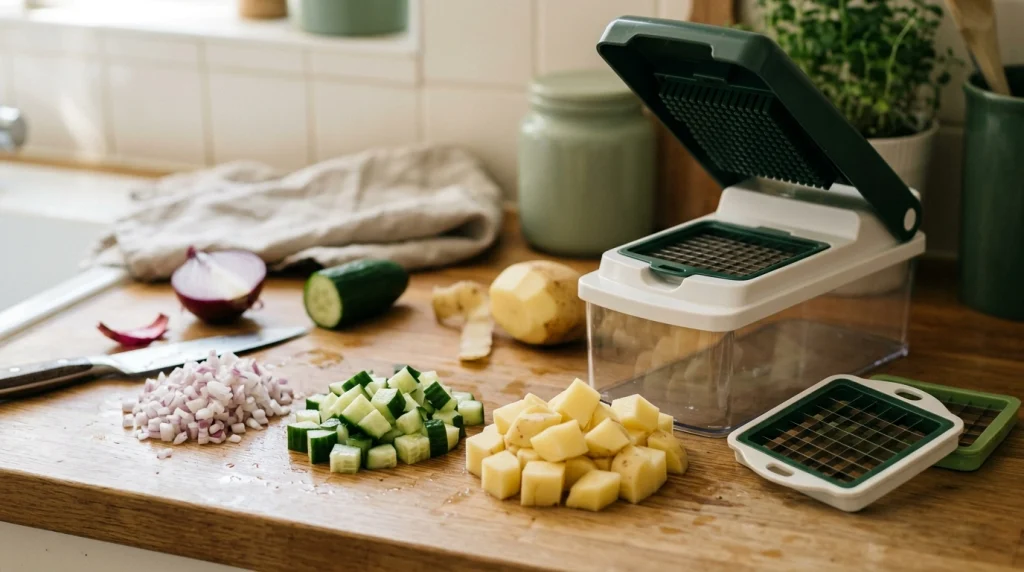
A push-down vegetable chopper can produce small, medium, or large dice, depending on its cutting-grid design. There is no single universal dice size for all manual push-down choppers.
Some models have one fixed grid, while others offer two or more interchangeable dicing inserts. The manufacturer’s dimensions, product diagram, or instruction manual are the most reliable ways to identify the actual cut size.
For example, a grid advertised as producing 10 × 10 mm dice is intended to make pieces approximately 10 mm wide and 10 mm thick. That is about 0.39 inches per side, making it close to a 3/8-inch dice.
However, a product described only as a small-dice or large-dice chopper does not provide enough information to establish an exact measurement. Those labels may be useful for comparing the same product range, but they should not be treated as standardized dimensions.
How Does the Blade Grid Determine Dice Size?
The blade grid is the main factor that controls the size of the pieces produced by a push-down chopper. Its intersecting blades divide the vegetable into sections as the lid or pusher presses the food downward.
The distance between neighboring cutting blades determines the approximate width and length of the resulting pieces. The cutting arrangement and any accompanying slicing mechanism influence the final shape and thickness.
Fixed-grid choppers
A fixed-grid model has one primary dicing configuration. It is straightforward to use if that cut suits most of your regular recipes, but you cannot change the dice size simply by pressing harder or faster.
If the grid produces relatively large pieces and you need finer dice, you may have to cut the ingredient again with a knife or choose a different chopper.
Interchangeable-grid choppers
Some models include removable blade inserts in different sizes. These let you choose a finer or coarser cut without replacing the entire appliance.
Before purchasing, check whether the listed grids are included with the product or sold separately. A product range may support several sizes even though an individual package contains only one or two cutting inserts.
Key Insight
A push-down chopper’s dice size comes from its cutting design, not from how forcefully you press. Excessive force is not a substitute for using the correct grid or preparing the vegetable properly.
How to Identify Small, Medium, and Large Dice
Small, medium, and large are descriptive terms rather than guaranteed measurements across all kitchen tools. Use them as a practical starting point, then check the exact grid dimensions when size consistency matters.
| Cut category | What it means | Common uses |
|---|---|---|
| Small dice | Fine pieces that blend into a dish more readily | Salsa, finely chopped vegetables, soup bases |
| Medium dice | Moderately sized pieces that remain visible in a dish | Salads, mixed vegetables, everyday cooking |
| Large dice | Chunkier pieces with a more substantial bite | Roasted vegetables, stews, chunky soups |
These categories describe intended results, not a universal millimeter range for every chopper. If a recipe specifies a precise cut, compare its measurement with the manufacturer’s stated output rather than relying on the label alone.
Also distinguish a dicing grid from a slicing blade. A slicing attachment creates flat pieces, while a grid-based dicing mechanism creates smaller sections from food pushed through its cutting arrangement. Some multifunction tools require a slicing step before the dicing grid to achieve the intended result.
Which Dice Size Is Best for Different Recipes?
The most useful dice size is the one that matches the recipe’s texture, cooking time, and presentation. A smaller cut is not automatically better, and a larger cut is not suitable for every dish.
For salsa and finely chopped ingredients
Smaller pieces can distribute more evenly throughout salsa, relish, and other mixtures. If your chopper’s grid produces chunks that are too large, use a suitable smaller insert or finish the ingredients with a knife.
For juicy vegetables such as ripe tomatoes, consider the design of the chopper before pressing. Soft produce may crush or release more liquid rather than pass cleanly through a grid intended for firmer ingredients.
For soups, sauces, and stews
Small or medium dice can work well when you want vegetables to soften and distribute throughout a soup or sauce. Larger pieces can be useful when you want distinct vegetable chunks in a stew.
Remember that cooking time depends on more than width alone. Vegetable type, starting temperature, cooking method, and the thickness of each piece all affect how quickly it becomes tender.
For salads and meal preparation
Medium dice can provide a practical balance between visible pieces and manageable bites in many salads. Consistent pieces also make it easier to portion ingredients evenly across multiple servings.
However, a fixed-grid chopper may not be ideal for every salad ingredient. Leafy greens, delicate herbs, and irregularly shaped produce may need a knife or another cutting method to preserve their intended texture.
For roasted vegetables
Larger, reasonably uniform pieces may be preferable when you want vegetables to retain their shape during roasting. Very small pieces can soften more quickly and may brown sooner, depending on the vegetable and oven conditions.
Choose the grid based on the recipe rather than assuming a chopper’s largest available setting is always appropriate. Check that the pieces fit the intended cooking method and can be prepared safely with your particular model.
Why Does the Actual Cut Sometimes Look Uneven?
Even when the blade grid has fixed dimensions, the finished pieces may not all look identical. A grid establishes the cutting pattern, but the shape and condition of the ingredient influence the result.
- Irregular starting pieces: A curved onion end or uneven vegetable section may produce pieces that differ in shape.
- Food that is too large: An oversized piece may sit poorly on the grid or fail to pass through it as intended.
- Soft or overripe produce: Delicate ingredients may compress or break apart instead of forming clean pieces.
- Very firm vegetables: Hard produce may resist the cutting action and place excessive stress on the grid or pusher.
- Different cutting mechanisms: Some multifunction choppers use a separate slicing blade before dicing, so the final dimensions depend on the combined setup.
For more consistent results, prepare vegetables into manageable sections, center them over the cutting area, and follow the manufacturer’s instructions. Do not force an ingredient through a grid if the lid does not close or the pusher meets unusual resistance.
How to Check Your Chopper’s Exact Dice Size
If the packaging does not make the dimensions clear, use this simple checking process before preparing a full batch.
- Identify the model. Look for the product name, model number, packaging, or instruction manual.
- Check the blade options. Find out whether the chopper has a fixed grid or interchangeable inserts, and identify the included attachments.
- Look for stated dimensions. Search the manufacturer’s specifications for a measurement in millimeters or inches. Do not treat the grid’s overall outside dimensions as the size of the cut.
- Prepare a suitable test ingredient. Choose a firm vegetable permitted by the manual and cut it to fit the chopper’s intended working area.
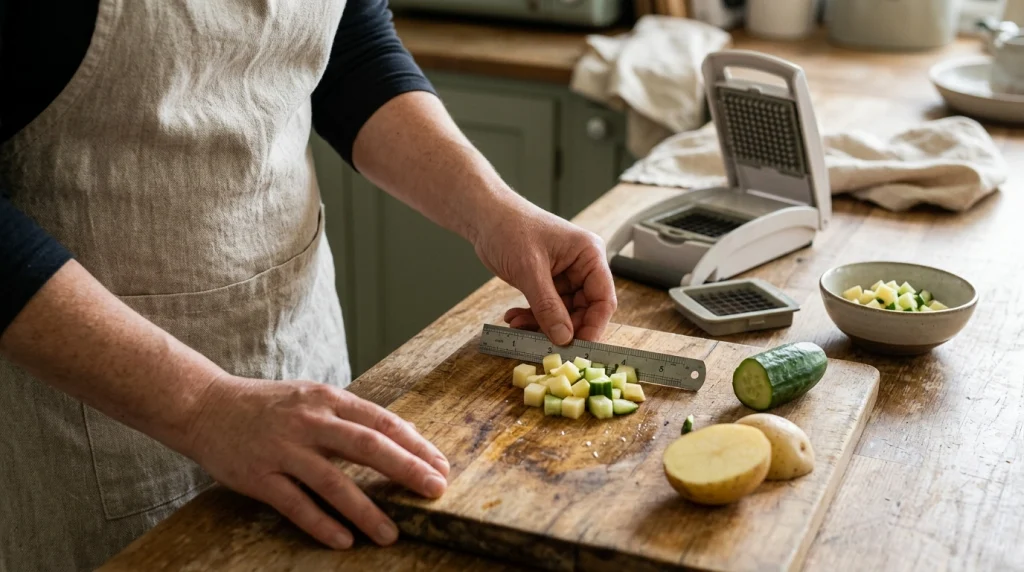
- Inspect the result. Compare several finished pieces rather than judging a single irregular edge. If exact dimensions are important, measure the pieces with a ruler or suitable measuring tool.
- Confirm the cooking fit. Check whether the pieces suit your recipe and whether another cutting method would provide a better result.
This process helps distinguish a manufacturer’s advertised cut size from the approximate size of pieces produced under normal kitchen conditions. It also avoids confusing blade-grid spacing with the finished dimensions of every individual piece.
Tip
If your recipe calls for an exact dice, test one small batch before chopping all the ingredients. It is easier to adjust your method at the beginning than to discover that an entire batch is cut too coarsely.
How to Choose a Chopper Based on Dice Size
Choose a push-down vegetable chopper by comparing the cut it produces with the way you usually prepare food. A long list of attachments is not necessarily useful if the main grid does not suit your everyday recipes.
- Choose a fixed-grid model if one cut size meets most of your needs and you prefer a simpler setup.
- Choose interchangeable grids if you regularly switch between fine and chunky dice and the required inserts are included or available.
- Look for published dimensions if your recipes depend on a particular cut size. Clear measurements are more useful than vague descriptions such as extra-fine or extra-large.
- Check ingredient compatibility if you plan to chop hard vegetables, soft tomatoes, or other produce that may behave differently under pressure.
- Consider cleaning access because food can remain trapped between narrow blades. A cleaning brush or removable grid may make maintenance easier.
Before buying, verify the actual configuration rather than assuming that all products with similar appearances have the same cutting dimensions. A manufacturer’s official specifications or manual should take priority over generic descriptions.
Common Mistakes When Comparing Dice Sizes
Several easy-to-miss mistakes can lead to the wrong expectations when selecting a chopper.
- Assuming all push-down choppers use the same grid. Designs and dimensions vary by model.
- Confusing slicing thickness with dice size. A thin slice is not the same as a cube, and some tools use separate attachments to produce diced pieces.
- Assuming the largest grid opening determines every dimension. The cutting mechanism and any preliminary slicing step affect the final shape.
- Pressing harder to obtain smaller pieces. Pressure does not change the fixed blade spacing and may damage the tool or cause an injury.
- Ignoring the recipe’s needs. A cut that works for chunky stew may be too large for a finely textured salsa.
When the manufacturer does not publish a precise cut measurement, treat the output as approximate and assess whether it is suitable for your cooking. Avoid presenting an estimated dimension as a verified product specification.
Frequently Asked Questions
Does every push-down vegetable chopper produce the same dice size?
No. Dice size varies by model and blade-grid design. Some choppers have a fixed cutting size, while others provide interchangeable grids for different results.
Can I change the dice size without buying another chopper?
Sometimes. If your model supports interchangeable dicing grids, you may be able to change the cut by installing a compatible insert. Check which accessories are included or sold separately.
How can I tell whether my chopper makes small or large dice?
Check the manufacturer’s stated cut dimensions or test a suitable vegetable and measure the resulting pieces. Labels such as small and large are not standardized across all brands.
Why are some pieces larger or more irregular than others?
Uneven starting pieces, soft produce, unsuitable ingredient sizes, and the chopper’s cutting arrangement can affect consistency. Prepare vegetables according to the manual and use ingredients compatible with the grid.
Is a smaller dice always better for cooking?
No. Smaller pieces can suit fine mixtures and dishes where vegetables should soften quickly, while larger pieces may be preferable for roasted vegetables and chunky stews. Choose the size that suits the recipe.
Can I force a hard vegetable through a push-down chopper?
No. Do not force the lid or pusher when an ingredient resists the blades. Check the manufacturer’s guidance, prepare the food as directed, and use a different cutting method if the ingredient is unsuitable for the model.
Conclusion
The dice size of a push-down vegetable chopper depends primarily on its blade grid and whether the model supports interchangeable cutting inserts. Small, medium, and large dice can serve different cooking purposes, but those labels do not guarantee a specific measurement.
For the most reliable result, check the manufacturer’s specifications, prepare vegetables to fit the tool, and test a small batch when precise dimensions matter. Choose a grid that suits your regular recipes, and never force food through a resistant blade assembly. Matching the cutting design to your ingredients and cooking method is the simplest way to get useful, consistent results.