
How Does a Vegetable Dicer Work? A Simple Guide to Faster, Even Chopping

Quick Answer
A vegetable dicer works by forcing food through sharp blades that divide it into evenly sized pieces. Most manual models use a blade grid and matching pusher, while push-style choppers may use rotating blades. Consistent cuts can also help ingredients cook more evenly.
How a vegetable dicer works
- Choose the blade: The blade or grid determines whether you get small cubes, larger chunks, slices, or strips.
- Position the food: The ingredient sits directly over the cutting grid or inside the chopping chamber.
- Apply pressure: A lid, handle, lever, or push knob drives the food into the sharp cutting surfaces.
- Blades divide it: Each cutting edge separates the vegetable into consistently sized pieces.
- Container catches it: Many modern dicers drop the finished pieces into a container underneath.
Best results
- Pre-cut oversized or extra-hard vegetables so they fit the blade area without excessive force.
I use a vegetable dicer when I want onions, peppers, potatoes, or cucumbers prepared quickly without trying to make every cube identical with a knife. Once you understand what happens between the pusher and blade, the tool becomes much easier to use correctly.
Modern vegetable choppers look simple, but blade design, food size, pressure, and technique all affect the result. Here is exactly how they work and where each style performs best in a real kitchen.
What Is a Vegetable Dicer?
A vegetable dicer is a manual or powered kitchen tool that cuts vegetables into smaller, more uniform pieces using fixed or moving blades. Many manual models combine a sharp grid, hinged lid, pusher teeth, and collection container.
Unlike ordinary freehand chopping, the blade arrangement controls much of the final shape. A grid with smaller openings produces smaller pieces, while a wider grid creates larger chunks.
- Grid dicer: Pushes vegetables straight through intersecting blades.
- Push chopper: Uses a spring-loaded or rotating blade inside a container.
- Mandoline combination: Adds flat slicing, julienne, shredding, or grating inserts.
- Electric chopper: Uses a motor to spin blades rapidly instead of relying on hand pressure.
The term “dicer” is sometimes used loosely. A true grid-style dicer gives the most cube-like, repeatable pieces because the blade spacing remains fixed.
How Does a Vegetable Dicer Work Step by Step?
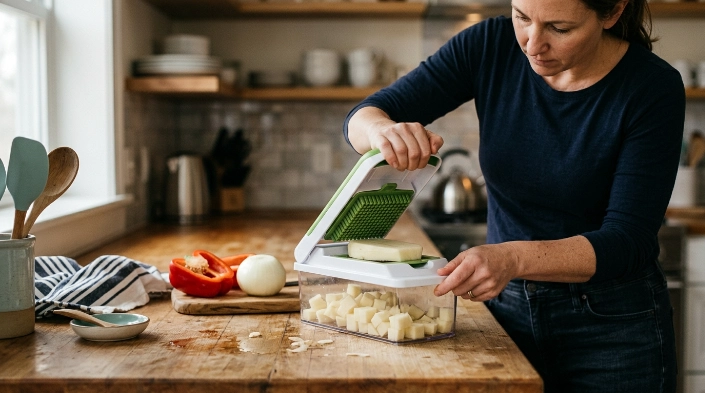
A manual vegetable dicer converts downward pressure from your hand into cutting force. The pusher presses the ingredient through several blades at once instead of making one knife cut at a time.
- Install the correct blade. Lock the dicing grid or cutting insert securely into the frame.
- Prepare the vegetable. Wash it and remove stems, seeds, skins, or damaged areas when needed.
- Pre-cut large food. Reduce oversized onions, potatoes, or peppers until they fit comfortably over the blade.
- Center the ingredient. Placing it near the middle spreads pressure more evenly across the grid.
- Close the lid firmly. The pusher teeth drive the vegetable through the sharp metal grid.
- Collect the pieces. The diced food drops directly into the container underneath.
The most important part is the relationship between the pusher and cutting grid. The pusher usually contains raised blocks or teeth that line up with spaces between the blades.
When the lid closes, those blocks continue pushing the vegetable through the grid. They also help clear pieces that might otherwise remain sitting above the blades.
Why does one quick push work better than slowly forcing the lid?
A controlled, confident press usually gives a cleaner cut because the blades can pass through the food before it compresses excessively. Slowly crushing a firm potato or carrot can increase resistance.
I notice this most with onions. A quick press tends to separate the layers cleanly, while hesitant pressure can flatten them before they pass through.
What Actually Cuts the Vegetable?
The cutting grid does the real work. It contains thin, sharpened metal edges arranged at fixed intervals, creating several cutting paths at the same time.
Some multi-function choppers use interchangeable grids. For example, certain Mueller Pro-Series models provide approximately 1/4-inch and 1/2-inch dicing grids for finer or coarser results.
| Chopper Type | How It Cuts | Typical Result | Best For |
|---|---|---|---|
| Grid dicer | Food is pressed through intersecting fixed blades | Consistent cubes or blocks | Onions, peppers, potatoes, zucchini |
| Push chopper | Each push rotates or moves a blade | Small chopped pieces | Onions, herbs, nuts, salsa ingredients |
| Mandoline insert | Food slides across a stationary blade | Slices or julienne strips | Cucumber, carrots, potatoes, zucchini |
| Electric chopper | Motor spins curved blades at high speed | Coarse to finely chopped food | Large or frequent prep jobs |
The grid system gives me the most predictable result when a recipe depends on consistent size. This matters for soups, roasted vegetables, salsa, omelets, and stir-fries.
If you’re still developing traditional cutting technique, my guide to essential cooking skills and knife cuts explains how dicing, mincing, and julienne cuts differ.
Why Do Evenly Diced Vegetables Matter?
Uniform pieces tend to cook at similar rates because their size and thickness are more consistent. Tiny pieces soften sooner, while thick chunks usually need more time for heat to reach the center.
A vegetable dicer reduces that variation. This is one reason I find it especially useful when several vegetables are going into the same pan.
- Roasting: Similar cubes brown and soften more evenly.
- Soups: Consistent pieces give each spoonful a more balanced texture.
- Stir-fries: Uniform vegetables reduce the chance of mixing mushy pieces with undercooked ones.
- Salsa: Similar-sized tomato, onion, and pepper pieces are easier to scoop and mix.
- Meal prep: Repeating the same cut across several portions becomes faster.
This also helps prevent one of the common cooking mistakes I see at home: combining ingredients cut into wildly different sizes.
Which Vegetables Work Best in a Dicer?
Vegetable dicers work best with foods that are firm enough to hold shape but not so hard that they require excessive pressure. Onions, bell peppers, zucchini, cucumbers, potatoes, and many firm fruits are common examples.
I judge the ingredient before pressing it. If closing the lid feels like a strength test, I stop and cut the food smaller first.
- Onions: Excellent for grid dicers after halving or quartering.
- Bell peppers: Remove the stem and seed core, then flatten or section the walls.
- Potatoes: Cut large potatoes into manageable slabs or chunks first.
- Zucchini: Usually passes through easily and holds a neat shape.
- Cucumbers: Good for salads, relishes, and quick meal prep.
- Carrots: Work better when cut into shorter or thinner sections.
- Tomatoes: Firmer varieties work better than very soft, overripe tomatoes.
Frozen-solid food, bones, fruit pits, and extremely hard ingredients should not be forced through a typical household vegetable dicer. They can damage the blades, hinge, or frame.
Should you wash vegetables before dicing them?
Yes. The FDA recommends washing fresh produce under running water before preparing or eating it, including produce you plan to peel.
I also dry slippery vegetables before putting them in the dicer. A dry exterior makes them easier to position without sliding across the blade frame.
Is a Vegetable Dicer Safer Than Using a Knife?
A vegetable dicer reduces some freehand knife work, but it still contains extremely sharp blades. Treat the inserts with the same caution you would give a sharp chef’s knife.
The greatest risk often comes during blade changes and cleaning rather than the actual pressing motion. I never push stuck food from a blade grid with my fingertips.
- Lock inserts fully: Never operate the chopper with a loose blade.
- Keep fingers above the grid: Use the lid, pusher, holder, or cleaning tool.
- Use a stable surface: A dry, flat counter reduces slipping.
- Don’t force the hinge: Reduce the ingredient size when resistance feels excessive.
- Store blades securely: Don’t leave loose cutting grids in a crowded drawer.
For broader precautions, see my kitchen safety guide for home cooks. The USDA also recommends keeping utensils, cutting boards, and preparation surfaces clean to reduce cross-contamination.
You can review the USDA’s broader food-safety basics when setting up your meal-prep routine.
Why Does Food Sometimes Get Stuck in the Dicer?
Food usually sticks because the ingredient is too large, too fibrous, too soft, or pressed through a crowded blade. Residue can also build between the pusher teeth after repeated cuts.
Celery is a good example. Long fibers may stretch across the grid instead of separating cleanly unless I cut the stalk into shorter sections first.
- Cut hard vegetables smaller before placing them over the grid.
- Center the ingredient rather than loading one edge heavily.
- Clear residue regularly instead of making many presses over a clogged grid.
- Use the supplied cleaning tool whenever one is included.
- Check blade orientation after changing inserts.
If the lid suddenly needs much more force than usual, I don’t keep pressing harder. I open the chopper and check what is blocking the grid.
How Do You Clean a Vegetable Dicer Safely?
Cleaning starts by separating the removable blade from the main body according to the manufacturer’s instructions. I rinse loose vegetable pieces away before they dry into the narrow grid spaces.
Never sweep a sponge or bare hand directly across the sharpened edge. A small cleaning brush or the tool supplied with the dicer is safer for clearing trapped onion, carrot, or potato.
- Empty the collection container.
- Remove the blade carefully by its frame.
- Rinse loose food away without touching the sharpened edges.
- Use a cleaning brush or manufacturer-supplied tool for tight spaces.
- Wash the container, lid, and approved parts as directed.
- Dry everything before reassembling or storing it.
Dishwasher compatibility varies by model and part, so I always check the manufacturer’s care instructions first. Even when plastic parts are dishwasher safe, handling the blade insert carefully remains important.
Vegetable Dicer vs Knife: Which One Makes More Sense?
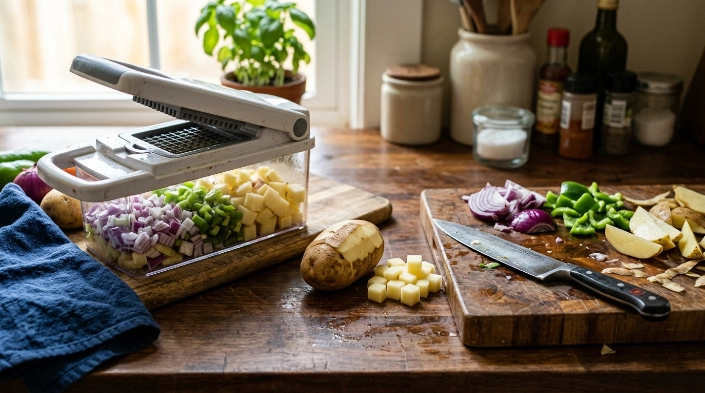
A dicer wins when I need a large amount of repetitive, uniform chopping. A knife gives me more flexibility and control over unusual shapes, delicate ingredients, and tiny quantities.
| Factor | Vegetable Dicer | Chef’s Knife |
|---|---|---|
| Consistency | Excellent with fixed grids | Depends on knife skill |
| Large batches | Fast for repetitive cuts | More manual cutting |
| Cut flexibility | Limited by included blades | Highly flexible |
| Cleanup | Several parts and grid spaces | Knife plus cutting board |
| Storage | Needs space for body and inserts | Compact |
For my kitchen, the dicer complements a knife rather than replacing it. I still trim vegetables with a knife, then let the grid handle the repetitive final cuts.
That combination can make everyday prep faster, especially when I am batch-cooking. My guide to saving time while cooking daily meals covers more ways to streamline the rest of the process.
Does a Vegetable Dicer Change the Nutrition of Vegetables?
Dicing changes the physical size of a vegetable, not its basic nutritional identity. The bigger practical concerns are how you store the cut produce and how you cook it afterward.
The USDA’s MyPlate Vegetable Group includes vegetables served whole, cut, cooked, raw, frozen, canned, or dried.
I usually dice only what I expect to use soon because freshly cut vegetables are easier to keep crisp and appealing. Refrigerate produce that needs refrigeration promptly and keep your tools and containers clean.
Which Vegetable Dicers Would I Choose in 2026?
If you’re ready to pick one, these are the three styles I would consider. Each serves a different kind of home cook rather than trying to do exactly the same job.
🏆 Best Overall
Fullstar Original Chopper 4-in-1
★★★★½
This manual chopper uses interchangeable stainless-steel cutting inserts, a hinged press lid, and a catch container. I like this format for onions, peppers, and everyday meal prep because the grid produces repeatable pieces with little counter mess.
🥕 Best for Multiple Cuts
Mueller Pro-Series 10-in-1 Vegetable Chopper
★★★★½
Selected Mueller Pro-Series versions include small and large dicing grids around 1/4 inch and 1/2 inch, plus slicing and grating attachments. I would choose this type when I want one prep system for cubes, slices, julienne vegetables, and grated ingredients.
⚡ Best Push Chopper
OXO Good Grips Chopper
★★★★☆
The OXO design uses a push knob that rotates its stainless-steel blade with repeated presses instead of forcing food through a square grid. I prefer this approach for onions, herbs, nuts, and salsa when exact cubes matter less than quick chopping.
Frequently Asked Questions
Does a vegetable dicer completely replace a kitchen knife?
No. A vegetable dicer is excellent for repetitive, uniform cuts, but you usually still need a knife for trimming, peeling, removing stems, and reducing large vegetables so they fit the cutting area.
Can a vegetable dicer cut potatoes?
Yes, most sturdy grid-style vegetable dicers can cut raw potatoes when the pieces fit the blade area. I pre-cut large or exceptionally firm potatoes because forcing an oversized piece can put unnecessary stress on the blades and hinge.
Why is my vegetable chopper hard to press?
The food may be too large, too hard, positioned poorly, or blocking part of the grid. Open the chopper, inspect the blade, reduce the ingredient size, and try again rather than using excessive force.
Can I sharpen vegetable dicer blades?
Most grid inserts are difficult to sharpen evenly at home because they contain many small cutting edges. I prefer replacing a damaged or noticeably dull insert when the manufacturer offers replacement blades.
What is the difference between a vegetable chopper and a vegetable dicer?
A dicer usually aims for consistent cube-like pieces using a fixed grid. A chopper is a broader term that can include grid dicers, rotating push choppers, pull-cord models, and electric machines that produce less uniform chopped pieces.
Final Takeaway
So, how does a vegetable dicer work? It uses your downward pressure, a pusher, and sharp fixed blades to divide vegetables into several uniform pieces in one motion.
The tool works best when you choose the correct grid, pre-cut oversized ingredients, center the food, and use firm controlled pressure. Those small habits improve both cutting quality and the life of the chopper.
As of 2026, I still see manual grid dicers as one of the simplest ways to speed up repetitive vegetable prep without adding another electric appliance. Use the safety features, keep the blades clean, and let the tool handle the repetitive cuts while your knife takes care of the detailed work.
