
What Is an Air Fryer and What Can You Cook in It?

An air fryer is a small countertop convection oven. It uses a heating element and a powerful fan to blow hot air around food in a basket or on a tray. The fast-moving hot air browns and crisps the outside of food, which gives results similar to frying with much less oil.
Despite the name, an air fryer does not fry. It roasts and bakes very quickly in a small space. Here is how it works, what types are available, what you can cook, and how to get the best results.
How Does an Air Fryer Work?
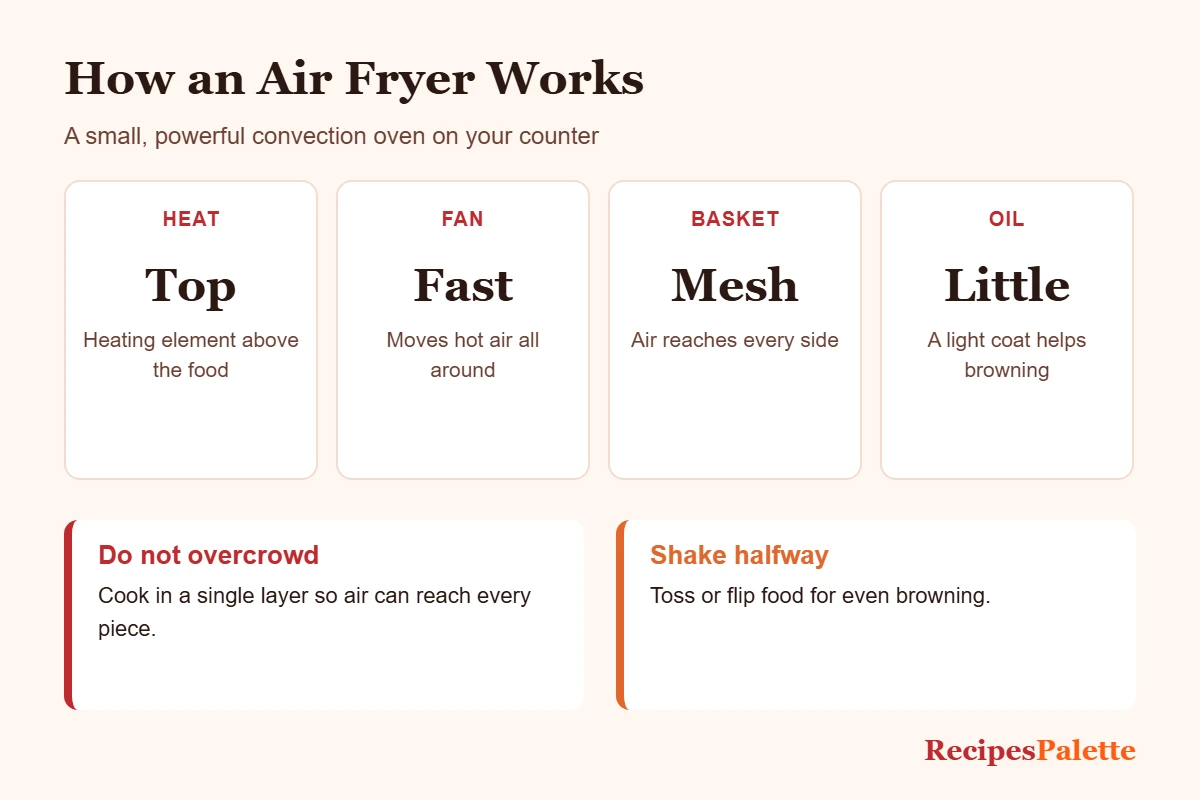
Inside an air fryer, a heating element sits above the cooking chamber and a fan sits just above or behind it. When you turn it on:
- The element heats the air in the small chamber.
- The fan pushes that hot air down and around the food at high speed.
- Perforated baskets or racks let air reach the bottom and sides of the food.
- The moving air carries moisture away from the surface, which lets the outside brown and crisp.
A regular oven with a convection fan works in a similar way, but an air fryer is much smaller and the fan is closer to the food, so it heats up faster and crisps food more quickly.

Types of Air Fryers
Basket air fryers
The most common type. Food goes in a pull-out drawer basket. They are compact, heat quickly and are easy to shake during cooking. Capacity usually ranges from about 2 to 6 quarts. Dual-basket models let you cook two foods at different settings at the same time.
Air fryer ovens
These look like a toaster oven, with a front door and several racks. They hold more food in flat layers and can often toast, bake, broil and dehydrate. They take up more counter space.
Air fryer lids and multicookers
Some pressure cookers and multicookers offer an air fryer lid or function. They are space-saving but may cook in smaller batches than a dedicated air fryer.
What Can You Cook in an Air Fryer?
Air fryers are best at foods that benefit from a crisp outside:
- Frozen foods: Fries, nuggets, fish sticks, spring rolls and other frozen snacks crisp up quickly.
- Potatoes: Fresh fries, wedges, roasted baby potatoes and baked potatoes.
- Chicken: Wings, drumsticks, thighs and breaded cutlets.
- Vegetables: Broccoli, Brussels sprouts, cauliflower, zucchini and green beans roast well.
- Fish: Salmon fillets and breaded fish.
- Reheating leftovers: Pizza, fries and fried chicken regain their crunch much better than in a microwave.
- Small bakes: Cookies, muffins and small cakes in oven-safe pans that fit the basket.
Want crispy chicken without a pot of oil? Our recipe for fried chicken without deep frying shares the same idea.
Foods That Do Not Work Well
- Wet batters: Liquid batters drip through the basket before they set. Use a dry breading instead.
- Loose leafy greens: Light spinach or kale leaves can blow around and burn.
- Large roasts: Big cuts may brown outside before the center is cooked, and may not fit.
- Grains like rice and pasta: These need water and are better in a pot or rice cooker.
- Lots of cheese on its own: Melted cheese can drip and smoke unless it is coated or in a dish.
Tips for Better Air Fryer Results
- Preheat when recommended. A few minutes of preheating gives better browning for many foods.
- Cook in a single layer. Overcrowding traps steam and makes food soggy. Cook in batches if needed.
- Shake or flip halfway. This exposes all sides to the hot air.
- Use a little oil. A light coating of oil, brushed or tossed on, helps fresh foods brown. Avoid aerosol cooking sprays on nonstick baskets, as they can leave a sticky residue.
- Pat food dry. Dry surfaces brown faster.
- Check early. Air fryers cook fast. Start checking a few minutes before the suggested time.
- Use a thermometer for meat. Chicken should reach 165°F (74°C) in the thickest part.
Converting Oven Recipes for an Air Fryer
A common starting point is to lower the oven temperature by about 25°F and reduce the cooking time by about 20 percent, then check often. Results vary by model and by how full the basket is, so treat this as a guide rather than a rule.
| Food | Typical temperature | Typical time |
|---|---|---|
| Frozen fries | 380 to 400°F | 12 to 18 minutes, shaking twice |
| Chicken wings | 380 to 400°F | 20 to 25 minutes, flipping halfway |
| Salmon fillets | 375 to 400°F | 7 to 10 minutes |
| Broccoli florets | 375 to 400°F | 8 to 12 minutes |
| Reheating pizza | 350 to 375°F | 3 to 5 minutes |
Always follow package directions and your air fryer’s manual where available.
Pros and Cons of an Air Fryer
| Pros | Cons |
|---|---|
| Heats up fast, often with little or no preheating | Small capacity in basket models |
| Crisps food with much less oil than deep frying | Takes up counter space |
| Great for reheating crispy leftovers | Can be noisy because of the fan |
| Keeps the kitchen cooler than a full oven | Not suited to wet batters or large roasts |
How to Clean an Air Fryer
- Unplug the air fryer and let it cool completely.
- Remove the basket and tray. Wash them in warm, soapy water with a soft sponge. Check the manual before using the dishwasher.
- For stuck-on grease, soak the basket in warm soapy water for 10 to 15 minutes.
- Wipe the inside of the unit with a damp cloth. Never put the main unit in water.
- Check the heating element area occasionally for grease and food bits. Clean it gently with a soft brush once cool.
- Dry all parts before reassembling.
Avoid metal scrubbers and harsh cleaners on nonstick baskets. Cleaning after each use prevents smoke and odors.
Air Fryer Safety Tips
- Place the air fryer on a flat, heat-safe surface with space around it, especially behind the air vent.
- Do not cover the vents or put anything on top of the unit.
- Only use parchment liners while food is on top of them, so they do not blow into the heating element.
- Do not overfill the basket.
- Unplug the unit when not in use.
Air Fryer vs Oven vs Deep Fryer
| Feature | Air fryer | Conventional oven | Deep fryer |
|---|---|---|---|
| How it cooks | Fast-moving hot air in a small chamber | Hot air in a large chamber, with or without a fan | Food submerged in hot oil |
| Preheat time | Little to a few minutes | 10 to 15 minutes or more | Several minutes to heat oil |
| Oil used | Little or none | Little to moderate | A lot |
| Capacity | Small to medium | Large | Small batches |
| Texture | Crisp outside, similar to oven-fried | Roasted or baked | Fully fried crunch |
| Cleanup | Basket and tray | Pans and racks | Oil disposal and filtering |
An air fryer will not exactly match deep-fried food, but it gets close for many snacks while using far less oil and making less mess.
How to Choose an Air Fryer
- Capacity: Match the size to your household. Remember that food must be in a single layer, so a bigger basket cooks more at once.
- Basket shape: Wide, square baskets fit more food in a single layer than tall, round ones.
- Controls: Simple dial models are easy to use. Digital models offer presets and precise temperature control.
- Temperature range: Many models go up to about 400°F. Some also offer low settings for dehydrating.
- Dishwasher-safe parts: Check whether the basket and tray can go in the dishwasher if that matters to you.
- Window and light: Some models have a viewing window so you can check food without opening the basket.
- Noise and footprint: Check the dimensions and think about where it will live on your counter.
Easy First Recipes to Try
Crispy potato wedges
Cut potatoes into even wedges, toss with a little oil, salt, garlic powder and paprika, and air fry at around 380 to 400°F, shaking every 5 minutes, until golden and tender.
Roasted broccoli
Toss florets with oil, salt and pepper. Air fry until the edges are crisp and browned, then finish with lemon juice and grated Parmesan.
Salmon fillets
Brush salmon with oil and season with salt, pepper and a little honey and soy sauce. Air fry skin side down until the fish flakes easily.
Chicken thighs
Season boneless thighs with your favorite spice mix. Air fry, flipping halfway, until they reach 165°F (74°C).
Common Air Fryer Mistakes
- Filling the basket too full, which leads to uneven, soggy results
- Skipping the shake, so one side stays pale
- Using wet batter that drips through the basket
- Putting the unit too close to a wall or under cabinets
- Letting grease build up, which can cause smoke
Frequently Asked Questions
Is an air fryer the same as a convection oven?
It works on the same principle, using a fan to move hot air, but it is smaller and the air moves faster around the food. That makes it quicker to heat and better at crisping small amounts.
Do you need oil in an air fryer?
Not always. Many frozen foods already contain oil. For fresh foods, a teaspoon or two of oil helps them brown and crisp.
Can you put aluminum foil in an air fryer?
Many manufacturers allow it if it is weighed down by food and does not block air flow. Check your manual first.
What size air fryer do I need?
About 2 to 3 quarts suits one or two people. For a family of four, 5 to 6 quarts or a dual-basket model is more practical.
Is an air fryer worth it for one person?
Often, yes. A small 2- to 3-quart model heats quickly and saves turning on a full oven for small meals and reheating.
Can you cook frozen food without thawing?
Yes. Most frozen snacks are designed to go straight into the air fryer. Add a few minutes and shake the basket.
Why is my air fryer smoking?
Usually because of grease buildup or fatty food dripping onto the hot base. Clean the basket and tray, and add a little water under the basket when cooking fatty foods if your manual allows it.
Can I bake a cake in an air fryer?
Yes, in a small oven-safe pan that fits the basket. Lower the temperature slightly and check early, since the top browns quickly.
The Bottom Line
An air fryer is a compact convection oven that uses a fan and a heating element to circulate hot air around food. It crisps fries, wings, vegetables and leftovers quickly with little oil. Cook in a single layer, shake food halfway, check early and clean the basket after each use for the best results.