
What Is a Good and Easy Alternative to a Dish Rack?

Quick Answer
A dish drying mat is the easiest alternative to a traditional dish rack. It takes almost no setup, handles plates, cups, pans, and bowls, and folds away when the dishes are dry. A silicone mat works especially well if you want a waterproof option, while an absorbent microfiber mat works for lighter loads. You can also compare dish drying mats and drain boards before choosing.
Easy dish rack alternatives
- Silicone drying mat: Waterproof, washable, compact, and easy to store.
- Microfiber mat: Absorbs drips and folds into a drawer after use.
- Roll-up sink rack: Sits over the sink and lets water drain straight down.
- Drain board: Gives wet dishes a simple sloped surface beside the sink.
- Dishwasher: Works as a drying space when your machine and dishes allow it.
My simplest choice
- For most small kitchens, I would start with a washable silicone drying mat because it needs almost no permanent counter space.
If a bulky dish rack keeps taking over your counter, you have several easier options. You do not need another large kitchen organizer to solve the problem.
I prefer solutions that disappear when cleanup is finished. Below, I’ll show which alternatives work best for small loads, big cookware, tiny counters, and everyday hand washing.
What Is the Easiest Alternative to a Dish Rack?
A dish drying mat is the easiest dish rack alternative for most kitchens. You place it beside the sink, set washed dishes on top, then wash or store the mat afterward.
There is no frame to assemble or tray to empty. That simplicity makes a mat useful in apartments, dorms, RV kitchens, and homes with limited counter space.
Definition: A dish rack alternative is any washable surface or system that supports clean dishes while excess water drains or evaporates without requiring a traditional countertop rack.
My rule is simple. A good alternative should manage water, allow airflow, clean easily, and stay out of the way when you do not need it.
What Can I Use Instead of a Dish Rack?
You can replace a dish rack with a drying mat, roll-up sink rack, drain board, clean temporary towel, or dishwasher drying setup. Each option solves a slightly different kitchen problem.
As of 2026, I would choose based on counter space and the amount of hand washing you normally do.
- Silicone drying mat: Best for a washable, waterproof surface that rolls or stores flat.
- Microfiber drying mat: Best for absorbing small amounts of water and folding away afterward.
- Roll-up over-sink rack: Best when you want wet dishes above the sink instead of on the counter.
- Drain board: Best when dishes can lean securely while water runs toward the sink.
- Clean dish towel: Best as a short-term solution when you have nothing else available.
- Dishwasher: Useful when washed items are dishwasher-safe and your machine provides adequate drying space.
If you still use a rack for some loads, good spacing matters. My guide on how to organize dishes in a dish rack explains how positioning affects drainage and airflow.
Dish Rack Alternatives Compared
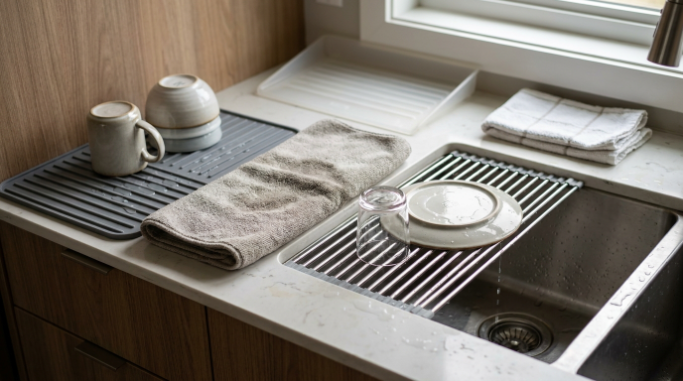
A silicone mat gives the best balance of convenience, cleaning, and storage. A roll-up sink rack is stronger for kitchens where saving counter space matters most.
| Alternative | Water Handling | Storage | Best For | Main Drawback |
|---|---|---|---|---|
| Silicone mat | Contains drips | Rolls or lies flat | Everyday small loads | Water does not absorb into the mat |
| Microfiber mat | Absorbs drips | Folds easily | Light dish loads | Needs thorough drying |
| Roll-up sink rack | Drains into sink | Rolls compactly | Tiny counters | Must fit the sink |
| Drain board | Directs water away | Usually bulky | Frequent hand washing | Needs counter space |
| Clean towel | Absorbs limited water | Excellent | Temporary use | Can remain damp |
Is a Drying Mat Better Than a Dish Rack?
A drying mat is better when easy storage and open counter space matter more than organized vertical capacity. A traditional rack remains better for large loads of plates that need stable separation.
I like mats for pots, pans, mugs, food containers, and a few plates. Those items can sit at safe angles without needing dozens of slots.
- Choose a mat if you wash small or mixed loads.
- Choose a rack if you regularly wash many dinner plates at once.
- Choose a roll-up rack if counter space is your main concern.
- Choose a hybrid setup if your dish load changes from day to day.
A permanent rack is not automatically more hygienic. Drainage, cleaning access, and thorough drying matter more than the basic format.
If cleanliness is your main concern, see my guide to choosing a more hygienic dish-drying setup.
Can I Just Dry Dishes on a Towel?
Yes, a clean towel can work as a temporary dish rack substitute. I would use it for a few cups or dishes rather than a large dripping load.
The problem is moisture. A towel absorbs water, so it needs to be changed and fully dried instead of staying wet beneath dishes all day.
- Start with a clean, dry towel.
- Leave space between dishes.
- Angle bowls so water cannot pool inside.
- Move dry items to the cabinet promptly.
- Replace the towel when it becomes wet.
The CDC’s household cleaning guidance recommends letting cleaned items air-dry thoroughly before storage or use.
What Is the Best Dish Rack Alternative for a Small Kitchen?
A roll-up over-the-sink drying rack is one of the best choices for a kitchen with almost no spare counter space. It uses the sink opening as temporary drying space.
Water can drip directly into the basin. Once the dishes are dry, many designs roll into a narrow bundle for storage.
- Measure the inside sink opening. Do not order from a product photo alone.
- Check faucet clearance. Tall dishes still need room above the rack.
- Leave part of the sink usable. You may still need access for rinsing.
- Clean the rack regularly. Soap residue and food debris can collect around joints.
If a small conventional rack still appeals to you, compare it with the options in my compact dish rack guide.
Can You Use a Dishwasher Instead of a Dish Rack?
Yes, a dishwasher can sometimes replace a countertop drying rack. You can place compatible washed items inside the machine while they finish drying.
This works best when the dishwasher is empty and the items sit securely. Do not put materials inside that the manufacturer says are unsuitable for the machine.
- Keep dishes separated instead of nesting them.
- Leave the dishwasher door positioned according to the manufacturer’s instructions.
- Do not mix newly washed clean dishes with dirty dishes.
- Use the dishwasher’s intended drying or sanitizing features only as directed.
NSF explains that dishwashers certified to NSF/ANSI Standard 184 meet specific sanitizing performance requirements when their sanitizing cycle is used.
How Do You Dry Dishes Without a Rack Safely?
Give water somewhere to drain and give wet surfaces enough room to air-dry. Avoid piling freshly washed dishes into a tight stack.
The U.S. FDA Food Code requires food-service equipment and utensils to drain and air-dry before storage. The same basic principle is practical at home.
- Shake off large drops. Let excess rinse water fall into the sink first.
- Use a clean surface. Start with a washed mat, drain board, or appropriate drying platform.
- Separate dishes. Do not nest wet bowls or press plates tightly together.
- Angle hollow items. Turn mugs and bowls so trapped water can escape.
- Let items dry. Avoid putting visibly wet dishes into a closed cabinet.
- Dry the drying surface. Wash and air-dry the mat or rack after use when needed.
CDC food-safety guidance also stresses keeping kitchen surfaces and utensils clean to reduce cross-contamination.
Which Dish Rack Alternative Should You Choose?
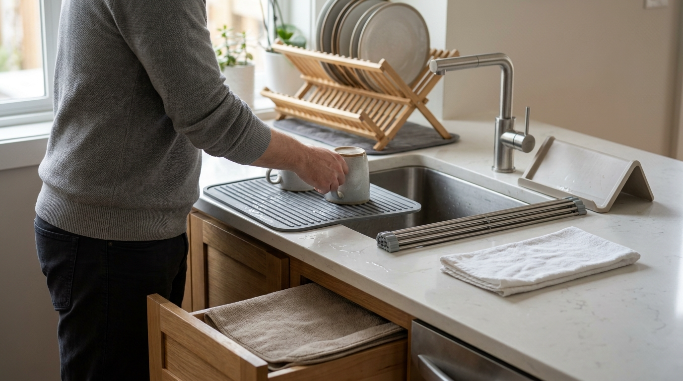
Choose the alternative that solves your biggest daily problem. You do not need the most complicated drying system.
- Want the easiest option? Use a silicone drying mat.
- Want something absorbent? Try a washable microfiber mat.
- Need your counter back? Use a roll-up over-sink rack.
- Wash large loads daily? A traditional rack may still be more practical.
- Need a temporary solution today? Use a clean towel and dry it afterward.
- Want direct drainage? Use an angled drain board or over-sink system.
I would not buy a permanent rack simply because every kitchen seems to have one. For light hand washing, a flat drying surface often does the job with less clutter.
If you’re ready to replace your bulky rack, these are the three styles I would consider first:
🏆 Best Simple Alternative
OXO Good Grips Large Silicone Drying Mat
★★★★☆ 4.8/5 Editor Rating
OXO lists this silicone mat at 16.9 × 12.5 × 0.25 inches, with raised ribs and dishwasher-safe construction. I like this format because it gives cookware and everyday dishes a washable drying surface without leaving a metal frame on the counter.
🚰 Best for Tiny Counters
Surpahs Over-the-Sink Roll-Up Drying Rack
★★★★☆ 4.7/5 Editor Rating
The large version measures about 20.5 × 13.1 inches and rolls up after use. I would choose this style when the goal is to move drying activity off the countertop and let drips fall directly into the sink.
📦 Best Foldaway Hybrid
Umbra UDry Dish Drying Rack with Mat
★★★★☆ 4.6/5 Editor Rating
Umbra lists the standard UDry at about 24 × 18 × 1.5 inches, combining a microfiber mat with a removable rack section. I like it for people who still want plate support but do not want a permanent rack sitting beside the sink.
Frequently Asked Questions
What can I use if I do not have a dish rack?
You can use a clean drying mat, silicone mat, drain board, roll-up sink rack, or clean towel. For the easiest everyday setup, I recommend a washable mat because it requires no assembly and can be stored after the dishes dry.
Is it okay to leave dishes drying on the counter?
Yes, as long as the dishes sit on a clean drying surface and have enough space for water to drain and air to circulate. Avoid placing wet dishes directly on a dirty counter or stacking them tightly while they are still damp.
Is a microfiber drying mat sanitary?
A microfiber mat can be a practical drying surface when you wash it regularly and let it dry thoroughly between uses. Do not leave a saturated mat trapped underneath dishes for long periods, and follow the manufacturer’s laundering instructions.
Can I use a silicone mat to dry dishes?
Yes. Silicone works well because it is waterproof, reusable, and easy to rinse. Ribbed models are especially useful because they lift dishes slightly above collected water, although you still need to empty or dry any water left on the mat.
What is the best dish rack alternative for an apartment?
A silicone drying mat or roll-up over-the-sink rack is usually the most practical choice. Both use little permanent space and can be stored after use, which leaves more counter room for cooking and food preparation.
Final Takeaway
A dish drying mat is the best easy alternative to a dish rack for most people. It is simple, inexpensive, easy to clean, and does not permanently occupy valuable counter space.
If counter space is extremely tight, move the drying area over the sink with a roll-up rack. Whatever you choose, prioritize drainage, airflow, easy cleaning, and a setup you will actually put away once the dishes are dry.