Are Dish Racks Outdated? What Modern Kitchens Use in 2026

Quick Answer
No, dish racks are not outdated. Bulky racks that permanently cover the counter can feel dated, but modern designs are compact, foldable, attractive, and easier to drain. If you are unsure why the tool still matters, see what a dish rack is used for.
Why Dish Racks Still Make Sense
- They save effort: Hand-washed items have a dedicated place to drain and dry.
- New designs save space: Over-sink, folding, roll-up, and compact racks reduce permanent counter clutter.
- Dishwashers have limits: Large cookware, delicate glassware, knives, and hand-wash-only items still need somewhere to dry.
- Better drainage helps: Sloped trays and sink-facing spouts prevent puddles around the washing area.
- Style has improved: Stainless steel, aluminum, low-profile frames, and hidden drying systems fit modern kitchens better.
The Better Question
- Instead of asking whether dish racks are outdated, ask which drying setup fits your counter space, washing habits, and kitchen style.
I understand why dish racks get labeled old-fashioned. A large plastic rack filled with yesterday’s dishes can make even a beautiful kitchen look cluttered.
The problem is usually the design and routine, not the idea of a drying rack. In 2026, there are far more flexible ways to dry hand-washed dishes without sacrificing half your counter.
Are Dish Racks Outdated in 2026?
No. Dish racks are still useful, but the traditional bulky version is no longer the only option. Modern kitchens increasingly favor racks that drain better, occupy less space, or disappear after use.
Dish rack definition: A dish rack is a raised organizer that holds clean, wet kitchenware apart while excess water drains and exposed surfaces air-dry.
Current kitchen-product testing still treats the dish rack as a useful everyday tool. What has changed is the emphasis on drainage, smaller footprints, cleaner lines, and easier storage.
A 2026 dish-rack test from Serious Eats, for example, evaluated modern racks on capacity and drainage rather than treating them as obsolete kitchen equipment.
What actually feels outdated?
A dish rack begins to feel dated when it behaves more like permanent countertop storage than a temporary drying station. That usually happens because of its size, appearance, or poor drainage.
- Oversized footprint: The rack covers valuable preparation space all day.
- Standing water: A flat drainboard collects puddles beneath clean dishes.
- Difficult cleaning: Tight corners and fixed parts collect residue.
- Permanent clutter: Dry dishes remain in the rack instead of returning to cabinets.
- Poor visual fit: A worn plastic rack can clash with a streamlined kitchen.
Why Do Dish Racks Still Make Sense If You Have a Dishwasher?
A dishwasher reduces the need for a large rack, but it rarely removes the need for a drying area completely. Most kitchens still have items that get washed by hand.
Think about what happens after a normal cooking session. There may be a chef’s knife, wooden board, oversized mixing bowl, delicate glass, pan lid, reusable bottle, or piece of cookware beside the sink.
- Large pots and pans that take too much dishwasher space
- Sharp knives you prefer to wash separately
- Delicate glassware and specialty kitchen tools
- Cutting boards and reusable containers
- Items marked for hand washing by the manufacturer
- A few plates or cups that are not worth running a dishwasher load for
A rack gives those wet items airflow without forcing you to spread them across a towel. It also keeps the washing zone more organized.
The FDA’s safe food handling guidance recommends washing dishes, utensils, cutting boards, and countertops with hot, soapy water after food preparation.
What Has Replaced the Traditional Bulky Dish Rack?
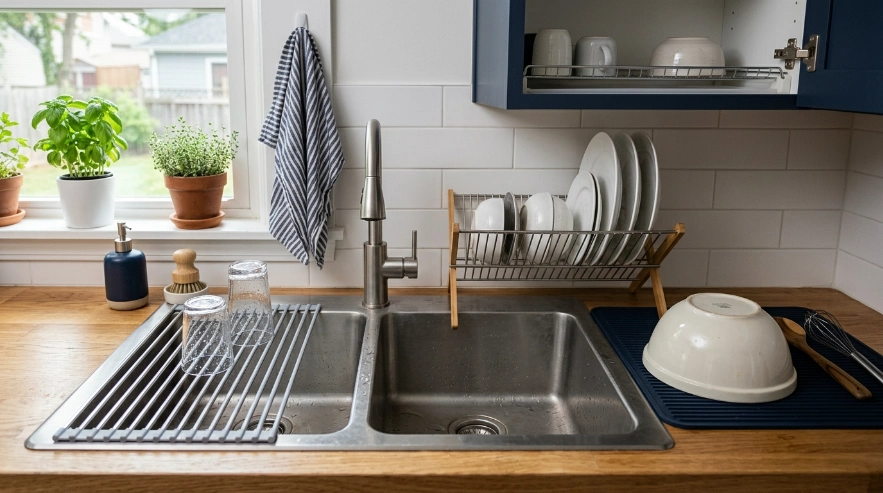
Nothing has completely replaced dish racks. Instead, several newer drying formats now solve the same problem in different ways.
This is where modern kitchen design becomes useful. You can choose a drying system based on how often you hand wash and how much counter space you can spare.
1. Over-the-sink dish racks
These racks move the drying zone from the countertop to the sink. Water falls directly into the basin, which reduces the need for a separate drainboard.
I like this approach for narrow kitchens because the rack uses space that already belongs to washing. The downside is that it can reduce access to the sink while dishes are drying.
2. Foldable dish racks
Foldable models work like regular racks during cleanup but collapse when you are finished. They are useful if you want an open counter between meals.
- Good for apartments and small kitchens
- Easier to store inside a cabinet
- Useful for households that do not hand wash large loads daily
3. Silicone and absorbent drying mats
A drying mat offers the cleanest visual appearance because it can be stored after use. It also accommodates awkward pots and large bowls without fixed plate slots.
However, plates cannot stand vertically unless you add another holder. Large loads can therefore consume more horizontal space.
4. Roll-up sink racks
A roll-up rack stretches across part of the sink and rolls into a small bundle afterward. Many people also use this format for rinsed produce or as temporary prep space.
It works best for smaller loads. A household washing several dinner settings may want more dedicated capacity.
5. Built-in drying cabinets
A drying cabinet hides wet dishes above or near the sink while allowing drainage and airflow. It offers one of the cleanest visual solutions if you are remodeling.
Installation and cabinet-space requirements make it less practical as a simple upgrade. Renters will usually find an over-sink or folding rack easier.
Dish Rack vs. Drying Mat vs. Over-Sink Rack: Which Is Better?
The best system depends on dish volume and available space. A regular rack favors capacity, while mats and over-sink systems favor flexibility.
| Drying Option | Counter Impact | Drainage | Best For |
|---|---|---|---|
| Countertop dish rack | Medium to high | Tray or sink-facing spout | Daily hand-washing |
| Drying mat | Temporary | Absorbs or holds water | Occasional or oversized items |
| Over-sink rack | Very low | Directly into sink | Small counters |
| Roll-up rack | Very low after storage | Directly into sink | Light loads and flexible use |
For a small apartment, I would usually start with an over-sink or foldable design. For a family that hand washes several times daily, a full countertop rack remains easier to live with.
Real examples show how modern racks have changed
| Current Design | Verified Design Detail | Why It Feels Modern |
|---|---|---|
| OXO Good Grips Over-the-Sink Aluminum Dish Rack | 5.9 × 14.9 × 11.6 inches; extendable sink arms | Moves drying off the counter |
| KitchenAid Expandable Dish-Drying Rack | Expandable design with angled drainage | Capacity adjusts to the load |
| simplehuman Steel Frame Dishrack | Swivel drain spout and dedicated glass storage | Combines countertop styling with controlled drainage |
When Does a Dish Rack Make a Kitchen Look Outdated?
A rack looks outdated when it adds more visual clutter than useful function. The age of the rack matters less than how it fits the surrounding kitchen.
A clean stainless steel rack can look natural in a modern room. A stained rack overflowing with dry dishes can make the same room feel neglected.
- Remove dry dishes: Treat the rack as a drying station rather than permanent storage.
- Control the footprint: Do not buy a family-size rack for two cups and two plates.
- Match the finish: Neutral metal, black, white, and simple frames disappear visually more easily.
- Hide it when possible: Foldable and roll-up options let you reclaim the counter.
- Keep the drainboard clean: Mineral marks and residue make any rack look older.
How Do You Choose a Dish Rack That Doesn’t Look Outdated?
Start with your available space, then choose capacity and drainage. Appearance should come after those practical decisions.
When I plan a sink-side drying area, I start with the largest item that gets hand washed regularly. That simple check prevents buying a beautiful rack that cannot safely hold the cookware you actually use.
- Measure beside and above your sink. Include faucet clearance and cabinet doors.
- Estimate a normal dish load. Do not size the rack around your biggest holiday cleanup.
- Prioritize drainage. Look for a sloped tray, removable board, or sink-facing spout.
- Check cleaning access. Removable utensil cups and trays make maintenance easier.
- Choose storage flexibility. Consider folding or roll-up designs if counters must stay open.
- Check stability. Wet plates and cookware should not make the rack tip or flex.
Is Air-Drying Dishes Still a Good Idea?
Yes. Air-drying remains a practical way to let clean items finish drying without using a reusable towel on every surface. The important part is starting with properly washed items and a clean drying area.
The USDA’s kitchen-sink guidance also emphasizes cleaning, sanitizing where appropriate, and allowing cleaned surfaces to air-dry.
Keep the rack itself clean
A drying rack spends much of its life around moisture. That makes routine cleaning just as important as good drainage.
- Empty standing water from trays.
- Wash removable parts with appropriate soap and water.
- Clean corners, feet, joints, and utensil cups.
- Rinse away residue thoroughly.
- Let the rack dry when it is not being used.
- Follow the manufacturer’s cleaning instructions for coated metal or specialty materials.
Can You Skip a Dish Rack Completely?
Yes, if your washing routine is small enough. A household that uses a dishwasher heavily may need only a drying mat or roll-up rack for occasional hand-washed pieces.
A 2026 Good Housekeeping discussion of dish-rack alternatives highlighted foldable silicone drying mats as one way to reduce permanent sink-side clutter.
You may not need a full rack if:
- You run the dishwasher for most dishes.
- You hand wash only a few items at once.
- Your countertop is extremely limited.
- You put dry items away immediately.
- A washable drying mat handles your normal workload.
On the other hand, spreading eight wet plates and several cups across a towel can use more counter space than a vertical rack. Removing the rack only helps when the replacement fits your routine better.
Modern Dish Racks Worth Considering
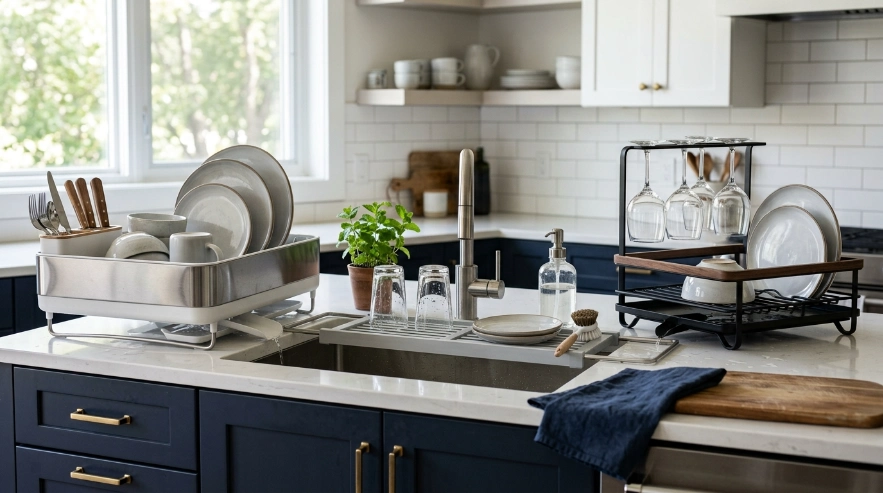
If you have decided a rack still fits your routine, I would focus on designs that solve a specific problem. These three represent different approaches rather than three versions of the same bulky rack.
🏆 Best Overall
KitchenAid Large Capacity Dish Rack
★★★★★ My rating: 4.8/5
A large-capacity format with an angled drainboard and dedicated flatware storage. I like this style for households that hand wash full dinner loads and need useful capacity more than hidden storage.
🏠 Best for Small Counters
OXO Good Grips Over-the-Sink Aluminum Dish Rack
★★★★★ My rating: 4.7/5
The aluminum frame uses extendable arms and drains directly into the sink. I would choose this format when preserving counter space is the main goal.
✨ Best Premium
simplehuman Steel Frame Dishrack
★★★★★ My rating: 4.7/5
A steel-frame rack with a swivel drain spout and dedicated glassware storage. I prefer this approach when the rack will stay visible and appearance matters almost as much as drainage.
Frequently Asked Questions
Are dish drying racks old-fashioned?
Dish drying racks are not inherently old-fashioned. Large permanent plastic racks may look dated in some kitchens, but compact steel, aluminum, foldable, over-sink, and hidden drying designs give the same function a much more modern appearance.
Do people still use dish racks if they have dishwashers?
Yes. A rack remains useful for knives, cookware, cutting boards, reusable containers, delicate items, and anything washed between dishwasher cycles. People who hand wash only occasionally may prefer a smaller rack or drying mat.
What is the most modern alternative to a dish rack?
For small kitchens, an over-the-sink or roll-up rack is one of the most space-efficient alternatives. A silicone drying mat works well when you want the drying area to disappear completely after the dishes are put away.
Is a drying mat better than a dish rack?
A mat is better for storage flexibility and awkward cookware, while a rack is better for keeping plates upright and handling larger mixed loads. Many kitchens benefit from a small rack plus a mat for oversized pieces.
Should you leave dishes in the drying rack permanently?
You can keep frequently used dishes there, but putting dry items away keeps the counter clearer. It also frees the rack for the next washing session and makes routine cleaning easier.
Final Takeaway
Dish racks are not outdated; oversized and poorly designed dish racks are. The basic need to drain and air-dry hand-washed kitchenware still exists.
Choose the smallest drying system that comfortably handles your normal load. Good drainage, easy cleaning, and a design that fits your space matter more than whether the solution is called a rack, mat, or sink bridge.
If your current rack annoys you every time you enter the kitchen, you probably do not need to abandon dish racks completely. You may simply need a better format.