
What are the standard dimensions of a dish rack?

Quick Answer
There is no universal standard size for a dish rack. However, a typical full-size countertop rack is roughly 19–20 inches long, 14–16 inches deep, and about 5–8 inches high. Real models vary, so checking the manufacturer’s dimensions, such as the OXO Foldaway Dish Rack specifications, is the safest way to confirm fit.
Useful Dish Rack Size Guidelines
- Typical full size: Plan for roughly 19–20 inches of counter length and 14–16 inches of depth.
- Compact racks: Choose a shallower or folding design when counter space is limited.
- Large racks: Premium high-capacity models can exceed 20 inches in depth.
- Height matters: Measure beneath cabinets if the rack has tall plate slots or glass holders.
- Allow drainage: Leave enough room for the drainboard or spout to reach the sink.
Before You Buy
- Measure the exact counter area, sink edge, backsplash clearance, and cabinet height instead of relying on a size label alone.
A dish rack looks like a simple kitchen accessory until you bring home one that’s several inches too large. Those few inches can block prep space, hang over the counter, or leave the drain spout nowhere near the sink.
I find it more useful to treat dish rack dimensions as a planning range rather than a fixed standard. Below, I’ll show you common sizes, real product examples, and a simple way to measure your kitchen before buying.
What Are the Standard Dimensions of a Dish Rack?

Most conventional full-size countertop dish racks need roughly 19–20 inches of horizontal space and about 14–16 inches from front to back. Height commonly stays under eight inches for simple single-level designs.
Those numbers are a practical range, not an official manufacturing standard. As of 2026, current products from major brands still vary noticeably in every dimension.
| Dish Rack | Published Dimensions | Best Size Category |
|---|---|---|
| OXO Good Grips Foldaway Dish Rack | 19.4 × 15.5 × 5.125 in. open | Medium/full-size |
| KitchenAid Full-Size Dish-Drying Rack | 19.6 × 14.9 × 6.9 in. | Full-size |
| simplehuman Standard Steel Frame Dish Rack | 20 × 22.3 × 11.5 in. | Large/high-capacity |
The comparison shows why the word “standard” can mislead shoppers. Two full-size racks can differ by seven inches or more in depth.
Is There Actually a Standard Dish Rack Size?
No formal universal dimension applies to household dish racks. Manufacturers design them around capacity, drainage systems, storage features, and different kitchen layouts.
A dish rack is a freestanding, sink-mounted, or over-sink structure designed to hold washed dishes apart so water can drain and air can circulate around them.
A “full-size” label therefore describes the product category more than an exact measurement. One brand may prioritize a small footprint, while another adds glass holders, a knife block, or a wide drain tray.
- Single-level racks usually stay lower and spread dishes horizontally.
- Two-tier racks use vertical space to increase capacity.
- Expandable racks change footprint when opened.
- Foldaway racks become shallower or flatter for storage.
- Over-sink racks depend more heavily on sink width and faucet clearance.
That’s why I wouldn’t buy a rack from the words “standard,” “large,” or “compact” alone. The actual length, depth, and height matter more.
How Much Counter Space Should You Allow for a Dish Rack?
Allow enough space for the rack itself plus its drainage components. A rack that technically fits can still be awkward if its drainboard hangs over the counter edge.
Standard kitchen countertops are commonly around 25 inches deep. That makes a 14–16-inch-deep rack manageable in many kitchens while preserving some usable surface in front or behind it.
Measure the footprint first
Measure the clear counter section beside your sink from left to right. Then measure from the backsplash or wall toward the front edge.
- Measure the available counter length beside the sink.
- Measure usable counter depth without counting unusable backsplash space.
- Measure from the countertop to any wall cabinet above it.
- Check the distance between the rack location and the sink basin.
- Confirm that doors, drawers, faucets, and appliances can still move freely.
I like to leave a little margin instead of choosing a rack that consumes every measured inch. Even one or two spare inches can make wiping the counter and repositioning the rack easier.
Don’t forget the drainboard
Drainboards and spouts sometimes extend beyond the main wire frame. Check whether the listed manufacturer dimensions include every detachable accessory.
Rotating spouts give you more positioning flexibility. Fixed drainboards may require the rack to sit in one specific direction.
What Size Dish Rack Fits a Small Kitchen?
For a small kitchen, prioritize footprint and storage flexibility instead of maximum dish capacity. A compact, foldable, roll-up, or over-sink design can preserve valuable prep space.
A rack around 12–16 inches deep is easier to work around than a large model extending beyond 20 inches. The best choice still depends on your sink and counter.
- One-person household: A compact rack usually handles plates, bowls, mugs, and utensils from one meal.
- Small apartment: Look for foldaway or roll-up designs that disappear after dishes dry.
- Narrow counter: Consider a rack that runs lengthwise beside the sink.
- Minimal counter space: An over-sink rack can move the drying zone off the worktop.
- Low cabinets: Avoid tall two-tier racks unless you’ve measured vertical clearance.
The Food Network’s tested dish-rack roundup also separates recommendations by kitchen needs, including smaller households. That approach makes more sense than assuming one size works everywhere.
How Big Should a Dish Rack Be for a Family?
A family that hand-washes several place settings needs more usable drying area than a person washing one plate and mug. Capacity becomes as important as the outside measurements.
For regular family loads, I would start around the common full-size footprint of roughly 20 by 15 inches. Larger cookware may justify an expandable or deeper model.
Think about what you wash
Plate slots consume little horizontal area, but pots and mixing bowls need open space. Wine glasses and water bottles may also require dedicated holders.
- Mainly dinnerware: Prioritize plate slots and a large utensil caddy.
- Pots and pans: Look for folding dividers or a wide open section.
- Lots of glasses: Check cup rails and stemware-holder clearance.
- Baby items: Look for flexible spacing for bottles and smaller pieces.
- Heavy cookware: Choose a stable rack with a broad base and strong frame.
A bigger rack isn’t automatically better. An oversized rack can turn a useful worktop into permanent drying space.
Should You Measure the Sink Before Buying a Dish Rack?
Yes, especially when the rack drains directly into the sink or sits across it. Sink width, rim thickness, faucet placement, and basin depth can all affect compatibility.
This matters even for countertop racks because the drainage outlet must reach the basin. A short fixed spout may not work when the rack sits several inches from the sink edge.
For over-the-sink racks
Measure the inside and outside sink dimensions before shopping. Also measure from the countertop to the tallest part of the faucet.
- Sink width from outside edge to outside edge
- Usable opening between faucet and backsplash
- Faucet height above the sink
- Distance from faucet center to the nearest wall
- Any window ledge or cabinet that limits height
Expandable over-sink racks should list a minimum and maximum supported width. Your measurement needs to fall safely inside that range.
Dish Rack Dimensions by Type
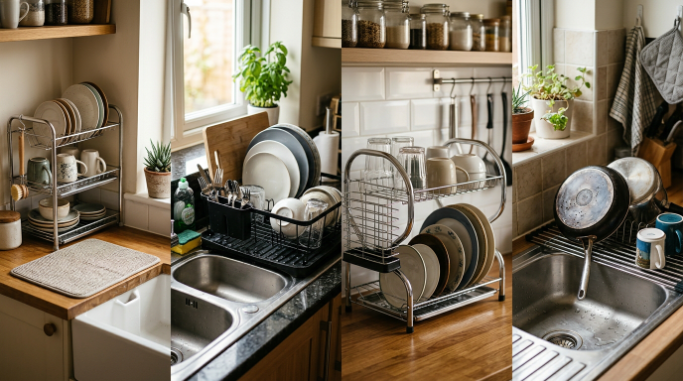
Different rack styles solve different space problems. These ranges work best as shopping guidelines rather than exact manufacturing standards.
| Rack Type | Typical Space Need | Best For |
|---|---|---|
| Compact countertop | Smaller than a conventional 20 × 15 in. footprint | One or two people |
| Full-size countertop | About 19–20 × 14–16 in. for many conventional models | Everyday household loads |
| Large/high-capacity | Can exceed 20 in. in one or more directions | Families and cookware |
| Two-tier | Moderate footprint with extra height | Limited counter width |
| Over-sink | Sized around sink span | Very limited counter space |
Which Dish Rack Size Is Best for Your Kitchen?
The best size leaves enough room for your normal washing load without taking over the kitchen. Start with your available space, then work backward to capacity and features.
If two racks meet your needs, I usually favor the smaller footprint. Counter space is useful all day, while a dish rack may only be full after meals.
- Choose compact when you use a dishwasher for most items or wash small loads.
- Choose full-size when you regularly hand-wash a normal meal’s dishes.
- Choose expandable when your load changes from day to day.
- Choose two-tier when vertical space is easier to spare than counter width.
- Choose large when you frequently wash pans, serving dishes, or several place settings.
Before ordering, mark the rack dimensions on your counter with painter’s tape. That quick mock-up makes an oversized footprint obvious before it becomes a return.
Common Dish Rack Measuring Mistakes
Most fit problems happen because shoppers measure only the wire basket. The complete drying system may need more room.
- Ignoring accessories: Cup holders and utensil caddies often extend beyond the main rack.
- Forgetting the spout: A drainage outlet must reach the sink without creating a puddle.
- Skipping height: Tall plates can extend well above the rack itself.
- Measuring an empty counter: Coffee makers, soap bottles, and cutting boards also need space.
- Trusting size labels: “Compact” and “full-size” aren’t fixed measurements.
Measure twice and use the manufacturer’s outside dimensions. That’s far more reliable than estimating from a product photo.
Dish Racks I’d Consider by Size
If you’re ready to pick one, these three models represent useful size categories. I would still measure your counter before ordering any of them.
🏆 Best Everyday Size
KitchenAid Full-Size Dish Rack
★★★★★
At about 19.6 × 14.9 × 6.9 inches, its footprint is close to what I use as a practical full-size benchmark. It’s a sensible starting point for everyday plates, bowls, cups, and flatware.
📦 Best Foldaway Option
OXO Good Grips Foldaway Dish Rack
★★★★☆
It measures about 19.4 × 15.5 × 5.125 inches when open and becomes shallower when closed. I like this format for kitchens where the rack needs to be stored between uses.
🍽️ Best for Large Loads
simplehuman Steel Frame Dish Rack
★★★★☆
The standard model is roughly 20 × 22.3 × 11.5 inches, so it demands substantially more counter depth. I’d consider it when drying capacity matters more than preserving a compact workspace.
Frequently Asked Questions
What is the average size of a dish drying rack?
A conventional full-size countertop rack is often around 19–20 inches long and 14–16 inches deep. Height varies more because plate slots, utensil holders, glass racks, and multi-level designs change the overall profile.
How wide should a dish rack be?
There is no required width. Choose a rack that fits your measured counter space while leaving room for drainage and nearby kitchen tasks, rather than selecting one according to a “standard” width label.
Will a 20-inch dish rack fit on a normal kitchen counter?
Usually, but placement matters. Many standard countertops are around 25 inches deep, yet a 20-inch measurement may describe the rack’s length rather than its front-to-back depth, so always check the dimension order.
What size dish rack is best for two people?
A compact or medium countertop rack is usually enough for two people who wash dishes after each meal. If you regularly hand-wash pots, pans, cutting boards, or several meals at once, a conventional full-size rack may be more comfortable.
Should a dish rack be bigger than the sink?
A countertop rack doesn’t need to match the sink dimensions. An over-sink rack does require careful sink measurements because its supports must span the basin securely without interfering with the faucet.
Final Takeaway
There is no single standard dish rack dimension, but roughly 19–20 inches by 14–16 inches is a useful planning range for many conventional full-size countertop models. Compact and high-capacity racks can differ significantly.
Measure your counter, vertical clearance, and drainage path before buying. A rack that fits your kitchen well will usually serve you better than the biggest rack you can squeeze beside the sink.