
When to Replace a Dish Rack? 7 Signs It’s Time for a New One

Quick Answer
Replace a dish rack when it has spreading rust, broken or sharp parts, peeling coating, poor drainage, serious warping, or mold and odors that return after proper cleaning. There is no fixed replacement date, so I judge the rack by its condition and whether it can still hold dishes safely and dry them well. Good kitchen safety habits also include keeping equipment clean and in usable condition.
Replace your dish rack if you notice:
- Spreading rust: Large or growing rusty areas mean the protective surface is failing.
- Sharp metal: Broken wires or exposed edges can scratch dishes or cut your hands.
- Peeling coating: Flaking vinyl or plastic exposes the metal underneath to water.
- Recurring mold: Growth that quickly returns after thorough cleaning is a warning sign.
- Poor drainage: A warped tray that holds standing water makes drying slower and cleaning harder.
- Unstable frame: Bent supports or loose joints can let plates and glasses tip over.
My quick test
- Clean the rack fully, let it dry, and inspect every joint, wire, foot, tray, and utensil holder before deciding.
I used to judge a dish rack mostly by appearance. If it looked a little old but still held plates, I kept using it.
That approach misses the important signs. I now check drainage, stability, rust, coating damage, and whether I can still clean every part properly.
- Small cosmetic marks: Usually not a reason to replace the rack.
- Damage that affects drying: Worth watching closely.
- Damage that affects safety or cleaning: Usually means replacement makes more sense.
How Do You Know When to Replace a Dish Rack?
You should replace a dish rack when cleaning and minor maintenance can no longer restore safe, stable, well-draining use. Age alone does not tell you enough.
I use a simple rule: if the problem is only dirt, I clean it. If the rack itself is deteriorating, I start thinking about replacement.
| What You See | Clean or Repair? | Replace? |
|---|---|---|
| Soap film or mineral spots | Yes | Usually no |
| One small surface-rust spot | Often possible | Not automatically |
| Rust spreading across several wires | Temporary at best | Usually yes |
| Peeling protective coating | Minor spot may be repairable | Yes if widespread |
| Cracked plastic or broken wire | Rarely worth patching | Yes if sharp or unstable |
| Warped drainboard holding water | Replace tray if separate | Yes if tray cannot be replaced |
| Mold returns after thorough cleaning | Try one deep clean | Often sensible |
Dish rack replacement means retiring the rack when physical deterioration prevents reliable cleaning, drainage, stability, or safe everyday use.
Is Rust on a Dish Rack a Sign You Should Replace It?
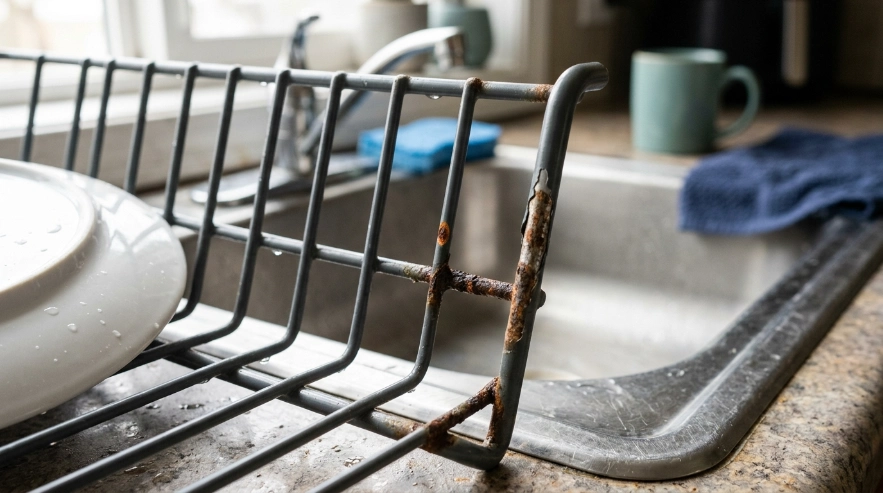
A tiny surface-rust spot does not always mean the entire rack is finished. Spreading rust, deep corrosion, and rust beneath peeling coating are much stronger replacement signals.
Metal racks often depend on stainless steel, rust-resistant finishes, vinyl coatings, or plastic coverings to protect the structure from constant moisture.
- Watch: One small orange spot with solid metal underneath.
- Repair carefully: A tiny damaged coating area if the manufacturer provides an appropriate repair method.
- Replace: Several rusted wires, pitting, weakened joints, or flakes coming away from the frame.
I treat rust differently from a simple water stain. A stain sits on the surface, while corrosion means the material itself has started changing.
The same moisture-control lesson applies to other kitchen equipment. My guide to cleaning and maintaining cast iron explains why keeping metal dry matters so much.
What if the coating is peeling off?
Peeling coating matters because water can reach the underlying metal. Once moisture gets underneath, corrosion can spread beyond the first visible spot.
- Look along plate dividers.
- Check corners and welded joints.
- Inspect utensil holders.
- Look underneath the frame.
- Check places where plates repeatedly rub the rack.
If several areas are peeling, I would replace the rack rather than chase one repair after another.
Should You Replace a Dish Rack With Mold or a Bad Smell?
Not immediately. A dirty dish rack can often be cleaned, but growth or odor that returns quickly after proper cleaning may justify replacement.
Dish racks stay wet by design. Food residue, soap film, trapped water, and poor airflow can make neglected corners harder to keep fresh.
- Remove all dishes and utensils.
- Separate removable trays and holders.
- Wash accessible surfaces with warm water and dish soap.
- Clean grooves, joints, feet, and drain openings.
- Rinse as appropriate for the material.
- Let every part air-dry thoroughly before reassembly.
USDA food-safety guidance recommends cleaning kitchen utensils and surfaces before sanitizing when extra sanitation is needed. See the USDA food-safety guidance on cleaning and sanitizing.
CDC guidance also stresses keeping kitchen surfaces and utensils clean to reduce the spread of germs. You can review the broader CDC food-safety prevention guidance.
- Keep the rack: Odor disappears after cleaning and drying.
- Watch it: Mold appeared because water sat in a removable tray.
- Replace it: Growth returns from cracks, damaged joints, or inaccessible spaces.
Why air-drying matters
A dish rack needs airflow to do its main job. Water that stays trapped under dishes or inside the drainboard works against that purpose.
The FDA Food Code applies to retail and food-service settings rather than ordinary home kitchens, but it provides useful context by specifying air-drying or adequate draining after cleaning and sanitizing. See the FDA Food Code.
Can You Repair a Dish Rack Instead of Replacing It?
Sometimes. A removable tray, utensil cup, foot, or minor finish problem may be cheaper and less wasteful to repair.
I avoid repairs when they create a new safety problem. Tape, exposed adhesive, rough wire, and makeshift supports do not belong where clean dishes repeatedly sit.
- Good repair candidate: Replaceable drain tray.
- Good repair candidate: Manufacturer-supplied foot or accessory.
- Possible repair: Small isolated coating damage with an approved repair product.
- Poor repair candidate: Cracked load-bearing frame.
- Poor repair candidate: Multiple rusted joints.
- Poor repair candidate: Broken wire with a sharp end.
When I compare repair with replacement, I also think about cleaning. A repair that creates another seam or water trap can become frustrating later.
This is similar to checking whether cookware belongs in a dishwasher. Material and manufacturer guidance matter, as explained in my guide on whether a frying pan can go in the dishwasher.
How Often Should a Dish Rack Be Replaced?
There is no reliable one-size-fits-all number of months or years. Usage, material, water exposure, cleaning habits, construction, and drainage all affect service life.
I prefer a condition check instead of putting a replacement date on the calendar.
- Monthly: Look underneath the rack and inspect the drainage tray.
- During cleaning: Check for cracks, loose feet, peeling coating, and rust.
- After a dropped dish: Check whether dividers or supports were bent.
- When drainage slows: Check for warping, buildup, and blocked drain channels.
As of 2026, modern dish racks come in coated steel, stainless steel, aluminum, plastic, silicone, and mixed-material designs. Each fails in a different way.
| Rack Material | What I Watch Most |
|---|---|
| Coated steel | Chipped coating, rust, exposed wire |
| Stainless steel | Corrosion, loose welds, sharp bends |
| Aluminum | Bent frame, damaged joints, drainage problems |
| Plastic | Cracks, warping, rough surfaces, trapped residue |
| Bamboo or wood | Splits, warping, persistent dark growth, loose joints |
What Should You Look for in a Replacement Dish Rack?
I put easy drainage and easy cleaning ahead of looks. A beautiful rack becomes annoying fast when its tray constantly holds dirty water.
- Direct drainage: Water should move toward the sink instead of pooling.
- Open airflow: Plates and bowls need enough space to dry.
- Stable feet: The rack should not slide when loaded.
- Accessible parts: Trays and utensil holders should be easy to clean.
- Suitable material: Pick a finish designed for repeated water exposure.
- Correct size: Leave some counter space around the rack.
NSF notes that properly designed dishwasher sanitizing cycles can sanitize suitable dishes and cookware. Its dishwasher certification guide is useful if you also use a dishwasher for compatible kitchen items.
If you plan to put removable rack parts in a dishwasher, confirm the manufacturer allows it first. The same principle appears in this dishwasher-safe cookware guide.
Dish Racks I’d Consider When It’s Time to Replace One
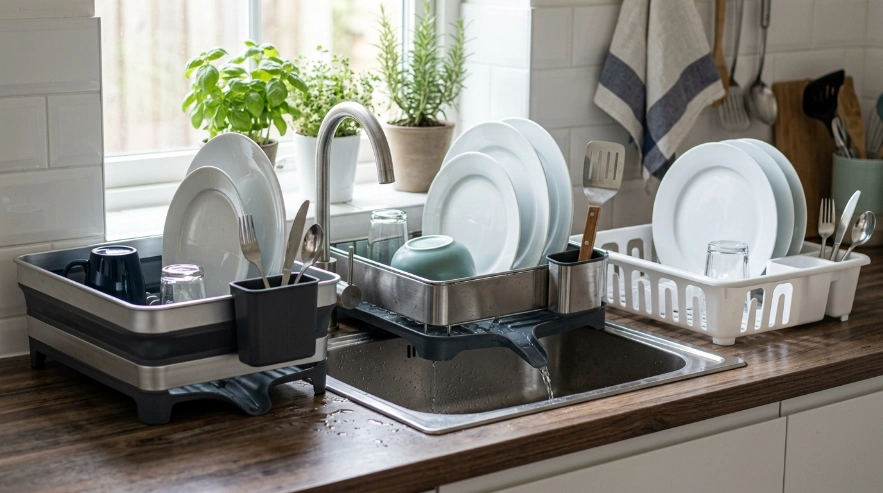
If your old rack has reached the end of its useful life, I would choose a replacement based on drainage, material, capacity, and how easy it is to clean.
🏆 Best for Flexible Counter Space
OXO Good Grips Aluminum Fold Flat Dish Rack
★★★★½
OXO uses a rustproof aluminum frame, removable utensil cup, raised draining ridges, and a design that folds flat. I like this style for kitchens where the rack needs to disappear between larger washing sessions.
💧 Best for Direct Drainage
Simplehuman Steel Frame Dishrack
★★★★½
The Steel Frame Dishrack uses a swivel spout to send water toward the sink and has a removable utensil caddy. I would consider it when standing water around the old rack has been the main frustration.
💰 Best Simple Plastic Option
Rubbermaid Antimicrobial Dish Drainer
★★★★☆
Rubbermaid makes this plastic rack with large drainage holes, an attached utensil section, and built-in antimicrobial protection for the product surface. I like the rust-free plastic approach for someone who wants a straightforward rack with few metal parts.
Frequently Asked Questions
How long should a dish rack last?
There is no universal lifespan for a dish rack. Material, moisture exposure, load, cleaning, drainage, and construction all matter, so replace it based on condition rather than an arbitrary date.
Should I throw away a rusty dish rack?
Not for one tiny cosmetic spot, but spreading rust deserves attention. Replace the rack if rust has weakened wires, spread under damaged coating, created rough surfaces, or affected several structural areas.
Can mold on a dish rack make it unusable?
Visible growth does not automatically mean the rack must be discarded because many racks can be thoroughly cleaned. Replacement is more sensible when mold repeatedly returns from cracks, porous damaged areas, inaccessible joints, or other surfaces you cannot clean properly.
Is a plastic dish rack better than a metal one?
Neither material is automatically better. Plastic avoids traditional metal rust, while quality metal racks can provide excellent strength; I compare drainage, cleaning access, stability, construction, and the manufacturer’s care instructions instead.
Should I replace a dish rack if the drain tray is warped?
Replace the tray if it is removable and a compatible replacement exists. If the warped tray is permanent and continually holds standing water, replacing the complete rack may be the easier long-term solution.
Final Takeaway
When deciding when to replace a dish rack, I look beyond age. Rust, sharp damage, peeling coating, instability, poor drainage, and contamination that keeps returning matter much more.
If the rack cleans up well, drains freely, stays stable, and has no structural damage, keep using it. Once those basics fail, a new rack is usually the more practical choice.
