
Does a Vegetable Chopper Save Time? A Practical Guide

Quick Answer
Yes, a vegetable chopper can save time when you need to dice several vegetables or prepare a large batch. The biggest savings come from repetitive cuts, while a knife may still be quicker for one small ingredient. I also use the same idea behind these practical meal-prep shortcuts: judge the whole job, including setup and cleanup.
When a chopper saves the most time
- Batch chopping: Several onions, peppers, potatoes, or similar vegetables can be processed with repeated presses.
- Uniform dicing: Grid-style blades create similar-sized pieces without repeated knife cuts.
- Meal prep: A catch container keeps chopped ingredients together and reduces transfer time.
- Limited knife skills: Beginners may work faster because they don’t need to make every dice individually.
- Repeat recipes: Soups, salsa, stir-fries, salads, and meal-prep bowls often need many similar cuts.
When it may not save time
- Small jobs: Cutting half an onion or one carrot may be faster with a knife because there is less equipment to wash.
If you’re wondering, “does a vegetable chopper save time?” the useful answer isn’t simply yes or no. It depends on the vegetable, the amount, your knife skills, and how easy the chopper is to clean.
I think about total kitchen time rather than chopping speed alone. A gadget that chops in seconds but takes five awkward minutes to scrub may not be saving much.
What Is a Vegetable Chopper?
A vegetable chopper is a kitchen tool that cuts vegetables using fixed or moving blades. Manual versions usually use a pressing lid, pull cord, push mechanism, or rotating blade.
Grid-style models are especially useful for making repeated cubes or slices. Many also include a container underneath to catch the food.
- Grid choppers: Push vegetables through a fixed blade grid.
- Push choppers: Press a top button to move or rotate internal blades.
- Pull-cord choppers: Pull a cord to rotate blades inside a bowl.
- Electric mini choppers: Use a motor to chop ingredients with short pulses.
This guide focuses mainly on manual vegetable choppers because they’re commonly used for onions, peppers, carrots, zucchini, potatoes, and salad ingredients.
Does a Vegetable Chopper Actually Save Time?

For repeated chopping, it often does. The advantage becomes clearer when you’re preparing several vegetables that need similar cuts.
A chef’s knife handles nearly every shape, but each piece requires controlled movement. A grid chopper can complete many individual cuts with one press.
| Prep Task | Chef’s Knife | Manual Chopper | Usually Faster |
|---|---|---|---|
| Half an onion | Few cuts, little cleanup | Setup plus washing | Knife |
| 2 onions + 2 peppers | Many repeated cuts | Repeated press-and-empty cycles | Chopper for many cooks |
| One garlic clove | Quick smash and mince | Too much equipment | Knife |
| Meal-prep vegetables | Flexible but repetitive | Fast repeated uniform cuts | Chopper |
| Fresh herbs | Good texture control | May bruise or over-process | Knife |
The biggest lesson is simple: volume changes the answer. The more repetitive cutting you need, the easier it becomes for a chopper to earn its cleanup time.
When Does a Vegetable Chopper Save the Most Time?
A chopper saves the most time when a recipe needs several cups of similarly cut vegetables. That’s why I see the biggest practical benefit during batch cooking.
Recipes that work especially well include:
- Fresh salsa with onions and peppers
- Vegetable soup or stew
- Stir-fry mixtures
- Chopped salads
- Potato or breakfast hashes
- Vegetable curry
- Weekly meal-prep bowls
For example, an easy vegetable curry may need several vegetables cut to similar sizes. That’s exactly where a grid-style chopper feels useful.
Uniform pieces also help ingredients cook at similar rates. My guide to cooking food evenly explains why consistent size matters once those vegetables hit the pan.
When Is a Knife Faster Than a Vegetable Chopper?
A knife usually wins for tiny jobs. If I only need a tomato sliced or a small amount of onion, taking apart another tool makes little sense.
A sharp knife also offers much better control over unusual shapes and delicate ingredients.
- One small ingredient: There isn’t enough repetitive cutting to justify setup.
- Precise slices: A knife lets you adjust thickness with every cut.
- Soft tomatoes: Some chopper grids can crush very ripe tomatoes instead of cutting cleanly.
- Fresh herbs: Hand chopping gives you more control over texture.
- Irregular pieces: Rustic soups and roasted vegetables don’t always need perfect cubes.
A chopper should complement basic knife skills rather than replace them. I still consider a chef’s knife the more flexible tool.
What Kind of Vegetable Chopper Saves the Most Time?
The best design depends on the job. A grid-style chopper tends to be fastest for repetitive cubes, while a rotating chopper handles smaller mixed ingredients better.
Before buying one, I would focus on these features:
- Sharp stainless-steel blades: Cleaner cuts need less force.
- Catch container: Chopped food drops directly into storage space.
- Non-slip base: Stability makes repetitive pressing easier.
- Useful blade sizes: Choose attachments you’ll use often.
- Simple cleaning: Fewer awkward crevices protect the time you saved.
- Dishwasher-safe parts: Helpful when the manufacturer allows dishwasher cleaning.
More attachments aren’t automatically better. Ten blades stored in a cabinet don’t save time if you regularly use only one.
Does Cleanup Cancel Out the Time Savings?
Sometimes it does. Cleanup is the most overlooked part of the vegetable-chopper equation.
A knife and cutting board have large, simple surfaces. Chopper grids may trap onion, pepper skin, carrot fragments, or potato pieces between narrow blades.
- Rinse the blade soon after use before food dries.
- Use the supplied cleaning tool instead of pushing food out with your fingers.
- Check the manufacturer’s dishwasher instructions.
- Let blade inserts dry completely before storage.
- Keep fingers away from exposed cutting edges.
For general kitchen hygiene, FDA food-safety guidance recommends cleaning food-preparation tools and surfaces after use.
FoodSafety.gov’s four food-safety steps also emphasize cleaning and keeping foods separated during preparation.
Can a Vegetable Chopper Help With Meal Prep?
Yes. Meal prep is one of the strongest reasons to own one because you’re already working with larger quantities.
Instead of chopping one portion of onion today and another tomorrow, you can prepare several recipe components in one session.
- Wash and dry your vegetables.
- Trim oversized vegetables into pieces that fit the chopper.
- Process similar vegetables together.
- Empty the catch container before it becomes packed.
- Store prepared vegetables appropriately for your planned recipes.
- Wash the chopper immediately after finishing.
I also like pairing efficient chopping with a written weekly plan. USDA MyPlate’s vegetable guidance is a useful reference when you want more variety in those meals.
Does a Vegetable Chopper Make Cooking Easier for Beginners?
It can make repetitive prep less intimidating, especially when perfect knife technique is still developing. The fixed grid creates predictable cuts without requiring rapid knife movement.
That doesn’t mean the blades are harmless. Chopper inserts can be extremely sharp, so safe handling still matters.
- Keep hands away from the cutting grid.
- Never force food through with bare fingers.
- Place the tool on a stable, dry counter.
- Cut oversized vegetables into manageable sections first.
- Use any supplied food holder or cleaning tool.
Beginners should also avoid treating speed as the only goal. Better preparation is about control, consistency, and avoiding the common cooking mistakes that create more work later.
Which Vegetables Work Best in a Chopper?
Firm vegetables usually give the most predictable results. They can press through a blade grid without collapsing.
- Onions: Excellent for quick, uniform dice.
- Bell peppers: Work well after removing the stem and seeds.
- Zucchini: Easy to process when firm.
- Carrots: Useful in smaller sections, depending on blade strength.
- Potatoes: Good for cubes when the tool is designed for firm vegetables.
- Cucumbers: Fast for salads and meal-prep bowls.
- Celery: Convenient for soups and stuffing mixtures.
Extremely hard vegetables can require too much force, while very soft produce may turn messy. Always follow the limits given by your chopper’s manufacturer.
How I Decide Whether a Chopper Is Worth Using
The most useful rule I use is to compare total prep time. Chopping speed alone gives an incomplete answer.
I mentally count four stages:
- Setup: Getting the tool and correct blade ready.
- Pre-cutting: Making large vegetables small enough to fit.
- Chopping: The actual pressing or cutting.
- Cleanup: Emptying, washing, drying, and storing the tool.
If I’m preparing one vegetable, the knife usually has the simpler workflow. If I’m making a large salad, soup, curry, or several meal-prep containers, the chopper becomes much more attractive.
That distinction matters more than any universal claim that a vegetable chopper is always faster.
Vegetable Chopper vs Food Processor: Which Saves More Time?
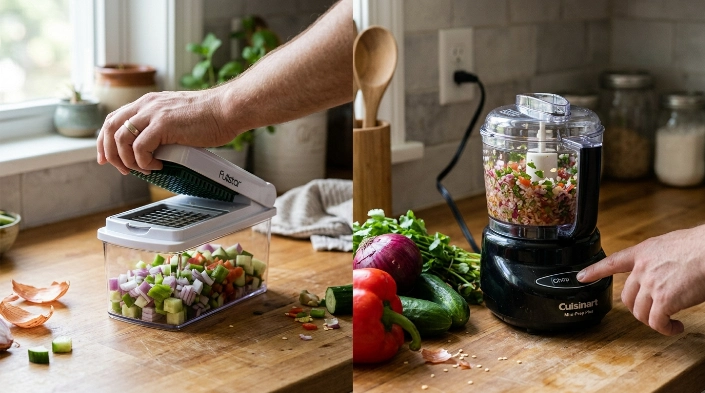
A food processor becomes more useful for large batches and finer textures. A manual vegetable chopper usually gives more defined cubes and requires less counter space.
| Feature | Manual Vegetable Chopper | Food Processor |
|---|---|---|
| Power | Manual | Electric |
| Best texture | Uniform dice or slices | Fine chop, shred, puree |
| Small kitchens | Usually easier to store | Needs more storage space |
| Large batches | Requires repeated loads | Often handles more at once |
For chunky salsa or diced soup vegetables, I prefer the logic of a manual chopper. For finely chopped mixtures or purees, the processor has the stronger advantage.
Vegetable Choppers I Would Consider for Faster Prep
If you’re ready to pick one, I’d prioritize simple designs with useful blades, a catch container, and straightforward cleanup.
🏆 BEST FOR BATCH PREP
Fullstar Pro Original Vegetable Chopper 4-in-1
★★★★★ 4.7/5 editorial fit
It uses interchangeable stainless-steel blade inserts and a catch container for repetitive vegetable prep. I like this style most when several onions, peppers, or other firm vegetables need similar cuts.
🥗 BEST SIMPLE DESIGN
OXO Good Grips Vegetable Chopper
★★★★☆ 4.6/5 editorial fit
OXO uses a stainless-steel blade pattern, recessed cutting area, and easy-pour opening. I would choose it when straightforward chopping matters more than collecting many attachments.
🔪 BEST MULTI-BLADE OPTION
Mueller 6-Blade Compact Vegetable Chopper
★★★★☆ 4.5/5 editorial fit
This compact Mueller model provides six blade options and a built-in container. I would look at it when you want more cutting choices without moving to a full-size food processor.
Frequently Asked Questions
How much time can a vegetable chopper save?
There isn’t one reliable number for every kitchen. Savings depend on ingredient quantity, cut size, your knife speed, the chopper design, and cleanup time. The advantage usually grows when you process several vegetables rather than one small ingredient.
Is a vegetable chopper faster than cutting with a knife?
It can be faster for repetitive dicing and batch preparation. A knife is often quicker for one or two simple cuts because it requires almost no setup and is easier to wash.
Are vegetable choppers worth it for meal prep?
They can be especially useful for meal prep because large batches make repetitive cutting more noticeable. A catch container also reduces the number of times you need to move chopped vegetables from the board to another bowl.
Can I chop all vegetables in a vegetable chopper?
No. Firm vegetables are generally the easiest to process. Very ripe tomatoes may crush, leafy herbs may bruise, and extremely hard vegetables can require excessive force. Follow your manufacturer’s instructions for suitable ingredients.
Is a vegetable chopper easier to clean than a knife?
Usually not. A knife and cutting board have simpler surfaces, while chopper grids can trap food. Models with removable blades, cleaning tools, and dishwasher-safe parts make cleanup easier and protect more of the time you gained.
Final Takeaway: Does a Vegetable Chopper Save Time?
Yes, a vegetable chopper can save meaningful prep time when you’re dicing several vegetables, preparing meals in batches, or making recipes that need lots of uniform pieces. It is much less useful when you only need one or two quick cuts.
As of 2026, my buying rule is simple: choose a chopper for the jobs you already do often, not because it has the longest attachment list. The best time-saving tool is the one that’s fast to use, easy to clean, and convenient enough to reach for every week.
