
How to Chop Carrots With a Push-Down Chopper

Quick Answer
You can chop carrots with a push-down vegetable chopper if its manufacturer permits firm vegetables such as carrots. Wash and trim the carrots, cut them into pieces that fit the blade grid, position them securely, and press straight down. Never force the pusher if the carrot resists or the blades cannot cut through it.
Carrots can be more difficult to chop than softer vegetables because their firm texture creates resistance against the cutting grid. Preparing the carrot to fit the chopper properly is often the most important step in getting evenly diced pieces without straining the tool.
However, not every push-down chopper is designed for raw carrots. Check the instructions for your particular model before using it, especially if the manufacturer restricts hard vegetables or specifies a particular preparation method.
Can a Push-Down Vegetable Chopper Cut Raw Carrots?
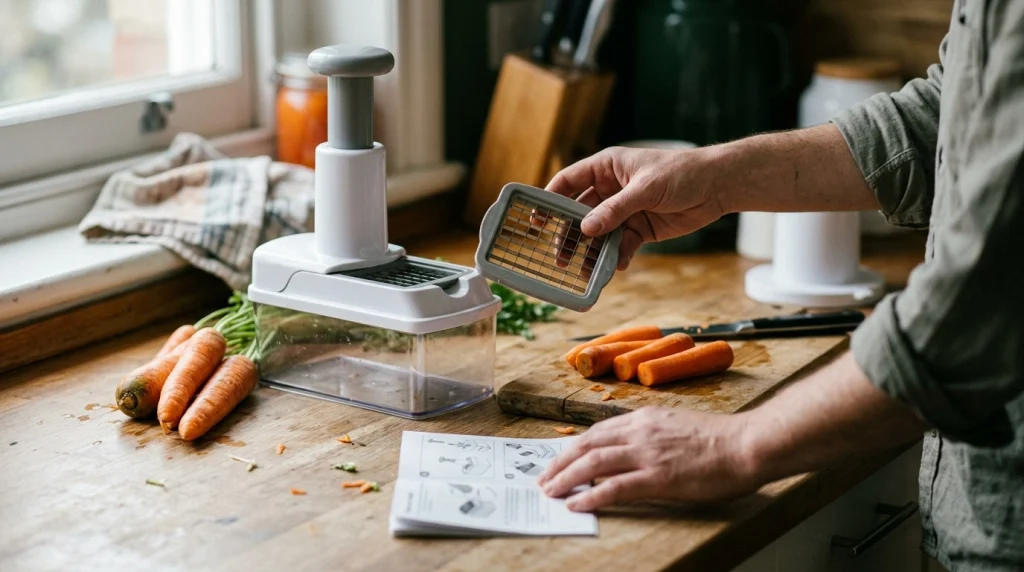
Yes, some push-down vegetable choppers can cut raw carrots, but the answer depends on the blade design, the permitted ingredients, and how the carrots are prepared. Some models list carrots among their suitable ingredients, while others warn against using hard vegetables.
For example, the Fullstar chopper’s user manual identifies carrots as suitable for a designated chopping blade and instructs users to prepare oversized food before cutting. This is an example of why the model-specific instructions matter; it is not a universal rule for every chopper.
Use these decision rules before starting:
- If raw carrots are explicitly permitted: Follow the manufacturer’s instructions for size, blade selection, and pressing technique.
- If the instructions prohibit hard vegetables: Do not use the chopper for raw carrots unless the manufacturer confirms that the restriction does not apply.
- If the instructions are unclear: Avoid testing the blade by applying extra force. Use a suitable knife or another approved preparation method instead.
A chopper that works well for onions or cucumbers may not handle carrots equally well. Ingredient suitability should take priority over the number of blades or accessories included with the tool.
How to Prepare Carrots for a Push-Down Chopper
Prepare the carrot before placing it over the blade grid. The goal is to make the piece small enough to fit within the cutting area while keeping it stable during the downward press.
- Wash the carrot. Rinse it under running water and rub the surface to remove dirt. Peel it if you prefer or if the recipe and tool instructions call for peeling.
- Trim the ends. Remove the stem end and the narrow tip so the pieces are easier to position.
- Check the grid dimensions. Compare the carrot’s width and length with the opening of the installed blade. Do not assume that a whole carrot will fit simply because the chopper is advertised for vegetables.
- Cut the carrot into manageable sections. Use a kitchen knife to shorten or split thick carrots as needed. Each section should fit comfortably within the grid and meet the manufacturer’s size restrictions.
- Inspect the carrot’s condition. Avoid using frozen, unusually hard, or damaged pieces if they fall outside the tool’s permitted uses.
Do not rely on one universal piece size. A small countertop dicer and a larger heavy-duty unit may have different grid openings, clearances, and cutting limits.
Tip
Prepare a few carrot pieces first instead of loading the chopper with a large quantity. This makes it easier to confirm that the pieces fit the grid and that the tool cuts them without excessive resistance.
How to Chop Carrots Step by Step
Once the carrots are prepared and the manufacturer confirms that the tool is suitable, use a controlled, straight-down movement. The pusher should guide the food through the cutting grid rather than compensate for a carrot that is too large or too hard.
- Place the chopper on a stable surface. Set it on a clean, dry, level countertop. Position the collection container correctly if your model includes one.
- Install the correct blade. Select a blade approved for carrots and secure it according to the instructions. Never use a loose or incorrectly seated insert.
- Position one carrot piece. Keep the piece within the cutting area. Do not stack several pieces or allow part of the carrot to sit beyond the grid unless the instructions explicitly permit that arrangement.
- Align the pusher. Close or position the pusher as designed. Keep your fingers away from the blade openings and cutting edges.
- Press straight down. Apply controlled pressure with both hands if the design calls for it. A suitable carrot piece should move through the grid without requiring you to force the mechanism.
- Check the result. Lift the pusher only as directed, then inspect the cut pieces. If the carrot has not passed through completely, stop and identify the cause rather than repeating the press with greater force.
- Repeat in small batches. Continue with properly sized pieces until you have enough diced carrot for the recipe.
The cut size is determined mainly by the blade grid. A larger grid generally creates larger pieces, while a finer grid creates smaller pieces when the food and tool are compatible. The actual result may also vary with the shape of the carrot and how it sits in the grid.
For broader preparation guidance, the RecipesPalette article on practical vegetable-chopping techniques provides additional context for organizing ingredients before cooking.
Why Does a Push-Down Chopper Struggle With Carrots?
If a chopper works with softer vegetables but struggles with carrots, the problem may be the ingredient’s firmness, the size of the piece, or the tool’s limitations. It does not automatically mean that the blade is defective.
The carrot is too large
A thick carrot may extend beyond the grid or fail to sit flat beneath the pusher. Cut it into smaller sections and check the dimensions again. Never try to compress an oversized piece through the opening.
The carrot is too hard for the blade
Some choppers are intended for softer vegetables and cannot safely cut firm raw produce. If a correctly sized carrot still requires excessive pressure, stop and check the manual. Changing your technique cannot make an unsuitable tool safe for an ingredient it is not designed to handle.
The blade insert is incorrectly positioned
A blade insert that is not fully seated or locked may prevent the pusher from travelling correctly. Stop using the device and inspect the assembly according to the manufacturer’s instructions, keeping your hands away from the sharp edges.
The grid contains leftover food
Carrot fragments can obstruct the openings and prevent the next piece from passing through. Stop pressing before removing the obstruction. Follow the manufacturer’s method for disassembly and use the recommended cleaning tool rather than your fingers.
What Should You Do if the Carrot Gets Stuck?
If the pusher stops, the carrot only partly passes through, or the tool begins to flex, stop applying pressure immediately. Forcing the pusher can damage the plastic housing, loosen the blade assembly, or cause a sudden movement that increases injury risk.
- Release the pressure and stop the cutting attempt.
- Open or disassemble the chopper only as described in its instructions, keeping your hands away from the blade edges.
- Remove the trapped carrot using the manufacturer’s recommended method and an appropriate cleaning tool.
- Check whether the piece was too large, the grid was obstructed, or the blade was incorrectly installed.
- Resume only if the tool is undamaged, properly assembled, and the manufacturer permits the ingredient and preparation method.
If the pusher remains stuck or the frame, blade, or locking mechanism appears damaged, do not use the chopper again until it has been repaired or replaced as appropriate. A damaged cutting tool is not worth risking an injury to finish food preparation.
How to Get More Even Carrot Pieces
Even pieces begin with consistent preparation. If the carrot sections differ greatly in thickness or shape, they may sit differently over the grid and produce uneven results.
- Choose similar-sized sections. Cut carrots into comparable lengths and widths before placing them in the chopper.
- Keep pieces inside the grid. Avoid letting the ends overlap the cutting area or placing food at an angle that prevents stable contact.
- Use the appropriate grid. Select the intended blade for the required dice size, provided it is approved for raw carrots.
- Work in small batches. Avoid crowding the cutting area or allowing chopped pieces to obstruct the container or mechanism.
- Check the result before continuing. If the pieces are too large for your recipe, use a suitable knife to adjust them instead of forcing the food through a finer grid that is not designed for carrots.
Uniformity matters most when the carrots will be cooked with other ingredients. Pieces of similar size are easier to portion and are more likely to cook at a similar rate, although the cooking method and recipe also affect the final texture.
How to Clean a Chopper After Cutting Carrots
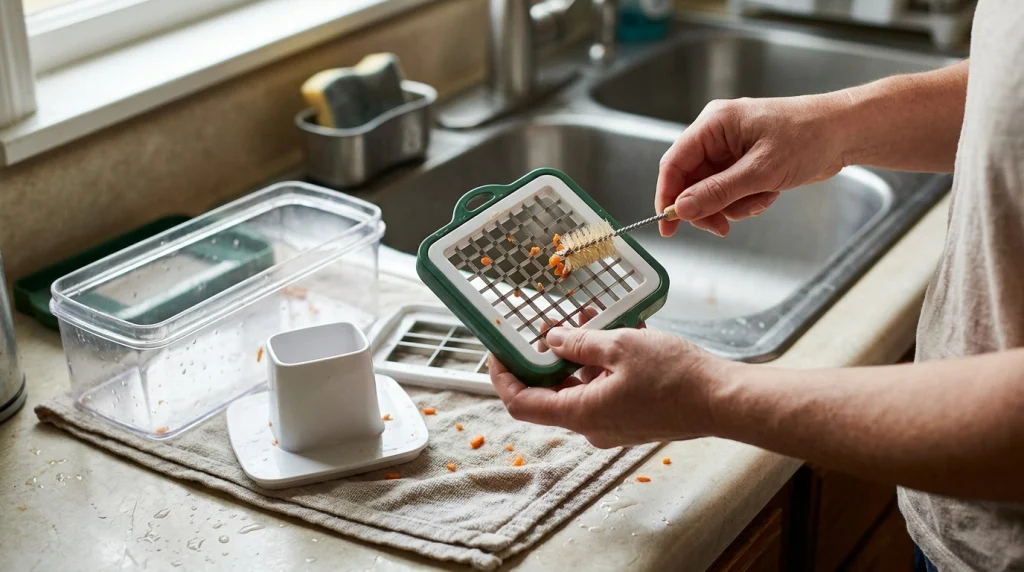
Clean the chopper after use so carrot residue does not dry inside the blade openings. Carrots may also leave orange stains on some plastic parts, particularly after prolonged contact.
- Disassemble the tool according to its instructions, keeping your fingers clear of the blades.
- Remove food fragments with the supplied brush or another cleaning tool approved by the manufacturer.
- Wash the removable parts using the recommended method and suitable dish detergent.
- Rinse away residue and dry the components thoroughly before storage.
- Check the blade, locks, and housing for damage before the next use.
Do not assume that every part is dishwasher-safe. Some models require hand washing, and harsh abrasives may damage plastic components. Follow the instructions for your specific device.
For safe ingredient preparation before chopping, the guide to choosing fresh vegetables offers useful guidance on assessing carrots and other produce before bringing them into the kitchen.
Warning
Never push a stuck carrot through the grid with your fingers or reach into the blade openings while the tool is assembled. Follow the manufacturer’s disassembly procedure before clearing trapped food.
Related Product
Push-Down Vegetable Chopper With a Carrot-Compatible Blade
If you prepare carrots regularly, look for a chopper whose manufacturer explicitly permits raw carrots and explains the required cutting size and blade attachment.
As an Amazon Associate, we earn from qualifying purchases.
Frequently Asked Questions
Should carrots be peeled before using a push-down chopper?
Peeling is not always necessary. Wash and scrub carrots thoroughly under running water, and peel them if you prefer, if the recipe requires it, or if your chopper’s instructions specify peeling.
Can I put a whole carrot into a push-down vegetable chopper?
Do not assume that a whole carrot will fit. Trim and cut it into pieces that fit within the grid and comply with the manufacturer’s size restrictions before chopping.
Why does my chopper cut onions but not carrots?
Carrots are firmer than onions and can create greater resistance against the cutting grid. Your model may not support raw carrots, or the pieces may be too large for its blade.
Can I use a small-dice blade for raw carrots?
Only if the manufacturer permits raw carrots with that particular blade. A finer grid is not automatically suitable for harder vegetables and may require more cutting force than the tool can safely provide.
What should I do if the carrot only cuts halfway?
Stop pressing, then check the carrot size, blade installation, and grid for an obstruction after safely disassembling the tool as instructed. Do not force the pusher to complete the cut.
Can I use a push-down chopper for cooked carrots?
Only if the manufacturer’s instructions allow cooked carrots. Soft cooked carrots may behave differently from raw ones, and some choppers are not designed for moist or soft ingredients that can crush or clog the grid.
Conclusion
A push-down vegetable chopper can make carrot preparation quicker when the model is designed to handle raw carrots and the pieces are properly prepared. Wash and trim the carrots, cut them to fit the grid, secure the correct blade, and press straight down without forcing the mechanism.
If the carrot resists, the pusher stops, or the tool begins to flex, stop and check the instructions rather than applying more pressure. Choosing a suitable blade and respecting the chopper’s limits helps protect both the cutting tool and your fingers while producing more consistent pieces for everyday cooking.
