Press Vegetable Chopper: How to Use It and Choose the Best One

Quick Answer
A press vegetable chopper is a manual kitchen tool that cuts vegetables when you push its lid or handle downward. Grid-style models create uniform cubes, while plunger-style choppers make smaller, less uniform pieces. For everyday cooking, choose a sturdy model with sharp stainless steel blades, a stable base, and removable parts that are easy to clean. Follow the FDA produce washing guidance before preparing vegetables.
What matters most when choosing one?
- Cutting mechanism: Choose a grid for neat cubes or a plunger for fine chopping.
- Blade quality: Sharp stainless steel blades cut more cleanly and require less force.
- Container capacity: Match the collection bin to your usual meal-prep portions.
- Stable construction: A nonslip base and secure lid help prevent unwanted movement.
- Easy cleaning: Removable cutting grids and accessible corners make maintenance simpler.
Chopping onions, peppers, and carrots can take longer than cooking the meal itself. A good press vegetable chopper can simplify that preparation, especially when you need several portions of evenly cut vegetables.
I’m Daniel Hartman, and in this guide I’ll explain how these tools work, where they help, and where a regular knife remains better. I’ll also compare practical options for different kitchens.
What Is a Press Vegetable Chopper?
A press vegetable chopper is a hand-operated food-preparation tool that cuts ingredients through downward pressure. It requires no electricity and usually includes a cutting blade, pressing mechanism, and collection container.
The term covers two different designs. Understanding their differences prevents disappointment after purchasing.
Grid-Style Press Choppers
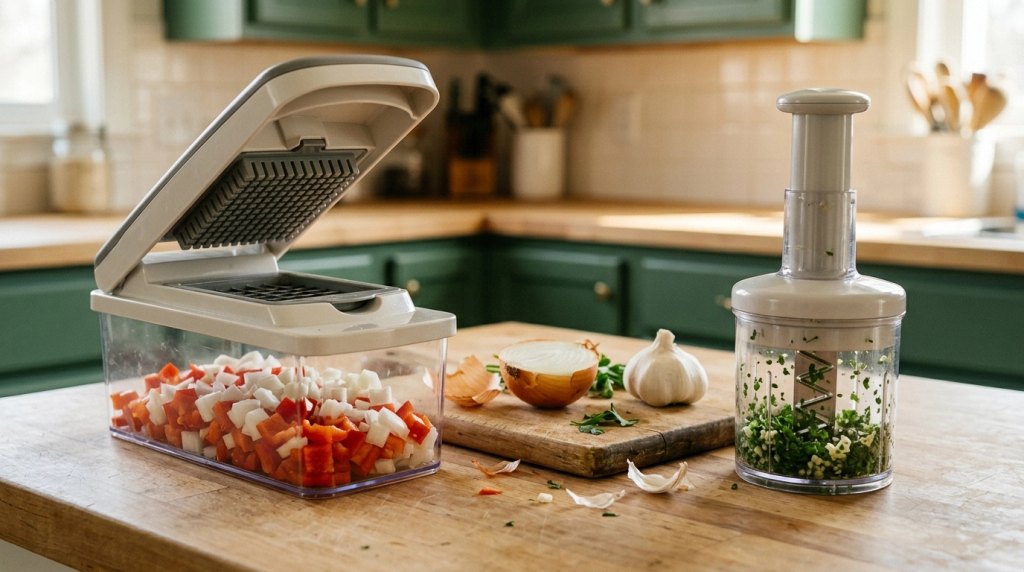
A grid-style chopper uses intersecting blades to create square or rectangular pieces. You position prepared vegetables above the grid and press the hinged lid downward.
The ingredients pass through the blades and collect in a container underneath. This design works particularly well for salsa ingredients, salad vegetables, and diced onions.
Plunger-Style Vegetable Choppers
A plunger-style chopper uses a vertically operated handle connected to a rotating or repositioning blade. Repeated presses chop ingredients into progressively smaller pieces.
This mechanism works well for garlic, herbs, and smaller vegetable portions. However, it typically produces less uniform shapes than a fixed cutting grid.
How Do You Use a Press Vegetable Chopper Correctly?
Start with washed vegetables, a stable countertop, and the correct blade attachment. Smaller portions are generally easier to process than oversized pieces.
Here’s a practical sequence for using a typical grid-style vegetable chopper.
- Wash your vegetables. Rinse produce under running water and remove damaged sections.
- Prepare the ingredients. Peel vegetables when appropriate and cut large pieces into manageable sections.
- Install the blade. Secure the cutting grid according to the manufacturer’s instructions.
- Position the vegetable. Place one manageable piece over the cutting grid.
- Press the lid. Apply firm, controlled downward pressure while keeping fingers clear.
- Empty the container. Transfer chopped vegetables into a bowl before the container becomes overcrowded.
- Clean the equipment. Remove trapped food using the supplied cleaning tool or a suitable brush.
A firm, controlled motion usually works better than forcing an oversized vegetable into the grid. Never strike the lid with another object to overcome resistance.
How Can You Get Evenly Chopped Vegetables?
Even cuts begin with consistent ingredient sizes. A grid chopper cannot compensate for every difference in vegetable thickness or firmness.
- Onions: Halve or quarter large onions before placing them over the grid.
- Bell peppers: Remove seeds, ribs, and the stem before cutting.
- Carrots: Cut thick carrots into shorter, manageable pieces.
- Potatoes: Use appropriately sized pieces and expect greater pressing resistance.
- Cucumbers: Cut long cucumbers into sections that fit the cutting surface.
For vegetable soup, I would prioritize consistent pieces over the smallest possible dice. Similar-sized ingredients are easier to cook evenly.
Which Vegetables Work Best in a Press Chopper?
Firm vegetables that fit the blade grid generally deliver the most predictable results. Extremely hard, oversized, or delicate ingredients may require different preparation methods.
This table compares common vegetables and their suitability for a manual grid chopper.
| Vegetable | Suitability | Preparation tip | Best use |
|---|---|---|---|
| Onion | Excellent | Peel and quarter | Salsa, soups |
| Bell pepper | Excellent | Remove core and seeds | Salads, stir-fries |
| Cucumber | Good | Cut into sections | Fresh salads |
| Carrot | Moderate | Use smaller pieces | Soups, stews |
| Potato | Moderate | Cut into grid-sized sections | Hash browns, soups |
| Tomato | Variable | Choose firm tomatoes | Salsa, toppings |
These ratings describe general cutting suitability, not laboratory measurements. Results depend on blade sharpness, vegetable ripeness, and individual chopper construction.
Press Vegetable Chopper vs. Knife vs. Food Processor
A press chopper offers a useful middle ground between traditional knife work and electric food processing. Its biggest advantage is producing repeated cuts without requiring advanced knife skills.
However, each method handles different kitchen jobs better.
| Feature | Press chopper | Kitchen knife | Food processor |
|---|---|---|---|
| Power | Manual | Manual | Usually electric |
| Uniform cubes | Good with grid blades | Skill-dependent | Usually inconsistent |
| Versatility | Moderate | Excellent | Good for bulk processing |
| Cleaning | Grid requires attention | Usually straightforward | Multiple components |
| Best suited to | Repeated vegetable dicing | Precise, varied cutting | Larger food-prep jobs |
For one tomato or a few garlic cloves, a knife may be simpler. For several onions and peppers, a grid-style press chopper becomes more appealing.
What Should You Look for Before Buying a Vegetable Chopper?
Choose a chopper around your most common ingredients rather than the largest accessory count. A simple, dependable tool often proves more useful than a complicated gadget.
Blade Design and Cutting Options
Stainless steel cutting grids are common because they provide rigid cutting edges. Different grid openings produce different dice sizes.
- Fine grid: Useful for onions, salsa, and finely diced garnishes.
- Medium grid: Suitable for everyday vegetable preparation.
- Large grid: Helpful for soups, salads, and chunky vegetable dishes.
- Slicing attachment: Useful when you also need uniform slices.
Extra blades increase versatility but also create more parts to store and wash. Consider whether you will actually use each attachment.
Container Size and Stability
A collection container reduces the need to move ingredients between a cutting board and bowl. Look for a stable base and enough capacity for your typical serving size.
A large container does not automatically mean faster chopping. You still need to feed suitable portions through the blade grid.
Comfort and Hand Strength
Manual pressure matters, especially with carrots and potatoes. A wide pressing handle can help distribute force more comfortably.
People with limited hand strength may prefer an electric processor or another preparation method. A press chopper is not automatically easier for every user.
How Do You Clean a Press Vegetable Chopper Safely?

Clean the chopper soon after use, before vegetable fibers dry around the blades. Always remove attachments according to the manufacturer’s directions.
- Disassemble carefully. Keep fingertips away from cutting edges.
- Remove trapped vegetables. Use the supplied comb or cleaning brush.
- Wash removable parts. Use warm water and dish soap, following the product instructions.
- Check the blade grid. Inspect the corners and blade intersections for remaining food.
- Rinse and dry. Allow parts to dry before reassembly and storage.
Use the dishwasher only when the specific components are labeled dishwasher-safe. A dishwasher-safe container does not necessarily mean every blade attachment is suitable.
The USDA cleaning guidance also explains why food-contact surfaces should be cleaned before sanitizing.
Can a Vegetable Chopper Spread Bacteria?
Yes, poorly cleaned equipment can transfer contamination between ingredients. Blade intersections and collection containers require particular attention because food can remain trapped there.
Keep fresh produce away from equipment contaminated by raw meat or poultry. Follow the FDA food preparation recommendations to reduce cross-contamination risks.
Why Does a Press Vegetable Chopper Get Stuck?
Jamming usually occurs when ingredients are too large, too hard, or positioned incorrectly. Dull or obstructed blades can also contribute.
Repeatedly forcing a stuck lid can damage the hinge, cutting grid, or container. Stop and inspect the obstruction instead.
- Oversized pieces: Reduce the vegetable size before pressing again.
- Hard ingredients: Confirm the model supports the vegetable you are preparing.
- Vegetable fibers: Remove trapped material using a cleaning tool.
- Misaligned blades: Check that the cutting insert is properly seated.
- Damaged equipment: Stop using cracked frames or bent cutting grids.
Never use your fingers to dislodge food while the cutting assembly is in place. Remove and clean components according to the manufacturer’s safety instructions.
Is a Press Vegetable Chopper Worth Buying in 2026?
A press vegetable chopper is worth considering when you regularly prepare diced vegetables. Its value comes from repeatable cuts, convenient collection, and reduced reliance on detailed knife work.
However, it still requires manual effort, cleaning, and storage space. Occasional cooks may get better value from a quality kitchen knife.
Who Benefits Most?
- Meal-prep cooks: Prepare onions, peppers, and other ingredients in repeated batches.
- Families: Make consistent vegetable pieces for soups and family meals.
- Salad enthusiasts: Prepare diced toppings and mixed vegetable bowls.
- Small-kitchen cooks: Avoid storing another electric appliance.
- Beginner cooks: Create relatively uniform cuts without advanced knife techniques.
My practical recommendation is to start with the cut you need most often. If that’s square vegetable pieces, prioritize a grid-style chopper over a plunger model.
Recommended Press Vegetable Choppers
Three widely available chopper designs stand out for different cooking needs. These are specification-based buying recommendations, not claims of personal hands-on testing.
The star scores below indicate editorial suitability for the stated use case, not verified customer ratings.
🏆 Best for Versatility
Mueller Pro-Series 10-in-1 Vegetable Chopper
★★★★½
This manual chopper offers eight interchangeable cutting attachments in a 10-in-1 preparation system. I’d favor its wider range of cuts for cooks who regularly dice, slice, and shred vegetables, provided they have space for the attachments.
🥗 Best for Everyday Dicing
Fullstar Pro Original Vegetable Chopper and Spiralizer
★★★★☆
The 4-in-1 version combines dicing grids with ribbon and spiral cutting options. I’d consider it for regular salad and meal preparation where collecting chopped ingredients in one container is useful.
🍃 Best Simple Plunger Design
OXO Good Grips Vegetable Chopper
★★★★☆
OXO uses a press-operated rotating blade rather than interchangeable dicing grids. I’d choose this format for smaller chopping tasks, especially garlic, herbs, and small vegetable portions.
Frequently Asked Questions
Can a press vegetable chopper cut raw potatoes?
Yes, some grid-style press choppers can cut raw potatoes when the pieces fit the grid. However, potatoes require more force than softer vegetables. Check the manufacturer’s instructions, cut potatoes into manageable sections, and stop if the blade jams.
Can you chop onions with a press vegetable chopper?
Yes, onions are among the most practical ingredients for grid-style vegetable choppers. Peel the onion and cut it into sections that fit the blade. A fine grid produces smaller pieces for sauces, while a larger grid suits soups and salads.
Are press vegetable choppers dishwasher-safe?
Some models include dishwasher-safe containers, lids, or removable attachments. However, cleaning requirements vary between manufacturers and models. Always follow the product’s care instructions, and use a cleaning brush when vegetable fibers remain between sharp blade sections.
Is a press vegetable chopper better than a knife?
A press vegetable chopper can be more convenient for preparing repeated batches of similarly sized vegetable pieces. A knife offers greater flexibility for trimming, slicing, and irregular shapes. The better choice depends on ingredient quantity, cutting style, cleaning effort, and your comfort with each tool.
Can people with arthritis use a manual vegetable chopper?
Some people may find the larger pressing surface more comfortable than detailed knife work. However, manual choppers can require considerable force, especially with hard vegetables. People with painful or limited hand movement should consider individual comfort, safer alternatives, and electric equipment where appropriate.
Final Takeaway: Choose a Chopper That Fits Your Cooking
A good press vegetable chopper can make everyday cooking more manageable by simplifying repetitive vegetable preparation. For uniform cubes, choose a sturdy grid-style model with suitable blade sizes.
If you mainly chop herbs or small ingredients, a plunger-style tool may be enough. Focus on cutting performance, hand comfort, safe operation, and cleaning convenience rather than an impressive accessory count.
Choose the model that matches your regular recipes, and you’ll have a much better chance of using it consistently.