
How to Use a Pull Cord Vegetable Chopper: A Step-by-Step Guide

Quick Answer
To use a pull cord vegetable chopper, place prepared vegetables in the bowl, fit the blade assembly, and secure the lid. Hold the chopper steady, pull the handle smoothly, and let the cord retract before repeating until you reach your preferred texture. For safe, consistent results, follow your model’s filling limit and cleaning instructions, as explained in this manufacturer’s pull-cord chopper guide.
Quick steps for successful chopping
- Prepare ingredients: Wash, dry, peel when needed, and cut large vegetables into smaller chunks.
- Load the bowl: Add a manageable amount without exceeding the manufacturer’s fill limit.
- Secure the parts: Position the blade correctly and lock the lid into place.
- Pull the cord: Use controlled pulls and allow the handle to return naturally.
- Check the texture: Stop, open the lid safely, and inspect the vegetables before chopping further.
- Clean carefully: Remove the blade by its safe grip and follow the model’s washing instructions.
Remember these safety tips
- Protect your fingers: Never reach into the bowl while the blade is installed.
- Avoid excessive force: Stop if the cord resists or the blade jams.
- Keep the lid dry: Do not immerse a pull-cord lid unless the manufacturer explicitly permits it.
A pull cord vegetable chopper can make everyday food preparation easier without electricity, complicated controls, or a large appliance on your counter.
I’m Daniel Hartman, and in this guide, I’ll walk you through the practical details that help you chop vegetables evenly, avoid common mistakes, and keep your kitchen tool in good condition. I’ll also explain which ingredients work well, how to adjust the texture, and what to consider when choosing a chopper in 2026.
What Is a Pull Cord Vegetable Chopper?
A pull cord vegetable chopper is a manual kitchen tool that uses a retractable cord to rotate blades inside a covered bowl. Each pull turns the blade assembly, cutting ingredients into smaller pieces without requiring electricity.
Most models include a bowl, removable blade assembly, lid, and pull handle, although the exact design varies by manufacturer.
The tool works well for everyday preparation tasks such as chopping onions, garlic, herbs, and suitable vegetables for sauces, salads, dips, and cooked dishes. It does not automatically produce perfectly uniform cubes, so the final texture depends on the ingredients and how you operate the cord.
How Does a Pull Cord Vegetable Chopper Work?
The pull cord connects to a mechanism inside the lid, which transfers your pulling motion into blade rotation. When you pull the handle, the blades spin; when you release it, a spring mechanism retracts the cord on many common designs.
Repeated pulls create more cutting action, gradually reducing the ingredient size. The number of pulls needed varies with the chopper design, blade arrangement, ingredient hardness, and amount of food in the bowl.
- One controlled pull: Starts the chopping process and lets you check whether the mechanism moves freely.
- A few additional pulls: Usually produce smaller pieces, depending on the food.
- Repeated chopping: Can produce a finer mixture, although juicy ingredients may become watery or mushy.
The goal isn’t to pull as hard or as quickly as possible. Controlled movement and frequent texture checks give you more control over the result.
How to Use a Pull Cord Vegetable Chopper Step by Step
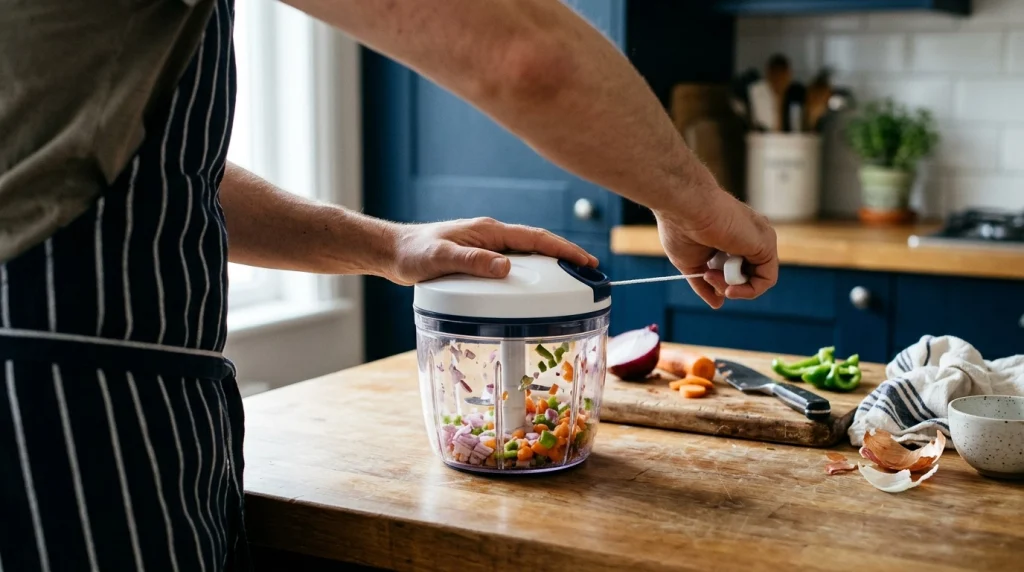
Follow these steps each time you use a manual pull-cord chopper. Your specific product manual takes priority if its assembly or operating instructions differ.
Step 1: Check the Chopper Before Use
Start by inspecting the bowl, lid, cord, handle, and blade assembly. Make sure the cord isn’t frayed, the blade isn’t bent, and the bowl has no cracks.
Wash the food-contact parts before first use according to the manufacturer’s instructions. Dry them as directed, especially around any mechanism that must remain free of water.
- Check that the blade assembly fits its central holder.
- Confirm that the lid attaches securely to the bowl.
- Place the chopper on a clean, dry, level countertop.
Never use a damaged cord or loose blade assembly. Replace damaged parts or contact the manufacturer rather than attempting an improvised repair.
Step 2: Wash and Prepare the Vegetables
Wash vegetables under running water before cutting them. Remove peels, stems, seeds, or damaged portions when your recipe requires it.
Cut large ingredients into smaller chunks that fit comfortably around the blades. A whole onion or thick carrot may be too large for some compact choppers.
- Onions: Peel and cut into quarters or smaller chunks.
- Garlic: Separate and peel the cloves.
- Bell peppers: Remove the stem and seeds, then cut into manageable pieces.
- Carrots: Cut into small pieces and check whether your model supports hard vegetables.
- Fresh herbs: Remove tough stems and shake off excess water.
Preparing similar-sized pieces helps the blades reach the ingredients more evenly. It also reduces the chance of large pieces becoming wedged around the blade assembly.
Step 3: Insert the Blade Assembly
Hold the blade assembly by its designated plastic stem or safe gripping area. Position it on the bowl’s central post, following the product’s assembly instructions.
Keep your fingers away from the sharp cutting edges. If the blade does not sit securely, remove it carefully and reposition it before adding food or attaching the lid.
Never force a blade into a holder that doesn’t fit. An incorrectly installed blade can interfere with chopping or damage the mechanism.
Step 4: Add the Ingredients
Place the prepared vegetables in the bowl, distributing them around the blade assembly rather than packing everything into one tight mass. Leave enough space for the ingredients to move as the blades rotate.
Many pull choppers recommend filling the bowl no more than two-thirds full, but the exact limit depends on the model. Follow the printed fill line or manual when available.
Overfilling is a common cause of poor chopping. Too much food can restrict blade movement and make the cord harder to pull.
Step 5: Secure the Lid
Align the lid with the bowl and engage its locking points or grooves, if present. Check that it sits firmly before operating the handle.
Place one hand on the designated lid or stabilizing area and use the other hand to operate the cord. Keep the chopper steady without placing your fingers near moving parts.
If the lid won’t fit, remove some ingredients and check the blade’s position. Never pull the cord with a loose or misaligned lid.
Step 6: Pull the Cord Smoothly
Hold the bowl steady and pull the handle outward in a controlled motion. Let the cord retract naturally before pulling again.
Begin with a few gentle pulls rather than immediately making repeated, forceful movements. If you feel unusual resistance, stop and investigate instead of forcing the mechanism.
Do not yank the cord beyond its normal travel or try to extend it farther than the design allows. Doing so may damage the retracting mechanism.
Step 7: Check the Chopping Texture
After several pulls, stop and open the lid according to the manufacturer’s instructions. Keep the blade assembly in place while checking the texture from a safe position.
If the pieces remain too large, secure the lid again and make a few more controlled pulls. Repeat this process until the vegetables reach the size your recipe needs.
This gradual approach is especially useful for onions, herbs, and tomatoes. These ingredients can quickly move from roughly chopped to very fine or watery.
Step 8: Remove the Blade and Transfer the Food
Once chopping is complete, remove the lid and lift the blade assembly by its designated grip. Keep the cutting edges away from your fingers while removing it.
Use a spoon or spatula to transfer the chopped vegetables into your pan, mixing bowl, or storage container. Never scoop food out with your fingers while the blade remains inside.
Clean the chopper promptly after use. Food residue becomes harder to remove when it dries around the blades and central holder.
How Many Times Should You Pull the Cord?
There is no universal number of pulls because choppers and ingredients differ. Use the texture as your guide instead of relying on a fixed count.
| Desired result | How to approach it | Suitable uses |
|---|---|---|
| Coarse chop | Start with a small number of pulls and inspect early. | Chunkier salsa, vegetable toppings |
| Medium chop | Add controlled pulls and check the size between rounds. | Omelet fillings, cooked vegetables |
| Fine chop | Continue gradually until the pieces are small enough. | Sauces, dressings, finely chopped aromatics |
| Very fine or paste-like | Check frequently because extra chopping can release liquid. | Some dips, pastes, and blended mixtures |
These are texture-based guidelines, not guaranteed pull counts. Blade design, food quantity, and moisture affect the result.
Which Vegetables Can You Chop With a Pull Cord Chopper?
Most standard manual choppers handle suitable small pieces of common vegetables, but their capabilities vary. Check the instructions before using harder, unusually fibrous, or wet ingredients.
| Ingredient | Preparation tip | What to watch for |
|---|---|---|
| Onion | Peel and quarter. | Extra pulls can make it watery. |
| Garlic | Peel the cloves. | Small amounts may need fewer pulls. |
| Bell pepper | Remove seeds and cut into chunks. | Excess moisture may collect in the bowl. |
| Carrot | Cut into small pieces. | Hard pieces can strain some mechanisms. |
| Fresh herbs | Remove tough stems and excess water. | Wet leaves may clump together. |
| Tomato | Use firm pieces and small batches. | Soft flesh releases liquid quickly. |
Avoid bones, ice, frozen vegetables, and very hard foods unless the manufacturer specifically approves them. A chopper designed for vegetables should not automatically be assumed suitable for meat or other demanding ingredients.
For additional produce preparation advice, see this guide on how to choose fresh vegetables at the market.
How Can You Get More Even Chopped Vegetables?
Consistent results start before you pull the cord. Ingredient preparation, batch size, and frequent checks usually matter more than pulling faster.
- Cut similar-sized pieces: Smaller, reasonably uniform chunks help ingredients move around the blades.
- Leave room in the bowl: Avoid tightly packing the ingredients above the recommended fill level.
- Use short rounds: Chop a little, inspect, and repeat rather than making many pulls without checking.
- Adjust the batch: If the bowl is crowded, remove some food and chop it separately.
- Match the tool to the recipe: Use a knife or suitable slicer when the recipe needs uniform slices or precise cubes.
For example, when preparing onion for an omelet, I would aim for small, reasonably even pieces rather than a smooth paste. A few controlled pulls followed by a texture check help prevent overprocessing.
This is a practical technique rather than a measured performance test; results still depend on the chopper and the onion’s size and firmness.
Pull Cord Vegetable Chopper vs. Knife vs. Electric Chopper
A manual pull-cord chopper is convenient for small batches, but it isn’t the best tool for every preparation task. Compare the methods based on texture, batch size, cleanup, and available counter space.
| Feature | Pull-cord chopper | Knife and board | Electric chopper |
|---|---|---|---|
| Power | Manual | Manual | Electricity or battery, depending on model |
| Texture control | Controlled through repeated pulls | Direct visual control | Usually controlled through pulse duration |
| Batch size | Small batches within bowl capacity | Flexible | Depends on bowl capacity |
| Cleaning | Several removable parts; lid care varies | Knife and board | Bowl, blade, lid, and motor base care |
| Best suited for | Small everyday chopping jobs | Precise cuts and larger pieces | Repeated or larger-volume preparation |
Choose the pull-cord model when you want a compact tool for small amounts of chopped ingredients. A knife remains useful for precise cuts, while an electric model may suit frequent larger batches.
If you’re building your general cooking skills, our guide to common cooking mistakes and how to avoid them offers further practical preparation advice.
How to Clean and Store a Pull Cord Vegetable Chopper
Cleaning the chopper promptly helps remove food residue and keeps the cutting parts ready for the next use. Always follow the care instructions for your particular model.
- Remove the lid: Open the chopper after use and keep your hands away from the blade.
- Lift out the blade: Hold its designated stem or safe gripping area.
- Wash the bowl: Use mild dish soap and a soft sponge if the bowl is washable.
- Clean the blade: Use a soft brush and take care around the cutting edges.
- Wipe the lid: Keep water away from the cord mechanism unless the manufacturer explicitly allows washing it under running water.
- Dry all parts: Follow the manufacturer’s drying and storage instructions before reassembly.
Do not assume every removable part is dishwasher-safe. Some bowls and blades can go in a dishwasher, while other models require handwashing.
For general food-handling guidance, consult FoodSafety.gov and the FDA’s food safety resources. For safe handling and cleaning, follow the appliance manufacturer’s instructions alongside standard kitchen hygiene practices.
What Should You Do If the Pull Cord Chopper Stops Working?
If the chopper becomes difficult to operate, stop pulling and check the simple causes first. Never force the handle or dismantle a sealed mechanism while attempting to troubleshoot it.
- The cord feels stiff: Check whether the bowl is overfilled or a hard ingredient is blocking the blades.
- The vegetables remain large: Check that the blade is installed correctly and the pieces can move around it.
- The cord fails to retract: Stop using the chopper and consult the product manual or manufacturer.
- The bowl slides around: Dry the countertop and check that the base sits flat.
- The ingredients become mushy: Reduce the number of pulls and check the texture more often.
- The lid won’t fit: Remove excess food and reposition the blade assembly.
If the cord, handle, bowl, or blade is visibly damaged, discontinue use. Replacing a damaged component with an approved part is safer than improvising a repair.
What Should You Look for When Buying a Pull Cord Vegetable Chopper?
The most useful chopper is one that matches your typical ingredients and is easy to clean safely. Look beyond appearance and compare the practical features.
- Bowl capacity: Choose a size that suits your usual batch without requiring overfilling.
- Blade assembly: Check how the blades attach and whether the assembly is easy to remove safely.
- Cord mechanism: Look for clear instructions about pulling, retracting, and maintenance.
- Stable base: A secure base can help prevent movement while you work.
- Cleaning requirements: Check which parts can be washed, whether the lid must stay dry, and whether any parts are dishwasher-safe.
- Replacement parts: Confirm whether the seller supports replacement blades or other components.
For a broader perspective on everyday food preparation, you can also explore our cooking temperature guide for beginners.
Pull Cord Vegetable Chopper Recommendations
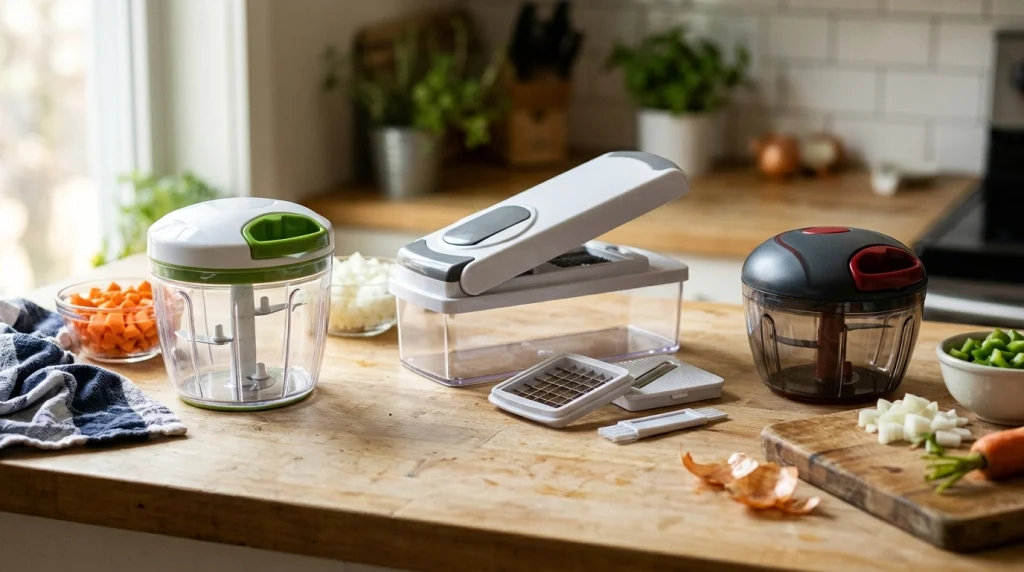
If you’re ready to choose a model, these established product lines provide different features worth comparing. The descriptions below are based on manufacturer-published information, not hands-on testing or independently verified customer ratings.
🏆 Best for straightforward manual chopping
Starfrit Pull Chopper
★★★★☆
Starfrit describes a three-blade cutting system and a self-retracting cord. I’d consider it for everyday chopping where adjustable texture and a compact manual design matter; the stars are an editorial fit assessment, not a customer rating.
💡 Best for a versatile manual tool
Brieftons Chopper Blender Slicer & Grater
★★★★☆
Brieftons documents a manual chopper with additional blending, slicing, and grating functions. I’d compare this option if you want more than basic chopping, while checking the included attachments and care instructions for the exact version; the stars reflect editorial fit.
🥕 Best for a compact chopping routine
Tefal 5-Second Chopper
★★★★☆
Tefal provides guidance for its manual pull-cord chopper, including setup and care. I’d shortlist it for routine vegetable preparation if its capacity and design suit your kitchen; verify the specific model’s included parts before purchasing. The stars indicate editorial fit, not a verified customer score.
Before ordering, compare the current listing, dimensions, included accessories, cleaning instructions, and seller details. Product versions and availability can change, so don’t assume every listing includes the same attachments.
Frequently Asked Questions
1. Do you need to cut vegetables before putting them in a pull cord chopper?
Yes, large vegetables should usually be cut into smaller chunks before you add them. Smaller pieces can move around the blade assembly more easily, reducing the chance of jamming. Follow the manufacturer’s instructions for particularly hard ingredients, and never force oversized pieces into the bowl.
2. How do you make vegetables finer in a pull cord chopper?
Make a few controlled pulls, stop, and check the texture. If the pieces remain too large, secure the lid again and repeat. This gradual method helps you avoid turning juicy ingredients into a watery mixture, and it gives you better control than pulling repeatedly without checking.
3. Can you put a pull cord vegetable chopper in the dishwasher?
Only if the manufacturer identifies the relevant parts as dishwasher-safe. Some models allow dishwasher cleaning for the bowl and blade but require handwashing for the lid. If the instructions are unclear, wash the permitted removable parts by hand and keep the cord mechanism dry.
4. Why is the pull cord difficult to pull?
A stiff cord can indicate an overfilled bowl, oversized ingredients, a jammed blade, or an assembly problem. Stop pulling, remove the lid carefully, and inspect the ingredients and blade position. If the cord remains stuck or appears damaged, stop using the chopper and consult its manual or manufacturer.
5. Can a pull cord vegetable chopper replace a kitchen knife?
No, not completely. A pull-cord chopper is useful for small batches of chopped ingredients, but a knife offers more precise control over slices, strips, and uniform cubes. Keeping both tools available gives you more flexibility when preparing different recipes.
Final Takeaway: Use Controlled Pulls for Better Results
Learning how to use a pull cord vegetable chopper comes down to preparing the ingredients properly, loading the bowl sensibly, securing the lid, and checking the texture between rounds. You don’t need to pull harder to get better results.
Start with easy ingredients such as onion or garlic, follow your model’s fill limit, and use controlled movements. With careful blade handling and proper cleaning, a manual chopper can become a useful part of your everyday cooking routine.
Affiliate disclosure: This article contains affiliate links. As an Amazon Associate, RecipesPalette may earn from qualifying purchases at no additional cost to you.