Is All-Clad Oven Safe? Stainless, Nonstick and Lids

Yes, All-Clad stainless steel cookware, including the D3, D5 and Copper Core lines, is oven-safe and broiler-safe. All-Clad lists its stainless lines as oven-safe up to 600°F (315°C). Its nonstick lines have lower limits, usually around 500°F (260°C), and should not go under the broiler. Glass lids have the lowest limits. Check the care guide for your specific line, and always use oven mitts, because the stainless handles get very hot in the oven.

Being able to go from stovetop to oven is one of the main reasons people buy clad stainless steel. You can sear a steak and finish it in the oven, bake a frittata, or keep a braise warm. This guide explains All-Clad’s oven limits by type, what clad stainless steel is, and how to use your pans in the oven without damaging them. We have not tested these pans ourselves; the limits here are based on the brand’s published care information.
All-Clad Oven Limits by Type
| Type | Oven-safe? | Broiler-safe? | Typical limit |
|---|---|---|---|
| Stainless steel (D3, D5, Copper Core) | Yes | Yes | Up to 600°F (315°C) |
| Stainless steel lids | Yes | Yes | Same as the pan |
| Nonstick (such as HA1) | Yes | No | Usually up to about 500°F (260°C) |
| Glass lids | Yes, with limits | No | Often around 350°F (175°C) |
| Pieces with silicone or plastic parts | Check the manual | No | Lower; varies by product |
These are general figures. Product lines and specifications change, so confirm the limit on the packaging or All-Clad’s care instructions for your exact piece.
What Is Clad Stainless Steel?
“Clad” means layers of different metals bonded together. A typical All-Clad pan has a stainless steel cooking surface, a core of aluminum (or copper) for even heat, and a stainless steel exterior. Because the whole pan is metal, with riveted stainless handles and no plastic parts, it handles high oven temperatures well. For more on what makes clad cookware good, see what to look for in stainless steel cookware.
Is All-Clad Nonstick Toxic?
All-Clad’s nonstick lines use PTFE coatings made without PFOA, like most modern nonstick cookware. PTFE is considered safe for normal cooking at low to medium heat. The concern is overheating: above about 500°F (260°C), PTFE can start to break down and release fumes. That is why nonstick pans have a lower oven limit and should never go under the broiler or be heated empty on high. For more, see are all non-stick frying pans bad for you.
Tips for Using All-Clad in the Oven
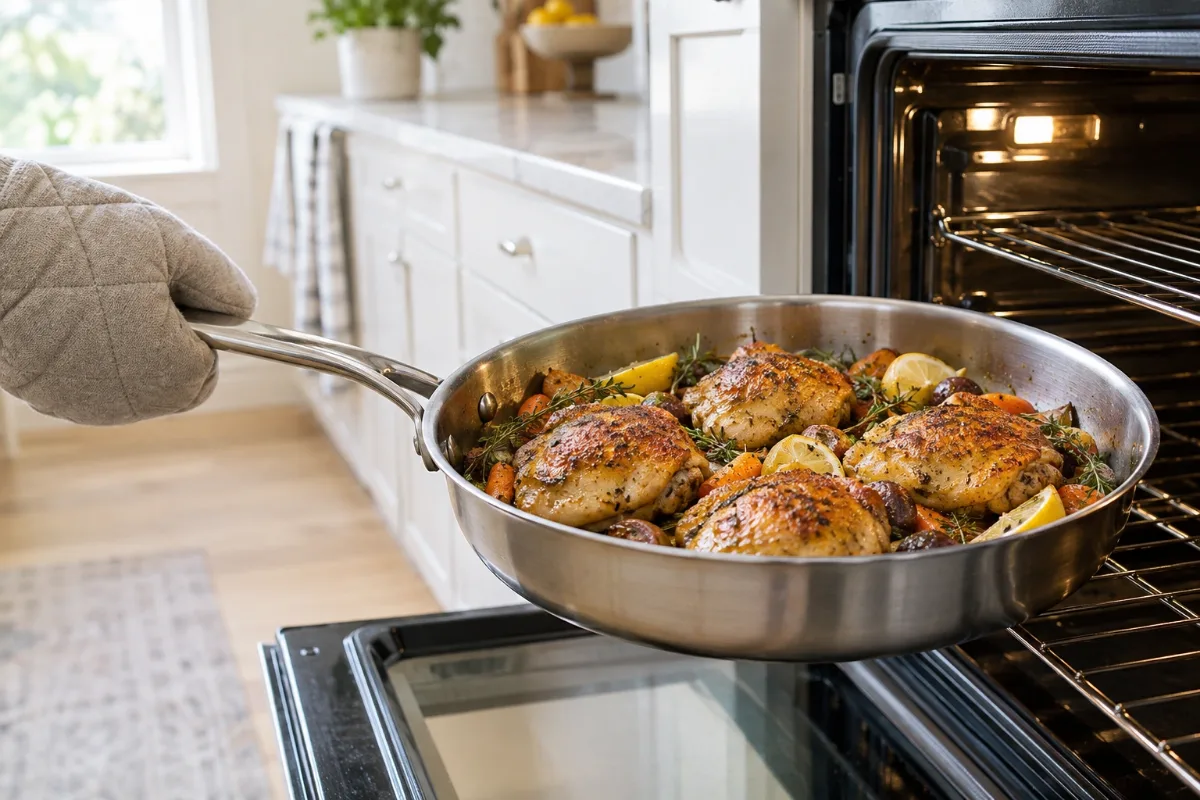
- Use oven mitts every time. Stainless handles conduct heat. After coming out of the oven, a handle stays dangerously hot for a long time. Many cooks drape a towel or mitt over the handle as a reminder.
- Preheat the oven, not the empty pan. Putting an empty pan in a hot oven for a long time is unnecessary and can cause discoloration.
- Let it cool before washing. Plunging a hot pan into cold water can warp it.
- Expect some discoloration. High oven heat can leave a golden or rainbow tint on stainless steel. It is cosmetic and usually comes off with a stainless steel cleaner or a little diluted vinegar.
- Keep nonstick away from the broiler. Direct, intense heat from the broiler can damage the coating.
- Check lid knobs. Some glass lids have knobs with lower heat limits than the glass itself.
Great Ways to Use All-Clad in the Oven
- Sear and finish: Sear steaks, pork chops or chicken thighs on the stove, then move the pan to a 400°F (205°C) oven to finish.
- Frittatas and Dutch baby pancakes: Start on the stove and finish in the oven.
- Roasting vegetables: A large stainless skillet or sauté pan works like a small roasting pan.
- Braising: Brown meat in a stainless stockpot or sauté pan, add liquid, cover and braise in a low oven.
- Broiling: Melt cheese on a gratin or crisp the top of a dish under the broiler in a stainless pan.
Is All-Clad Dishwasher Safe?
All-Clad stainless steel is generally dishwasher-safe, but hand washing helps keep the finish looking new, and harsh detergents can dull polished exteriors over time. Nonstick pans last longer when hand washed. Check the care guide for your line.
Does All-Clad Work on Induction?
Most current stainless lines do, because they have a magnetic stainless exterior. Older lines with aluminum exteriors do not. See does All-Clad work on induction for a line-by-line guide.
Understanding Oven-Safe Ratings
An oven-safe rating is the highest temperature a piece of cookware is designed to handle without damage. For All-Clad, the limit depends on the material, and the lowest-rated part decides the limit for the whole pan.
- Stainless steel bodies and handles handle the highest heat. Lines like D3 and D5 are commonly listed as oven and broiler safe up to about 600°F.
- Nonstick coatings have lower limits. All-Clad’s nonstick lines are usually rated around 500°F, and the coating should not go under the broiler.
- Glass lids have the lowest limits, often around 350°F.
- Any non-metal parts, such as silicone grips or knobs on some products, may have their own lower limits.
Ratings can change between product lines and years, so check the care guide for your specific pieces, which is usually on the All-Clad website or in the box.
Avoiding Warping and Temperature Shock
Clad stainless is durable, but sudden temperature changes can stress any metal pan. A few habits help your cookware stay flat for years.
- Do not plunge a hot pan into cold water. Let it cool on the stovetop or a trivet before washing.
- Avoid heating an empty pan on high for long periods. Preheat on medium, especially for nonstick.
- Match the burner to the pan. A small pan on a large, high flame heats unevenly at the edges.
- Do not place a hot pan on a cold, wet surface. Use a dry trivet or the stovetop.
Cleaning All-Clad After Oven Use
Oven cooking, especially roasting or broiling, can leave baked-on grease and brown or rainbow stains on stainless steel. These do not affect cooking but can be removed.
- Let the pan cool completely.
- Soak it in warm, soapy water to loosen baked-on food.
- Scrub with a nonabrasive sponge. For tougher spots, use a stainless steel cleanser such as an oxalic-acid powder made into a paste.
- Rinse well and dry with a towel to prevent water spots.
Avoid steel wool and oven cleaner on All-Clad. Steel wool scratches the finish, and oven cleaners are too harsh for cookware. For nonstick pieces, use only a soft sponge and mild soap.
Oven-to-Table Tips
Pans that come out of the oven stay hot for a long time, and so do their handles. Many cooks drape a dry kitchen towel or a silicone handle cover over the handle as a reminder. Never use a wet towel to grab a hot handle, since the moisture turns to steam and can burn your hand.
When you finish a dish in the oven, such as a seared steak or a frittata, set the pan on a heat-safe trivet to serve, and warn others at the table that it is hot.
Recipes That Go From Stovetop to Oven
Oven-safe stainless steel is ideal for recipes that start on the burner and finish with dry oven heat.
- Pan-seared steak or pork chops: Sear on high on the stove, then finish in a 400°F oven until they reach the temperature you want.
- Roast chicken thighs: Brown them skin side down in a skillet, flip, and roast at 425°F until the skin is crisp and the meat reaches 165°F.
- Frittata: Cook vegetables in the pan, pour in beaten eggs, let the edges set on the stove, then bake until puffed and set. Use enough oil, as eggs can stick to stainless steel.
- Braised short ribs: Sear the meat in a sauté pan or saucier with a lid, add liquid, cover and braise in a 325°F oven for several hours.
- Roasted vegetables: A large stainless skillet or roasting pan can roast potatoes, carrots or Brussels sprouts with a nicely browned finish.
Use the stainless pieces for broiling and high-heat roasting, and save nonstick pans for gentler oven work like keeping food warm or finishing an omelet.
Frequently Asked Questions
Can All-Clad D3 go in the oven?
Yes. All-Clad lists D3 stainless steel cookware as oven and broiler safe up to 600°F (315°C).
Can All-Clad nonstick go in the oven?
Yes, at lower temperatures, often up to about 500°F (260°C). Do not use it under the broiler.
Are All-Clad lids oven-safe?
Stainless steel lids are. Glass lids have a lower limit, often around 350°F (175°C). Check your line.
Why did my All-Clad pan turn rainbow-colored in the oven?
That is heat tint, a thin oxide layer from high heat. It is harmless and usually removable with a stainless steel cleaner.
Can All-Clad pans warp in the oven?
Clad pans are resistant to warping, but sudden temperature changes, such as putting a hot pan in cold water, can still cause damage.
Can All-Clad go in the oven at 500°F?
Stainless steel lines such as D3 and D5 generally can. Nonstick pieces are often rated around 500°F, and glass lids much lower. Always check the limit for your exact piece.
Can I use All-Clad in a toaster oven?
Yes, if it fits safely with space around it. The heating elements are close to the food, so keep the pan away from the elements and follow the same temperature limits.
Do All-Clad handles get hot in the oven?
Yes. Handles are metal and get as hot as the oven. Always use oven mitts or a dry towel.
The Bottom Line
All-Clad stainless steel cookware is oven- and broiler-safe up to 600°F (315°C), which makes it great for searing and finishing in the oven. Nonstick lines and glass lids have lower limits and should stay out from under the broiler. Always use oven mitts, let pans cool before washing, and check your line’s care guide for the exact limits.