
How Does a Vegetable Chopper Cut Vegetables?

Quick Answer
A vegetable chopper cuts vegetables by forcing sharp blades through the food or moving blades repeatedly across it. Grid-style choppers push vegetables through intersecting blades, while plunger and manual food processors use repeated or rotating blades. For safer prep, follow basic kitchen safety tips for home cooks whenever you handle sharp inserts.
How the cutting happens
- Grid choppers: A hinged lid pushes food downward through a fixed grid of sharp blades.
- Plunger choppers: Each downward press moves a blade through the vegetable, creating progressively smaller pieces.
- Rotating choppers: Pulling a cord or turning a handle spins curved blades around the bowl.
- Electric choppers: A motor spins the blade rapidly instead of relying on hand pressure.
- Cut size: Blade spacing and the number of cutting strokes determine how coarse or fine the pieces become.
For cleaner cuts
- Cut oversized vegetables into manageable pieces first, then use firm, controlled pressure rather than forcing an overloaded chopper.
A vegetable chopper looks simple, but several different cutting mechanisms sit behind that name. Understanding those mechanisms helps you get cleaner cubes, fewer crushed vegetables, and less frustration.
I’ll explain exactly what happens between the blade and the vegetable, which foods work best, and how to use these tools more safely in 2026.
What Is a Vegetable Chopper?
A vegetable chopper is a kitchen tool that cuts produce by pressing, slicing, or rotating one or more sharp blades through it. Unlike a chef’s knife, the tool controls much of the blade path for you.
Simple definition: A vegetable chopper converts hand pressure, a pulling motion, a turning motion, or motor power into blade movement that divides vegetables into smaller pieces.
The term includes hinged grid choppers, push-down choppers, pull-cord processors, rotating manual processors, and compact electric models.
How Does a Vegetable Chopper Cut Vegetables?
The blade must create enough concentrated force to break through the vegetable’s skin and plant tissue. A sharp, thin cutting edge concentrates that force into a narrow line.
The exact motion depends on the style of chopper.
How Does a Grid Vegetable Chopper Work?
A grid chopper uses stationary intersecting blades. You place a vegetable over the blade grid and close or press the upper section downward.
- Place a manageable piece of vegetable over the cutting grid.
- The lid or pusher spreads your hand force across the food.
- The vegetable moves downward while the blade grid stays fixed.
- Each blade divides the food along a straight cutting line.
- The diced pieces drop into the container below.
The spacing between blades controls the finished size. A tightly spaced grid creates smaller dice, while a wider grid makes larger chunks.
This design works especially well when you want repeatable pieces of onions, peppers, zucchini, potatoes, or similar produce.
How Does a Push or Plunger Chopper Work?
A plunger chopper moves its blade each time you press the top. Instead of forcing the whole vegetable through a fixed grid, the blade repeatedly passes through food inside the chamber.
- First presses: Break large pieces into rough chunks.
- More presses: Re-cut those chunks into smaller pieces.
- Final texture: Depends on how many times you press.
Some designs also rotate the blade slightly after each stroke. That rotation changes the cutting path and reduces the chance of repeatedly hitting the same spot.
How Does a Pull-Cord or Rotating Chopper Work?
A rotating manual chopper works more like a small food processor. Several curved blades sit around a central shaft inside a bowl.
Pulling the cord or turning the handle spins those blades horizontally through the ingredients.
- Few rotations: Produce a coarse chop.
- More rotations: Produce smaller, more finely chopped pieces.
- Extended chopping: Can move soft ingredients toward a minced or mashed texture.
This mechanism is useful for onions, herbs, tomatoes, peppers, nuts, salsa ingredients, and mixtures where perfectly square dice are not essential.
How Does an Electric Vegetable Chopper Work?
An electric chopper replaces your hand motion with a motor. Pressing a button causes the central blade assembly to spin rapidly through the food.
The basic cutting principle remains the same: a sharpened edge moves through vegetable tissue. The major difference is speed.
Vegetable Chopper Types Compared
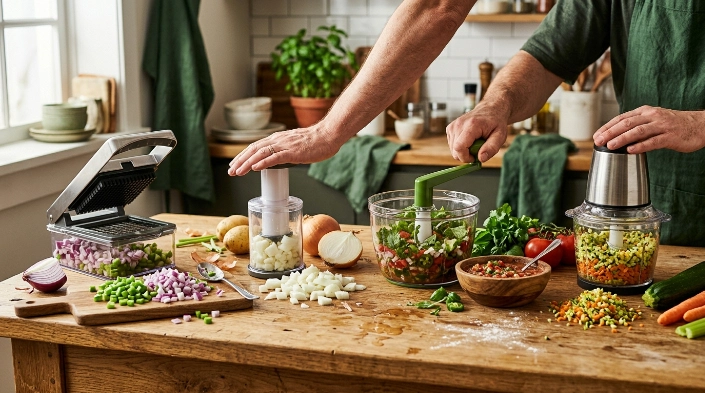
| Chopper Type | Blade Motion | Typical Result | Best For | Main Limitation |
|---|---|---|---|---|
| Grid press | Food moves through fixed blades | Uniform cubes or strips | Onions, peppers, potatoes, zucchini | Needs enough force for dense produce |
| Plunger | Blade moves vertically with each press | Coarse to fine chop | Onions, herbs, garlic, nuts | Less uniform than a fixed grid |
| Manual rotating | Curved blades spin around a shaft | Coarse chop to fine mince | Salsa, herbs, onions, mixed ingredients | Can over-process soft foods |
| Electric | Motor-driven rotating blades | Rapid coarse or fine chop | Larger batches and frequent prep | Easy to process food too finely |
Why Do Some Choppers Make More Even Pieces?
Uniformity mainly comes from blade geometry and controlled movement. A fixed grid forces every piece through openings with the same dimensions.
A rotating blade follows different paths through the bowl, so the final pieces naturally vary more.
- Blade spacing: Determines the basic width of grid-cut pieces.
- Blade sharpness: Affects whether food is sliced cleanly or crushed.
- Food placement: Flat, centered pieces move through a grid more predictably.
- Vegetable firmness: Crisp produce holds its shape better during cutting.
- Pressure: A firm, controlled movement usually gives a cleaner result than hesitant pressure.
For recipes where cooking time depends on even pieces, that consistency can be useful. Similar-size vegetables tend to cook more evenly than a mixture of tiny fragments and large chunks.
Which Vegetables Work Best in a Vegetable Chopper?
Firm vegetables with enough structure usually give the cleanest results. I prefer to think about texture rather than creating one rule for every vegetable.
- Onions: Excellent for grid, plunger, and rotating choppers.
- Bell peppers: Work well after removing the stem, seeds, and thick inner ribs.
- Zucchini: Easy to dice, although very soft zucchini can release moisture.
- Cucumbers: Chop cleanly when firm and fresh.
- Carrots: Work better when first cut into shorter, thinner pieces.
- Potatoes: Suitable for sturdy grid choppers but often require more downward force.
- Celery: Can work well, though long fibers may occasionally cling to blades.
- Tomatoes: Best with sharp rotating blades or choppers designed for softer produce.
Using a chopper can make it easier to prepare a larger variety of produce for meals. If that is your goal, this guide to the benefits of vegetables in your daily diet gives more ideas for adding them regularly.
Why Does a Vegetable Chopper Sometimes Crush Food Instead of Cutting It?
Crushing usually happens when the vegetable deforms before the cutting edge passes completely through it. Dull blades, overfilling, soft produce, and excessive thickness all contribute.
- Dull blade: Pushes against the vegetable instead of entering it cleanly.
- Oversized pieces: Require more force than the mechanism can comfortably deliver.
- Overfilled chamber: Prevents rotating blades from moving freely.
- Very ripe produce: Collapses easily under pressure.
- Wrong blade insert: May create more resistance than a wider cutting grid.
My simplest rule is to pre-cut anything that feels awkwardly large for the chopper. A few seconds of preparation often saves much more effort during the actual cut.
How Should You Use a Vegetable Chopper Safely?
The blades inside a vegetable chopper may be partly hidden, but they still need the same respect as a sharp knife. Never test blade sharpness with your fingertip.
- Wash the produce before cutting it.
- Place the chopper on a stable, dry work surface.
- Pre-cut vegetables that are too large for the chamber or grid.
- Use the supplied pusher, guard, lid, or handle rather than your fingers.
- Keep fingertips away from exposed blade inserts during assembly.
- Stop if a piece jams instead of adding uncontrolled force.
- Disassemble the tool according to its manufacturer’s instructions.
- Handle loose blade inserts by their safe edges or designated grips.
The FDA recommends washing fresh produce under running water before preparation and keeping produce away from surfaces or utensils contaminated by raw meat. You can review its fresh produce safety guidance for more detail.
Should You Wash Vegetables Before or After Chopping?
Wash whole vegetables before putting them into the chopper. Cutting first creates many extra exposed surfaces and makes small pieces harder to rinse and dry effectively.
For ordinary fresh produce, rinse under clean running water rather than using dish soap. Firm produce such as cucumbers can also be scrubbed with a clean produce brush.
- Wash first: Helps remove surface soil before a blade carries it inward.
- Dry when practical: Reduces slipping and excess moisture during chopping.
- Remove damaged areas: Trim bruised or spoiled sections before processing.
- Keep prep areas separate: Avoid using unwashed meat-prep utensils for ready-to-eat vegetables.
FoodSafety.gov also summarizes home food handling around four principles: clean, separate, cook, and chill.
Does Chopping Vegetables Reduce Their Nutrition?
Chopping does not suddenly remove the fiber, minerals, or most nutrients from a vegetable. It mainly changes physical size and increases the amount of cut surface exposed to air.
For everyday meal preparation, the practical approach is simple: chop vegetables reasonably close to when you plan to cook, serve, or store them.
- Fiber remains: Cutting changes size, not the presence of dietary fiber.
- Exposure increases: Smaller pieces have more surface area in contact with air.
- Storage matters: Keep prepared perishable vegetables refrigerated when needed.
- Variety still counts: Chopped, whole, cooked, frozen, and other forms can all contribute to vegetable intake.
The USDA’s MyPlate Vegetable Group guidance includes whole, cut-up, cooked, raw, fresh, frozen, canned, dried, and puréed vegetables.
How Do You Clean a Vegetable Chopper Without Cutting Yourself?
Disconnect or disassemble the tool before cleaning it, following the manufacturer’s instructions. Treat every removable blade insert as you would a sharp kitchen knife.
- Remove food first: Shake or rinse loose pieces away rather than digging between blades.
- Use the cleaning tool: Many grid choppers include a small brush or pick for clearing the pusher plate.
- Rinse from the safer side: Avoid pushing a sponge directly toward an exposed cutting edge.
- Check dishwasher guidance: Not every lid, mechanism, or blade assembly is dishwasher safe.
- Dry thoroughly: Moisture left around metal components or enclosed mechanisms can shorten useful life.
- Store assembled safely: Keep loose sharp inserts covered or locked away from children.
Cleaning matters because bits of vegetables can lodge around blade frames and joints. Good cleaning habits also support the broader prep routines in these essential cooking skills for home cooks.
Is a Vegetable Chopper Faster Than Using a Knife?
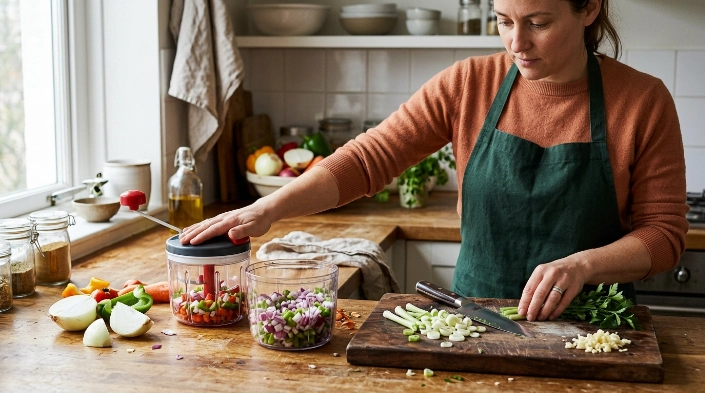
A vegetable chopper can be faster when you need many similar pieces. The advantage becomes most noticeable with repeated jobs such as dicing several onions or peppers.
A knife may still be quicker when you only need one or two cuts because the knife has almost no assembly or cleanup time.
- Choose a chopper: For repeated dice, batch meal prep, salsa ingredients, or multiple vegetables.
- Choose a knife: For trimming, irregular cuts, delicate produce, or a tiny amount of food.
- Use both: Pre-cut large vegetables with a knife, then finish them in the chopper.
That combined approach fits well with other strategies for saving time while cooking daily meals.
What Should You Look for in a Vegetable Chopper?
The right mechanism matters more than the number of accessories in the box. Choose a tool that matches the texture and cut style you make most often.
- Sharp replaceable or durable blades: Cleaner cuts require less force.
- Stable base: Non-slip feet or a wide container help control movement.
- Useful blade spacing: Pick grid sizes that match your usual recipes.
- Simple cleaning: Fewer inaccessible corners make regular cleanup easier.
- Safe storage: Blade covers or contained inserts reduce accidental contact.
- Appropriate capacity: Small bowls suit herbs and onions, while larger containers suit batch prep.
If you’re ready to pick one, here are three different chopper styles I’d consider based on how they cut rather than simply how many accessories they include:
🏆 Best for Uniform Dice
Fullstar Original Vegetable Chopper
★★★★★
Its press-through blade design is aimed at fast, repeatable vegetable prep with a catcher container underneath. I’d choose this style when consistent onion, pepper, zucchini, or potato pieces matter most.
🥗 Best Compact Press Chopper
OXO Good Grips Vegetable Chopper with Easy-Pour Opening
★★★★☆
This model uses a stainless-steel blade pattern and a recessed cutting area, with an opening for pouring prepared food out. I’d consider it for smaller everyday chopping jobs where compact storage matters.
🌿 Best for Variable Texture
OXO One Stop Chop Manual Food Processor
★★★★☆
Its rotating manual blade system lets you control texture by changing how long you operate it. I’d pick this format for salsa, herbs, nuts, onions, and mixtures where coarse-to-fine control matters more than square dice.
Frequently Asked Questions
Does a vegetable chopper slice or crush vegetables?
A sharp vegetable chopper should slice through vegetable tissue rather than simply crush it. Crushing becomes more likely with dull blades, very soft produce, oversized pieces, or an overloaded cutting chamber.
Can a vegetable chopper cut hard vegetables like carrots and potatoes?
Yes, many sturdy grid choppers can cut carrots and potatoes, but hard vegetables create more resistance. Cut them into manageable sections first and never force a mechanism beyond what its manufacturer recommends.
Why does my vegetable chopper get stuck?
A chopper usually sticks because the food is too thick, too hard, badly positioned, or caught between the blades. Remove the pressure, reposition or pre-cut the ingredient, and clear the tool safely rather than forcing the lid closed.
Are vegetable chopper blades supposed to be extremely sharp?
They need a sharp cutting edge to work efficiently with reasonable pressure. Because many blades are hidden inside grids or cartridges, always assume they are sharp and avoid touching the cutting surfaces during cleaning or assembly.
Can I use a vegetable chopper for fruit?
Yes, depending on the model. Firm apples, pears, and similar fruits can work well in grid choppers, while rotating choppers may suit softer fruit better. Very ripe fruit can become crushed or puréed instead of cleanly chopped.
Final Takeaway
A vegetable chopper cuts vegetables by concentrating force through sharp blades. Grid choppers push food through fixed blades, while plunger, rotating, and electric designs move their blades through the food instead.
The best results come from matching the mechanism to the ingredient. Firm vegetables suit grid systems, while rotating choppers give you more control over coarse and fine textures.
Keep the blades clean, avoid overfilling, pre-cut oversized ingredients, and protect your fingers during assembly and washing. Once those habits become automatic, a good chopper can make everyday vegetable prep noticeably simpler.
