Push-Down Vegetable Chopper for Potatoes: How to Use

Quick Answer
A push-down vegetable chopper can cut raw potatoes into cubes if its blade grid is designed for firm vegetables. Wash and peel the potatoes if desired, trim them into manageable pieces, position each piece flat on the grid, and press the lid using controlled, even pressure. Never force a resistant chopper; check the manufacturer’s instructions for permitted foods and blade compatibility.
A push-down vegetable chopper for potatoes is useful for preparing evenly diced pieces for soups, stews, curries, hash, and other dishes. Its success depends on the chopper’s blade design, the potato’s size, and how the potato is positioned before pressing.
The main challenge is that raw potatoes are firm enough to resist a small cutting grid, especially when a large piece sits unevenly across the blades. Preparing the potato correctly can make cutting easier without placing unnecessary strain on the tool.
Can a Push-Down Vegetable Chopper Cut Raw Potatoes?
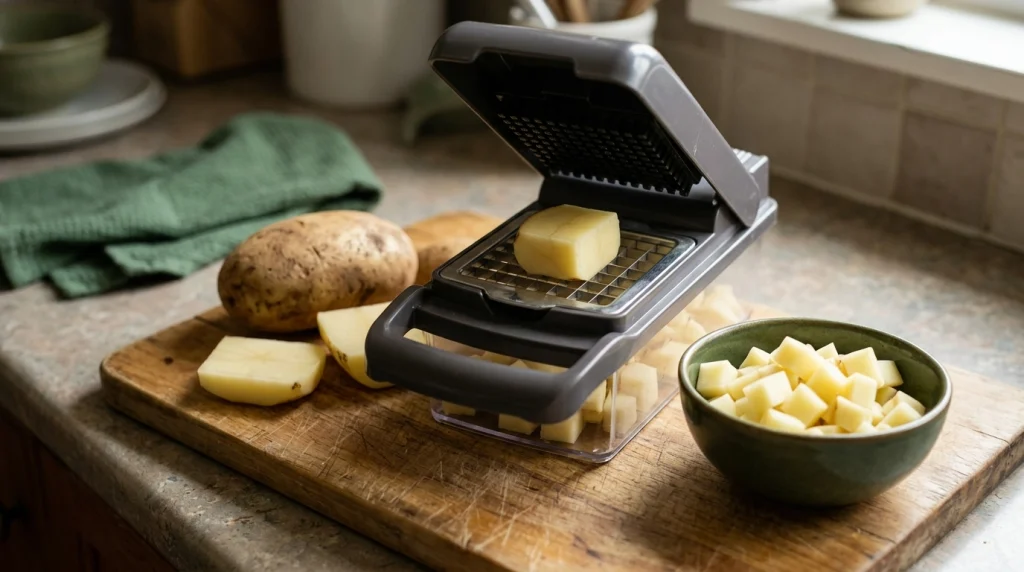
Yes, many manual push-down choppers can dice raw potatoes, but not every model is suitable for them. Some manufacturers approve potatoes for their dicing grids, while others warn against particularly hard vegetables or restrict which ingredients their blades can handle.
Check your model’s instructions before using it. For example, the Cuisinart CTG-00-VC instruction booklet includes potatoes among its suggested foods and recommends preparing them into smaller pieces for certain cuts.
A chopper that works well for onions may not perform equally well with a whole potato. Potatoes generally require more force to cut than softer produce, so the tool’s intended use matters more than the number of attachments included.
How to Prepare Potatoes Before Using the Chopper
Good preparation reduces uneven cuts and helps prevent the potato from jamming between the pusher and blade grid. Follow these steps before assembling the cutting tool.
- Wash the potatoes. Rinse them under running water and scrub away visible dirt. If you plan to peel them, use a vegetable peeler after washing.
- Remove damaged areas. Cut away bruised or spoiled sections. If a potato has extensive decay or an unusual smell, discard it rather than trying to salvage it.
- Trim oversized potatoes. Cut large potatoes into halves or smaller sections that fit comfortably within the cutting area. The required size varies by model.
- Create a stable, flat surface. When practical, trim a small portion so the potato piece rests securely on the grid without rocking or tilting.
- Check the cut size. Confirm that the prepared piece fits the grid and does not extend beyond its edges. Do not stack several pieces unless the manufacturer specifically allows it.
Peeling is optional for many recipes. Leaving the skin on can be appropriate when the potatoes are clean and the recipe calls for it, but removing it may help if the skin is thick or the desired result requires peeled potatoes.
Tip
Prepare a single potato piece that sits flat and fits inside the grid. A stable starting position is more useful than trying to process the largest possible piece in one press.
How to Cut Potatoes With a Push-Down Vegetable Chopper
Once the potatoes are prepared, assemble the chopper according to its manual and select a blade intended for dicing. Keep your fingers away from the cutting edges throughout the process.
- Set up the chopper. Place the collection container on a level, stable surface. Fit the correct blade securely into its designated position and confirm that the lid and container align properly.
- Choose the appropriate grid. Use the small or large dicing blade according to the recipe and the manufacturer’s guidance. A smaller grid does not automatically mean easier cutting.
- Position the potato. Place one prepared piece in the center of the cutting grid, with its flatter side facing down when the design permits. Keep the piece within the grid’s boundaries.
- Close the pusher or lid. Make sure the potato is correctly positioned and the lid can close as intended. Keep your hands on the designated pressing surfaces.
- Press with controlled force. Follow the manufacturer’s prescribed motion, using both hands if instructed. Do not rock the unit, strike the lid, or force the mechanism if it meets strong resistance.
- Check the result. Open the chopper only as directed and inspect the cut pieces. If the potato has not passed through completely, stop and determine why before attempting another cut.
- Empty the container as needed. Remove the diced potatoes before the container becomes overfilled or the pieces interfere with the cutting mechanism.
The finished pieces should be reasonably consistent in size when the potato fits the grid correctly. If a piece remains partly cut, do not reach through the grid to pull it free; follow the model’s safe clearing procedure instead.
Which Blade Should You Use for Potatoes?
The correct blade depends on the shape you need and which attachments your chopper supports. Dicing grids create cubes, while separate slicing blades create flat pieces that may be better suited to certain recipes.
| Blade type | Typical result | Potential use |
|---|---|---|
| Small dicing grid | Smaller cubes | Soups, finely diced vegetables, and some curry preparations |
| Large dicing grid | Larger cubes | Stews, chunky vegetable dishes, and potato hash |
| Slicing blade | Flat slices | Potato chips, gratins, and layered potato dishes |
These are general uses, not a guarantee that every chopper includes all three attachments. Check the supplied blade set and instructions before selecting a cutting method.
Also distinguish between a grid-style vegetable chopper and a dedicated French-fry cutter. A dicing grid produces cubes, while a fry cutter uses a different arrangement designed to produce sticks. A potato chopper should not be assumed to make uniform fries unless its cutting attachment is designed for that purpose.
Why Does a Push-Down Chopper Struggle With Potatoes?
If the lid will not close or the potato stops halfway through, forcing it can bend the cutting grid, damage the pusher, or cause the unit to slip. Stop pressing and check the likely cause.
The potato piece is too large
A piece that extends beyond the grid may not enter the blades evenly. Remove it using the manufacturer’s safe procedure, cut it smaller with a separate kitchen knife on a stable cutting board, and try again only if the model permits the prepared piece.
The potato is poorly positioned
A rounded or uneven piece may rock or contact the grid at an angle. A stable, flat starting surface can help distribute pressure across the intended cutting area, provided the food remains entirely within the grid.
The grid is blocked
Potato fragments can obstruct the cutting openings or collection area. Stop using the chopper, keep your fingers clear, and remove the obstruction only after following the manufacturer’s instructions for opening and clearing the unit.
The model is not suitable for hard produce
Some choppers are intended for a narrower range of ingredients. The Fullstar 9-in-1 chopper manual, for example, warns against certain hard vegetables, including sweet potatoes. This illustrates why the instructions for your exact model should take priority over generic advice.
Warning
Never use your body weight, a hammer, or another object to force a stuck lid down. Do not push potato pieces through the grid with your fingers or attempt to clear the blades while the mechanism is under pressure.
How to Get More Even Potato Pieces
Uniformity depends on both the blade grid and how the potato is prepared. A grid can only produce its intended shape when the food enters correctly and the mechanism completes its cutting motion.
- Use similarly sized pieces. When preparing several potatoes, trim them into manageable sections that fit the grid rather than alternating between whole potatoes and tiny scraps.
- Keep the blade area clear. Empty the container before accumulated pieces obstruct the space beneath the cutting grid.
- Match the blade to the recipe. Smaller cubes may suit soups, while larger cubes may work better in dishes where the potato should retain a chunkier texture.
- Inspect incomplete cuts. If the pieces are connected by uncut sections, check positioning, blade installation, and ingredient suitability before continuing.
- Finish oversized pieces separately. If a few pieces remain larger than the rest, trim them safely on a cutting board instead of repeatedly forcing them through the chopper.
Even cuts can help potatoes cook more consistently, although cooking time also depends on the potato variety, preparation method, and the size of the pieces. Do not assume that a particular grid guarantees a specific cooking time.
Should You Cut Potatoes Raw or Cook Them First?
For most grid-style push-down choppers, raw potatoes are the appropriate starting point when the manufacturer explicitly permits them. Raw potato holds its shape during cutting, whereas cooked potato may crumble or compress rather than pass cleanly through the grid.
Do not assume that cooking a potato first will make a resistant chopper safer or easier to operate. Soft, cooked potatoes can clog a blade or produce mashed pieces instead of neat cubes. Use cooked potatoes only if the manufacturer specifies that the particular attachment is suitable for soft foods.
For potato salad, for example, you may prefer to dice raw potatoes using an approved chopper and then cook them, or cook larger pieces and cut them afterward with a knife. The best method depends on the desired shape, recipe, and the tool’s permitted use.
How to Clean the Chopper After Cutting Potatoes
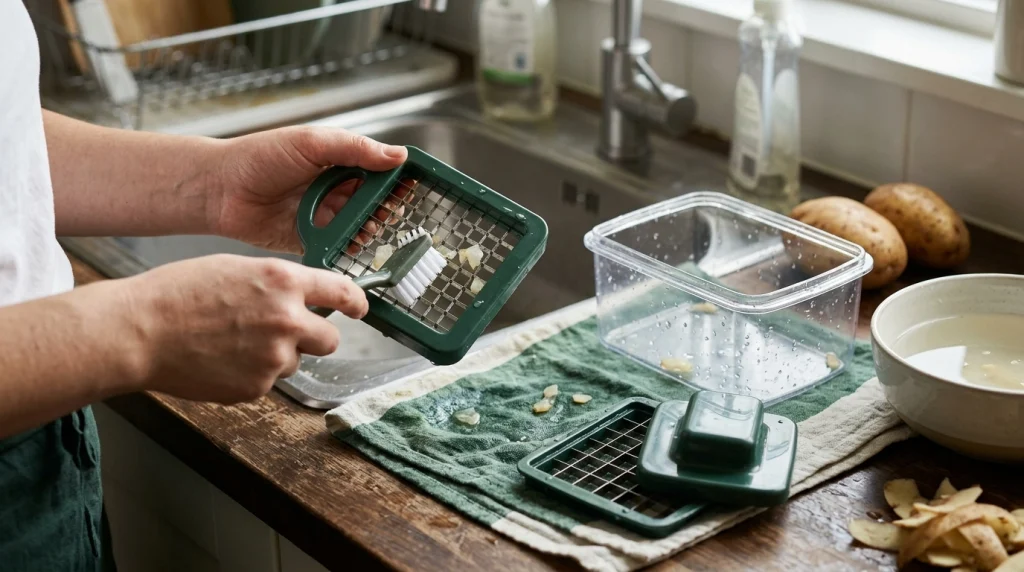
Clean the chopper promptly after use so potato residue does not dry inside the grid or around the pusher. Before disassembling it, make sure the mechanism is fully open and follow the manufacturer’s instructions for safely removing sharp attachments.
- Remove the remaining potato pieces from the collection container.
- Detach the blade only as directed, holding it by its frame or designated safe handling area.
- Rinse away loose residue and use the supplied cleaning brush or another manufacturer-approved tool to clear the grid.
- Wash the removable parts with the recommended method, using mild dish soap when appropriate.
- Rinse and dry the components thoroughly before storing them in their designated positions.
Do not drag your fingers across the blade edges or use a knife to dig food out of the grid. Dishwasher suitability varies by model, so check the care instructions before placing any component in a dishwasher.
Frequently Asked Questions
Can I use a push-down vegetable chopper for sweet potatoes?
Only if the manufacturer explicitly permits sweet potatoes for your model and attachment. Sweet potatoes can be particularly hard to cut, and some chopper manuals warn against using them because they may damage the blades.
Should I peel potatoes before using a vegetable chopper?
Peeling is optional for many recipes. Wash the potatoes thoroughly first, and peel them when the recipe or the condition of the skin calls for it.
Why do my potatoes get stuck in the blade grid?
The piece may be too large, unevenly positioned, or unsuitable for the blade. A blocked collection area or an incompatible attachment can also interfere with cutting. Stop and clear the obstruction according to the manual.
Can a push-down vegetable chopper make French fries?
Only when it has a suitable fry-cutting attachment. An ordinary dicing grid generally makes cubes rather than the long sticks associated with French fries.
Can I put cooked potatoes through a push-down chopper?
Do so only if the manufacturer approves the attachment for cooked potatoes. Soft potatoes can compress or crumble, so a knife or an appropriate potato tool may be better for cooked ingredients.
How do I know if my vegetable chopper is safe to use with potatoes?
Check the manual for permitted ingredients, blade compatibility, and preparation instructions. If the unit or blade is damaged, the lid does not align correctly, or the potato requires excessive force, stop using it until the issue is resolved.
Conclusion
A push-down vegetable chopper can simplify potato preparation when its blades are designed for raw potatoes and the pieces are prepared to fit the grid. Wash the potatoes, trim oversized sections, position each piece securely, and use the prescribed pressing motion rather than forcing the lid.
If the chopper repeatedly jams or requires excessive force, stop and check the blade, positioning, and manufacturer’s instructions. Choose a dedicated fry cutter when you need potato sticks, and use a knife or another suitable tool when the chopper cannot safely handle the ingredient. Careful preparation, correct blade selection, and prompt cleaning help keep potato cutting practical and safe.