Vegetable Choppers with Interchangeable Blades: A Practical Guide for Smarter Prep

A vegetable chopper with interchangeable blades is built for one main job: giving you more than one cutting style in a single tool. Instead of being limited to one fixed cut, you can swap inserts to dice, slice, grate, or julienne depending on what you’re making.
For home cooks, that flexibility can be useful in very ordinary situations. You might dice onions for soup, slice cucumbers for lunch prep, grate carrots for slaw, and switch to a finer cut for garnish or salad toppings. The appeal is not just speed. It is also consistency, especially if you want vegetables that cook evenly or look more uniform in a meal prep container.

That said, more blades do not automatically mean a better tool. The real value depends on how often you use those cut styles, how easy the blade system is to manage, and whether the chopper is sturdy enough for the foods you prep most often.
What a Vegetable Chopper with Interchangeable Blades Is
A vegetable chopper with interchangeable blades is a manual food prep tool that uses removable cutting inserts. Each blade or insert is designed for a different cut, so the same base unit can perform more than one task.
In practical terms, that means you are not buying a single-purpose chopper. You are buying a small cutting system. One blade may be for dicing onions, another for slicing zucchini, and another for grating carrots or cheese. Some models also include a julienne insert or a mandoline-style cutter for thinner, stick-like cuts.
This setup is especially appealing in kitchens where storage space matters. Instead of keeping several separate tools, you keep one base and a set of blades. The trade-off is that you also have more parts to track, clean, and store safely. On some models, the blades are true interchangeable inserts that lock into the base, while on others the cutting pieces function more like add-on accessories or trays, so it helps to check how the system actually attaches before buying.
How Interchangeable Blades Work in Real Kitchen Use
The main benefit of interchangeable blades is that they change the cut without requiring a different appliance. You prepare the ingredient, choose the blade, lock it into place, and press or move the food through the cutting surface depending on the design.
That can make prep more efficient when you are cooking different dishes in one session. For example, you might use a dicing blade for onions and peppers, then switch to a slicing blade for cucumbers or mushrooms. If you are meal prepping several containers at once, that flexibility can reduce the number of tools you reach for.
It also helps with consistency. A sharp, properly fitted blade often produces more even cuts than hand chopping alone, especially for repetitive prep tasks. But the result still depends on the model, the blade quality, and the ingredient itself. Soft tomatoes, for instance, may crush more easily than firmer vegetables.
The practical question is whether your cooking style actually benefits from switching blades. If you only ever dice onions, a simpler fixed-blade chopper may be easier to live with.
Common Blade Types and the Cuts They Produce
Different blade types serve different prep jobs. If you understand the cut style each one creates, it becomes much easier to choose a set that matches your kitchen habits.
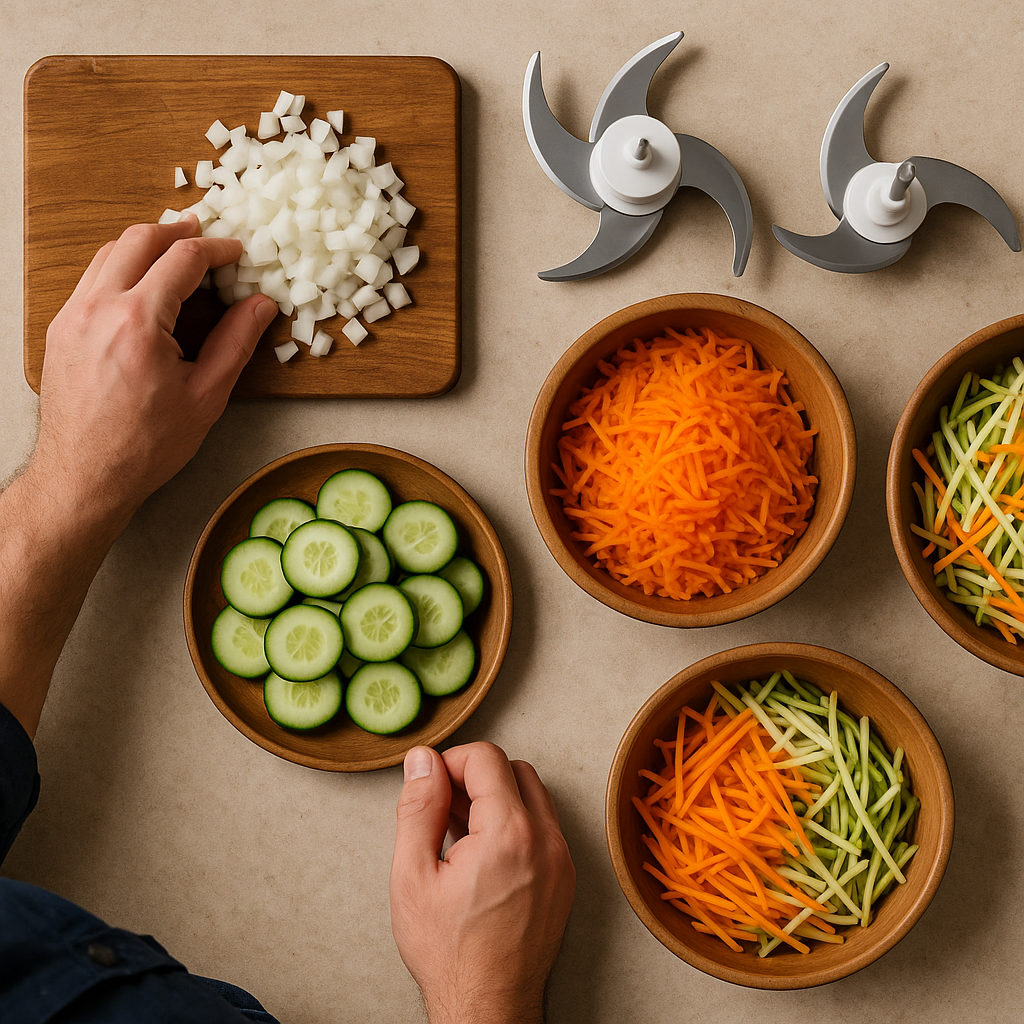
| Blade type | Typical cut | Best for | Main trade-off |
|---|---|---|---|
| Dicing blade | Small cubes or chunks | Onions, peppers, potatoes, carrots | Best for uniform pieces, but not ideal for very soft produce |
| Slicing blade | Thin or medium slices | Cucumbers, zucchini, mushrooms, potatoes | Fast for salads and gratins, but less versatile than a dicing insert |
| Grating blade | Fine shreds | Carrots, cheese, cabbage | Useful for slaws and toppings, but can clog with wet ingredients |
| Julienne blade | Thin matchstick cuts | Carrots, zucchini, peppers | Good for stir-fries and garnish, but usually more limited in use |
| Mandoline-style cutter | Very thin slices | Potatoes, cucumbers, onions | Efficient for thin, even slices, but requires careful handling |
A dicing blade is the most common “everyday” choice because it fits a lot of recipes. If you make soups, stews, salsa, or meal prep bowls, uniform diced vegetables are useful. Slicing blades make more sense if you often prepare salads, roasted vegetable trays, or layered dishes. Grating and julienne blades are more specialized, but they can be worth having if you use them regularly.
The key is not to buy the biggest blade set just because it looks complete. A smaller set that matches your actual cooking is often more practical.
What Foods These Choppers Handle Well—and Where They Struggle
A vegetable chopper with interchangeable blades can handle many common ingredients, but performance varies by texture.
Onions are usually one of the best uses. They cut cleanly, and a dicing blade can save time while reducing the uneven pieces that happen with rushed knife work. Peppers also tend to work well when the chopper has enough opening space and a sharp blade.
Potatoes are often manageable too, especially when the model is sturdy and the blade is intended for firmer produce. That said, harder vegetables can put more strain on lighter plastic-body tools. If the chopper flexes too much, the cut may become uneven or require extra force.
Tomatoes are trickier. Their soft flesh can crush or smear rather than cut cleanly, especially if the blade is dull or the food is overripe. If tomatoes are a major use case, look for a model that is known for clean slicing and avoid expecting perfect cubes from a manual chopper.
Other firm vegetables like carrots, celery, and cucumbers are usually good candidates. Very hard produce, such as dense squash varieties, may be less suitable unless the manufacturer specifically says the tool can handle them.
A useful rule: if the ingredient is firm enough to resist squashing but not so hard that it demands heavy force, a manual multi-blade chopper is more likely to work well.
Interchangeable-Blade Choppers vs Fixed-Blade Choppers
A fixed-blade chopper is simpler. You use one cutting style, clean fewer parts, and spend less time swapping inserts. That can be a strong advantage if your prep is repetitive and predictable.
An interchangeable-blade model gives you more flexibility. If you cook a wider range of recipes, that versatility can be more valuable than simplicity. You can move from diced onions to sliced cucumbers without switching tools.
Here is the practical trade-off:
- Choose fixed blades if you mostly want one cut, want fewer parts, or prefer a tool that is quick to set up.
- Choose interchangeable blades if you regularly prep different vegetables in different styles and want one compact system to do it.
The extra blade options are worth paying for only when you will actually use them. If half the inserts sit unused in a drawer, you are paying for convenience you do not need.
Manual Chopper vs Electric Food Processor
A manual vegetable chopper with interchangeable blades is not the same thing as an electric food processor. They solve overlapping problems, but at different scales.
A manual chopper is usually better for smaller batches, quick prep, and kitchens where storage space is limited. It is also simpler to grab for a few onions or a salad ingredient without setting up a larger appliance.
An electric food processor makes more sense when you process larger amounts at once or want more power for tougher tasks. It can be useful for big meal prep sessions, but it usually takes more counter space, more cleanup, and a bigger budget.
For a home cook making dinner ingredients or several lunch containers, a manual multi-blade chopper is often enough. For batch cooking large amounts of vegetables or working through heavy prep regularly, an electric appliance may be more efficient.
Key Features to Look for Before Buying
When comparing models, focus on the features that affect everyday use rather than the number of blades alone.
Blade material and sharpness
Stainless steel blades are commonly preferred because they are often more durable and better suited to repeated use than lower-quality alternatives. Still, stainless steel is not automatically equal across all products. Blade thickness, edge quality, and fit matter too.
If the blade feels flimsy or the edge looks rough, the cut quality may suffer sooner.
Blade count and actual usefulness
A larger blade count is not always better. It helps to check whether the set includes the cut styles you will actually use most often. For many kitchens, a small set with one good dicing blade, one slicing blade, and maybe one grating or julienne insert is more practical than a large bundle of niche pieces.
Body construction
Plastic-body models are often lighter and less expensive, which can be fine for occasional use. More durable builds may feel steadier during pressing and hold up better over time. If you prep vegetables often, a sturdier frame is usually worth prioritizing.
Stability and grip
A stable base matters more than many shoppers expect. If the chopper slips while you press, prep becomes slower and less safe. Look for a design that sits securely on the counter or cutting board.
Capacity and container size
Think about the amount you usually prep at once. A small container may be fine for one onion or a few cucumbers, but it can become annoying if you are preparing several servings. Oversized containers are not always better, though, especially in small kitchens.
Dishwasher-safe parts
Dishwasher-safe parts can make cleanup easier, but check the manufacturer’s instructions carefully. Not every blade or plastic component tolerates the same washing method. If you dislike hand washing, this feature may matter more than extra inserts.
Storage and organization
More blades mean more storage needs. A good set should include a safe way to keep inserts organized and protected. Loose blades are inconvenient and create avoidable safety risks.
Replacement blades and secure locking
Before you buy, it can also be worth checking whether replacement blades are available from the manufacturer and whether the inserts lock securely into place. That combination can make the chopper easier to keep using over time and less frustrating if a part wears out.
Safety Tips for Changing, Using, and Storing the Blades
Sharp inserts demand more care than a basic plastic chopper. The main risks usually happen when swapping blades, washing them, or storing them loosely in a drawer.
A few practical habits help reduce the risk:
- Handle blades one at a time, not in a pile.
- Keep fingers away from the cutting edge when locking or removing inserts.
- Set the chopper on a stable surface before pressing food through it.
- Do not rush the swap process, especially if the blade system uses clips or tabs.
- Use a blade guard, caddy, or dedicated storage case if one is included.
- Store blades out of reach of children.
It also helps to wash blades carefully rather than reaching into soapy water without looking. A sponge or brush is safer than running a hand over a sharp insert.
If the model includes a locking mechanism, use it every time. A blade that is not seated correctly can shift during use and affect both the cut and the safety of the tool.
Cleaning and Maintenance: What to Expect
Cleaning is one of the biggest factors in whether a chopper gets used often or ends up forgotten in a cabinet.
A simple fixed-blade tool may be easier to rinse quickly, but interchangeable-blade models can still be manageable if the parts come apart cleanly. The main challenge is food trapped around the blade edges, hinges, or container corners. Onion pieces, grated carrot, and soft produce can cling to surfaces if you wait too long before cleaning.
If parts are dishwasher-safe, that can reduce effort, but it does not eliminate the need for careful handling. Blades may still need pre-rinsing so food does not dry on them. If the manufacturer recommends hand washing, follow that guidance to avoid dulling or damaging the inserts.
For long-term maintenance, dry the blades fully before storing them. Moisture can shorten the useful life of metal parts or leave unpleasant residue on plastic components. A quick towel dry after washing is a small step that can prevent bigger problems later.
Who Gets the Most Value from This Type of Chopper
This type of chopper is most useful for people who prep the same vegetables in different ways.
Meal preppers often benefit the most because they can move from diced onions to sliced cucumbers to grated carrots without changing tools. If you make several lunches at once, that versatility can save time and keep cuts more consistent across containers.
Home cooks who make a lot of soups, salads, stir-fries, or roasted vegetable dishes can also get strong value from it. The tool becomes more useful when your recipes call for varied cuts rather than one repeated task.
Budget-conscious shoppers should look closely at the blade set before buying. A lower-cost model is a better value if it includes the cuts you actually use. A larger set is not a bargain if half the inserts never leave the package.
If your cooking is simple and repetitive, a fixed-blade chopper may be enough. If your prep changes from recipe to recipe, interchangeable blades become much easier to justify.
Is It Worth Buying for Everyday Cooking?
A vegetable chopper with interchangeable blades is worth considering if you want more flexibility than a basic chopper and less bulk than a larger appliance. It can be a smart middle ground for everyday cooking, especially when you prep onions, peppers, cucumbers, carrots, and potatoes on a regular basis.
It is less compelling if you only need one cut style, dislike cleaning multiple parts, or want the simplest possible setup. In that case, a fixed-blade chopper may be the better buy.
The best approach is to match the blade set to your real routine. If the included blades cover your most common prep tasks, the tool can earn its place quickly. If not, the extra complexity is usually not worth it.
Frequently Asked Questions
What does interchangeable blades mean on a vegetable chopper?
It means the chopper uses removable cutting inserts or blades that can be swapped to create different cuts, such as dicing, slicing, grating, or julienne-style strips. On some models, the inserts lock into the base; on others, the design may work more like add-on accessories, so the exact mechanism can vary.
Which blade types usually come with these choppers?
Common options include dicing, slicing, grating, and julienne blades. Some sets also include mandoline-style inserts for thinner slices.
Can it handle onions, tomatoes, potatoes, and harder vegetables?
Usually, yes for onions and potatoes, and often for firmer vegetables like carrots and cucumbers. Tomatoes are more variable because soft produce can crush or smear depending on the blade and the ripeness of the fruit.
Is a vegetable chopper with interchangeable blades better than a regular chopper?
It is better if you need different cut styles and want one compact tool. A regular fixed-blade chopper can be better if you only use one cut and want simpler cleanup.
How easy is it to switch blades and clean the unit?
That depends on the design. Some models make blade changes quick and intuitive, while others require more careful alignment. Cleaning is easier when parts separate cleanly and the manufacturer allows dishwasher-safe washing.
What should I look for in a safe, durable model?
Look for sharp stainless steel blades, a stable base, a body that feels sturdy, and a safe storage method for the inserts. Also check the manufacturer’s instructions for cleaning and blade handling.
Are these choppers worth buying for everyday cooking?
Yes, if you regularly prep vegetables in different styles and want a faster, more consistent process. If your needs are simple, a basic chopper may be the better value.
When should I choose a larger appliance instead?
Choose a larger appliance if you prep big batches often, need more power for tougher ingredients, or want to process larger volumes with less manual effort.
