What Is a Vegetable Chopper? Types, Uses, and How It Works

Quick Answer
A vegetable chopper is a kitchen tool that cuts vegetables into smaller pieces with less repetitive knife work. Depending on the design, it can dice, chop, mince, slice, shred, or julienne ingredients. It is especially useful for onions, peppers, cucumbers, potatoes, carrots, and other meal-prep staples, and it can make organized food preparation easier.
What a vegetable chopper does
- Cuts vegetables: Sharp blades turn whole or pre-cut produce into smaller pieces.
- Saves repetitive work: One press, pull, or powered cycle can make several cuts at once.
- Improves consistency: Grid-style models can produce fairly even cubes for salads, soups, and sautés.
- Contains ingredients: Many designs collect chopped food in a bowl or container.
- Offers different cuts: Multi-function models may include slicing, grating, or julienne inserts.
Before you use one
- Wash produce, trim oversized pieces, keep fingers away from exposed blades, and follow the chopper manufacturer’s cleaning instructions.
A vegetable chopper looks simple, but the term covers several different tools. Some make neat cubes, while others create a rough chop more like a small food processor.
I find the easiest way to understand these tools is to focus on the cutting mechanism. Once you know how the blade moves, it becomes much easier to decide what the chopper can handle.
What Is a Vegetable Chopper?
A vegetable chopper is a manual or electric food-preparation tool designed to cut produce into smaller pieces. It reduces the number of individual knife strokes needed during everyday meal preparation.
Simple definition: A vegetable chopper uses fixed or moving blades to chop, dice, mince, slice, or shred vegetables by pressing, pulling, pumping, cranking, or using an electric motor.
A basic grid chopper usually has a blade insert, hinged lid, and collection container. You place a manageable piece of vegetable over the blade and close the lid firmly.
Other designs use rotating blades inside a bowl. Pull-cord and electric versions fall into this group.
- Grid chopper: Pushes food through square or rectangular blades.
- Pull-cord chopper: Spins internal blades when you pull a cord.
- Push or pump chopper: Rotates blades as you repeatedly press the handle.
- Electric chopper: Uses a motor to spin a blade inside a bowl.
- Multi-function chopper: Adds slicers, graters, julienne blades, or spiralizing attachments.
How Does a Vegetable Chopper Work?
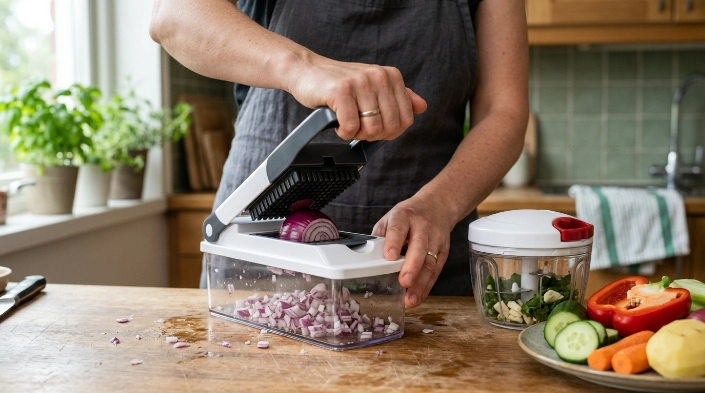
A vegetable chopper works by forcing food against a sharp cutting surface. The exact motion depends on whether the blades stay fixed or rotate.
With a grid model, the vegetable moves through the blades. With bowl-style models, the blades move through the vegetable.
How does a grid vegetable chopper work?
A grid chopper uses intersecting blades arranged in a pattern. Closing the lid presses the ingredient through those openings and into a container below.
This design works well when you want repeatable pieces. Onion, bell pepper, cucumber, zucchini, and potato are common examples.
- Wash the vegetable under running water.
- Trim stems, roots, damaged sections, or tough ends.
- Cut large vegetables into pieces that fit the chopping area.
- Place one piece flat against the blade grid.
- Close or press the lid using steady pressure.
- Empty the collection container before it becomes overcrowded.
Do not force a piece that is too large or unusually hard. Cutting it into smaller sections first usually makes the tool easier to control.
How does a rotating vegetable chopper work?
A rotating chopper places one or more curved blades inside a bowl. Pulling a cord, pushing a handle, or powering a motor turns those blades through the ingredients.
The result is usually less geometrically uniform than a grid dice. However, it works well for salsa ingredients, herbs, onions, nuts, and quick rough chopping.
What Can You Use a Vegetable Chopper For?
A vegetable chopper is most useful for repetitive preparation. It can turn a pile of produce into recipe-ready pieces without requiring advanced knife skills.
I especially like the concept for meals where several vegetables need similar-sized pieces. Chili, soups, omelets, salads, stir-fries, tacos, and casseroles are good examples.
- Onions: Dice them for sauces, soups, burgers, and sautés.
- Bell peppers: Create cubes for salads, eggs, fajitas, and stir-fries.
- Cucumbers: Prepare quick salad or salsa pieces.
- Potatoes: Cut manageable sections before pushing them through a sturdy grid.
- Carrots: Smaller pre-cut sections work better than forcing a whole thick carrot.
- Zucchini: Dice firm zucchini for soups, pasta dishes, or roasting.
- Mushrooms: Rough-chop them in a rotating model or dice firm mushrooms carefully.
- Firm fruit: Some models can also handle apples, pears, or similar ingredients.
Fresh produce should still be handled safely before chopping. The FDA recommends washing produce thoroughly under running water and keeping it separate from utensils or surfaces contaminated by raw meat, poultry, or seafood.
You can review the FDA’s produce safety guidance for more detailed preparation practices.
Vegetable Chopper vs Knife vs Food Processor: What Is the Difference?
A vegetable chopper sits between a chef’s knife and a full-size food processor. It trades some flexibility for quick, repetitive cutting.
The right option depends more on the result you want than on which tool looks more advanced.
| Tool | How It Cuts | Best For | Main Limitation |
|---|---|---|---|
| Grid vegetable chopper | Food is pressed through fixed blades | Consistent dice and repetitive prep | Hard or oversized food can require extra pre-cutting |
| Pull-cord chopper | Rotating blades move through food | Rough chopping, herbs, salsa, onions | Does not create true uniform cubes |
| Electric chopper | Motor spins internal blades | Fast chopping and small-batch mixing | Needs power and can over-process food |
| Chef’s knife | Hand-guided blade | Maximum control and almost any cut | Requires more technique and repetitive cutting |
| Food processor | Powered blades and optional discs | Large batches, shredding, slicing, mixing, puréeing | More parts, storage space, and cleanup |
If you’re still building basic prep habits, my guide to essential cooking skills explains why organization and safe cutting techniques matter just as much as the gadget you choose.
Is a Vegetable Chopper Worth Using?
A vegetable chopper is worth considering when chopping is one of the tasks that slows down your normal cooking routine. It is less compelling if you only prepare small amounts or already prefer using a knife.
The biggest benefit is not that it replaces every cutting tool. Its strength is performing the same simple cut repeatedly.
When does a vegetable chopper make sense?
- You regularly dice several onions, peppers, or potatoes.
- You prepare salads, soups, salsa, or meal-prep bowls in batches.
- You want pieces with similar dimensions.
- You prefer keeping chopped ingredients contained in one vessel.
- You have limited space for a large food processor.
- You want a non-electric option for routine prep.
When might you skip one?
- You only chop one small ingredient at a time.
- You already have confident knife skills and enjoy hand cutting.
- You dislike cleaning blade inserts and small crevices.
- You mainly need purées, dough mixing, or large-batch processing.
- You have little storage space for extra attachments.
My practical rule is simple: count how often the tool would solve a task you already do. A chopper that handles Tuesday-night onions every week earns its storage space more easily than one with ten attachments you never use.
Are Manual and Electric Vegetable Choppers the Same?
No. Manual choppers rely on your hand pressure or pulling motion, while electric versions use a powered motor.
Manual grid models are usually better for defined cubes. Electric bowl choppers are better when speed and rough chopping matter more than exact shape.
| Feature | Manual Chopper | Electric Chopper |
|---|---|---|
| Power source | Hand pressure, pull cord, crank, or pump | Electric motor |
| Typical result | Dice or controlled rough chop | Fine or rough chop depending on run time |
| Storage | Usually compact | Needs space for motor base, bowl, and cord |
| Control | Cut style determined mainly by blade design | Texture changes with pulse time |
How Do You Use a Vegetable Chopper Safely?
Vegetable chopper blades are sharp even when they look small. Treat every exposed insert with the same care you would give a kitchen knife.
The USDA’s food safety basics also emphasize keeping hands, surfaces, cutting boards, and utensils clean during food preparation.
- Use a stable surface: Place the chopper flat before applying force.
- Pre-cut oversized food: Do not use excessive pressure to force ingredients through the blades.
- Use the supplied cleaning tool: Avoid pushing food debris from sharp grids with your fingers.
- Keep blades covered: Store loose inserts where hands cannot accidentally contact the edges.
- Follow the manual: Dishwasher-safe claims can differ between the container, lid, and blade inserts.
- Separate raw foods: Clean the chopper thoroughly if it contacts ingredients that can contaminate ready-to-eat produce.
Good preparation habits matter beyond the chopper itself. My guide to fresh versus frozen vegetables can also help when deciding which produce makes sense for a recipe.
How Do You Clean a Vegetable Chopper?
Clean the chopper soon after use so vegetable fibers do not dry inside the grid or around moving parts. Always confirm which pieces the manufacturer says are dishwasher safe.
- Remove leftover food from the container.
- Separate removable blade inserts carefully.
- Rinse loose vegetable pieces away without touching cutting edges.
- Wash the parts according to the manufacturer’s instructions.
- Use a small cleaning tool for food trapped in blade grids or lid teeth.
- Let every component dry before reassembly or storage.
Pay extra attention to corners and grooves where onion, herbs, or wet vegetable pieces can become trapped. A design that comes apart easily is often more practical than a model with many complicated attachments.
Does Chopping Vegetables Make Them Less Healthy?
Chopping changes the size and exposed surface of a vegetable, but vegetables remain an important part of a balanced diet. The bigger practical issue is how you store and prepare cut produce afterward.
The USDA’s MyPlate guidance notes that vegetables may be raw or cooked and can be whole, cut, mashed, fresh, frozen, canned, or dried. You can explore the MyPlate Vegetable Group for examples.
Once vegetables are cut, refrigerate perishable items promptly when needed. Keep the storage container clean and avoid cross-contamination.
If eating more whole ingredients is your goal, see my guide to the benefits of eating fresh food for practical ways to build produce into everyday meals.
What Should You Look for When Buying a Vegetable Chopper?
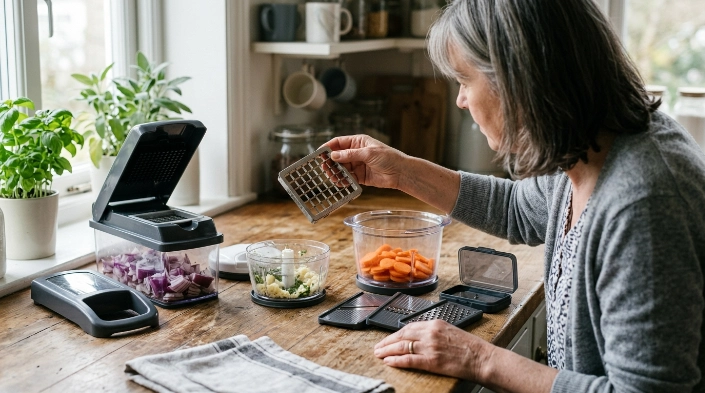
Start with the cutting style you actually need. A simple one-blade chopper can be more useful than a large attachment kit if you only dice onions and peppers.
- Blade design: Choose grid blades for defined cubes and rotating blades for rough chopping.
- Container size: Bigger bowls help with batch preparation but require more storage.
- Stable base: Non-slip feet or a secure base make pressing safer and easier.
- Easy disassembly: Fewer hidden gaps usually mean faster cleaning.
- Blade storage: Loose sharp inserts should have a safe storage method.
- Useful attachments: Pay for slicers and graters only if you expect to use them.
- Replacement parts: Check whether the brand supports replacement containers or accessories.
As of 2026, manual choppers range from simple one-purpose models to multi-blade prep systems. The best fit depends on your recipes, batch size, storage space, and tolerance for cleanup.
If you’re ready to pick one, here are three established styles I would compare first:
🏆 Best for Versatility
Fullstar Vegetable Chopper
★★★★☆
Fullstar’s multi-function chopper format combines grid-style vegetable prep with extra cutting options. I would consider it when you want one compact prep system for dicing, slicing, and similar everyday jobs.
🥕 Best Simple Design
OXO Good Grips Vegetable Chopper
★★★★☆
OXO offers a straightforward chopping design aimed at common fruits and vegetables without a large collection of loose accessories. I like this style for cooks who prioritize simple setup and storage over maximum attachment count.
🍅 Best Multi-Blade Option
Mueller Pro-Series Vegetable Chopper
★★★★☆
Mueller’s Pro-Series format is aimed at cooks who want several vegetable-prep functions in one manual set. I would compare it when blade variety matters more than owning the smallest possible chopper.
Frequently Asked Questions
What is a vegetable chopper used for?
A vegetable chopper is used to cut produce into smaller pieces with fewer repetitive knife strokes. Depending on its blade system, it may dice onions, chop peppers, slice cucumbers, shred vegetables, mince herbs, or roughly chop ingredients for salsa and similar recipes.
Is a vegetable chopper the same as a food processor?
No. A vegetable chopper is usually smaller and focused on straightforward cutting jobs, while a food processor can perform broader tasks such as slicing, shredding, mixing, and puréeing. Grid choppers can also make defined cubes that rotating processor blades do not produce in the same way.
Can you put carrots and potatoes in a vegetable chopper?
Many sturdy manual choppers can handle carrots and potatoes, but large or hard pieces should usually be cut into smaller sections first. Never force an ingredient through a blade if the manufacturer’s instructions do not recommend it.
Can a vegetable chopper replace a knife?
A vegetable chopper can reduce repetitive knife work, but it rarely replaces a knife completely. You may still need a knife to trim vegetables, remove stems, halve oversized ingredients, make precise cuts, or prepare foods that do not fit the chopper.
Are vegetable choppers easy to clean?
That depends on the design. Simple models with removable containers and blades are usually easier to clean than sets with many inserts, grooves, and lid mechanisms. Rinse food residue promptly and always follow the manufacturer’s instructions for dishwasher use.
Final Takeaway
A vegetable chopper is a simple food-prep tool designed to make repetitive cutting faster and more consistent. Grid models excel at dicing, while rotating manual and electric models work better for quick rough chopping.
Choose one based on the vegetables you prepare most often, not the number of attachments in the box. A chopper that is stable, easy to clean, easy to store, and suited to your usual recipes is far more likely to become part of your everyday cooking routine.
