
Is a Dish Rack Necessary? When You Need One and When You Don’t

Quick Answer
No, a dish rack is not strictly necessary, but it is one of the easiest ways to organize wet dishes and let them air-dry. You can use a drying mat, dishwasher, or clean draining area instead, but a rack becomes especially useful when you regularly hand-wash plates, cups, cookware, and utensils. If you are unsure what it does, see this guide to what a dish rack is used for.
A dish rack is most useful when:
- You hand-wash daily: It gives wet dishes a permanent place to drain and dry.
- You wash several items: Slots keep plates and bowls separated instead of piled together.
- You own delicate cookware: Hand-wash-only items can dry outside the dishwasher.
- Your counter gets wet: A drainboard or spout helps control dripping water.
- You want better airflow: Raised dishes have more exposed surface area for air-drying.
When you can skip it
- A drying mat or dishwasher may be enough if you rarely hand-wash dishes and need every inch of counter space.
I do not consider a dish rack essential in the same way as a sink or dish soap. Still, it can make the wet side of a kitchen much easier to manage.
The deciding factor is your routine. This guide will help you decide whether a rack deserves permanent space beside your sink.
Is a Dish Rack Necessary?
A dish rack is optional, not mandatory. What you really need is a clean place where washed dishes can drain and dry without sitting in pooled water.
A rack simply makes that job easier. It separates dishes, supports them at useful angles, and gives dripping water somewhere to go.
Simple definition: A dish rack is a raised kitchen organizer that holds clean, wet dishes while they drain and air-dry.
My rule is simple. If I regularly hand-wash several pieces after a meal, a rack earns its counter space.
If almost everything goes into the dishwasher, I would rather reclaim that space and keep a small drying mat available.
What Does a Dish Rack Actually Do?
A dish rack does more than keep plates off the counter. Its design creates a dedicated transition point between washing and putting dishes away.
- Separates plates: Vertical slots stop plates from resting flat against each other.
- Supports bowls: Bowls can sit at an angle instead of holding puddles.
- Drains cups: Glasses and mugs can be positioned so water escapes.
- Organizes utensils: A removable cup keeps forks, spoons, and cooking tools contained.
- Controls water: Drainboards and spouts help keep drips around the sink.
- Creates airflow: Raised surfaces expose more of each item while it dries.
I notice the biggest difference after cooking a full meal. A loose pile of pans, bowls, knives, and plates becomes much easier to manage when everything has a defined drying spot.
Do You Need a Dish Rack If You Have a Dishwasher?
You can still benefit from a dish rack even when you own a dishwasher. Most kitchens have at least a few items that are easier or safer to wash by hand.
Dishwashers handle large everyday loads well. ENERGY STAR also notes that certified dishwashers can use substantially less water and energy than washing full loads by hand.
- Chef’s knives
- Wooden cutting boards
- Oversized pots and pans
- Delicate glasses
- Reusable bottles
- Specialty cooking tools
- Items labeled hand-wash only
Always check the manufacturer’s instructions before choosing the machine. The same applies when deciding whether a stainless steel frying pan can go in the dishwasher.
A compact rack often works best in this situation. You do not need capacity for an entire dinner service.
When Is a Dish Rack Not Necessary?
You can comfortably skip a traditional rack when you hand-wash very little or have another effective drying setup. Small kitchens often benefit most from avoiding permanent countertop equipment.
Here are situations where I would consider an alternative first:
- You use a dishwasher for nearly everything: A mat may handle the occasional knife or pan.
- You have almost no counter space: An over-sink or roll-up solution can work better.
- You wash only one or two items: A full-size rack may be unnecessary.
- Your sink has an integrated draining area: The built-in surface may already do the job.
- You need a clear counter: Foldable racks and drying mats disappear more easily after use.
The goal is not to own a particular kitchen gadget. The goal is to let clean items drain, dry, and stay organized without creating another cleaning problem.
Dish Rack vs. Drying Mat vs. Dishwasher: Which Is Better?
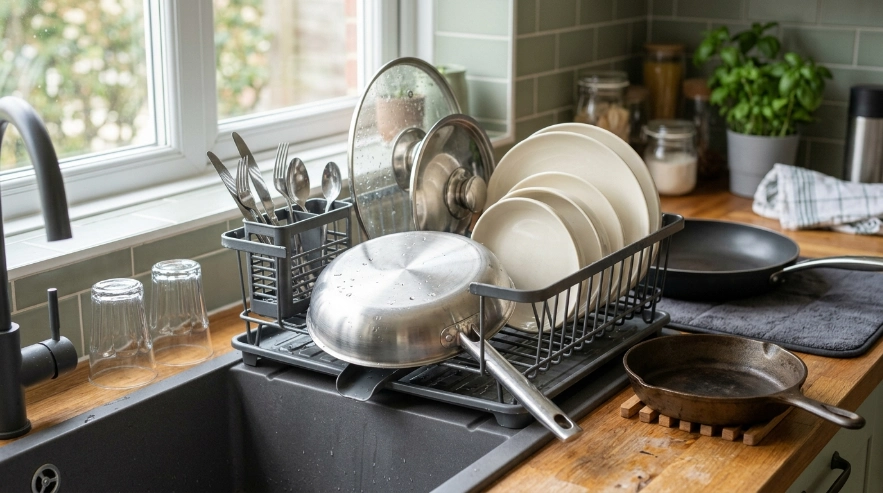
No single drying setup works best for every kitchen. Your available space and washing habits matter more than the product category.
| Method | Best For | Main Advantage | Main Drawback |
|---|---|---|---|
| Dish rack | Daily hand washing | Keeps dishes separated and upright | Uses counter space |
| Drying mat | Small or occasional loads | Easy to fold and store | Does not hold plates upright |
| Over-sink rack | Small counters | Drips go directly into sink | Can reduce sink access |
| Dishwasher | Large dishwasher-safe loads | Washes and dries in one appliance | Not suitable for every kitchen item |
I like combining methods rather than forcing one solution to do everything. A rack can hold plates while a mat handles an oversized mixing bowl.
Is Air-Drying Dishes Better Than Towel-Drying?
Air-drying is a sensible way to finish cleaned dishes because it avoids rubbing them with a reusable towel. Proper washing and a clean drying area still matter first.
The FDA’s safe food handling guidance recommends washing dishes, utensils, cutting boards, and counters with hot, soapy water after food preparation.
FDA Food Code guidance for food establishments also calls for cleaned and sanitized utensils to air-dry or adequately drain rather than being cloth-dried. That commercial guidance is stricter than normal home-kitchen rules, but the principle is useful.
- Wash dishes thoroughly first.
- Rinse away food and detergent.
- Keep wet items separated.
- Avoid stacking items while they are still damp.
- Put dishes away after they are fully dry.
The CDC’s household cleaning guidance also recommends thorough air-drying for appropriate sanitized household items.
How Much Counter Space Does a Dish Rack Need?
Dish racks vary enough in size that measuring first is essential. Even a few inches can determine whether you can still use the faucet and sink comfortably.
As of 2026, OXO lists its standard Good Grips Dish Rack at 13.75 × 10.5 × 3.5 inches. Its larger Foldaway Dish Rack measures 19.4 × 15.5 × 5.125 inches when open.
| Current Example | Listed Size | Useful For |
|---|---|---|
| OXO Good Grips Dish Rack | 13.75 × 10.5 × 3.5 in | Compact daily loads |
| OXO Good Grips Foldaway | 19.4 × 15.5 × 5.125 in open | Larger loads with fold-down storage |
| OXO Compact Drying Rack with Dish Rest | 15 × 18.3 × 1.35 in | Low-profile drying and storage |
Measure width and depth, not just the empty rectangle beside your sink. Leave room for the faucet, backsplash, cabinet doors, soap dispenser, and normal hand movement.
Are Dish Racks Worth It in Small Kitchens?
Yes, but the right design matters more in a small kitchen. A bulky permanent rack can create more frustration than convenience.
I would prioritize designs that move, fold, or use sink space instead of valuable prep space.
- Foldable racks: Collapse after the dishes are dry.
- Roll-up racks: Span the sink and roll away for storage.
- In-sink racks: Keep the counter completely open.
- Over-sink racks: Use vertical or sink space for drainage.
- Compact racks: Hold a small everyday load without dominating the counter.
A drying mat is another strong option for a studio or dorm-style kitchen. Hang it to dry after use instead of leaving it permanently beside the sink.
How Do You Keep a Dish Rack Clean?
A dish rack needs cleaning because it constantly handles water and freshly washed kitchenware. Drain trays, corners, feet, and utensil cups deserve the most attention.
I treat the rack as part of the sink area rather than as permanent clean storage. If the tray looks cloudy or feels slippery, I clean it before loading another batch.
- Remove dishes and detachable accessories.
- Pour out any standing water.
- Wash the rack with warm water and dish soap.
- Scrub corners, joints, slots, and utensil compartments.
- Rinse away loosened residue.
- Clean the drainboard or drainage spout.
- Let the rack dry before loading it again.
The broader FoodSafety.gov cleaning guidance also emphasizes washing kitchen dishes, utensils, and food-contact surfaces with hot, soapy water.
What Should You Use Instead of a Dish Rack?
A drying mat is the easiest alternative, but it is not your only choice. Choose an option that still lets water drain and wet surfaces remain exposed.
- Microfiber drying mat: Good for occasional dishes and large cookware.
- Roll-up sink rack: Useful when countertop space is limited.
- Built-in drainboard: Works well when your sink already includes one.
- Dishwasher rack: Convenient for dishwasher-safe items after a completed cycle.
- Clean elevated tray: Useful for small loads when designed to avoid standing water.
Some tools require special care regardless of the drying setup. Check the material and manufacturer’s directions when deciding whether a garlic press can go in the dishwasher.
Can You Dry Pots and Pans on a Dish Rack?
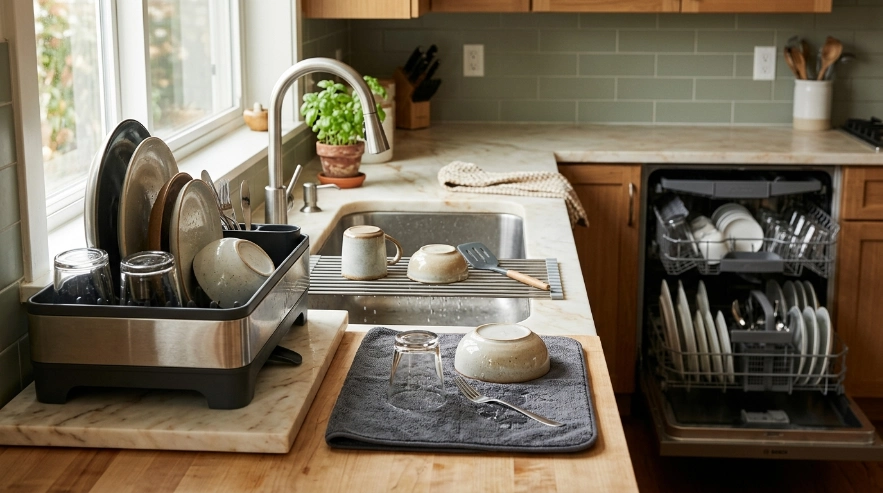
Yes, if the rack is stable and designed to support the weight. Large cookware should never make the rack lean, twist, or become easy to tip.
- Stand lids vertically when the slots support them securely.
- Angle pans so water cannot remain trapped inside.
- Keep heavy cookware near the strongest part of the rack.
- Do not balance large pans above fragile glasses.
- Use a separate mat when cookware overcrowds the rack.
Cast iron deserves special treatment because leaving moisture against bare or poorly seasoned iron encourages rust. After drying it properly, move heavy cast iron to an appropriate cast iron skillet storage rack rather than overloading a lightweight dish drainer.
How Do You Choose the Right Dish Rack?
Choose for your washing habits first and appearance second. A beautiful rack becomes annoying quickly if it blocks the sink or constantly holds standing water.
- Measure the space: Record both usable width and depth.
- Check capacity: Match the rack to a normal load, not your smallest load.
- Inspect drainage: Look for a sloped tray, removable board, or drain spout.
- Check stability: Non-slip feet help when plates and cookware add weight.
- Look at spacing: Plates should stand without being packed tightly together.
- Inspect the utensil cup: Removable sections are easier to wash.
- Consider storage: Foldable designs make sense when counters serve several purposes.
- Think about cleaning: Avoid complicated areas that are difficult to reach.
As of 2026, drainage and ease of cleaning are the two features I would prioritize most. Fancy attachments matter less if water constantly pools underneath the rack.
So, Is a Dish Rack Worth Buying?
A dish rack is worth buying when you hand-wash dishes regularly and have enough space to use one comfortably. It turns a messy collection of wet items into a predictable drying system.
I would skip a traditional rack when hand washing is rare. In that situation, a folding rack or drying mat gives you flexibility without sacrificing permanent counter space.
If you’re ready to add one, these are three practical designs I would consider for different kitchens:
🏆 BEST PREMIUM
simplehuman Steel Frame Dishrack
★★★★★ 4.8/5
The steel-frame design includes a swivel drainage spout, silicone-capped plate supports, and dedicated glass space. I like it for busy kitchens where the rack stays beside the sink and handles frequent loads.
📦 BEST FOLDABLE
OXO Good Grips Foldaway Dish Rack
★★★★★ 4.7/5
This stainless steel rack measures 19.4 × 15.5 × 5.125 inches when open and includes a drainage spout. I would pick it when you need useful capacity but want the option to reduce its footprint afterward.
💰 BEST COMPACT VALUE
OXO Good Grips Dish Rack
★★★★☆ 4.6/5
At 13.75 × 10.5 × 3.5 inches, this rack has a much smaller footprint than many full-size designs. I like it for one- or two-person kitchens where simple drainage matters more than maximum capacity.
Frequently Asked Questions
Do you really need a dish drying rack?
No. You need a clean, suitable place for washed dishes to drain and dry, but that can be a rack, drying mat, over-sink system, built-in drainboard, or dishwasher.
Can I dry dishes on a towel instead of a rack?
Yes, a clean drying mat or towel can hold a small number of dishes. Avoid crowding wet items together, and wash and thoroughly dry reusable towels or mats regularly.
Is a dish rack useful for one person?
Yes, but a compact or foldable model usually makes more sense than a full-size rack. If you only wash one or two items at a time, a small drying mat may be enough.
Should I leave dishes in the rack overnight?
Leaving clean dishes in the rack while they finish air-drying is generally practical. Once everything is dry, putting the dishes away frees the rack for the next load and makes cleaning easier.
Is a metal or plastic dish rack better?
Both can work well. Focus on stability, drainage, rust resistance, cleaning access, and the manufacturer’s care instructions rather than choosing on material alone.
Final Takeaway
A dish rack is helpful rather than essential. It is most valuable when you hand-wash dishes often, need organized airflow, and have enough counter or sink space for the rack.
If your dishwasher handles nearly everything, choose a smaller solution instead. Match the drying setup to your routine, keep it clean, and make sure wet dishes can drain fully before storage.
