
How Hot Does a Rice Cooker Get?

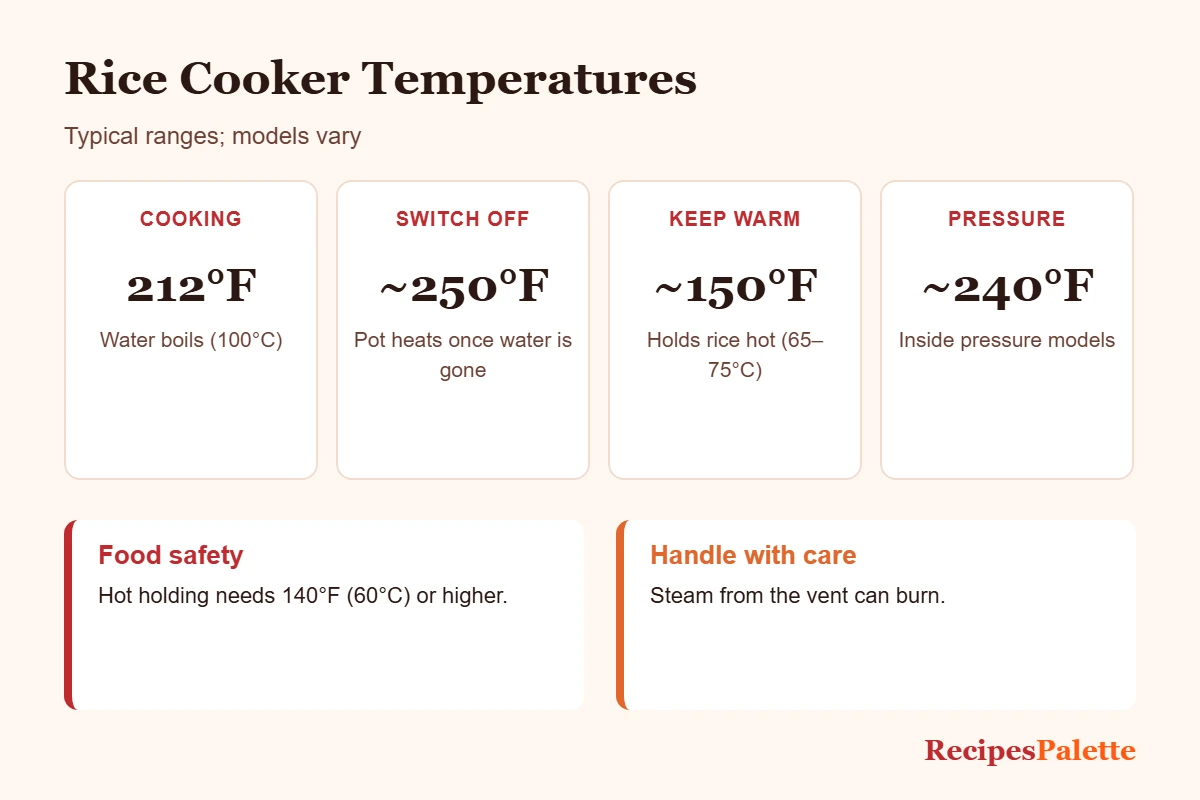
A standard rice cooker heats the water and rice to about 212°F (100°C), the boiling point of water at sea level. Once all the water is absorbed, the temperature of the pot rises above boiling, which tells the cooker the rice is done and switches it to Keep Warm. On Keep Warm, most rice cookers hold rice at about 140 to 165°F (60 to 74°C). Pressure rice cookers can cook a little hotter, often up to about 240°F (115°C), because pressure raises the boiling point.
Here is how a rice cooker controls its temperature, what happens on Keep Warm, and what the numbers mean for safety and texture.
Why a Rice Cooker Stays Around 212°F While Cooking
Water cannot get hotter than its boiling point at normal pressure. While there is liquid water in the pot, the rice and water stay at about 212°F (100°C), and the extra energy goes into turning water into steam. This natural limit is what makes rice cookers so reliable: the rice cooks gently and evenly as long as water remains.
At higher altitudes, water boils at a lower temperature. At 5,000 feet, for example, water boils at roughly 203°F (95°C), so rice can take a little longer and may need slightly more water.
How the Cooker Knows the Rice Is Done
A basic rice cooker has a thermostat under the inner pot. While water remains, the pot stays near boiling. When the rice absorbs the last of the water, the bottom of the pot quickly gets hotter than 212°F. The thermostat senses this jump and switches the cooker from Cook to Warm.
In simple one-switch cookers, this trip point is often described as around 250°F to 265°F (about 120 to 130°C) at the base of the pot. In fuzzy logic and induction models, sensors and a microchip adjust heat throughout the cycle, including soaking, boiling, steaming and resting stages.
Keep Warm Temperature
On Keep Warm, most rice cookers hold rice between roughly 140°F and 165°F (60 to 74°C). This keeps rice above the minimum hot-holding temperature recommended for food safety, which is 140°F (60°C). Some models have an “extended” or “reheating” warm mode that holds rice slightly cooler or briefly reheats it.
Keep Warm is safe for several hours, but rice quality drops over time. It slowly dries out, firms up and may turn yellow. Many manufacturers recommend serving within about 12 hours. Read more in can you leave rice in the rice cooker overnight?.
How Hot Do Pressure Rice Cookers Get?
Pressure rice cookers seal the pot and build up pressure, which raises the boiling point of water. Inside, temperatures can reach around 220 to 240°F (105 to 115°C), depending on the model and setting. The higher heat:
- Helps the grains absorb water more fully
- Can make brown rice and mixed grains softer
- May shorten cooking time for some settings
Pressure models release steam carefully at the end. Do not try to force the lid open while the cooker is under pressure.
Rice Cooker Temperatures at a Glance
| Stage | Approximate temperature |
|---|---|
| Soaking (fuzzy logic models) | Warm water, around 100 to 140°F (38 to 60°C) |
| Cooking (standard cooker) | About 212°F (100°C) at sea level |
| Cooking (pressure cooker) | About 220 to 240°F (105 to 115°C) |
| Switch to Warm (base of pot) | Above boiling, often around 250°F (120°C) |
| Keep Warm | About 140 to 165°F (60 to 74°C) |
Exact numbers differ between brands and models, so treat these as typical ranges.
How Hot Does the Outside Get?
The outside of most rice cookers gets warm but not dangerously hot. The parts to watch are:
- The steam vent: Steam is well above 200°F and can burn skin. Keep hands and faces away while cooking.
- The inner pot: It is very hot after cooking. Use the handles or oven mitts.
- The lid: Inner lids and metal plates can be hot when you open the cooker.
Keep the cooker away from cabinets so steam does not damage them, and out of reach of children.
Can You Cook Other Foods at These Temperatures?
Because a rice cooker boils at about 212°F, it can cook many foods that are normally simmered or steamed: oatmeal, quinoa, soups, steamed vegetables, eggs and even noodles. Meat must still reach safe internal temperatures, such as 165°F (74°C) for poultry, so check with a thermometer. For ideas, see how to make ramen in a rice cooker.
Why Rice Burns or Crusts on the Bottom
A thin golden crust is normal in some cookers, especially after Keep Warm. Heavy browning or burning usually means there was too little water, the rice was not rinsed, or the thermostat is not switching off on time. If burning happens every time with the correct water level, the cooker may need servicing or replacing. If you do get a burnt layer, our guide on getting burnt rice off a pot can help.
Food Safety Tips
- Keep cooked rice at 140°F (60°C) or above, or refrigerate it within 2 hours.
- Do not use Keep Warm to reheat cold rice. Reheat it on the stove or in the microwave until steaming hot (165°F / 74°C).
- Do not leave rice in a cooker that has been switched off for long periods.
How Different Rice Cookers Control Heat
Basic one-switch cookers
These use a simple thermostat, often a magnet that loses its pull at a set temperature. When the pot gets hotter than boiling, the magnet releases, the switch flips, and the cooker moves to Warm. They are simple and durable, but cannot adjust heat for different grains.
Fuzzy logic cookers
A microchip reads temperature sensors throughout the cycle. It can soak rice at a warm temperature, raise heat gently to boiling, reduce it during absorption, and steam the rice at the end. This gives more even results and allows settings for brown rice, porridge and mixed grains. See how to use a Tiger rice cooker for an example of menu settings.
Induction heating cookers
The inner pot itself heats through a magnetic field, so the whole pot warms evenly rather than just the bottom. Temperature control is very precise.
Pressure cookers
Pressure raises the boiling point, so the rice cooks slightly hotter. Many pressure models also use induction and fuzzy logic.
Does Altitude Change Rice Cooker Results?
Yes. At higher elevations, water boils at a lower temperature, so rice cooks at a slightly lower heat and may come out firmer. Common fixes:
- Add a little more water, starting with 1 to 2 extra tablespoons per cup of rice.
- Soak rice for 20 to 30 minutes before cooking.
- Let the rice rest longer on Keep Warm before opening the lid.
- Use a pressure rice cooker, which raises the boiling point and helps rice cook through.
Keep Warm vs Reheat Settings
Some rice cookers have a separate Reheat button. Reheat briefly raises the temperature to warm rice that has cooled on Keep Warm, then returns to Warm. It is designed for rice that is already in the cooker, not for cold rice from the refrigerator. For cold leftovers, the microwave or stove is faster and safer.
Frequently Asked Questions
What temperature is a rice cooker’s Keep Warm setting?
Usually about 140 to 165°F (60 to 74°C), depending on the model.
Can a rice cooker get hot enough to fry?
Not in the normal Cook mode, because water limits the temperature. Some multicookers have a sauté function that gets hotter.
Does a rice cooker get hotter than boiling?
The base of the pot does briefly once the water is gone, which triggers the switch to Warm. Pressure models also cook slightly above boiling.
Is it safe to leave a rice cooker on Keep Warm all day?
It keeps rice at a safe temperature, but quality drops after several hours. Follow your manual’s time limit.
Why does my rice cooker switch to Warm too early?
Too little water, very small batches or a dirty heating plate can trigger the switch early. Check the water level and clean the plate.
Can I check the temperature of my rice?
Yes. Insert a food thermometer into the center of the rice. On Keep Warm it should read 140°F (60°C) or higher.
The Bottom Line
A standard rice cooker cooks at about 212°F (100°C), the boiling point of water, then switches to Keep Warm at roughly 140 to 165°F once the water is absorbed. Pressure models cook slightly hotter. Watch for hot steam and pots, refrigerate leftovers within 2 hours, and reheat cold rice until steaming hot.