
What Can I Use Instead of a Dish Rack 9 Practical Alternatives

Quick Answer
You can use a silicone drying mat, microfiber mat, clean kitchen towel, over-sink rack, roll-up sink rack, drainboard, or cooling rack instead of a traditional dish rack. For most kitchens, I prefer a silicone mat because it stores easily and protects the counter; if water control is your main problem, see what works best beneath a dish-drying setup.
Best Dish Rack Alternatives
- Silicone drying mat: Best simple option for small and medium loads.
- Over-sink rack: Best when you want dishes to drip straight into the sink.
- Microfiber mat: Best when easy folding and storage matter most.
- Clean kitchen towel: Fine as a temporary solution for a few dishes.
- Cooling rack: Useful when placed over a tray that catches dripping water.
- Roll-up sink rack: Great for tiny kitchens because it uses space above the sink.
My Quick Rule
- Choose an option that keeps dishes separated, lets water escape, and can dry completely between uses.
I’ve used several makeshift drying setups when counter space was tight or my regular rack was being cleaned. Some worked surprisingly well, while others created more wet-counter problems than they solved.
The good news is that you do not need a traditional rack to dry dishes properly. You mainly need drainage, airflow, stability, and a surface that is easy to keep clean.
A dish rack alternative is any clean, stable setup that holds or supports washed dishes while excess water drains and the dishes air-dry. It can be as simple as a drying mat or as structured as an over-sink rack.
What Can I Use Instead of a Dish Rack?
The easiest alternatives are a drying mat, clean towel, drainboard, over-sink rack, roll-up rack, or cooling rack over a tray. Your best choice depends on your dish load and available counter space.
I usually start by deciding where I want the water to go. Once that is clear, choosing an alternative becomes much easier.
- Silicone drying mat: Catches water on a waterproof, washable surface.
- Microfiber drying mat: Absorbs small amounts of water and folds away easily.
- Clean dish towel: Works for a few cups, plates, or utensils in a pinch.
- Over-the-sink rack: Lets water drip directly into the sink.
- Roll-up sink rack: Creates temporary drying space across the basin.
- Drainboard: Gives wet dishes a dedicated draining surface beside the sink.
- Cooling rack and tray: Raises dishes above runoff when you need a homemade setup.
- Clean baking sheet: Works beneath cups or bowls when paired with something that lifts them above pooled water.
- Clean sink basin: Can handle a few items temporarily if you need no counter setup at all.
Which Dish Rack Alternative Is Best?
A silicone drying mat is my favorite all-purpose replacement. An over-sink rack is better when saving counter space and controlling dripping water matter more.
Here is how I compare the main options as of 2026.
| Alternative | Water Handling | Storage | Best For | Main Drawback |
|---|---|---|---|---|
| Silicone mat | Contains drips | Excellent | Everyday small loads | Water still needs removing |
| Microfiber mat | Absorbs drips | Excellent | Light washing | Must dry fully |
| Over-sink rack | Drains into sink | Good | Tiny counters | Uses sink space |
| Roll-up sink rack | Drains into sink | Excellent | Apartments | Must fit sink |
| Kitchen towel | Absorbs limited water | Excellent | Temporary use | Gets damp quickly |
| Cooling rack + tray | Collects runoff below | Fair | No-buy workaround | Less secure for plates |
Is a Drying Mat Better Than a Dish Rack?
A drying mat is better when you wash small loads and want to reclaim your counter afterward. A traditional rack is better when you need plates and bowls held upright.
I like mats most for cups, mugs, utensils, lunch containers, and a few bowls. They become less convenient when tall plates start leaning against each other.
Silicone Drying Mat
Silicone is my first choice because it does not absorb the dripping water. Ribbed designs can also lift cups and cookware slightly above the wet surface.
- Easy cleanup: Rinse or wipe the surface after use.
- Compact storage: Many mats roll or store flat.
- Counter protection: The waterproof material keeps routine drips off the countertop.
- Flexible use: Large models also work beneath pans and awkward cookware.
If persistent moisture is your bigger concern, my guide to keeping the area under a drying setup dry covers drainage and cleanup in more detail.
Microfiber Drying Mat
Microfiber takes the opposite approach because it absorbs runoff. I find it useful for small loads when I know I can hang or spread the mat out afterward.
The important part is not leaving it wet under dishes all day. The EPA’s mold guidance emphasizes moisture control as a key part of preventing indoor mold growth.
Can I Use a Towel Instead of a Dish Rack?
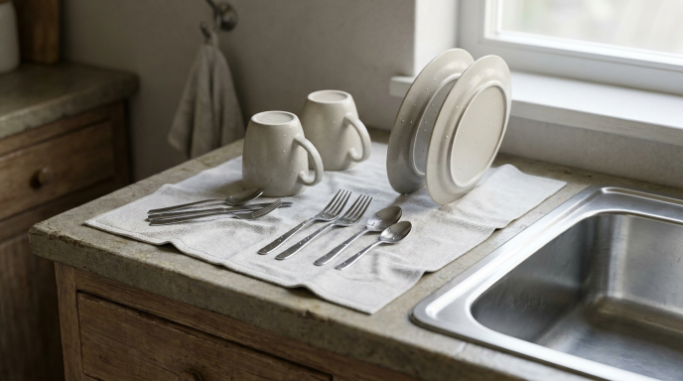
Yes, a clean kitchen towel works as a temporary dish rack substitute. I use one for a few mugs or plates, but I would not make a permanently damp towel my everyday setup.
A towel works best when the load is small enough for everything to stay in a single layer. Avoid stacking wet bowls or placing glasses where they can tip easily.
- Start with a freshly washed, completely dry towel.
- Spread it flat beside the sink.
- Shake excess water from each item over the sink.
- Keep cups and bowls separated instead of nesting them.
- Hang the towel to dry after the dishes are put away.
- Replace and wash it whenever it becomes dirty or develops an odor.
The FDA’s safe food handling guidance recommends washing dishes, utensils, cutting boards, and countertops with hot, soapy water. It also advises laundering reusable kitchen towels often.
How Do I Dry Dishes Without Using Counter Space?
An over-sink or roll-up rack is the most practical answer. Both move the drying area above the sink and let runoff fall into the basin.
This is the setup I prefer in kitchens where one short stretch of counter handles food prep, appliances, and dishes. Direct drainage also means fewer puddles to wipe afterward.
Use an Over-the-Sink Rack
An over-sink rack rests across the sink and supports dishes above the basin. Some models have extendable arms, so measuring your sink before buying is essential.
- Best advantage: Water falls directly into the sink.
- Space benefit: Your counter remains available for other tasks.
- Possible problem: A large rack can interfere with the faucet or washing space.
- Before buying: Measure the inside and outside width of your sink.
If you need something more structured but still small, compare the options in my guide to the best compact dish racks.
Try a Roll-Up Sink Rack
A roll-up rack uses parallel bars that stretch across part of the sink. Once the dishes dry, you can roll the rack into a narrow bundle.
I especially like this idea for apartments because nothing permanent has to stay beside the sink. Just make sure the rack is rated for the weight you plan to place on it.
Can I Make a Dish Rack From Things I Already Own?
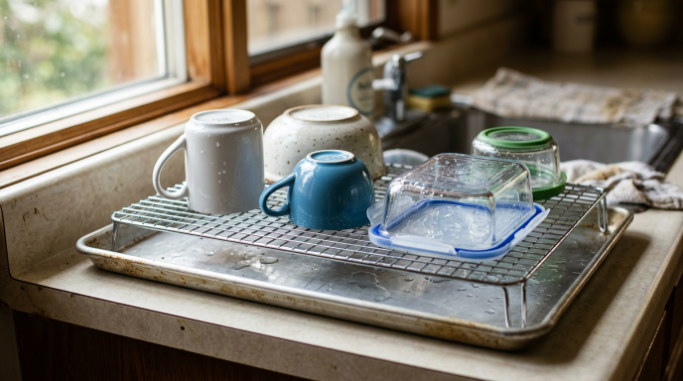
Yes, and a cooling rack over a rimmed tray is one of the easiest homemade options. The rack creates airflow while the tray underneath catches dripping water.
I would use this mainly for cups, bowls, food-storage containers, and other stable pieces. Traditional dinner plates can slide if the cooling rack has no slots to support them.
- Choose a clean cooling rack that sits securely on a rimmed baking sheet or tray.
- Wash both pieces before using them for clean dishes.
- Set the tray on a flat, stable section of counter.
- Place dishes in one uncrowded layer.
- Empty collected water before it sits for long periods.
- Wash and dry both pieces after the dishes are stored.
A large clean baking sheet alone can also serve as an emergency drip tray. I would place cups upside down with enough space between them rather than piling dishes together.
What Should I Avoid Using Instead of a Dish Rack?
A dish rack substitute should not trap dirty water, damage the counter, or make dishes unstable. Several convenient-looking shortcuts fail that test.
- Cardboard: It absorbs water, weakens quickly, and is difficult to clean.
- Newspaper: It becomes soggy and is not a reusable food-area drying surface.
- Dirty towels: A towel should be clean before it touches freshly washed dishes.
- Unprotected wood: Regular soaking is a poor match for unfinished or moisture-sensitive surfaces.
- Deep flat trays: Dishes can sit directly in pooled water unless something elevates them.
- Unstable stacks: Leaning plates against glasses or walls increases the chance of breakage.
The USDA Food Safety and Inspection Service recommends cleaning kitchen utensils and surfaces with warm, soapy water and allowing cleaned items to air-dry or using appropriate single-use towels. A drying substitute should support that clean, dry workflow.
How Can I Make Dishes Dry Faster Without a Rack?
Better airflow and less trapped water make the biggest difference. I get better results by removing excess rinse water before setting anything down.
- Shake off large droplets: Let them fall into the sink first.
- Leave gaps: Do not let wet bowls nest inside each other.
- Angle hollow items: Cups and containers should not hold puddles.
- Use a raised surface: Ribs or rack bars improve airflow below dishes.
- Remove standing water: Empty trays and wipe silicone mats when needed.
- Let the drying surface dry: Do not immediately trap a wet mat inside a cabinet.
If you decide that a permanent rack would be easier after all, my current dish drying rack comparison for 2026 covers several counter and space-saving designs.
How Do I Choose the Right Alternative for My Kitchen?
Match the drying method to your normal load instead of choosing by appearance. A person washing two mugs needs a different setup from a household hand-washing dinner plates and pans.
- For one or two people: Start with a silicone or microfiber mat.
- For almost no counter space: Choose an over-sink or roll-up rack.
- For occasional hand washing: A clean towel may be enough.
- For a no-buy solution: Use a clean cooling rack over a rimmed tray.
- For frequent large loads: A proper dish rack with drainage will usually be easier.
My own rule is simple. If the alternative takes more effort to clean than a dish rack, it is probably the wrong long-term solution.
Dish-Drying Alternatives I Would Consider
If you want something more purpose-built than a towel or homemade tray, these are the three setups I would consider first.
🏆 Best Simple Alternative
OXO Good Grips Large Silicone Drying Mat
★★★★☆
The mat measures 16.9 × 12.5 × 0.25 inches and uses raised silicone ribs. I like it when I want a washable surface that can roll away instead of a permanent rack.
🧺 Best All-in-One Mat
Umbra UDry Dish Drying Rack with Mat
★★★★☆
UDry combines a removable rack with a 24 × 18-inch microfiber mat that is machine washable. I would choose it when I want plate support but still need the whole drying setup to fold away.
🚰 Best for Saving Counter Space
OXO Good Grips Over-the-Sink Aluminum Dish Rack
★★★★★
Its rustproof aluminum frame has extendable arms for fitting different sink sizes and lets dishes drain into the basin. I prefer this style when keeping the counter clear matters more than having full access to the sink.
Frequently Asked Questions
What is the cheapest alternative to a dish rack?
A clean kitchen towel is usually the cheapest option because you probably already own one. For regular use, I prefer a reusable drying mat because it provides a more defined drying surface and is easier to manage around repeated dripping water.
Can I dry dishes directly on the countertop?
You can place a few dishes on a clean, water-resistant countertop, but I do not recommend making it your regular system. Water can collect beneath cups and bowls, so a clean mat, towel, tray, or raised surface gives you better drainage and easier cleanup.
Is air-drying dishes better than drying them with a towel?
Air-drying is convenient because clean dishes can dry without repeated contact with a reusable cloth. Whatever method you choose, keep the drying area clean and allow wet surfaces and reusable mats or towels to dry completely between uses.
Can I use a cooling rack to dry dishes?
Yes, a clean cooling rack can work for cups, bowls, containers, and other stable items. Put it over a rimmed tray to catch runoff, and avoid balancing heavy plates on a rack that was not designed to hold them upright.
Do I need a dish rack at all?
No. A dish rack is convenient, but it is not the only way to air-dry dishes. If your alternative keeps clean dishes stable, separated, well drained, and easy to keep clean, you can manage perfectly well without a traditional rack.
Final Takeaway
If you are asking what you can use instead of a dish rack, start with the simplest solution that fits your space. A silicone mat works for most small loads, while an over-sink rack is my pick when counter space is limited.
You can also use a microfiber mat, clean towel, roll-up rack, drainboard, or cooling rack over a tray. Whichever method you choose, focus on airflow, drainage, stability, and easy cleaning rather than trying to copy the shape of a traditional rack.
