
What Can a Vegetable Chopper Do? Uses, Limits, and Practical Tips

Quick Answer
A vegetable chopper can chop, dice, mince, slice, julienne, grate, or spiralize produce, depending on its blade design. Rotating-blade and electric choppers may also mix sauces, mince herbs, chop nuts, and purée soft or cooked foods. If faster prep is your main goal, these time-saving cooking strategies work especially well with a chopper.
What a vegetable chopper can handle
- Dice vegetables: Prepare onions, peppers, potatoes, zucchini, and similar produce in consistent pieces.
- Mince ingredients: Rotating blades work well for garlic, herbs, onions, and other small ingredients.
- Slice produce: Models with slicing inserts can prepare cucumbers, carrots, potatoes, and firm fruit.
- Grate or julienne: Multifunction models may prepare shredded carrots, cheese, or thin vegetable strips.
- Mix and purée: Electric choppers can often mix dressings or purée cooked vegetables and soft foods.
One important rule
- Match the food and task to your specific chopper’s blades rather than forcing hard or oversized ingredients through it.
I used to think a vegetable chopper was mainly an onion gadget. Once you look at the different designs, though, it becomes clear that some can replace several repetitive prep tools.
The important part is knowing what your particular model can do. A simple dicer, pull-cord chopper, and electric mini chopper all behave differently.
What Is a Vegetable Chopper?
A vegetable chopper is a kitchen tool that cuts food using fixed or rotating blades. The mechanism may be powered by hand, a pull cord, repeated downward pressure, or an electric motor.
Some choppers perform one job exceptionally well. Others combine several interchangeable blades for dicing, slicing, grating, and julienne cutting.
- Grid choppers: Push vegetables through a fixed cutting grid to create fairly uniform pieces.
- Push choppers: Use repeated downward pressure to rotate an internal blade.
- Pull-cord choppers: Spin curved blades when you pull a cord attached to the lid.
- Electric choppers: Use a motor-driven blade for chopping, mincing, mixing, and sometimes puréeing.
- Multifunction choppers: Include interchangeable dicing, slicing, grating, julienne, or spiralizing inserts.
The differences matter. A grid-style chopper produces a different result from a machine with a rapidly spinning blade.
What Can a Vegetable Chopper Do?
A vegetable chopper can handle many repetitive cutting jobs involved in everyday meal preparation. The most useful functions include chopping, dicing, mincing, slicing, shredding, and preparing ingredients for sauces or salads.
1. Dice Onions and Other Vegetables
Dicing is where a manual grid chopper shines. You place appropriately sized pieces over the grid and press the lid downward.
The food passes through the blades and drops into the container. This makes it useful when I want consistent pieces without making dozens of individual knife cuts.
- Onions for soups, curries, salsa, and sauces
- Bell peppers for omelets, stir-fries, and salads
- Potatoes for roasting or breakfast dishes
- Zucchini for sautés and casseroles
- Firm tomatoes for salsa and salads
- Celery for soups, stuffing, and mirepoix
This can also make eating more produce feel less inconvenient. My guide to the benefits of vegetables in your daily diet explains why keeping vegetable preparation simple can be useful.
2. Mince Garlic, Herbs, and Aromatics
Rotating-blade choppers can mince smaller ingredients that would be awkward in a grid dicer. Garlic, parsley, cilantro, onion, and similar aromatics are common examples.
With a manual rotating model, extra pulls or presses usually create progressively smaller pieces. An electric chopper provides similar control through short pulses.
- Garlic for marinades and sauces
- Parsley or cilantro for garnishes
- Onions for dips or dressings
- Ginger for curries and stir-fries
- Fresh herbs for compound butter
I prefer short pulses rather than running a rotating chopper continuously. It gives me more control before the ingredients become wetter or finer than I intended.
3. Slice Vegetables Evenly
Multifunction vegetable choppers may include flat slicing attachments. These work more like a compact mandoline than a traditional dicing grid.
Slicing attachments are useful when thickness consistency matters. Even pieces tend to cook more predictably than a mixture of thick and thin ones.
- Cucumbers for salads
- Potatoes for gratins or frying
- Carrots for salads and stir-fries
- Zucchini for roasting
- Radishes for garnishes
Blade inserts are extremely sharp. I treat them with the same care I give a knife and avoid pushing food toward exposed blades with my fingers.
4. Julienne, Grate, or Spiralize Produce
Some multifunction choppers expand beyond basic chopping. Interchangeable inserts can turn one frame into a grater, julienne cutter, or spiralizer.
That makes the tool more useful for meals where vegetables need different textures.
- Julienned carrots for slaw
- Shredded vegetables for fritters
- Grated firm cheese for toppings
- Spiralized zucchini for vegetable noodles
- Shredded cabbage for salads
I find this type most appealing when storage space is limited. One compact system can potentially replace several separate handheld gadgets.
5. Chop Nuts and Other Small Foods
Rotating-blade choppers can often process nuts in small batches. Short pulses help maintain a coarse texture for baking, oatmeal, salads, or dessert toppings.
Don’t keep processing once the nuts reach the texture you need. Excessive chopping can turn them from pieces into a fine meal or oily paste.
6. Mix Sauces, Dips, and Dressings
Electric mini choppers can move beyond cutting and into basic mixing. Models designed for liquids can combine vinaigrettes, sauces, dips, and other small recipes.
For example, KitchenAid’s 3.5-cup chopper is designed to chop, mix, and purée. Its lid also includes a drizzle basin for slowly adding liquids.
- Salad dressings
- Pesto-style mixtures
- Small batches of salsa
- Hummus-style dips, if the model supports the texture
- Sauces and condiments
Always check the manufacturer’s instructions before adding substantial liquid. Manual grid choppers aren’t designed to perform the same jobs as electric rotating-blade machines.
7. Purée Soft or Cooked Foods
Some electric choppers can purée cooked vegetables and soft fruit. This makes them useful for soup bases, sauces, and small portions of smooth food.
A chopper still isn’t automatically a blender. Capacity, blade shape, motor design, and liquid handling differ between appliances.
Vegetable Chopper vs. Knife vs. Food Processor
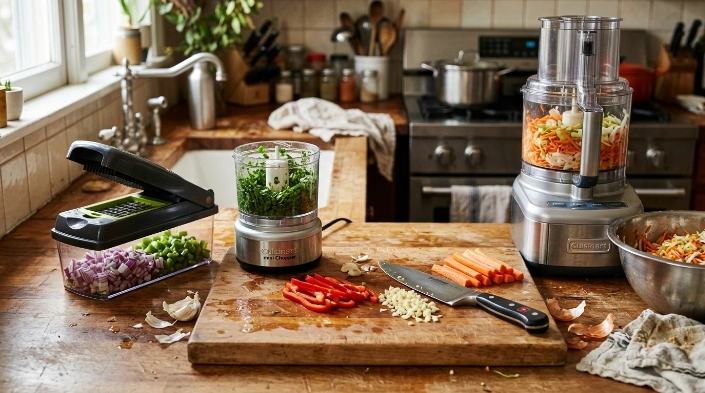
A chopper is best for repetitive small-to-medium prep jobs, while a knife offers maximum control and a full food processor handles larger, more complex jobs. I don’t see these tools as complete substitutes for one another.
| Feature | Grid Vegetable Chopper | Electric Mini Chopper | Chef’s Knife | Food Processor |
|---|---|---|---|---|
| Main action | Pushes food through fixed blades | Spins a motorized blade | Cuts manually | Motorized processing with attachments |
| Best at | Uniform dice | Mincing, chopping, mixing | Precise custom cuts | Larger batches and varied processing |
| Electricity | No | Yes | No | Yes |
| Texture control | Determined mainly by blade insert | Controlled with speed or pulses | Highest manual control | High, attachment dependent |
| Typical cleanup | Grid, lid, and container | Bowl, lid, and blade | Knife and board | Bowl, lid, blade, and attachments |
For one tomato or a few herbs, I still reach for a knife. For six vegetables going into meal prep containers, a chopper becomes much more attractive.
What Should You Not Put in a Vegetable Chopper?
A vegetable chopper shouldn’t be forced through foods beyond the limits of its blade or mechanism. The safest answer always comes from your model’s manual.
These situations deserve extra caution:
- Oversized hard vegetables: Cut dense foods into manageable sections before using the chopper.
- Bones or frozen-solid foods: Don’t process them unless the manufacturer specifically allows it.
- Large amounts of liquid: Only use liquids in models designed to contain them safely.
- Raw meat: Avoid using a produce chopper for meat unless its manufacturer explicitly permits it and gives cleaning instructions.
- Hot ingredients: Let foods cool when the manual warns against heat.
For more general precautions around sharp equipment, cross-contamination, and appliances, see my kitchen safety tips for home cooks.
How Do You Use a Vegetable Chopper Safely?
Keep your hands away from exposed blades, stabilize the unit, and clean food-contact parts after use. Sharp chopper grids can cut fingers just as easily as they cut vegetables.
- Read the manual first. Confirm suitable foods, assembly instructions, and cleaning requirements.
- Wash produce. Rinse fruits and vegetables under running water before cutting them.
- Pre-cut when needed. Large onions, potatoes, and other dense foods may need smaller sections.
- Use the supplied guard. Use finger guards or food holders whenever your model includes them.
- Keep the base stable. Work on a flat, dry counter and make sure non-slip feet can grip.
- Don’t force the mechanism. Stop and reduce the food size if the lid or handle requires excessive pressure.
- Clean the blades carefully. Use the supplied brush or cleaning tool rather than pushing fingers into a cutting grid.
The FDA recommends washing produce under running water and cleaning utensils and food-contact surfaces between tasks. It also recommends keeping produce separate from utensils used with raw meat, poultry, and seafood.
If you use your chopper only for vegetables, keeping it separate from raw-meat preparation can simplify that routine.
Is a Vegetable Chopper Worth Having?
A vegetable chopper is most useful for people who regularly prepare several vegetables at once. It offers less advantage when you normally cut only one or two small ingredients.
I judge the value by how often the repetitive prep appears in my normal meals, not by how many attachments come in the box.
- Great for meal prep: Useful when preparing several containers or meals in one session.
- Helpful for families: Larger quantities make repetitive cutting more noticeable.
- Useful for salads: Dicing several vegetables becomes quicker and more consistent.
- Good for batch cooking: Soups, curries, sauces, and casseroles often need several chopped ingredients.
- Less useful for tiny jobs: Washing several chopper components may take longer than making two knife cuts.
Another mistake is assuming every attachment needs to be used. The best setup is usually the one that handles your most common vegetables and remains easy to clean.
Which Type of Vegetable Chopper Should You Choose?

Choose a chopper according to the result you want most often. Uniform dice, fine mincing, and puréeing require different blade systems.
- Choose a grid chopper for onions, peppers, potatoes, and consistent dice.
- Choose a rotating manual chopper for herbs, garlic, nuts, onions, and coarse mincing.
- Choose a multifunction model if you want slicing, dicing, grating, and julienne attachments.
- Choose an electric mini chopper when you want chopping plus mixing or puréeing.
As of 2026, there are good examples in each category. I would focus on blade style, capacity, cleanup, stability, and replacement-part availability before counting accessories.
If you’re ready to pick one, these are three practical styles I’d consider:
🏆 Best for Dicing
Fullstar Pro Original Vegetable Chopper
★★★★½ 4.5/5 editorial fit
Manual Fullstar models use stainless-steel blade inserts and a catch container for vegetable prep. I’d pick this style when consistent onion, pepper, and vegetable dice are the main goal.
🥗 Best Simple Manual Pick
OXO Good Grips Vegetable Chopper
★★★★½ 4.5/5 editorial fit
OXO’s fixed-grid design uses stainless-steel blades and an integrated container with an easy-pour opening. I like this straightforward style for cooks who mainly want quick vegetable dice without a motor.
⚡ Best Electric Option
KitchenAid 3.5 Cup Food Chopper
★★★★½ 4.6/5 editorial fit
The 3.5-cup model offers two speeds plus pulse and is designed to chop, mix, and purée. I’d choose it when sauces, herbs, garlic, and soft-food purées matter as much as basic vegetable chopping.
Frequently Asked Questions
Can a vegetable chopper chop carrots?
Yes, many vegetable choppers can cut carrots, but dense carrots may need to be cut into shorter or thinner pieces first. Use a blade intended for firm vegetables and never force the lid or handle if the carrot creates excessive resistance.
Can you put tomatoes in a vegetable chopper?
Yes, firm tomatoes can work well in grid or rotating choppers. Soft, overripe tomatoes may crush and release more juice instead of producing clean pieces, so the tomato’s firmness and the blade design make a noticeable difference.
Can a vegetable chopper replace a food processor?
Usually not completely. A basic vegetable chopper handles smaller cutting tasks, while a food processor typically offers greater capacity and more processing options. An electric mini chopper can overlap with a food processor for small jobs such as mincing, mixing, and puréeing.
Can you use a vegetable chopper for fruit?
Yes, many choppers can process firm fruits such as apples, pears, and some melons after appropriate preparation. Remove pits, cores, or other hard parts first, and check the manufacturer’s instructions before processing unusually hard or juicy fruit.
Does a vegetable chopper save time?
It can save time when you need repeated cuts or several ingredients prepared in the same style. The benefit is smaller for one tiny task because assembling and washing the chopper may take longer than simply using a knife.
Final Takeaway
A vegetable chopper can do far more than cut onions. Depending on the design, it can dice vegetables, mince herbs, slice produce, grate ingredients, julienne carrots, chop nuts, mix sauces, or purée soft foods.
The key is matching the chopper to the task. I would choose a grid model for uniform dice, a rotating model for mincing, or an electric model when mixing and puréeing also matter.
Whichever style you use, don’t force food through the blades. Keep the cutting surfaces clean, respect the sharp inserts, and choose the functions you’ll use regularly rather than the model with the longest attachment list.
Used that way, a vegetable chopper can turn one of the most repetitive parts of cooking into a much quicker step.
