Are Vegetable Choppers Worth It? Pros, Cons, and Who Should Buy One

Quick Answer
Vegetable choppers are worth it if you regularly dice onions, peppers, potatoes, cucumbers, or similar produce and want faster, more consistent prep. They make the most sense for meal preppers, busy families, and cooks who value convenience, although a good knife may still be better for occasional chopping. If speed is your priority, these time-saving cooking strategies can help you decide where a chopper fits into your routine.
When a vegetable chopper makes sense
- Frequent chopping: It can reduce repetitive knife work during everyday meal preparation.
- Meal prepping: Push-grid models can create consistent diced vegetables quickly.
- Uniform pieces: Fixed cutting grids help keep onions and peppers close to the same size.
- Mess control: Models with collection containers keep chopped food off the counter.
- Limited knife confidence: A well-designed chopper may feel easier than repeated freehand dicing.
Think twice if
- You only chop a small amount of produce occasionally, dislike washing extra parts, or already work quickly with a chef’s knife.
I understand why vegetable choppers look tempting. Chopping an onion isn’t difficult, but repeating the job across onions, peppers, carrots, cucumbers, and potatoes can make dinner prep feel endless.
At the same time, no kitchen gadget earns its storage space simply because it looks convenient. Here’s how I decide whether a vegetable chopper is useful or just another appliance to clean.
What Is a Vegetable Chopper?
A vegetable chopper is a manual or electric kitchen tool designed to cut produce into smaller pieces with less repetitive knife work. Depending on the design, it may dice, chop, slice, grate, shred, or roughly mince ingredients.
The most common manual version uses a hinged lid and a sharp cutting grid. You place a manageable piece of food over the grid and press the lid downward.
- Push-grid choppers: Produce defined cubes or rectangular pieces and usually include a collection container.
- Pull-cord choppers: Spin internal blades when you pull a cord, producing a rough or fine chop.
- Pump choppers: Rotate internal blades each time you press the top mechanism.
- Electric mini processors: Use a motor-driven blade for chopping, mincing, and some grinding tasks.
A chopper isn’t a complete replacement for knife skills. Long vegetables still need trimming, oversized onions need halving, and many foods must be cut small enough to fit the tool safely.
Are Vegetable Choppers Worth It for Everyday Cooking?
Yes, for the right kitchen. A vegetable chopper becomes worthwhile when the time and repetitive work it saves outweigh the setup, cleaning, and storage it adds.
I think frequency matters more than hype. Someone preparing chopped vegetables five days a week can get far more value from one than someone who dices half an onion every Saturday.
- Worth it: Weekly meal prep, salads, salsa, soups, stir-fries, casseroles, and large family meals.
- Probably worth it: You avoid recipes because the chopping feels tedious.
- Maybe: You have limited counter space but can store a compact model easily.
- Probably not: You cook infrequently or prefer the flexibility of one sharp knife.
One useful test is simple. Think about your last seven dinners and count how many involved chopping several vegetables.
If the answer is four or five, a chopper has a clear job to perform. If the answer is one, the gadget may spend more time in the cabinet than on your counter.
What Are the Main Benefits of a Vegetable Chopper?
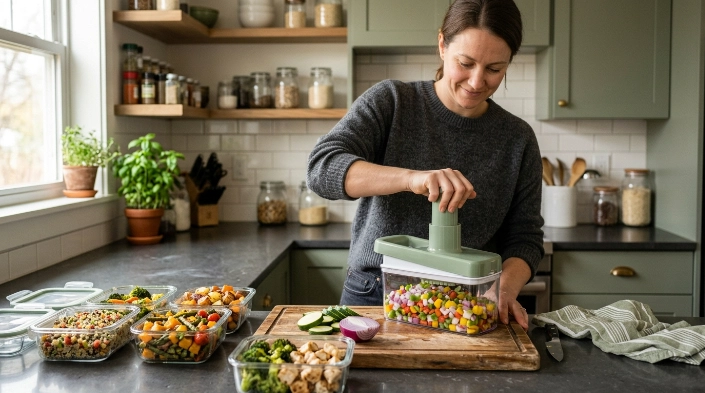
The biggest advantages are faster repetitive prep, consistent pieces, and less loose food on the cutting board. Those benefits matter most when you’re processing several portions at once.
1. Faster repetitive chopping
A push-grid design can process prepared onion halves, peppers, zucchini, and similar ingredients with one downward motion per portion. That makes it especially useful when you’re building several meals at once.
Saving a few minutes doesn’t sound dramatic until it happens every week. Faster prep can also make it easier to include more produce in everyday meals, which pairs naturally with the broader benefits of eating vegetables regularly.
2. More consistent pieces
A fixed grid creates pieces that are much closer in size than hurried freehand chopping. Consistent pieces tend to cook at a more similar rate.
That matters with skillet dishes, roasted vegetables, soups, and sheet-pan meals. My basic rule is that consistent prep makes temperature and timing easier to control.
3. Less scattered mess
Many push-style choppers drop the finished pieces directly into a container. Onion fragments and pepper pieces stay contained instead of spreading across the board.
This benefit is easy to overlook before buying one. During a large meal-prep session, a collection container can keep the counter noticeably calmer.
4. Lower dependence on detailed knife work
A chopper can reduce how much fine dicing you do manually. You still need a knife for trimming and portioning, but the repetitive part becomes simpler.
Sharp chopper blades still require careful handling. I recommend reviewing basic kitchen safety practices before using any cutting gadget with removable blades.
What Are the Disadvantages of Vegetable Choppers?
Vegetable choppers aren’t automatically faster for every task. Cleanup, storage, cutting limitations, and the force required by some manual models are the main tradeoffs.
More parts to clean
A knife and cutting board are simple to wash. A chopper may have a lid, container, cutting grid, pusher, cleaning tool, and several interchangeable blades.
Food can lodge in narrow grid openings. Onion, tomato skin, herbs, and cheese can make those spaces especially annoying if they’re allowed to dry.
Hard vegetables can require force
Dense raw produce such as carrots, sweet potatoes, and beets can require substantial downward pressure with a push-through model. Oversized pieces make the job harder.
I prefer cutting hard vegetables into thinner sections before placing them over a grid. I never use body weight aggressively on a tool that feels unstable.
They take storage space
Multi-blade sets look attractive because they promise several functions. The downside appears when you need somewhere safe to store every razor-sharp attachment.
Compact households should measure cabinet space before buying. One useful blade can be more practical than eight attachments you rarely touch.
They don’t replace every knife cut
A chopper excels at repeatable tasks. It isn’t ideal for delicate herbs, decorative cuts, trimming meat, peeling produce, or adjusting the exact shape of every piece.
A chef’s knife remains the more flexible tool. The chopper works best as a shortcut rather than a complete knife replacement.
Vegetable Chopper vs Knife: Which Is Better?
A vegetable chopper is usually better for repetitive uniform dicing, while a knife wins for versatility, precision, and minimal cleanup. The best choice depends on what you’re cutting and how much you’re preparing.
| Tool | Best Use | Cut Style | Cleanup | Main Limitation |
|---|---|---|---|---|
| Chef’s knife | Almost any cutting task | Fully adjustable | Very simple | Requires skill and repeated cutting |
| Push-grid chopper | Onions, peppers, potatoes, meal prep | Defined, consistent dice | Moderate | Hard produce may need extra force |
| Pull/pump chopper | Herbs, nuts, salsa ingredients | Rough to fine chop | Moderate | Doesn’t create a true cube |
| Electric mini processor | Fast chopping and mincing | Variable chopped texture | Moderate | Easy to overprocess food |
If I need two tablespoons of diced onion, I reach for the simpler tool. Setting up a large chopper for such a small job defeats the purpose.
When I’m planning several containers of vegetables, the equation changes. A dedicated chopper’s repetitive consistency becomes much more useful.
Do Vegetable Choppers Make Vegetables Cook More Evenly?
They can help because a fixed cutting grid produces similarly sized pieces. Similar dimensions reduce large differences in cooking time between individual pieces.
That doesn’t mean every vegetable should be cut identically. Carrots and zucchini cook differently even when their pieces have matching dimensions.
For roasting or sautéing, I still group vegetables by density and cooking speed. The same principle appears in these techniques for cooking food evenly.
- Onions and peppers: Excellent candidates for consistent grid chopping.
- Zucchini: Works well but can release moisture when chopped too small.
- Potatoes: Useful for cubes if pieces fit comfortably over the grid.
- Tomatoes: Firm tomatoes work better than very ripe, soft ones.
- Leafy herbs: A spinning or pump chopper often works better than a grid.
Are Vegetable Choppers Safe?
Vegetable choppers can be safe when used as directed, but their blades are extremely sharp. The biggest risks occur during blade changes, cleaning, and forcing oversized food through the cutting surface.
I treat removable grids exactly as I treat a sharp knife blade. I never run my fingers directly through the openings to remove trapped pieces.
- Place the chopper on a stable, dry surface.
- Cut oversized produce into manageable sections first.
- Use the supplied cleaning brush or tool when available.
- Keep loose blades away from children.
- Don’t try to catch a blade attachment if you drop it.
- Follow the manufacturer’s dishwasher and cleaning instructions.
For broader consumer-product precautions, the U.S. Consumer Product Safety Commission’s safety resources are a useful reference. Food-contact equipment should also be cleaned thoroughly between uses.
The CDC’s food-safety guidance emphasizes clean hands and surfaces, safe food separation, proper cooking, and prompt refrigeration. Those habits still matter when a gadget makes prep faster.
How Do You Know if a Vegetable Chopper Will Save You Time?
Look at the entire workflow rather than chopping speed alone. A tool that chops quickly but takes ten frustrating minutes to disassemble and scrub may not save much time overall.
I use five questions when evaluating one.
- How often will I use it? Several times weekly is a stronger case than once monthly.
- How much do I chop? Large batches benefit more than tiny portions.
- Can I clean it quickly? Dishwasher-safe removable parts can make regular use easier.
- Where will I store it? Easy access matters because hidden gadgets tend to stay unused.
- Does it solve a real annoyance? A chopper earns its space when it removes a prep task you genuinely dislike.
This is also why I don’t automatically recommend the model with the most accessories. Useful simplicity usually beats a drawer full of specialty blades.
What Features Should You Look for in a Vegetable Chopper?
Prioritize blade quality, stability, cleaning access, container design, and the cuts you will use regularly. Extra attachments should come after those basics.
- Stainless steel cutting surfaces: Common on established models and easier to maintain than flimsy cutting inserts.
- Stable base: A chopper should stay planted while pressure is applied.
- Accessible blade grid: Deep, unreachable crevices make cleanup harder.
- Useful container: A catcher keeps vegetables together during batch prep.
- Replaceable or organized attachments: Loose exposed blades are difficult to store safely.
- Dishwasher guidance: Check which individual parts are approved for machine washing.
I also check the manufacturer’s instructions before the first use. The FDA’s food resources provide broader information about safe food handling and food-contact practices.
Three Vegetable Choppers I’d Consider in 2026
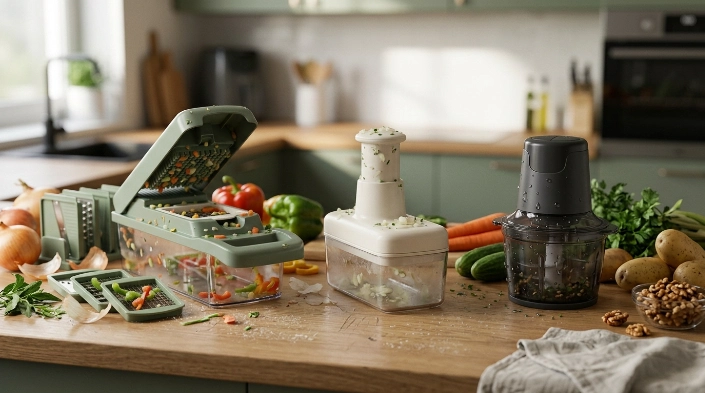
If you’re ready to pick one, I would start with established designs that solve different prep problems. I wouldn’t buy three; the point is to match one design to your routine.
🏆 Best Multi-Function Pick
Mueller Pro-Series 8-Blade Vegetable Chopper
★★★★☆
Mueller lists eight interchangeable stainless-steel blades for chopping, dicing, slicing, julienne cuts, grating, and shredding. I’d consider this style when versatility matters more than having the fewest parts to wash.
🥗 Best Simple Manual Pick
OXO Good Grips Vegetable Chopper
★★★★☆
OXO’s push-through model uses a stainless-steel blade pattern, an integrated catcher, and an easy-pour opening. I like this simpler design for cooks who want straightforward dicing without storing a large collection of attachments.
⚡ Best Electric Alternative
Cuisinart Mini-Prep Plus
★★★★☆
Cuisinart specifies a 24-ounce work bowl, 250-watt motor, and auto-reversing stainless-steel blade. I’d choose this format when quick chopping and mincing matter more than producing sharply defined cubes.
Frequently Asked Questions
Are vegetable choppers worth buying if I already own a good knife?
They can be. A good knife is more versatile, but a vegetable chopper can make repetitive dicing faster and more consistent when you prepare several vegetables at once.
Do vegetable choppers work on carrots and potatoes?
Many sturdy push-grid models can handle carrots and potatoes when the vegetables are cut into manageable pieces first. Dense produce requires more force, so never overload the cutting grid or force the lid when the food doesn’t fit comfortably.
Are vegetable choppers hard to clean?
Cleanup varies by design. Simple models with removable dishwasher-safe components are easier, while multi-blade choppers can trap food in grids and corners that need a small cleaning brush.
Can a vegetable chopper replace a food processor?
Not completely. A push-grid chopper produces defined pieces, while a food processor can mince, puree, mix, and process ingredients into much finer textures.
How long should a vegetable chopper last?
There isn’t one dependable lifespan because durability depends on materials, usage, blade care, and how much force the mechanism receives. Replace the tool if the frame cracks, the locking mechanism fails, or damaged blades no longer sit securely.
So, Are Vegetable Choppers Worth It?
For frequent vegetable prep, I think a well-designed chopper can earn its place in the kitchen. The strongest case is simple: you chop several vegetables regularly, want consistent pieces, and don’t mind washing a few extra components.
If you cook occasionally or already enjoy working with a chef’s knife, you may not need one. A chopper should remove friction from cooking, not create another storage and cleaning problem.
Choose the simplest model that matches the cuts you make most often. When the gadget solves a task you repeatedly dislike, that’s when a vegetable chopper becomes genuinely worth it.
