
Manual Vegetable Chopper Types: 6 Designs Explained

Quick Answer
The main manual vegetable chopper types are push-down grid choppers, pull-cord choppers, pump choppers, hand-crank processors, mandoline-style choppers, and rocker choppers. Choose a grid chopper for uniform cubes, a pull-cord or pump model for quick rough chopping, and a mandoline-style tool when consistent slices matter for even cooking.
Which Type Fits Which Job?
- Uniform cubes: A push-down grid chopper gives the most consistent diced pieces.
- Onions and salsa: Pull-cord choppers make quick work of small batches without electricity.
- Repeated chopping: Pump choppers rotate the blade every time you press the top.
- Sauces and dips: Crank processors offer more texture control through repeated turns.
- Thin slices: Mandoline hybrids are better for slices, julienne strips, and shredding.
- Herbs: Rocker-style blades work well when you want direct control on a cutting board.
Simple Buying Rule
- Pick the mechanism according to the cut you make most often, rather than choosing the model with the most attachments.
Manual vegetable choppers can look surprisingly similar on a store shelf, yet the way they cut food can be completely different.
As of 2026, I find it more useful to compare the mechanism first. Once you understand how each design works, choosing the right chopper becomes much easier.
Definition: A manual vegetable chopper is a non-electric kitchen tool that uses hand pressure, pulling, pumping, cranking, rocking, or sliding to cut food into smaller pieces.
What Are the Main Manual Vegetable Chopper Types?
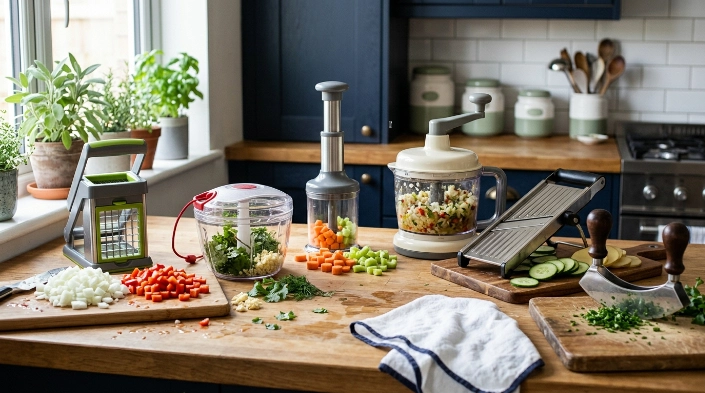
Six designs cover most manual chopping jobs in a home kitchen. Their biggest differences are the blade movement, final shape, effort required, and amount of control you get.
| Chopper Type | How It Works | Typical Result | Best Uses | Main Limitation |
|---|---|---|---|---|
| Push-down grid | Food is pressed through fixed blade squares. | Uniform cubes | Onions, potatoes, peppers, cucumbers | Firm produce may require strong pressure. |
| Pull-cord | A cord spins curved blades inside a bowl. | Rough to fine chop | Onions, herbs, garlic, salsa | Does not produce geometric cubes. |
| Pump or press | Each downward press turns the internal blade. | Controlled chopped pieces | Mirepoix, nuts, herbs, onions | Small bowls limit batch size. |
| Hand-crank processor | A rotating handle drives bowl-mounted blades. | Coarse chop to fine mixture | Salsa, hummus, pesto, vegetable mixtures | More parts may need cleaning. |
| Mandoline hybrid | Produce slides across or presses through interchangeable blades. | Slices, strips, shreds, some dice | Potatoes, carrots, cucumbers, zucchini | Exposed blades require careful handling. |
| Rocker chopper | A curved blade rocks across food on a board. | Coarse or fine mince | Herbs, greens, garlic | Does not contain the food while chopping. |
1. Push-Down Grid Vegetable Choppers
A push-down chopper forces vegetables through a fixed metal grid. The openings determine the final cube size, so each piece comes out much more uniform than a spinning-blade chop.
I like this design when shape matters. My simple rule is: if I want visible cubes rather than chopped fragments, I start with a grid.
- Best for: onions, bell peppers, potatoes, cucumbers, zucchini, and firm fruit.
- Cut style: square dice with a consistent width.
- Prep needed: large vegetables usually need halving or slicing first.
- Watch for: a non-slip base, removable blade grid, and easy-cleaning pusher plate.
Fullstar’s Original Chopper is a current example of this format. Its configurations use interchangeable stainless-steel inserts with a catch container underneath.
2. Pull-Cord Vegetable Choppers
Pull-cord choppers place curved blades inside a covered bowl. Pulling the handle rapidly rotates those blades through the food.
The number of pulls controls texture. A few pulls leave a coarse chop, while repeated pulls create smaller pieces suitable for salsa, herbs, and similar mixtures.
- Best for: onions, garlic, herbs, nuts, salsa ingredients, and small vegetables.
- Cut style: irregular chop rather than exact dice.
- Main advantage: compact operation without electricity.
- Watch for: cord durability, a stable base, and a bowl that separates fully for cleaning.
Brieftons sells a three-cup manual food chopper using this mechanism. Its design combines a pull cord, stainless-steel blades, and a covered bowl.
3. Pump and Press Choppers
A pump chopper turns the blade each time you push its top handle. That makes the action easy to understand and gives you direct control over the number of chops.
OXO’s Good Grips Chopper is a clear example. Its stainless-steel blade rotates with each press of the knob, and chopped food collects in a removable cup.
- Best for: onions, celery, carrots, herbs, nuts, and small salsa batches.
- Cut style: coarse to moderately fine chop.
- Main advantage: one-handed repeated chopping motion.
- Watch for: hand comfort if you’re preparing several batches.
If you want to improve your broader chopping technique too, my guide to essential cooking skills explains dicing, mincing, julienne cuts, and basic knife control.
4. Hand-Crank Manual Food Processors
A crank processor sits between a basic chopper and an electric food processor. Turning the handle spins blades through ingredients inside an enclosed bowl.
This design is useful when you want to keep checking texture. Stop after a few turns for chunks, or continue when you need a finer mixture.
- Best for: salsa, pesto, hummus, nuts, chopped vegetables, and mixed dips.
- Cut style: adjustable from coarse pieces toward a finer mixture.
- Main advantage: controlled processing without a motor.
- Watch for: lid complexity and the number of parts requiring washing.
These models make the most sense when you want versatility rather than identical cubes.
5. Mandoline and Chopper Hybrids
Mandoline hybrids focus on consistent slicing rather than ordinary chopping. Interchangeable plates may add julienne, grating, shredding, or dicing functions.
They are especially useful when vegetables need the same thickness. Uniform thickness helps potatoes, carrots, and similar produce cook at a more consistent rate.
- Best for: potatoes, cucumbers, carrots, zucchini, cabbage, and onions.
- Cut style: slices, matchsticks, shreds, or selected dice.
- Main advantage: greater variety of shapes.
- Watch for: sharp exposed cutting surfaces during use and cleaning.
Use the supplied hand guard whenever the design includes one. Cutting tools should never be handled casually simply because they are manual.
6. Rocker and Mezzaluna-Style Choppers
A rocker chopper uses a curved blade moved back and forth over ingredients. Unlike bowl-style choppers, you can see the food throughout the process.
That visual control makes it useful for herbs and leafy ingredients. However, it doesn’t contain splashes or loose pieces like an enclosed bowl does.
- Best for: parsley, cilantro, basil, leafy greens, garlic, and small piles of vegetables.
- Cut style: coarse chop through fine mince.
- Main advantage: direct visual control.
- Watch for: blade storage and a stable cutting board.
Which Manual Vegetable Chopper Is Best for Different Vegetables?
The best chopper depends more on the vegetable than the marketing label. Firm vegetables need leverage, while delicate herbs benefit from fast blades and lighter pressure.
| Food | Best Chopper Type | Why |
|---|---|---|
| Onions | Grid or pull-cord | Choose grid for cubes and pull-cord for salsa-style pieces. |
| Potatoes | Heavy-duty grid or mandoline | Dense texture benefits from leverage and fixed blades. |
| Carrots | Mandoline or grid | Useful for slices, julienne strips, or dice. |
| Herbs | Pull-cord or rocker | Fast, light chopping protects delicate leaves from excessive crushing. |
| Cucumbers | Mandoline | Thin, repeatable slices are easy to produce. |
| Garlic | Pull-cord, pump, or rocker | Small blades can quickly reduce several cloves. |
How Do You Choose the Right Manual Vegetable Chopper?
Start with the result you need most often. Extra accessories are less valuable when the basic cutting mechanism doesn’t match your recipes.
- Choose by cut: cubes need a grid, slices need a mandoline, and rough chops suit spinning blades.
- Check capacity: small bowls work for garlic and herbs, while batch prep needs a larger container.
- Check stability: rubberized or non-slip bases reduce movement while pressing or pulling.
- Inspect cleaning access: blade grids and hidden corners can trap onion, pepper, and herb pieces.
- Consider hand effort: hard potatoes demand more force from grid choppers than softer vegetables.
- Think about storage: multi-blade sets need a safe place for sharp inserts.
If saving prep time is your main goal, combine the chopper with a sensible workflow. My time-saving cooking strategies cover batch preparation and organizing ingredients before cooking.
Are Manual Vegetable Choppers Safe to Use?
Manual choppers are safe when you treat their blades like any other sharp kitchen tool. Keep fingers away from grids and cutting edges, and use supplied guards or pushers.
The FDA recommends washing fresh produce under running water before preparing it. That includes produce you plan to peel because cutting can transfer contamination from the surface.
- Wash produce first: clean vegetables before cutting rather than after chopping.
- Use a stable surface: stop if the chopper slides during use.
- Handle blades carefully: hold removable inserts by their safe edges or frames.
- Clean after use: trapped vegetable pieces become harder to remove after drying.
- Store blades securely: don’t leave loose inserts unprotected in a utensil drawer.
The USDA recommends cleaning cutting boards with hot, soapy water after use. It also advises keeping produce separate from surfaces used for raw meat when possible.
For broader precautions around blades and countertop tools, see my kitchen safety guide for home cooks.
Manual Vegetable Chopper vs Electric Chopper: Which Makes More Sense?
A manual chopper suits quick jobs, small kitchens, camping, and recipes where you want direct control. An electric model makes more sense for frequent large batches or tougher processing tasks.
| Feature | Manual Chopper | Electric Chopper |
|---|---|---|
| Power source | Hand-operated | Electric motor |
| Noise | Low | Higher |
| Best batch size | Small to medium | Medium to large |
| Texture control | Direct through pulls, presses, or turns | Controlled with pulses or speed settings |
| Portability | Excellent | Requires power access |
For most quick vegetable prep, I wouldn’t choose based on power alone. I would choose the tool that creates the shape the recipe needs.
How Should You Clean a Manual Vegetable Chopper?
Take the chopper apart as soon as practical after use. Small onion, carrot, and herb particles are easier to remove before they dry around the blades.
- Separate the lid, bowl, blade assembly, inserts, and pusher pieces.
- Remove large food pieces using the supplied cleaning tool when available.
- Wash components according to the manufacturer’s care instructions.
- Keep fingers away from exposed cutting edges while washing.
- Let every component dry completely before reassembling or storing it.
The FDA’s food-handling guidance recommends washing utensils and food-preparation surfaces with hot, soapy water after preparing food.
Manual Vegetable Choppers I Would Consider
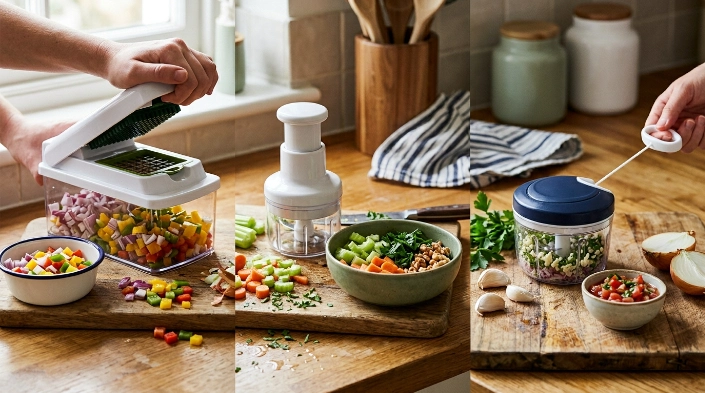
If you’re ready to pick one, I would start with these three designs because each solves a different prep problem.
🏆 Best for Uniform Dice
Fullstar Original Vegetable Chopper
★★★★☆ 4.5/5 Editorial Fit
This push-down design uses interchangeable stainless-steel blade inserts and a catch container. I’d choose this style when onions, peppers, potatoes, and salad vegetables need recognizable, consistent pieces.
⚡ Best Press-Action Pick
OXO Good Grips Chopper
★★★★☆ 4.4/5 Editorial Fit
Its stainless-steel blade rotates whenever you press the top knob, while the catcher cup keeps food contained. I like the mechanism for small batches of onions, celery, carrots, herbs, and nuts.
🥗 Best for Salsa & Herbs
Brieftons Manual Food Chopper
★★★★☆ 4.3/5 Editorial Fit
This pull-cord chopper uses a three-cup bowl and rotating stainless-steel blades. I’d consider it for herbs, garlic, onions, nuts, pesto ingredients, salsa, and other jobs where exact cubes aren’t necessary.
Frequently Asked Questions
What type of manual vegetable chopper is best for onions?
A push-down grid chopper works best when you want visible, evenly sized onion cubes. A pull-cord or pump chopper is better when exact shape doesn’t matter, such as onions for salsa, sauces, soups, or cooked mixtures.
Can a manual vegetable chopper cut potatoes?
Yes, a sturdy grid chopper or mandoline-style tool can cut potatoes. Large potatoes should usually be halved or sliced into manageable pieces first, and you should never apply excessive force if the food doesn’t pass through the blade safely.
Are pull-cord vegetable choppers worth using?
Pull-cord choppers are useful for quick, small-batch jobs such as onions, herbs, garlic, nuts, and salsa. They aren’t the best choice when a recipe needs identical cubes, because spinning blades create a less geometric chop.
What is the easiest manual vegetable chopper to clean?
The easiest models have few parts, removable blades, wide bowls, and minimal hidden grooves. A simple pump or pull-cord bowl can be easier to rinse than a multi-blade grid set, although care instructions vary by manufacturer.
Is a vegetable chopper better than a knife?
Neither tool is always better. A chopper can speed up repetitive cuts and contain ingredients, while a chef’s knife gives more flexibility and precise control over size, shape, and technique.
Final Takeaway
The best manual vegetable chopper type is the one that matches the cut you make most often. Choose a push-down grid for uniform dice, a pull-cord or pump design for quick chopping, and a mandoline hybrid for slices and julienne cuts.
Don’t let attachment count make the decision for you. Focus on blade mechanism, stability, cleaning, storage, and the vegetables you prepare every week.
Once those pieces match your cooking routine, a simple manual chopper can become one of the most useful time-saving tools in your kitchen.
