
Grid Vegetable Chopper: How to Choose and Use One

Quick Answer
A grid vegetable chopper is a manual kitchen tool that cuts vegetables into evenly sized pieces using a fixed blade grid and pressing lid. It’s especially useful for onions, potatoes, peppers, and meal-prep vegetables. For most home kitchens, I recommend choosing a model with two dicing sizes, a sturdy collection container, and a removable cleaning grid. A good chopper also fits into a practical kitchen cleanup routine.
What matters most when choosing one?
- Sharp cutting grid: Stainless steel blades should cut cleanly without excessive pressure.
- Useful dice sizes: Fine and medium grids handle most common vegetable preparations.
- Stable container: A nonslip base helps prevent movement while pressing.
- Easy cleaning: Removable inserts and a cleaning tool simplify maintenance.
- Comfortable handle: A broad, secure pressing surface makes repeated chopping easier.
Dicing vegetables by hand can make a simple dinner feel like a bigger project. A grid vegetable chopper offers a straightforward way to prepare consistent pieces without using electricity.
But these tools aren’t all alike. This guide explains their strengths, limitations, cutting techniques, cleaning requirements, and which designs deserve your attention.
What Is a Grid Vegetable Chopper?
A grid vegetable chopper is a manual food-preparation tool that pushes produce through intersecting blades. The grid creates square or rectangular pieces that drop into a container below.
Unlike a rotating food processor, the cutting pattern stays fixed. This makes a grid chopper particularly useful when consistent vegetable size matters.
Most models share five basic components:
- Blade grid: Intersecting metal cutting edges that determine the dice size.
- Pressing lid: Pushes the vegetable against the cutting blades.
- Collection container: Catches chopped ingredients beneath the grid.
- Removable blade insert: Allows different cutting sizes or replacement of supported attachments.
- Cleaning accessory: Helps remove vegetable fragments trapped between blades.
The most useful feature is consistency. Similar-sized vegetable pieces are easier to portion and generally cook more evenly than widely mixed sizes.
How Does a Grid Vegetable Chopper Work?
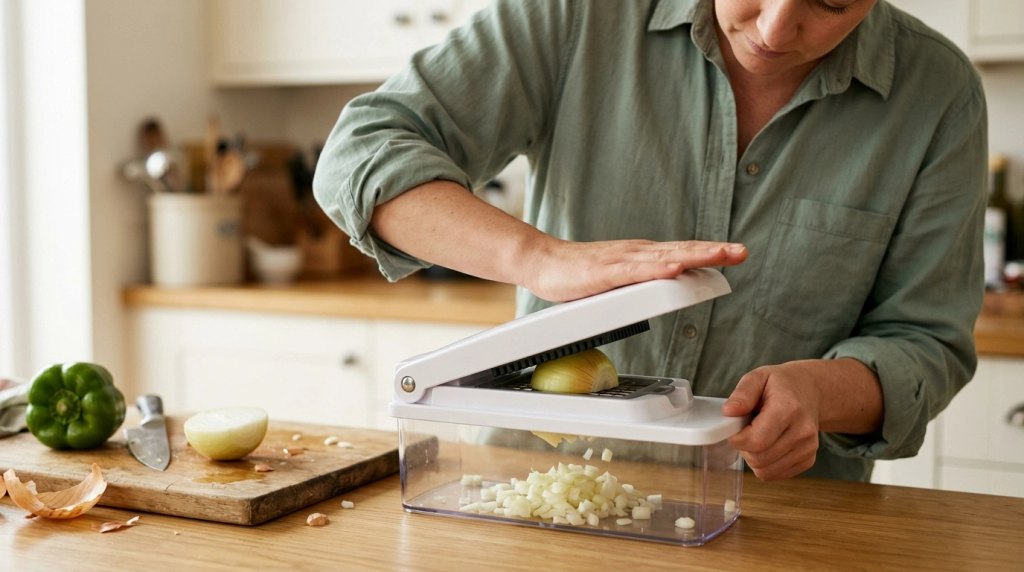
A grid chopper works by forcing a vegetable through stationary blades using downward pressure. The blades divide the food into pieces according to their spacing.
It’s a mechanical cutting process. No motor, battery, or electrical outlet is required.
How to use a grid vegetable chopper step by step
- Prepare the surface. Place the chopper on a flat, stable countertop away from the edge.
- Install the blade. Secure the desired cutting grid according to the manufacturer’s instructions.
- Wash your vegetables. Rinse fresh produce under running water before cutting.
- Trim large ingredients. Cut oversized vegetables into pieces that fit the cutting opening.
- Position the food. Center a manageable piece over the blade grid.
- Close the lid. Apply controlled downward pressure through the designated handle.
- Collect the pieces. Empty the container before ingredients reach the cutting mechanism.
- Clean the tool. Disassemble and wash its components after use.
I recommend beginning with a peeled onion half or a piece of bell pepper. Both demonstrate how the grid works without requiring exceptionally dense produce.
A controlled press is better than repeatedly striking the lid. Excessive force can damage the hinge, container, or blade assembly.
Why does vegetable size matter before chopping?
The cutting opening determines how large an ingredient can be. A vegetable wider than that opening needs trimming first.
Thickness matters too. A thick carrot section generally requires more pressure than a thin piece of bell pepper.
- Cut large potatoes into manageable sections.
- Remove pepper stems and seed cores before dicing.
- Place onion pieces flat-side down when the design allows.
- Use smaller batches for firm vegetables.
- Stop if the lid resists rather than forcing it closed.
Which Vegetables Can You Cut With a Grid Chopper?
Grid vegetable choppers work best with produce that has enough structure to pass through the blades cleanly. Onions, peppers, zucchini, potatoes, and some tomatoes are common choices.
Extremely hard, fibrous, or delicate foods need more caution. The right result depends on ripeness, thickness, and blade sharpness.
| Vegetable | Suitability | Preparation Tip |
|---|---|---|
| Onion | Excellent | Peel and cut into halves or sections. |
| Bell pepper | Excellent | Remove the stem, core, and seeds. |
| Potato | Good | Use smaller pieces to reduce resistance. |
| Cucumber | Good | Remove excessively watery seeds if needed. |
| Zucchini | Good | Trim to fit the opening. |
| Carrot | Conditional | Cut thin sections; avoid forcing thick pieces. |
| Tomato | Conditional | Choose firm fruit and a sharp grid. |
| Leafy greens | Poor | Use a knife or suitable food processor. |
These are general suitability guidelines, not guaranteed capabilities for every model. Always follow the manufacturer’s produce and cutting restrictions.
Can a grid chopper cut hard vegetables?
Some models can dice raw potatoes and carrots, but dense vegetables require greater pressure. Blade geometry and hinge strength make a major difference.
Never force frozen vegetables, bones, or produce beyond the manufacturer’s limits. A chef’s knife may be the safer choice for particularly hard ingredients.
Grid Vegetable Chopper vs. Food Processor: Which Is Better?
A grid chopper is usually better when you want recognizable, evenly shaped vegetable cubes. A food processor is more useful for fast mincing, shredding, and processing larger quantities.
Neither replaces every function of the other. The best choice depends on the final texture you need.
| Feature | Grid Chopper | Food Processor |
|---|---|---|
| Power source | Manual | Usually electric |
| Cube consistency | Fixed grid size | Variable unless using a dicing attachment |
| Best texture | Defined vegetable pieces | Chopped, minced, shredded |
| Physical effort | Downward hand pressure | Minimal cutting effort |
| Cleaning | Small grid openings need attention | Bowl, blade, lid, and seals |
| Storage | Typically compact | Often bulkier |
For homemade salsa, diced salad vegetables, and soup ingredients, I favor the predictable shape of a grid chopper. For finely minced mixtures, a food processor makes more sense.
What Should You Look for When Buying a Grid Vegetable Chopper?
The best grid vegetable chopper isn’t necessarily the model with the most attachments. Blade performance, structural stability, and easy maintenance matter more.
As of 2026, many manual choppers combine dicing grids with slicing, grating, or spiralizing accessories. Those extras are useful only if you’ll actually use them.
1. Choose practical cutting-grid sizes
A fine grid works well for salsa, relish, and small onion pieces. A larger grid suits soups, roasted vegetables, and chunky salads.
Some models advertise exact spacing, such as 6 mm, 12 mm, or 19 mm. Compare the actual blade sizes rather than assuming every small or large grid is identical.
2. Examine the blade and hinge design
Stainless steel blades are common, but steel type alone doesn’t guarantee cutting performance. Blade sharpness, attachment fit, and hinge alignment also influence results.
Look for secure locking mechanisms and a rigid pressing lid. A flexible lid can make harder vegetables frustrating to cut.
3. Check the collection capacity
Container capacity matters when preparing several servings. A larger bowl reduces how often you need to pause and empty chopped ingredients.
However, a large container also requires additional storage space. Match the size to your normal meal-preparation routine.
4. Prioritize cleaning access
Food can lodge between narrow blade openings. Removable inserts and a dedicated cleaning comb make regular maintenance easier.
I would choose fewer well-designed attachments over a large accessory set with awkward cleaning requirements.
5. Consider physical effort and comfort
Manual choppers still require hand pressure. A broad handle and nonslip base improve control, but they don’t eliminate the effort needed for dense produce.
If hand strength is limited, a suitable electric food processor may be more comfortable. Test the lid movement before buying when possible.
Are Grid Vegetable Choppers Worth Buying?
A grid vegetable chopper is worth considering when you frequently prepare diced vegetables and want consistent pieces. It’s less appealing for occasional chopping or kitchens with very limited storage.
The main benefit is reducing repetitive knife cuts. The trade-off is another tool that needs washing and storage.
Who will benefit most?
- Meal-prep cooks: Prepare repeated batches of onions, peppers, and potatoes.
- Families: Produce consistent vegetable sizes for shared meals.
- Salad lovers: Make evenly sized ingredients for chopped salads.
- Home salsa makers: Control the texture without turning everything into puree.
- Small-kitchen cooks: Use a manual alternative to a larger appliance.
When should you skip one?
- You rarely need uniformly diced vegetables.
- You already dice efficiently with a sharp knife.
- You mainly process herbs, nuts, or leafy ingredients.
- You struggle with repetitive downward pressure.
- You dislike cleaning narrow cutting grids.
One practical buying test is to examine your usual recipes. If several weekly meals require diced onions and peppers, the tool has a clear purpose.
How Do You Clean a Grid Vegetable Chopper Safely?
Clean a grid vegetable chopper immediately after use with warm, soapy water and a suitable cleaning tool. Remove trapped food carefully without pressing your fingers against the cutting edges.
The USDA recommends cleaning food-contact equipment and surfaces to help prevent cross-contamination. Its cutting board guidance explains relevant washing and drying principles.
Simple cleaning routine
- Empty the container and separate removable components.
- Rinse away loose vegetable fragments.
- Use the supplied cleaning comb to dislodge food from the grid.
- Wash the components with mild dish soap and warm water.
- Rinse thoroughly with clean water.
- Allow each component to dry completely before storage.
Never scrape the sharp grid with bare fingers. Use the included tool or an appropriate soft cleaning brush.
Check the manual before putting parts in the dishwasher. A dishwasher-safe container doesn’t automatically mean every blade, lid, and attachment is dishwasher-safe.
How should you dry and store the parts?
Dry removable components separately before reassembly. This helps prevent trapped moisture around joints and blade holders.
A clean dish rack can provide a convenient drying location. If countertop space is limited, review these dish drying alternatives.
Store blade inserts in their protective holder when one is included. Keep exposed edges away from children and crowded utensil drawers.
What Are the Most Common Grid Chopper Problems?
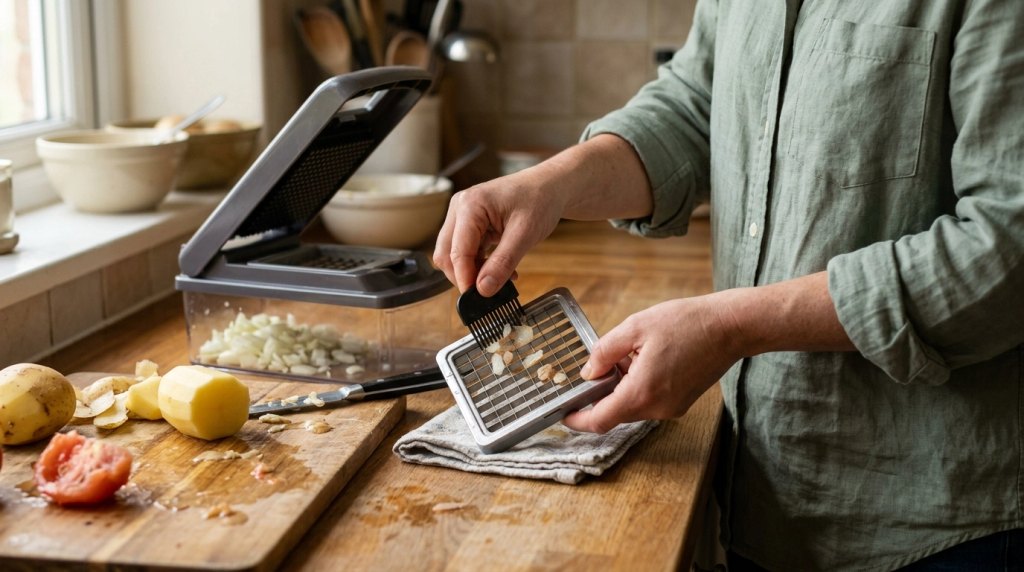
Most grid chopper frustrations involve difficult cutting, trapped food, or a lid that won’t close smoothly. Correct food preparation and routine cleaning often resolve these issues.
The chopper won’t cut through vegetables
- Reduce the thickness of the vegetable pieces.
- Check whether the blade insert is seated correctly.
- Remove food lodged between the grid openings.
- Inspect the blades for damage or misalignment.
- Stop using the unit if the hinge or frame appears cracked.
Vegetables become crushed instead of diced
Soft tomatoes and other delicate ingredients can collapse under pressure. Firmer produce and sharper blades generally produce cleaner edges.
A blunt or misaligned grid may also contribute to crushing. Replace damaged parts instead of applying additional force.
Food sticks inside the grid
Small onion fragments and soft vegetable skins sometimes remain inside the openings. Use the supplied cleaning accessory after removing the insert safely.
Avoid metal picks that could damage the blades or protective components. Follow the manufacturer’s cleaning instructions.
Three Grid Vegetable Choppers Worth Considering
If you’re choosing a manual dicer, these three models cover different kitchen priorities. They offer a practical starting point for comparing blade choices, capacity, and convenience.
The recommendations below reflect published features rather than personal testing. Prices, included attachments, and availability can change between listings.
🏆 Best Everyday Choice
Fullstar Pro Original 4-in-1 Vegetable Chopper
★★★★☆ 4.5/5 editorial fit
This manual chopper combines two dicing grids with ribbon and spiralizing accessories. Its collection container suits everyday ingredient preparation. My reason for putting it first is the practical combination of common cutting functions without requiring electricity.
🔧 Best for Versatility
Mueller Pro-Series 10-in-1 Vegetable Chopper
★★★★☆ 4.4/5 editorial fit
The Mueller Pro-Series offers interchangeable attachments for dicing, slicing, and other preparation tasks. It’s a sensible choice when you want several cutting options in one tool. My main consideration would be whether you’ll use the extra blades often enough to justify cleaning and storing them.
🥗 Best for Defined Dice Sizes
Brieftons QuickPush BR-QP-02 Vegetable Chopper
★★★★☆ 4.3/5 editorial fit
The QuickPush BR-QP-02 offers three published grid sizes: 6 mm, 12 mm, and 19 mm. Its stated 8-cup collection capacity is useful for preparing larger batches. I’d consider this model when predictable cube sizes matter more than spiralizing accessories.
Frequently Asked Questions
Is a grid vegetable chopper better than a knife?
A grid vegetable chopper can be more convenient for preparing repeated batches of uniformly diced ingredients. However, a sharp chef’s knife is more versatile and handles unusual shapes, delicate produce, and trimming tasks better. I recommend keeping a knife available even when using a chopper.
Can you use a grid vegetable chopper for potatoes?
Yes, many grid vegetable choppers can cut raw potatoes into cubes when the pieces fit the opening. Firm potatoes require more downward pressure than softer vegetables. Cut large potatoes into smaller sections and follow the model’s instructions before pressing.
Are grid vegetable choppers dishwasher-safe?
Some grid choppers include dishwasher-safe containers and removable components, but cleaning requirements vary by model. Check the manufacturer’s manual before placing blades or lids in the dishwasher. Hand-washing sharp inserts with a suitable cleaning tool can also help prevent accidental injury.
Can a grid vegetable chopper cut onions without tears?
A grid chopper can reduce repeated knife cuts, potentially limiting how long you handle freshly cut onions. However, cutting onions still releases irritating compounds, so the tool cannot guarantee a tear-free experience. Chilled onions and good ventilation may improve comfort.
How long does a vegetable chopper last?
Lifespan depends on construction quality, usage frequency, cleaning habits, and the foods being processed. Inspect the blades, hinge, lid, and container regularly. Replace the tool or damaged components when you notice cracking, dullness, loose fittings, or unsafe operation.
Final Takeaway: Is a Grid Vegetable Chopper Right for Your Kitchen?
A grid vegetable chopper is most useful when you regularly prepare onions, peppers, potatoes, and other ingredients that benefit from consistent dicing. It offers predictable cuts without the bulk of an electric food processor.
My recommendation is to prioritize sturdy construction, two useful dice sizes, and accessible cleaning parts before considering extra attachments. Choose a tool that fits the meals you already make.
Good preparation equipment should make cooking simpler, not create more cleanup. Pair your chopper with safe handling habits and a practical countertop drying setup to keep the entire routine manageable.
