
Does Stainless Steel Work on Induction? How to Tell in 10 Seconds

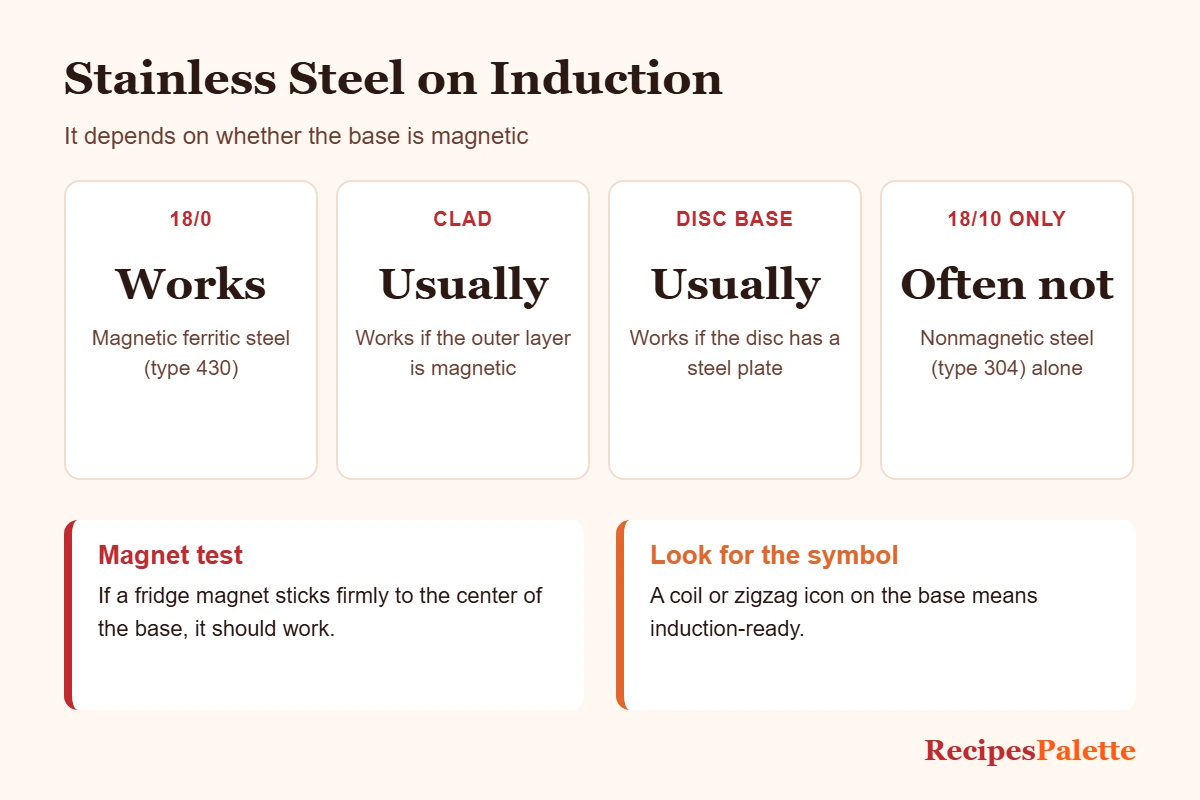
Some stainless steel works on induction and some does not. Induction cooktops only heat cookware with a magnetic base. Magnetic stainless steel, such as 18/0 (type 430), works well. Many multi-ply and disc-bottom stainless pans also work, because they have a magnetic layer on the bottom. But cookware made only from nonmagnetic 18/10 or 18/8 stainless steel (type 304) often will not heat at all. The easy test: if a fridge magnet sticks firmly to the bottom of the pan, it should work on induction.
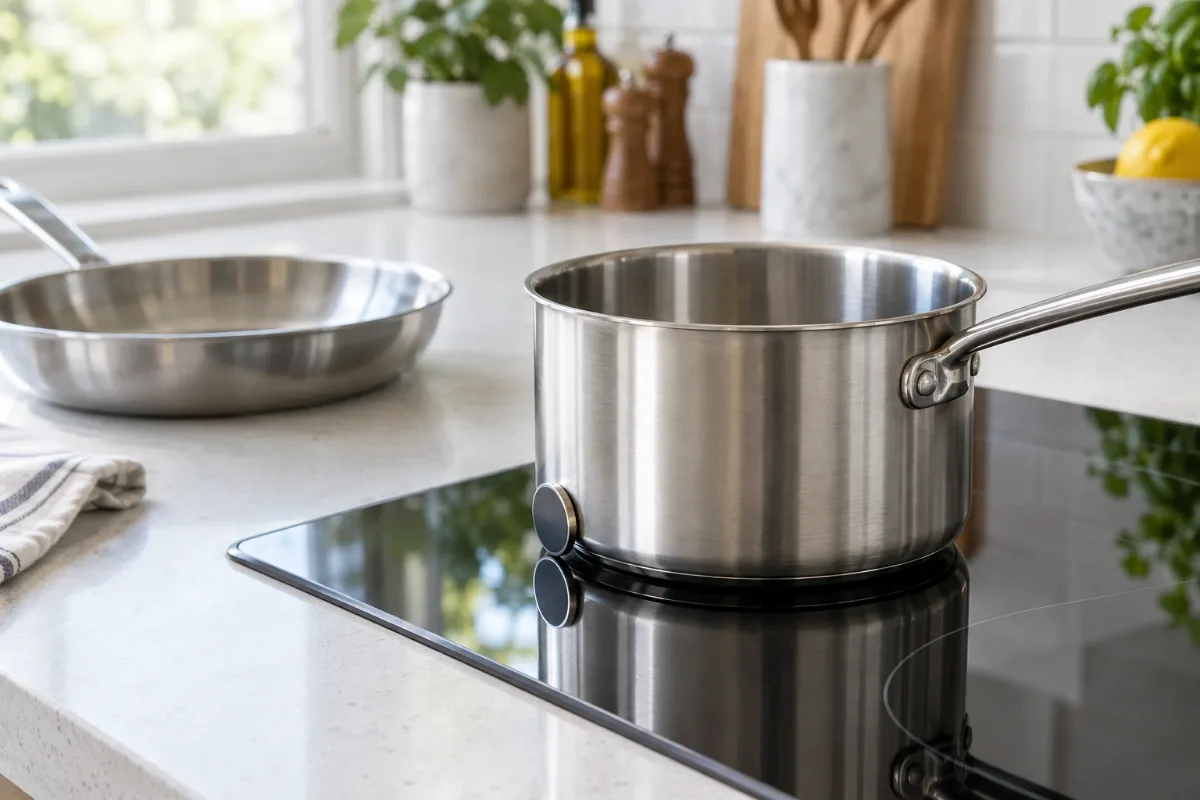
Stainless steel is the most common cookware material, so this question comes up constantly after people buy an induction cooktop. Here is why stainless steel is not one material, how to check what you own, and what to look for when you buy new pans.
How Induction Cooking Works
An induction cooktop has a copper coil under the glass. When you turn it on, electric current through the coil creates a rapidly changing magnetic field. If you put a pan made of a magnetic (ferromagnetic) metal on top, that field creates electrical currents inside the base of the pan, and the pan itself heats up. The glass stays relatively cool, apart from heat that transfers back from the hot pan.
This is why the material of the pan matters so much. A pan that is not magnetic does not respond to the field, so it stays cold, and most cooktops will flash an error or a “no pan” symbol. For the full list of what works, see what cookware works on induction.
Why Some Stainless Steel Is Magnetic and Some Is Not
“Stainless steel” is a family of iron alloys. Adding chromium makes steel resist rust, and adding nickel makes it shinier and even more corrosion-resistant. But nickel also changes the steel’s crystal structure, and that changes whether it is magnetic.
| Grade (common name) | Typical type | Nickel | Magnetic? | Works on induction on its own? |
|---|---|---|---|---|
| 18/0 | 430 (ferritic) | Little or none | Yes | Yes |
| 18/8 | 304 (austenitic) | About 8% | No or very weak | Usually no |
| 18/10 | 304 (austenitic) | About 10% | No or very weak | Usually no |
| Surgical / marine | 316 (austenitic) | About 10–14% | No | No |
The first number is the chromium percentage and the second is nickel. So 18/10 means about 18 percent chromium and 10 percent nickel. Cookware makers love 18/10 for cooking surfaces because it is shiny, durable and non-reactive, but on its own it is a poor fit for induction.
Why Many 18/10 Pans Still Work
Here is where it gets confusing. Plenty of pans labeled “18/10 stainless steel” work perfectly on induction. That is because most good stainless cookware is not a single piece of one metal. The 18/10 is usually the cooking surface, while other layers do the rest.
- Clad (multi-ply) cookware: Layers of metal are bonded together all the way up the sides, often 18/10 stainless inside, an aluminum or copper core for even heating, and a magnetic stainless exterior. If the outer layer is magnetic, it works on induction.
- Disc-bottom (impact-bonded) cookware: The pan body is thin stainless steel, with a thick disc bonded to the bottom. If that disc includes a magnetic steel plate, it works on induction.
- Single-layer 18/10 or 18/8 pans: No magnetic layer anywhere. These usually will not work.
How to Test Your Stainless Steel Pans
1. The magnet test
Take an ordinary fridge magnet and hold it against the center of the outside bottom of the pan.
- Sticks firmly: it should work on induction.
- Sticks weakly or slides off: it may heat slowly, unevenly or not at all.
- Does not stick: it will not work on induction.
Test the middle of the base, not just the edges. Some disc-bottom pans have a magnetic plate that is smaller than the base, so the magnet may stick in the middle but not near the rim.
2. Look for the induction symbol
Many manufacturers stamp an induction symbol on the base, often a coil or zigzag line, sometimes with the word “induction.” The product box or listing may also say “induction compatible” or “suitable for all cooktops.”
3. Try it on the cooktop
Put a little water in the pan and set it on the smallest suitable zone. If the cooktop recognizes the pan, it will heat; if not, it will usually show an error or switch off after a few seconds. This is safe to try.
What to Look for When Buying Stainless Steel for Induction
- “Induction compatible” in the description, or the induction symbol on the base.
- A magnetic exterior on clad cookware. Many brands list the layers, for example “18/10 interior, aluminum core, magnetic stainless exterior.”
- A flat, thick base. Induction works best with full contact. Warped or domed bottoms heat poorly and may rattle.
- The right size. Most induction zones need a minimum base diameter, often around 4 to 5 inches (10 to 12 cm). Very small pans and stovetop espresso makers may not be detected.
- Bring a magnet when shopping. It is the simplest way to check pans in a store.
Fixes If Your Stainless Pan Does Not Work
- Induction interface disc: a flat magnetic steel plate that sits on the cooktop. The disc heats up, and it heats your pan by contact. It works, but it is slower and less efficient, and it loses the precise control that makes induction appealing. Do not leave it heating empty.
- Use other cookware: cast iron, enameled cast iron and carbon steel all work on induction. See can cast iron skillets be used on induction cooktops and will Dutch ovens work on induction.
- Replace a few key pieces: many people keep their old pans for other uses and buy just one induction-ready skillet and saucepan to start.
Tips for Cooking With Stainless Steel on Induction
- Heat it gradually. Induction heats much faster than gas or electric. Preheat on medium rather than high to avoid hot spots and scorching.
- Do not overheat an empty pan. Thin stainless pans can warp, and some multi-ply pans can discolor with a rainbow tint. The tint is cosmetic and usually comes off with a stainless steel cleaner or a little vinegar.
- Expect some buzzing. A light hum or buzz at high power is normal with layered pans. It often goes quiet at lower settings or when there is food in the pan.
- Do not drag pans. Lift them instead, to avoid scratching the glass.
- Match the pan to the zone. A pan much bigger than the zone heats unevenly at the edges.
Stainless Steel vs Other Materials on Induction
| Material | Works on induction? | Notes |
|---|---|---|
| Magnetic stainless (18/0) or clad with magnetic exterior | Yes | Durable, non-reactive, oven-safe |
| Cast iron and enameled cast iron | Yes | Heavy, holds heat well; lift, do not slide |
| Carbon steel | Yes | Lighter than cast iron, needs seasoning |
| Aluminum, copper, glass, ceramic | No, unless the base has a magnetic plate | Look for an “induction base” |
| Single-layer 18/10 or 18/8 stainless | Usually no | Check with a magnet |
If you are also thinking about safety and non-toxic options, see what is the safest cookware.
Frequently Asked Questions
Does 18/10 stainless steel work on induction?
Solid 18/10 stainless steel does not, because it is not magnetic. But many pans marketed as 18/10 have a magnetic outer layer or base disc, and those work fine. Use a magnet to check.
Is 18/0 stainless steel good for induction?
Yes. 18/0 is magnetic, so it heats well on induction. It is often used as the outer layer of induction-ready clad cookware.
Why does my stainless steel pan buzz on the induction cooktop?
The magnetic field makes the layers of the pan vibrate slightly. It is normal and harmless, and usually quieter at lower power settings.
Will an induction cooktop damage stainless steel pans?
No, as long as you do not overheat them empty. Induction heats quickly, so moderate heat prevents warping and discoloration.
Can I use a stainless steel pressure cooker on induction?
Many stovetop pressure cookers have an induction-ready base. Check for the symbol or do the magnet test on the bottom.
Do magnets stick to all induction cookware?
A magnet should stick firmly to the base of any pan that works on induction. That is the simplest rule to remember.
The Bottom Line
Stainless steel works on induction only when the base is magnetic. 18/0 stainless works on its own; 18/10 and 18/8 usually work only when they are combined with a magnetic exterior layer or base disc. Keep a fridge magnet handy: if it sticks firmly to the middle of the base, the pan is ready for induction.