
Sakugi 3-Tier Over Sink Dish Rack Review 2026

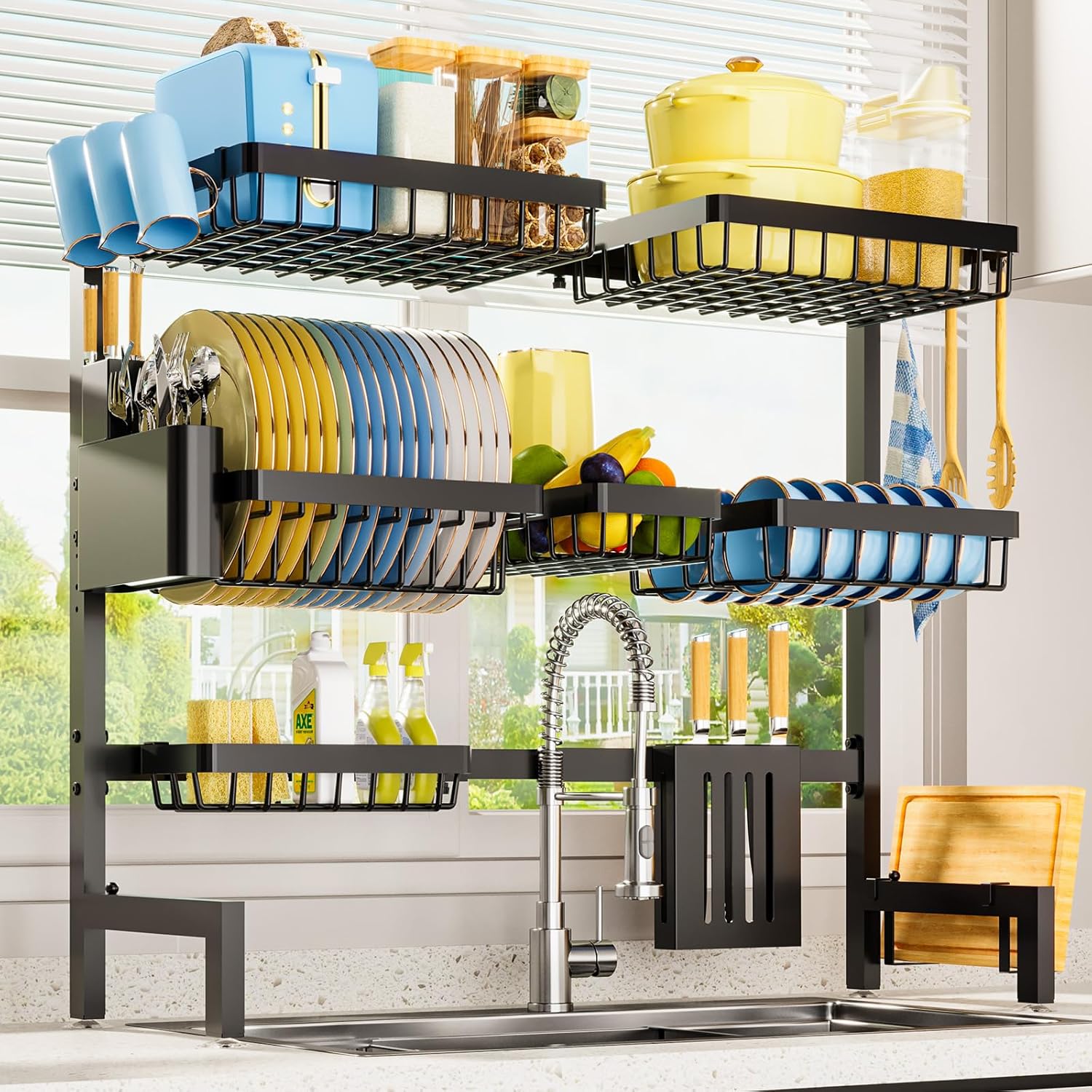
The Sakugi 3-Tier Over-the-Sink Dish Drying Rack (ASIN B0DYNYQ52P) is built for one job: moving a large amount of dish drying off the counter and into the unused vertical space above the sink. This XX-Large model uses a 304 stainless-steel frame, adjusts from 31.5 to 39 inches wide, and combines four baskets with holders for utensils, knives and cutting boards plus 10 removable hooks. The capacity is impressive, but this is a genuinely tall rack, so measurements matter more than they do with a normal countertop drainer.
Quick Overview and Specifications
| Feature | Details |
|---|---|
| Model | Sakugi LSJ054, XX-Large 3 Tier |
| Material | 304 stainless steel, black finish |
| Listed size | About 11.8 in D × 31.5–39.0 in W × 30.3 in H |
| Storage | 4 baskets, utensil holder, knife holder, cutting-board holder, 10 hooks |
| Fit limits | Sink under 39 in wide; faucet under 21 in high; about 42.5 in vertical clearance above counter |
| Weight | About 4.17 kg / 9.2 lb |
| Drainage | Directly into the sink; no separate drainboard |
| Buyer feedback | About 4.4/5 across 1,000+ ratings in the latest listing snapshot reviewed |
First Impressions
This rack feels more like a small sink-side storage station than a basic dish drainer. At 30.3 inches high, it has real visual presence, but the payoff is that bowls, plates, cookware and accessories can be separated instead of piled together. Assembly tools and instructions are included, and recent buyer feedback repeatedly describes setup as straightforward. Before ordering, compare the rack with this standard dish rack size guide; the critical numbers are your total sink width, faucet height and cabinet clearance, not just the basin opening.
Performance and Feel
The four-basket layout is the main reason to choose this version. It gives you enough zones to keep plates apart from bowls and cookware, while the side holders free basket space for larger items. Buyers report that the rack can stay stable under substantial everyday loads, and several specifically praise the lack of center sag when correctly assembled. The tradeoff is that the wide basket spacing is not ideal for tiny lids or similarly narrow pieces, which can slip through unless you add a liner. Good loading also matters; this guide to organizing dishes in a dish rack is useful when mixing plates, cups and cookware.
Drainage, Sink Clearance, and Everyday Access
Direct-to-sink drainage is excellent for keeping counters dry because there is no tray collecting standing water. The rack also leaves prep space beside the sink open. However, this design succeeds or fails on clearance. Sakugi specifies a faucet below 21 inches and about 42.5 inches of vertical room above the countertop. One buyer also noted that the upper tiers can be awkward for shorter users. In other words, the rack saves horizontal space by spending vertical space.
Durability
The 304 stainless-steel construction and waterproof finish are encouraging for a wet environment, and multiple buyers report months of stable use. Still, the feedback is not uniformly perfect. One recent owner mentioned water spotting that wiped away easily, while another reported needing replacements because of broken wires or missing fixed nuts. There are also comments that the suction or anchoring pieces and lightweight connecting bar could feel more substantial. I would treat the frame as durable for normal dishware, but inspect the hardware during assembly and avoid assuming it is an industrial shelf.
Value for Money
Value is strongest if your alternative is sacrificing a large section of countertop. The Sakugi combines drying, utensil storage, knife storage and hanging hooks in one footprint, so it replaces several smaller organizers. Pricing varies by seller and promotion, so the live Amazon price matters. Its real value advantage is capacity per square inch of counter, not simply being the cheapest rack.
Comparison to Similar Competing Products
The Kitsure US4184 is a closer, lower-profile alternative: it adjusts from 30.0 to 33.9 inches, uses two tiers, three multipurpose baskets and five hooks, and adds four suction cups. Sakugi reaches farther to 39 inches and offers more basket and hook capacity. RecipesPalette’s review of the smaller Sakugi over-the-sink rack is also worth checking if this 30-inch-tall model is simply too large.
The OXO Good Grips Extendable Over-the-Sink Rack takes the opposite approach: compact, single-level and retractable rather than tall and permanent. It is better suited to lighter loads; see the OXO over-the-sink dish rack review. The ADBIU expandable rack competes on large capacity and adjustable height, but its own seller warns that size-related returns are common—another reminder that giant over-sink racks reward careful measuring.
Pros and Cons
- Large four-basket, three-tier capacity
- 31.5–39.0-inch adjustable width
- 304 stainless-steel construction
- Direct drainage into sink
- 10 hooks plus dedicated holders
- Needs substantial overhead clearance
- Small items can slip through wide wires
- Some buyer reports of hardware or QC issues
- Upper tiers may be inconvenient for shorter users
Who Should Buy This?
Buy it if you hand-wash a meaningful volume of dishes, have a sink in the 31.5–39-inch range, and want your countertop back. It especially suits small kitchens with generous vertical clearance. Skip it if your cabinets sit low, your faucet is unusually tall, or you mostly wash only a few items at a time. If you are unsure whether a permanent rack makes sense at all, this guide on whether a dish rack is necessary lays out compact and fold-away alternatives.
Extended FAQ
What sink width fits this Sakugi rack?
The listed adjustment range is 31.5 to 39.0 inches. Measure the full support span where the feet will sit, not only the inside of the basin.
How much overhead clearance does it need?
Sakugi recommends about 42.5 inches of vertical space above the countertop so the 30.3-inch rack and loaded dishes do not collide with cabinets.
Will it fit around a tall faucet?
The listed guidance is a faucet under 21 inches high. Also check handle movement and sprayer clearance.
Does water drain onto the counter?
The baskets are positioned to drip directly into the sink. Poor alignment or side accessories extending outside the basin can still create stray drops.
Is it rustproof?
The listing specifies 304 stainless steel with a waterproof surface. Regular wiping is still sensible, especially in hard-water areas where mineral spots show on dark finishes.
Can it hold pots and pans?
It is designed for mixed dishware and the baskets are roomy, but Sakugi does not publish a clear load rating for this exact model. Heavy cast iron should be handled conservatively.
Final Verdict
The Sakugi B0DYNYQ52P earns its 8.6/10 because it solves the counter-space problem more aggressively than a normal rack: three tiers, four baskets, a 31.5–39-inch span and a full set of holders turn the area above the sink into a genuine drying station. The downside is equally specific—this is a large structure with strict fit requirements and a few buyer-reported QC concerns. Measure first, inspect the hardware during setup, and it can be an excellent high-capacity choice for the right kitchen.
As an Amazon Associate, we earn from qualifying purchases…
