
What Can I Do With an Old Dish Rack? 12 Smart Reuse Ideas

Quick Answer
You can reuse an old dish rack as a lid organizer, cutting-board holder, mail sorter, craft organizer, garage tool rack, or drying station for reusable bags and bottles. If the rack no longer fits your kitchen, repurposing it can be more useful than immediately replacing it, although you can also explore these easy dish rack alternatives.
Best ways to reuse it
- Organize pan lids: Stand lids between the existing plate dividers inside a cabinet.
- Store cutting boards: Use the slots to separate boards, trays, and thin baking sheets.
- Sort office papers: Turn the plate slots into sections for mail, folders, or notebooks.
- Organize craft supplies: Separate palettes, paper pads, rulers, stencils, and small tools.
- Use it elsewhere: Move a sturdy rack to a garage, utility room, pantry, or garden workspace.
- Donate or recycle: Pass along a usable rack or check local recycling rules if it is beyond repair.
Check before reusing
- Clean the rack thoroughly and inspect it for sharp edges, cracked plastic, loose wires, peeling coatings, and significant rust.
I dislike throwing away something simply because it has stopped doing its original job. Dish racks are especially easy to overlook because their dividers already make surprisingly useful organizers.
I have moved old racks from the sink to cabinets, desks, and utility spaces instead. The trick is matching the rack’s shape and condition to a new job.
What Can You Do With an Old Dish Rack?
An old dish rack can become a vertical organizer anywhere you need to separate flat or narrow objects. Plate dividers work well for pan lids, cutting boards, folders, trays, craft supplies, and similar items.
The rack does not have to remain anywhere near the sink. In many cases, its second life works better in a dry cabinet, pantry, office, garage, or hobby area.
Simple definition: Repurposing a dish rack means using its frame, dividers, tray, or utensil compartments for a different household job instead of discarding the entire rack.
As of 2026, I start with reuse because it keeps a usable item working longer. The U.S. EPA also places source reduction and reuse ahead of recycling in its waste-management hierarchy.
What Should You Check Before Repurposing a Dish Rack?
Clean and inspect the rack before deciding where it belongs. A rack suitable for storing folders may not be suitable for holding clean dishes.
- Wash away residue: Remove grease, soap film, dust, food particles, and mineral deposits.
- Inspect metal: Look for rust, broken welds, exposed wire, and peeling coatings.
- Inspect plastic: Check for deep cracks, brittle areas, and sharp broken corners.
- Check stability: Put the rack on a flat surface and make sure it does not collapse or lean dangerously.
- Remove loose pieces: Discard broken utensil cups, feet, or accessories that cannot be secured.
- Match condition to use: Keep questionable racks away from food-contact jobs.
If the rack still dries dishes, cleanliness matters more than appearance. My guide on keeping a dish rack sanitary explains what to inspect around trays, corners, and wet areas.
How Can I Repurpose an Old Dish Rack in the Kitchen?
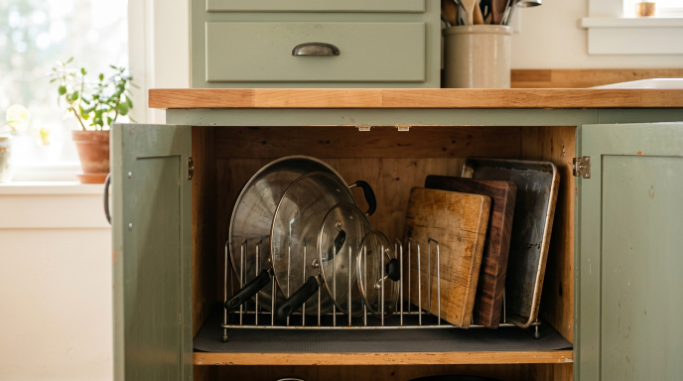
The easiest kitchen reuse is turning the rack into a vertical cabinet organizer. You already have evenly spaced dividers, so little modification is usually needed.
1. Turn It Into a Pan-Lid Organizer
Place a clean rack inside a lower cabinet and stand pan lids between the plate dividers. Position each lid so its handle remains easy to grab.
- Put larger lids toward the back.
- Keep glass lids away from damaged metal edges.
- Use the utensil compartment for small detachable handles when appropriate.
- Make sure the rack cannot slide when you pull out a lid.
I like this setup because it stops lids from becoming a noisy horizontal pile. You can see the size you need before touching anything.
2. Separate Cutting Boards and Serving Trays
A dish rack can hold cutting boards vertically instead of letting them lean against a cabinet wall. The same setup works for lightweight serving trays.
Measure your cabinet first. Tall boards need enough clearance to slide straight upward without hitting a shelf.
3. Organize Baking Sheets and Cooling Racks
Wide dish racks can separate thin baking sheets, muffin tins, cooling racks, and flat roasting accessories. This works best with a strong rack on a stable cabinet shelf.
- Keep heavy cast-iron cookware elsewhere.
- Place the heaviest sheet pans near the center.
- Avoid overfilling narrow dividers.
- Add a non-slip cabinet liner if the rack moves.
4. Make a Reusable-Bag Drying Station
If the rack remains clean and structurally sound, use it for washable storage bags, bottle parts, or other lightweight kitchen pieces. Spread the items apart so moisture can escape.
For more ideas that do not require a traditional countertop rack, see these methods for drying dishes without a dish rack.
Where Else Can an Old Dish Rack Be Useful?
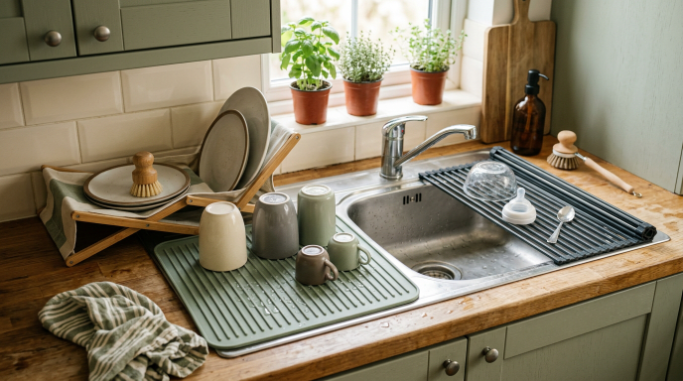
An old rack becomes more versatile once you stop treating it as kitchen equipment. Its slots are simply a ready-made vertical sorting system.
5. Make a Mail and File Sorter
A clean, dry rack can separate incoming mail, notebooks, folders, catalogs, and papers on a desk. Assigning one slot to each category makes the setup easier to maintain.
- First slot: Mail that needs attention.
- Second slot: Documents to file.
- Third slot: School or work papers.
- Utensil cup: Pens, scissors, markers, and rulers.
A rack with an unattractive drainboard can still work. Remove the tray if the design allows it and the remaining frame stays stable.
6. Create a Craft-Supply Organizer
Craft rooms create exactly the type of thin, awkward items that rack dividers handle well. I would use one for stencils, paper pads, cutting mats, rulers, small canvases, and plastic palettes.
The utensil section can hold brushes or tools when they fit securely. Keep sharp blades in a proper covered holder instead.
7. Organize a Sewing or Fabric Station
Use wide dividers for pattern envelopes, quilting rulers, cutting templates, and folded project instructions. Smaller compartments can hold marking tools that cannot fall through the rack.
This works particularly well on a dedicated project table. Everything remains visible instead of disappearing beneath a stack.
8. Use It as a Garage or Workbench Sorter
A sturdy rack can organize sandpaper sheets, polishing pads, small manuals, paint trays, or lightweight workshop supplies. Keep it away from machinery where a loose rack could become an obstruction.
- Do not store heavy tools in narrow plate slots.
- Keep sharp objects properly covered.
- Do not hang the rack on a wall unless it is securely mounted for the expected load.
- Keep chemicals in their original approved containers.
9. Build a Garden Workstation Organizer
A retired rack can sit on a potting bench and separate plant labels, empty seed trays, garden notebooks, and lightweight hand-tool accessories. A plastic model is especially convenient because soil can be rinsed away.
I would keep seed packets themselves in a dry container rather than leaving them exposed to outdoor moisture. The rack works better for washable supplies.
10. Display Books, Records, or Decorative Plates
A good-looking rack can become a casual display stand for lightweight books, record sleeves, or decorative pieces. Test each object individually because rack slots vary widely in width and support.
Do not use a damaged rack for valuable or fragile items. A bent divider that is harmless in a garage could scratch a collectible.
Which Old Dish Rack Reuse Idea Is Best?
The best option depends more on the rack’s condition than its original price. A rusty metal rack may still organize workshop supplies, while a spotless plastic rack can work inside a cabinet.
| Reuse Idea | Best Rack Type | Best Location | Condition Needed | Setup Difficulty |
|---|---|---|---|---|
| Pan-lid holder | Wire or plastic | Kitchen cabinet | Clean, stable, smooth | Easy |
| Cutting-board sorter | Wide-slot rack | Cabinet or pantry | Clean and rust-free | Easy |
| Mail sorter | Any stable rack | Desk or entryway | Clean and dry | Easy |
| Craft organizer | Wire or plastic | Craft room | Stable | Easy |
| Workbench sorter | Sturdy metal or plastic | Garage | Structurally sound | Easy |
| Garden organizer | Washable plastic | Potting bench | Functional | Easy |
Can I Reuse a Rusty Dish Rack?
You can sometimes repurpose a lightly rusted rack for a non-food job, but significant corrosion changes the decision. Flaking metal, broken welds, sharp spots, or weakened sections are signs to stop using the rack for clean dishes.
If the corrosion is minor, first identify what the rack is made from. The repair approach for coated steel differs from stainless steel, so follow appropriate instructions rather than attacking every orange mark with an abrasive.
My guide on stopping a dish rack from rusting covers cleaning and corrosion prevention in more detail.
- Light cosmetic rust: Consider a dry, non-food organizational use after appropriate cleaning.
- Peeling coating: Keep the damaged surface away from dishes and food-contact items.
- Sharp corrosion: Stop using the rack where hands or fragile items may touch it.
- Weak welds: Recycle or discard the rack according to local rules rather than loading it again.
I would not casually repaint a rack and put it straight back under clean dishes. Any coating used around food-related items needs to be appropriate for the intended application and used exactly as its manufacturer directs.
Should You Donate an Old Dish Rack Instead?
Donate or give away the rack if it is clean, complete, stable, and still useful. Someone moving into a first apartment or setting up a temporary kitchen may value a rack you no longer need.
The EPA specifically encourages donating usable unwanted goods rather than automatically discarding them. Its household waste-reduction guidance lists donation as one way to keep useful products in circulation.
- Wash and dry the rack before offering it.
- Include its drainboard and utensil holder when you still have them.
- Mention broken or missing components clearly.
- Do not donate a rack with dangerous sharp edges or serious structural damage.
Can an Old Dish Rack Be Recycled?
Possibly, but recyclability depends on the material and your local collection program. Metal, plastic, wood, rubber feet, and mixed-material components may be handled differently.
The EPA advises checking with your local recycling provider because accepted materials vary by location. Its guide to recycling common materials also notes that metal and plastic acceptance depends on local programs.
- Identify the main material. Determine whether the frame is steel, stainless steel, aluminum, plastic, bamboo, or mixed materials.
- Remove detachable accessories. Separate trays, rubber feet, utensil holders, and other components when your recycler requests it.
- Check local rules. Do not assume a large plastic rack belongs in curbside recycling.
- Use a drop-off facility if needed. Metal recyclers may accept items that curbside programs do not.
Plastic deserves particular attention because a recycling symbol or resin number does not automatically mean your local program accepts that item. The EPA’s plastic waste guidance recommends checking local requirements before placing plastic in a recycling bin.
What Should I Use If I Retire My Old Dish Rack?
You do not necessarily need another traditional rack. A drying mat, roll-up over-sink rack, or smaller hybrid setup may solve the problem that made you retire the old one.
If countertop water was the issue, compare your next setup with these options for protecting the area under a dish rack.
- Choose silicone: Good when you want a washable flat drying surface.
- Choose an over-sink rack: Useful when counter space is limited.
- Choose a foldaway hybrid: Helpful when you still want plate support without permanent clutter.
If your old rack has reached the end of its useful life, these are the three replacement styles I would consider first:
🏆 Best Simple Replacement
OXO Good Grips Large Silicone Drying Mat
★★★★☆ 4.8/5 Editor Rating
The large mat measures about 16.9 × 12.5 inches and uses raised ribs to keep items above collected water. I like it when the goal is a washable drying surface without another permanent wire frame.
🚰 Best for Tiny Counters
Surpahs Over-the-Sink Roll-Up Drying Rack
★★★★☆ 4.7/5 Editor Rating
The large version measures about 20.5 × 13.1 inches and rolls into a compact bundle after use. I would choose this format when reclaiming countertop space is the main reason for retiring an old rack.
📦 Best Foldaway Hybrid
Umbra UDry Dish Drying Rack with Mat
★★★★☆ 4.6/5 Editor Rating
The standard UDry is about 24 × 18 inches and combines an absorbent mat with removable plate support. I like the concept for kitchens that need a rack occasionally but not all day.
Frequently Asked Questions
Can I use an old dish rack to organize pot lids?
Yes. A clean, stable dish rack can work well as a pot-lid organizer because its plate dividers keep lids upright and separated. Put the rack inside a cabinet, check that it cannot slide, and make sure metal edges cannot scratch glass lids.
What can I do with a rusty old dish rack?
A lightly rusted rack may still work for dry, non-food storage after appropriate cleaning, depending on its condition. Stop using a rack with sharp corrosion, broken welds, significant flaking, or structural weakness, especially around clean dishes or fragile objects.
Can a metal dish rack go in the recycling bin?
Do not assume that it can. Recycling rules vary between municipalities, and a dish rack may combine metal with plastic, rubber, or coatings. Check with your local recycling provider or metal-recycling facility and follow its instructions for separating components.
What can I do with an old plastic dish rack?
A sturdy plastic rack can become a cabinet organizer, craft sorter, office file holder, or garden-workstation organizer. If it is cracked or brittle, check local recycling rules before disposal because not every type or shape of household plastic is accepted curbside.
Is an old dish rack worth donating?
Yes, when it remains clean, complete, stable, and safe to use. Wash and dry it first, include removable accessories when possible, and disclose any minor cosmetic wear. A rack with sharp edges, serious rust, or broken structural parts is better kept out of the donation stream.
Give the Rack One More Job Before Throwing It Away
An old dish rack is already designed to separate objects, drain water, and keep awkward pieces upright. Those features can remain useful long after you stop drying plates in it.
Start with your cabinets, desk, craft area, or utility space and see whether the rack solves an organization problem there. If it cannot be safely reused or donated, check the material and follow your local recycling or disposal rules.