
What to Do With an Old Dish Rack? 11 Practical Ideas

Quick Answer
An old dish rack does not need to go straight into the trash. If it is clean and sturdy, you can repurpose it for lids, cutting boards, cleaning tools, crafts, or plant supplies; otherwise, donate, give away, sell, or recycle it where accepted. If you are removing the rack to reclaim counter space, you can also dry dishes without a traditional rack.
Best options for an old dish rack
- Reuse it: Turn sturdy slots into storage for pot lids, cutting boards, trays, or food-container lids.
- Repurpose parts: Use removable trays and utensil cups separately for cleaning or household organization.
- Donate it: Offer a clean, complete rack to a thrift store or reuse organization that accepts household goods.
- Give it away: A free local listing can find a new home for a functional rack quickly.
- Recycle carefully: Check local rules before placing metal, plastic, or mixed-material racks in recycling.
- Discard damaged racks: Retire racks with dangerous sharp edges, broken supports, or badly deteriorated coatings.
Before you decide
- Clean the rack, identify its material, and check whether the frame is still structurally sound.
I have a hard time throwing out kitchen organizers that still have some useful life left. A dish rack is especially tempting because its slots, tray, and utensil holder can solve problems far beyond drying plates.
The right choice depends on its condition. In this guide, I will show you what to keep, what to repurpose, where to donate, and when recycling or disposal makes more sense.
What Counts as an Old Dish Rack?
An old dish rack is a drying rack you no longer want for everyday dish drying. It may be too small, stained, rusty, missing a piece, difficult to clean, or simply replaced by a better design.
Simple definition: An old dish rack is any dish-drying rack that has reached the end of its current job but may still be safe and useful somewhere else.
Age alone does not make a rack useless. A ten-year-old stainless-steel rack can sometimes remain more useful than a newer rack with cracked plastic supports.
- Good condition: Stable frame, intact coating, working tray, and no dangerous sharp edges.
- Usable with limitations: Stained tray, missing utensil cup, worn feet, or cosmetic discoloration.
- Poor condition: Broken load-bearing joints, dangerous rust, sharp exposed wire, or badly cracked plastic.
Should You Reuse, Donate, Recycle, or Throw Away an Old Dish Rack?
Reuse is usually my first choice when the rack remains sturdy. Donation or giving it away comes next, while recycling depends on the materials and your local program.
Trash should be the last practical option. I reserve it for racks that are unsafe, badly damaged, or rejected by available recycling programs.
| Option | Best Rack Condition | Preparation | My First Check |
|---|---|---|---|
| Repurpose | Stable, even with cosmetic wear | Wash, dry, inspect | Are the slots and frame still useful? |
| Donate | Clean, complete, functional | Deep-clean and reassemble | Would I comfortably give it to a friend? |
| Sell or give away | Functional with honest cosmetic wear | Clean and photograph | Can another household use it safely? |
| Recycle | Broken but separable by material | Separate removable components | Does the local program accept that material? |
| Trash | Unsafe or unrecyclable | Contain sharp pieces | Is there truly no safe reuse or recycling route? |
What Can You Do With an Old Dish Rack? 11 Practical Ideas
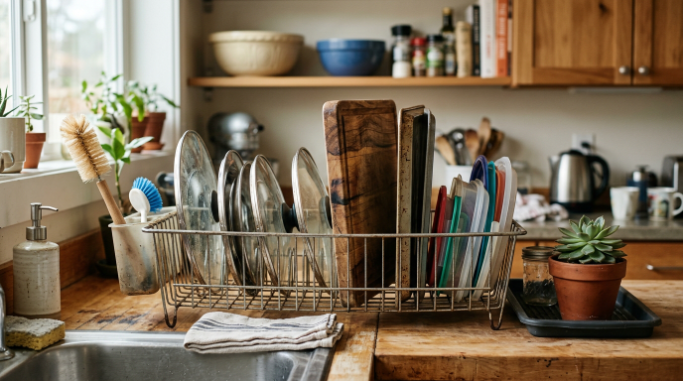
The easiest repurposing ideas use the rack’s original strengths: upright slots, airflow, drainage, and removable compartments. I start by looking at those features rather than asking what the rack was originally sold for.
1. Use It as a Pot-Lid Organizer
Vertical dish slots often hold pot and pan lids surprisingly well. Place the rack inside a deep cabinet or pantry where lids can stand separately instead of forming a noisy stack.
I like this idea because it requires almost no modification. Measure the tallest lids first so cabinet doors and shelves still close safely.
2. Store Cutting Boards and Baking Trays
A sturdy rack can separate cutting boards, cooling racks, sheet pans, and serving trays. Wider slots work best for thicker boards.
Keep heavy baking sheets toward the center or against a stable cabinet wall. A lightweight rack can tip if you load one side with several metal pans.
3. Organize Food-Container Lids
Food-storage lids create clutter because different sizes slide into each other. Dish-rack slots can separate small, medium, and large lids into visible groups.
If the rack stays in the kitchen, clean it thoroughly before switching jobs. You can use the same basic organization principles from my guide on organizing dishes in a dish rack and apply them to lids.
4. Turn the Utensil Cup Into a Cleaning Caddy
Do not overlook removable parts. The utensil holder can store bottle brushes, sink brushes, small scrubbers, gloves, or cleaning tools.
I prefer keeping cleaning equipment separate from food-contact utensils. Once a rack component becomes a cleaning caddy, I would leave it in that role.
5. Use the Drain Tray Under Small Plant Pots
A removable plastic tray can catch small drips beneath indoor plant pots. This works best when the tray is watertight and large enough to keep water off the furniture below.
Do not allow irrigation water to sit indefinitely. Empty the tray after watering and protect surfaces that can be damaged by moisture.
6. Create a Craft-Paper or Coloring-Book Organizer
A clean rack can separate coloring books, thin sketch pads, folders, craft paper, and lightweight activity boards. It is especially useful when children need to see each item instead of digging through a pile.
Remove anything sharp first. Wire ends that were harmless behind a plate can become a problem when small hands reach between the slots.
7. Make a Mail or File-Sorting Station
Place a dry rack on a desk or entryway shelf to separate incoming mail, bills, notebooks, and folders. The utensil compartment can hold pens or scissors.
This works best with compact racks that have straight dividers. I would avoid using a large drainboard model unless you have enough desk space.
8. Keep It as a Backup Drying Rack
A second rack can help during holidays, meal-prep days, parties, or large cooking sessions. Store it in a pantry or utility area until your main rack fills up.
Foldable models are especially easy to keep for this purpose. Even an older fixed rack can be worthwhile if it is clean and does not consume valuable storage space.
9. Donate It to a Reuse Organization
A clean rack in good condition may be useful to another household. Goodwill lists kitchenware and other household goods among the types of items its network may accept.
Habitat for Humanity ReStores also accept various housewares at participating locations. Acceptance rules vary, so check with the specific location before making a trip.
10. Sell It or Give It Away Locally
A branded stainless-steel, aluminum, folding, or expandable rack may still have resale value when it works properly. Clean it first and photograph the actual wear rather than hiding stains or scratches.
If selling feels like too much work, offer it free. The Freecycle Network is built around giving usable items to people in local communities instead of discarding them.
11. Separate the Materials for Recycling
Some old racks combine steel wire, plastic feet, silicone pieces, coatings, and a plastic drain tray. That mixture means the whole rack may not belong in one recycling bin.
Remove components only when they separate safely. Keep any screws, sharp wire, or broken metal contained while you sort the materials.
How Do You Clean an Old Dish Rack Before Reusing or Donating It?
Clean the rack before deciding whether it deserves another job. Dirt and mineral buildup can make a usable rack look far worse than it is.
- Take it apart: Remove the tray, utensil cup, feet, spout, and other detachable pieces.
- Wash loose grime: Use warm water and dish soap suitable for the rack material.
- Scrub corners: Pay attention to wire joints, tray channels, feet, and utensil compartments.
- Rinse completely: Remove soap and loosened residue.
- Inspect the coating: Look for peeling surfaces, cracked plastic, severe corrosion, or exposed sharp wire.
- Dry every part: Reassemble the rack only after trapped water has disappeared.
The tray deserves extra attention because standing water can hide underneath the frame. My guide to keeping the area under a dish rack dry explains how drainage and regular drying help prevent that recurring mess.
Can You Recycle an Old Dish Rack?
You may be able to recycle parts of a dish rack, but there is no universal rule for every rack or municipality. Material type and local collection rules decide what is accepted.
The U.S. Environmental Protection Agency recommends checking local recycling requirements. It also warns that putting unacceptable items in recycling can contaminate the recycling stream or damage processing equipment.
- Metal rack: Ask whether your local scrap-metal or recycling facility accepts household wire racks.
- Plastic tray: Check the plastic identification mark, if present, against local acceptance rules.
- Mixed-material rack: Separate removable pieces when safe and permitted.
- Bamboo or wood rack: Do not assume curbside recycling accepts treated or finished wood.
- Silicone feet and accessories: Check separately because these may not belong with ordinary rigid plastics.
I would never put a complete mixed-material rack into curbside recycling just because part of it is metal. A quick local check is better than wish-cycling.
When Should You Throw an Old Dish Rack Away?
Dispose of a rack when keeping it creates more risk than value. Cosmetic staining alone does not automatically make a rack unsafe, but structural failure does.
- Sharp exposed wire: Broken or corroded metal can cut hands and scratch dishes.
- Unstable frame: A rack that collapses or tips can damage glassware and ceramics.
- Cracked supports: Load-bearing plastic that keeps splitting is difficult to trust.
- Failing coating: Peeling or deteriorated surfaces can make continued dish contact impractical.
- Severe unrecoverable damage: Warping, broken welds, or missing structural sections may make reuse unsafe.
Before discarding it, check whether individual components still have a safe use. A damaged frame and a perfectly good drain tray do not always need to share the same fate.
What Should You Look for If You Replace an Old Dish Rack?

Replacing a rack is a good chance to fix whatever annoyed you about the old one. Think about counter space, normal washing volume, drainage, cleaning, and storage before choosing another model.
Measure before shopping, especially if the rack must sit between a sink, backsplash, faucet, and appliance. My dish rack dimensions guide explains the measurements worth taking first.
- For small counters: Look for a rack that folds flat or stores vertically.
- For changing loads: Consider an expandable design.
- For heavy hand-washing: Prioritize stability and open capacity for cookware.
- For wet counters: Choose a rack with controlled drainage toward the sink.
- For easy cleaning: Favor removable trays, cups, and drain components.
If your old rack has finally earned retirement, my dish rack buying guide covers more replacement styles. These are the three current designs I would put on a practical shortlist:
🏠 Best for Small Kitchens
OXO Good Grips Aluminum Fold Flat Dish Rack
★★★★☆ 4.7/5 Editor Rating
Its rustproof aluminum frame measures about 16.4 by 14.6 inches and folds flat for storage. I like it when the main reason for replacing an old rack is reclaiming counter space between washing sessions.
↔️ Best Expandable
Joseph Joseph Extend Steel Expandable Dish Rack
★★★★☆ 4.6/5 Editor Rating
The Extend Steel expands for larger loads and uses a movable drainage spout plus raised ribs beneath glasses and bowls. I would choose it when weekday loads are small but weekend cooking regularly overwhelms a fixed rack.
💧 Best Premium Drainage
Simplehuman Steel Frame Dishrack
★★★★☆ 4.8/5 Editor Rating
Simplehuman’s standard Steel Frame Dishrack combines a swivel drainage spout, coated plate holders, anti-slip feet, and dedicated wine-glass storage. I prefer this style when the rack stays permanently visible and drainage matters more than foldaway storage.
Frequently Asked Questions
Can I donate a used dish rack?
Yes, if the dish rack is clean, stable, functional, and accepted by the organization. Donation policies vary by location, so contact the thrift store or reuse center first and describe the rack’s material and condition before dropping it off.
What can I make from an old wire dish rack?
An old wire dish rack can become a pot-lid holder, cutting-board organizer, baking-tray divider, file sorter, craft organizer, or backup drying rack. Inspect the wire carefully first and do not reuse a rack with dangerous corrosion, loose welds, or exposed sharp ends.
Can a rusty dish rack be recycled?
Possibly. A metal recycling or scrap facility may accept the metal frame, but coated wire and attached plastic parts can affect acceptance. Separate components only when safe, then check your municipality or recycling facility instead of assuming the complete rack belongs in curbside recycling.
What can I do with the plastic tray from an old dish rack?
A sound plastic drain tray can catch water beneath small plant pots, organize messy cleaning supplies, protect a shelf, or continue serving as a drying surface. If you want to recycle it, look for a material marking and compare it with your local recycling rules.
Is it worth keeping an old dish rack as a spare?
Yes, when the rack is clean, sturdy, and easy to store. A spare rack is useful during holidays, parties, canning sessions, or large meal-prep days when the normal drying area fills quickly.
Give the Rack One More Job Before You Toss It
When I look at an old dish rack, I do not see only a place for wet plates. I see dividers, drainage, vertical storage, removable containers, and a frame that may still solve another household problem.
Start with condition, then choose the simplest useful path. Repurpose a good rack, pass a usable one to somebody else, recycle accepted materials, and reserve the trash for pieces that have genuinely reached the end of their useful life.
That small decision keeps your kitchen clearer without throwing away something that still has work left to do.
