
What Is the Best Dish Rack? Best Picks and Buying Guide for 2026

Quick Answer
The best dish rack for most kitchens is a sturdy full-size rack with reliable drainage, stable plate slots, a removable utensil holder, and enough space for bowls and cookware. The KitchenAid Full-Size Dish Rack is my best overall choice, while Simplehuman suits premium kitchens and the OXO Fold Flat Dish Rack works better in tight spaces. Whichever style you choose, learning how to properly use a dish rack helps it dry dishes faster.
What matters most
- Stable construction: The rack should stay planted when you add plates, bowls, or a heavy pan.
- Effective drainage: Water should move toward the sink instead of pooling underneath dishes.
- Useful capacity: Buy for your normal washing load rather than the biggest rack available.
- Easy cleaning: Removable trays and utensil cups make regular washing much simpler.
- Good airflow: Plates and bowls need enough separation for moisture to escape.
- Correct footprint: Measure your counter and sink before choosing a model.
My quick picks
- Best overall: KitchenAid Full-Size Dish Rack.
- Best premium option: Simplehuman Steel Frame Dishrack.
- Best for small kitchens: OXO Good Grips Aluminum Fold Flat Dish Rack.
I care less about how impressive a dish rack looks in a product photo. I care about what happens after dinner when it is loaded with wet plates, bowls, mugs, utensils, and one awkward frying pan.
A good rack should make that load easier to manage. It should not wobble, trap water, scratch dishes, or leave a puddle across the counter.
What Is the Best Dish Rack for Most Kitchens?
For most households, I would choose the KitchenAid Full-Size Dish Rack. Its roomy design makes more sense for everyday loads than a tiny rack designed only for plates and cups.
Independent dish-rack testing has also favored KitchenAid’s full-size design for capacity and stability. That combination matters more to me than decorative extras.
- Best overall: KitchenAid Full-Size Dish Rack
- Best premium: Simplehuman Steel Frame Dishrack
- Best space-saving: OXO Good Grips Aluminum Fold Flat Dish Rack
- Best priority: Stable drainage before extra accessories
The best model can still change with your kitchen. Someone hand-washing cookware every night needs something different from someone washing two mugs and a breakfast plate.
That is why I recommend choosing by dish volume, counter space, drainage, and cleaning before choosing by appearance.
Dish rack definition: A dish rack is a raised holder that keeps freshly washed dishes separated while excess water drains and air circulates around them.
What Should You Look for in the Best Dish Drying Rack?
The best dish drying rack should stay stable, drain well, and fit your normal washing load. Those three qualities solve most of the problems people have with disappointing racks.
When I compare designs, I use the following checklist.
- Stable feet: The rack should not slide when you remove one plate.
- Strong plate supports: Slots should keep dishes upright without letting them lean heavily.
- Drainage path: Look for a drainboard, channel, or spout that moves water away.
- Open layout: Bowls, cups, and pans need flexible space.
- Utensil separation: A divided holder helps stop spoons and forks from bunching together.
- Removable parts: Trays and cups are easier to wash when they detach.
- Safe contact points: Coated or protected supports can reduce scratching and chipping.
I also check what happens underneath the rack. Even a strong frame becomes annoying if water runs across the countertop.
If your rack lacks good drainage, see what to put under a dish rack before relying on a permanently damp kitchen towel.
How Do the Best Dish Racks Compare?
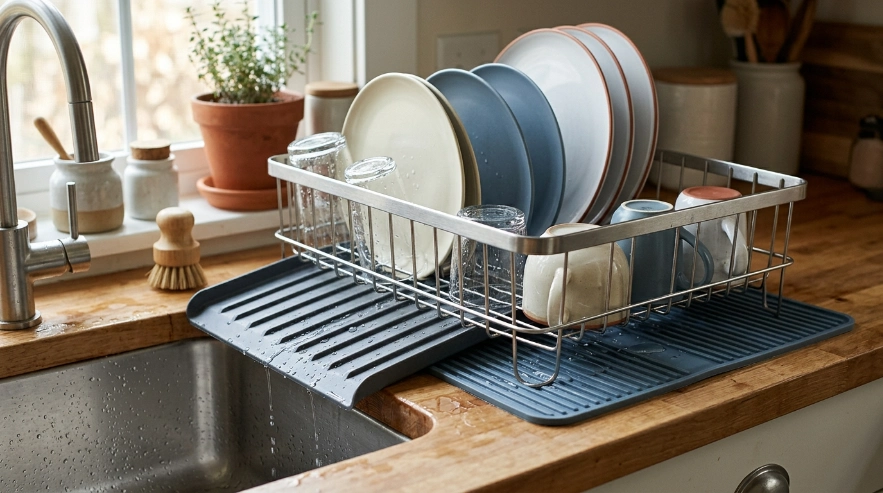
KitchenAid makes the most sense for capacity, Simplehuman focuses heavily on drainage, and OXO wins when storage space matters. The right choice depends on which problem you need the rack to solve.
| Dish Rack | Best For | Notable Detail | Main Tradeoff |
|---|---|---|---|
| KitchenAid Full-Size Dish Rack | Everyday family loads | Commonly listed around 20 × 14.96 × 7 inches | Takes substantial counter space |
| Simplehuman Steel Frame Dishrack | Premium drainage | Swivel spout, 5-year warranty, holder for up to four large wine glasses | Premium price |
| OXO Good Grips Aluminum Fold Flat | Small kitchens | About 16.4 × 14.6 inches and folds flat | Less room for very large loads |
The table makes one thing clear. There is no useful reason to buy a giant rack when your counter cannot support it.
Likewise, a compact rack becomes frustrating when you regularly wash dinnerware for four people.
Which Dish Rack Material Is Best?
Stainless steel and aluminum are my preferred frame materials for long-term everyday use. Plastic can still work well, especially for lightweight or low-cost designs.
The material alone does not decide quality. Joints, coatings, drainage pieces, feet, and cleaning access matter too.
Stainless steel dish racks
Stainless steel feels solid and suits racks designed to stay on display. Good models can support heavier dinnerware without feeling flimsy.
- Strong enough for everyday loads
- Clean, modern appearance
- Available in large-capacity designs
- Still needs drying and regular care
Aluminum dish racks
Aluminum is useful when you want something lighter. OXO specifically uses rustproof aluminum in several current drying-rack designs.
- Lightweight
- Rustproof aluminum options are available
- Works well for folding designs
- Easier to move or store than many heavy racks
Plastic dish racks
Plastic can be inexpensive and easy to rinse. It is also useful for simple trays and compact racks.
My concern is usually stiffness and long-term wear. Thin plastic can feel less secure with heavy cookware.
What Size Dish Rack Should You Buy?
Buy a rack large enough for your normal dish load, but small enough to leave useful counter space. Measuring first prevents one of the most common buying mistakes.
I would measure three things before ordering.
- Available counter width: Measure the usable space beside your sink.
- Available depth: Make sure the rack will not hang over the counter edge.
- Drainage distance: Confirm that the tray or spout can reach the sink correctly.
Then think about the dishes you wash most. Large dinner plates, cutting boards, pans, and mixing bowls need more room than cups and flatware.
Organization matters as much as raw capacity. My guide to organizing dishes in a dish rack explains how better loading can make a smaller rack surprisingly useful.
Is a Countertop, Fold-Flat, or Over-the-Sink Rack Better?
A countertop rack is best for frequent use, while fold-flat and over-the-sink racks work better when space is limited. Choose based on where the rack will live between washing sessions.
| Rack Style | Best Use | Biggest Advantage | Drawback |
|---|---|---|---|
| Countertop | Daily dishwashing | High capacity and easy access | Always occupies counter space |
| Fold-flat | Apartments and small kitchens | Stores away after use | Usually less capacity |
| Over-the-sink | Minimal counter space | Drips fall directly into sink | Uses part of the sink |
| Two-tier | Large dish loads | Adds vertical capacity | More parts to clean |
I prefer a full countertop rack when it gets used every day. Constantly folding and storing a rack can become another chore.
For a small apartment, that tradeoff changes. A rack that disappears after use may be worth slightly lower capacity.
If visual clutter bothers you, see these ideas for hiding a dish rack without sacrificing useful drying space.
Does Drainage Matter More Than Capacity?
Yes, poor drainage can ruin an otherwise spacious dish rack. Standing water leaves the rack harder to maintain and keeps the surrounding counter wet.
I would rather have a slightly smaller rack with controlled drainage than a huge rack sitting over a puddle.
- Look for a sloped drainboard.
- Check whether the drainage spout can face your sink.
- Keep the drainage channel free from utensils.
- Empty collection trays instead of leaving water standing.
- Make sure rack feet remain above pooled water.
Simplehuman’s current Steel Frame Dishrack uses a swivel spout. Its internal tray also spreads water before directing remaining moisture toward the drain.
OXO uses raised drainage ridges on its Fold Flat model. Those ridges keep drying items raised above collected water.
How Do You Keep a Dish Rack Clean?
Clean the rack whenever you see food debris, residue, standing water, slime, or discoloration. Daily users should inspect drainage areas and removable pieces regularly.
The CDC food-safety guidance stresses keeping kitchen surfaces and utensils clean. That same simple habit makes sense around your drying area.
- Put away dry dishes before cleaning the rack.
- Remove the utensil cup and drainage tray when possible.
- Wash compatible parts with warm water and dish soap.
- Pay attention to corners, feet, joints, and drain channels.
- Rinse away soap residue.
- Let the rack dry before loading another clean batch.
The FDA’s safe food handling guidance also recommends hot, soapy water for dishes, utensils, and food-contact kitchen surfaces.
For broader kitchen cleanliness, the USDA Food Safety and Inspection Service also emphasizes keeping utensils and surfaces clean.
What Dish Rack Mistakes Should You Avoid?
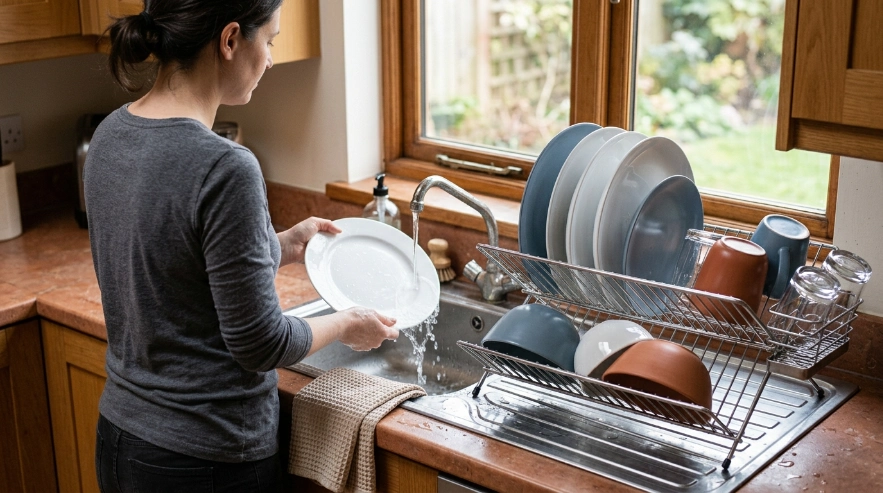
The biggest mistakes are overloading, blocking drainage, and buying without measuring. Each one can make a perfectly decent rack seem badly designed.
- Overcrowding: Touching dishes trap moisture and reduce airflow.
- Nesting bowls: Water gets trapped between their surfaces.
- Blocking the spout: A pan or utensil can stop water from leaving the tray.
- Balancing heavy pans: Keep heavy cookware low and secure.
- Ignoring rack dimensions: A large rack can take over a small prep area.
- Leaving dry dishes forever: Put them away so the rack stays ready for the next load.
- Ignoring the rack itself: Clean the tray and supports instead of focusing only on the dishes.
A good rack should simplify the sink area. That is also one of the main benefits of using a dish rack in the first place.
Which Dish Rack Would I Choose in 2026?
I would choose KitchenAid for a normal family kitchen, Simplehuman for premium drainage, and OXO Fold Flat for limited space. Those three designs solve different everyday problems.
If you are ready to pick one, these are the models I would consider first.
🏆 Best Overall
KitchenAid Full-Size Dish Rack
★★★★★ 4.8/5
This full-size design gives plates, bowls, utensils, and larger cookware useful room without turning the rack into a complicated system. I would choose it for a household that hand-washes a mixed load almost every day.
💧 Best Drainage
Simplehuman Steel Frame Dishrack
★★★★☆ 4.7/5
Its swivel drainage spout, stable feet, protected plate supports, and integrated wine-glass area make it a feature-rich option. I would spend the extra money when the rack stays permanently visible beside the sink.
🏠 Best for Small Kitchens
OXO Good Grips Aluminum Fold Flat Dish Rack
★★★★☆ 4.6/5
OXO uses a rustproof aluminum frame, raised drainage ridges, removable utensil cup, and fold-flat layout. I like it for apartments where a rack needs to work during cleanup and disappear afterward.
Frequently Asked Questions
What is the best dish rack overall?
The KitchenAid Full-Size Dish Rack is my best overall choice for most homes because it balances capacity, stability, drainage, and flexible loading. A smaller rack may be better if counter space is limited, while Simplehuman makes more sense if premium drainage and appearance matter most.
Is stainless steel better than plastic for a dish rack?
Stainless steel is usually better when strength and long-term countertop use matter. Plastic can still be practical because it is light and easy to clean, but thin plastic racks may feel less secure with heavy plates, pans, or cutting boards.
What is the best dish rack for a small kitchen?
A folding or over-the-sink rack is usually best for a small kitchen. The OXO Good Grips Aluminum Fold Flat Dish Rack is especially practical because it provides structured drying space during use and folds down when you need the counter back.
Are expensive dish racks worth it?
An expensive rack can be worth it when you hand-wash daily and care about better drainage, stronger construction, replaceable parts, or cleaner countertop appearance. If you wash only a few items occasionally, a simpler rack may do the same basic job for much less.
How long should a good dish rack last?
There is no single lifespan because materials, water exposure, cleaning, and load weight vary. A well-built rack should remain stable and easy to clean for years, but replace it when corrosion, broken supports, damaged coatings, or unstable joints make safe loading difficult.
Final Takeaway: What Is the Best Dish Rack?
The KitchenAid Full-Size Dish Rack is the option I would choose for most kitchens in 2026. It offers the practical mix of capacity and everyday usability that a busy drying area needs.
Choose Simplehuman when premium drainage and countertop appearance matter more than price. Choose the OXO Fold Flat model when reclaiming counter space after dishes dry is the bigger priority.
Most importantly, measure your space first. A dish rack is only “best” when it fits your sink area, handles your normal load, drains without a mess, and stays easy enough to clean that you will maintain it
