
What Is the Best Kitchen Dish Rack?

Quick Answer
For most kitchens, the best dish rack is a sturdy, rust-resistant model with a sloped drainboard, secure plate slots, and enough open space for bowls and cookware. My best all-around choice is the KitchenAid Full Size Expandable Dish Rack, while Simplehuman is excellent for premium kitchens and OXO works especially well when counter space is tight. Keeping your washing and drying area clean also follows basic FDA safe food handling guidance.
What to look for in the best kitchen dish rack
- Reliable drainage: Water should flow toward the sink instead of collecting beneath clean dishes.
- Enough capacity: Choose a rack that comfortably holds your normal hand-washed load.
- Stable construction: Plates and heavy bowls should not make the rack lean, flex, or tip.
- Easy cleaning: Removable trays and utensil holders make routine maintenance much simpler.
- Smart footprint: Measure your counter and sink area before choosing a full-size, compact, or foldable rack.
My quick verdict
- Choose KitchenAid for versatile everyday capacity, Simplehuman for premium drainage and organization, or OXO for a smaller kitchen.
A dish rack looks like a simple kitchen accessory until you use a bad one every day. Poor drainage, unstable plates, trapped water, and wasted counter space become annoying surprisingly fast.
I judge a dish rack by how easily it disappears into the cleanup routine. The right model should hold the dishes securely, drain without babysitting, and be easy enough to clean that you actually maintain it.
What Makes a Kitchen Dish Rack the Best?
The best kitchen dish rack balances drainage, capacity, stability, cleanability, and counter space. A premium-looking rack is not useful if water pools underneath it or your plates constantly fall sideways.
A dish rack is a countertop or sink-side structure designed to hold wet dishes apart while water drains and air moves around them. That separation lets plates, bowls, cups, and utensils dry without being stacked while wet.
Good drainage matters more than fancy extras
I put drainage near the top of my checklist. A rack that holds plenty of dishes but leaves a puddle on the counter creates more cleanup instead of less.
Look for one of these drainage designs:
- Sloped drainboard: Directs runoff naturally toward the sink.
- Swiveling spout: Lets you position drainage for different counter layouts.
- Raised draining tray: Keeps dishes above standing water.
- Over-sink design: Sends dripping water directly into the sink basin.
Drainage also affects how often you need to lift the rack and wipe underneath it. Fewer hidden wet spots make routine maintenance easier.
Capacity should match your real washing habits
A small rack may look neat when empty but become frustrating after dinner. On the other hand, an oversized rack can permanently consume valuable prep space.
Think about what you normally hand-wash:
- Dinner plates and side plates
- Cereal and serving bowls
- Coffee mugs and drinking glasses
- Knives and cooking utensils
- Cutting boards
- Pots, pans, and lids
If cookware regularly goes into your rack, leave a generous flat section instead of choosing a design filled entirely with narrow plate slots.
What Is the Best Kitchen Dish Rack for Most People?
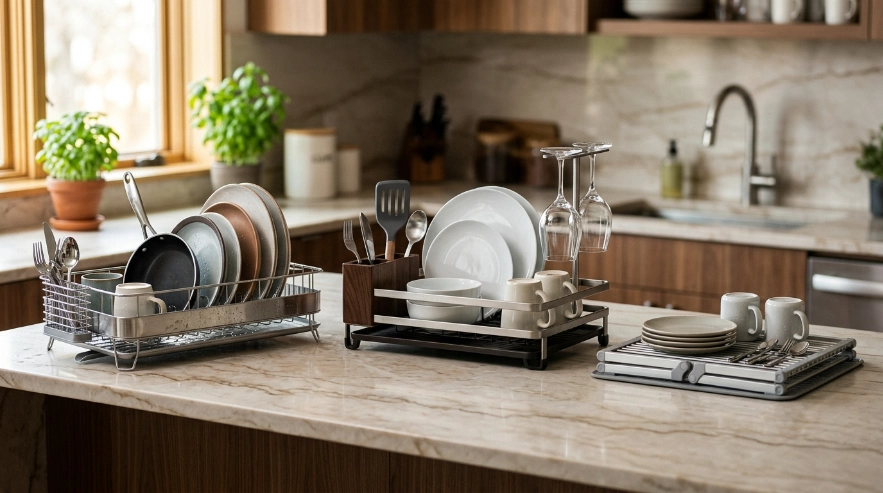
The KitchenAid Full Size Expandable Dish Rack is my strongest all-around choice for a typical home kitchen. Its combination of large capacity, expandable drying space, dedicated flatware storage, and room for cookware makes it flexible.
The current expandable model can accommodate up to 11 dinner plates, six cups, four glasses, plus flatware and larger cookware. Its drying area can expand when you need additional room.
That flexibility is the feature I find most useful. You are not committing your entire countertop to the largest possible footprint every time you wash a few breakfast dishes.
How does KitchenAid compare with Simplehuman and OXO?
| Dish Rack | Best For | Capacity | Key Advantage | Main Drawback |
|---|---|---|---|---|
| KitchenAid Full Size Expandable | Most households | Large, expandable | Flexible drying space | Large when fully expanded |
| Simplehuman Steel Frame | Premium kitchens and heavy loads | Large | Excellent organization and drainage | Premium price and big footprint |
| OXO Good Grips Aluminum Fold Flat | Small kitchens | Small to medium | Folds for easier storage | Less room for bulky cookware |
Simplehuman is particularly appealing if you routinely dry pots, bakeware, glasses, and several plates together. Its standard steel-frame rack measures roughly 20.2 by 22.3 by 11.5 inches and includes dedicated cup, utensil, and wine-glass areas.
OXO goes in the opposite direction. The Aluminum Fold Flat rack prioritizes a smaller footprint and easier storage, making it more attractive for apartments and compact kitchens.
Should You Choose Stainless Steel, Aluminum, Plastic, or Bamboo?
For most households, coated steel, stainless steel, or aluminum offers the best balance of durability and maintenance. Material alone does not determine quality, because drainage design and construction matter just as much.
Stainless steel and coated steel
Metal racks feel rigid and handle heavier dinnerware well. Quality models often combine metal frames with plastic, silicone, or rubber parts where dishes and countertops need protection.
Metal still needs care around constant moisture. If rust is something you have fought elsewhere in your kitchen, my guide to why cast iron develops rust explains why persistent moisture deserves attention.
Aluminum
Aluminum is useful when you want a lightweight rack with strong corrosion resistance. It also works well in folding designs because the frame does not need to be excessively heavy.
OXO’s aluminum drying racks are a good example. They suit cooks who value storage and easy handling more than maximum pot-and-pan capacity.
Plastic
Plastic dish racks are usually lightweight and affordable. They also avoid the traditional red-brown rust associated with iron-containing metal.
The tradeoff is cleaning. Textured plastic corners, seams, and drainage channels can collect residue, so choose a design you can take apart easily.
Bamboo
Bamboo racks provide a warm, natural appearance and are often foldable. I would choose one mainly for aesthetics and light dish loads rather than heavy cookware.
Wood-based materials also need a chance to dry fully between uses. Constant trapped moisture is not ideal for any dish rack material.
What Size Dish Rack Should You Buy?
Measure your available countertop before comparing features. A fantastic rack that blocks your sink, coffee maker, or prep area will quickly become the wrong rack.
Measure these areas before buying:
- Counter width: Measure the horizontal space beside the sink.
- Counter depth: Check the distance from backsplash to counter edge.
- Sink position: Confirm where a drainage spout needs to point.
- Upper cabinets: Make sure tall plates will not hit shelves above.
- Storage space: If you plan to put the rack away, measure that location too.
A household that hand-washes several dinner settings needs more capacity than someone who mainly uses a dishwasher. Do not pay for permanent countertop bulk you will rarely use.
Expandable racks offer a useful middle ground. They stay manageable for ordinary loads but provide temporary extra room after a large meal.
Is a Two-Tier Dish Rack Better Than a Single-Tier Rack?
A two-tier rack is better when vertical storage matters more than easy access to heavy cookware. A single-tier rack is usually simpler for pots, oversized bowls, and mixed loads.
Two-tier racks can hold impressive amounts of dinnerware without becoming extremely wide. That makes them attractive in apartments and narrow kitchens.
There are tradeoffs:
- Two-tier racks: Save horizontal space and organize plates efficiently.
- Single-tier racks: Make loading bulky cookware easier.
- Expandable racks: Offer flexible capacity without permanently adding another level.
- Over-sink racks: Preserve countertop space but depend heavily on sink dimensions.
I prefer a sturdy single-level or expandable rack for a mixed home kitchen. Tall tiered systems make more sense when plates, cups, and bowls dominate your hand-washing routine.
How Do You Keep a Dish Rack Clean?
Wash the rack regularly, remove standing water, and clean the drainboard before residue becomes difficult to remove. A drying rack handles clean dishes, but that does not mean the rack itself stays clean automatically.
The FDA recommends washing dishes, utensils, cutting boards, and countertops with hot, soapy water during food preparation. The CDC’s food-safety guidance likewise emphasizes keeping hands and kitchen surfaces clean.
My basic rack-care routine is simple:
- Unload the rack completely. Remove utensil cups, trays, and other detachable pieces.
- Wash accessible surfaces. Use warm water, dish soap, and a non-abrasive sponge or brush.
- Clean grooves and corners. These areas tend to hold moisture and residue.
- Rinse thoroughly. Remove leftover soap from surfaces that will contact dishes.
- Let everything dry. Reassemble the rack only after the parts are dry.
The USDA also advises cleaning kitchen sinks, utensils, and surrounding surfaces as part of preventing cross-contamination. You can review its broader kitchen cleanliness guidance for food preparation areas.
Can dish rack parts go in the dishwasher?
Only put components in a dishwasher when the manufacturer identifies them as dishwasher-safe. Heat, detergent, and mechanical washing can affect materials differently.
The same rule applies to other kitchen equipment. My guide on whether frying pans can go in the dishwasher explains why material and manufacturer care instructions matter.
What Dish Rack Features Are Actually Worth Paying For?
Spend your money on better drainage, sturdy construction, useful capacity, and removable parts before decorative extras. Those four features affect your routine every day.
These upgrades are especially useful:
- Adjustable drain spout: Helps the rack work with different sink positions.
- Removable utensil caddy: Makes unloading and cleaning easier.
- Protected plate slots: Reduce sliding and direct metal-on-dish contact.
- Stemware holder: Helpful if you regularly hand-wash wine glasses.
- Expandable section: Gives extra capacity only when needed.
- Fold-flat construction: Valuable when the counter doubles as prep space.
- Non-slip feet: Keep a loaded rack from shifting on a wet countertop.
I would not choose a rack just because it has more attachments. Every extra holder also creates another piece you may eventually need to clean.
Common Dish Rack Buying Mistakes to Avoid
The biggest mistake is buying by appearance before measuring your counter and thinking about drainage. Dish racks live beside water, so practical details win over showroom looks.
- Ignoring dimensions: Product photos can make large racks look deceptively compact.
- Forgetting the drain direction: A fixed spout may not work on both sides of a sink.
- Choosing too many plate slots: This can leave little room for bowls and pans.
- Buying for maximum capacity: A huge rack wastes space if most loads are small.
- Ignoring cleanability: Complicated trays and narrow seams can turn maintenance into a chore.
- Assuming “rust-resistant” means maintenance-free: Standing moisture should still be removed.
Good kitchen organization is often about avoiding small workflow problems. I cover that broader idea in my guide to common cooking mistakes and better kitchen habits.
My Recommended Kitchen Dish Racks
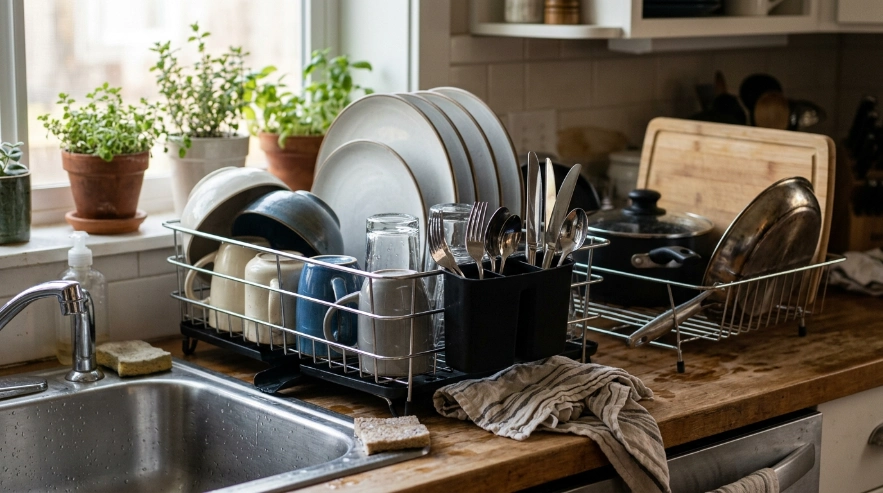
If you’re ready to choose one, these are the three styles I would put at the top of the list for most kitchens.
🏆 BEST OVERALL
KitchenAid Full Size Expandable Dish Rack
★★★★☆ 4.8/5 editorial score
Its expandable layout can handle plates, cups, glasses, flatware, and full-size cookware. I like it for households that need substantial capacity without dedicating the maximum footprint to every small load.
✨ BEST PREMIUM
Simplehuman Standard Steel Frame Dish Rack
★★★★☆ 4.7/5 editorial score
This large steel-frame rack offers dedicated cup and utensil storage, a wine-glass holder, and a well-designed drainage system. I would pay the premium when daily hand-washing volume and countertop appearance matter equally.
🏠 BEST FOR SMALL KITCHENS
OXO Good Grips Aluminum Fold Flat Dish Rack
★★★★☆ 4.6/5 editorial score
Its aluminum-and-plastic construction combines everyday drying space with a folding design that is easier to store. This is my pick when reclaiming countertop space between dishwashing sessions is the priority.
Frequently Asked Questions
What is the best material for a kitchen dish rack?
Stainless steel, coated steel, and aluminum are strong choices because they combine rigidity with practical everyday maintenance. The best material still depends on the rack’s drainage design, construction quality, and how consistently you keep standing moisture from collecting around it.
Is a metal or plastic dish rack better?
A metal rack is usually better for heavy plates, cookware, and long-term rigidity. Plastic is lighter and often cheaper, but you should look for smooth, accessible surfaces because complicated plastic seams can require more cleaning.
Are expensive dish racks worth it?
A premium rack can be worth paying for when it improves drainage, stability, capacity, and ease of cleaning. If you wash only a few cups and plates each day, a simpler compact model may provide everything you need for much less money.
How often should I clean my dish rack?
Clean it whenever you see residue, trapped water, or buildup, and include it in your regular kitchen-cleaning routine. How quickly it needs attention depends on water hardness, rack design, dishwashing frequency, and whether the drainboard dries fully between loads.
What is the best dish rack for a small kitchen?
A compact, foldable, or over-the-sink design usually works best when countertop space is limited. The OXO Good Grips Aluminum Fold Flat Dish Rack is a strong example because it provides structured drying space but can be folded down when you need the counter back.
Final Takeaway: Which Kitchen Dish Rack Should You Choose?
For most households, I would start with the KitchenAid Full Size Expandable Dish Rack. It hits the useful middle ground between capacity, flexibility, cookware space, and everyday organization.
Choose the Simplehuman Steel Frame Dish Rack when you want a more premium setup with substantial capacity. Pick the OXO fold-flat model when every inch of countertop matters.
Most importantly, measure first and buy for the dishes you actually wash. A well-matched rack should make cleanup easier without becoming another kitchen item that gets in your way.
