
What Is the Most Hygienic Dish Drainer?

A dish drainer handles freshly washed plates, cups, and utensils every day. That makes its drainage and cleanliness more important than its appearance.
When I evaluate one, I ask a simple question first: where does the water go after the dishes start dripping? A hygienic design gets that water away quickly and lets both the dishes and rack dry.
What Makes a Dish Drainer Hygienic?
A hygienic dish drainer is one that supports thorough air-drying while remaining easy to wash and dry itself. No material automatically stays sanitary just because it is labeled stainless steel, plastic, or bamboo.
Definition: A hygienic dish drainer is a drying rack designed to minimize trapped moisture, keep washed items separated, and allow routine cleaning of every surface that collects water or residue.
The FDA Food Code requires cleaned and sanitized food-service utensils to be air-dried or adequately drained before use. That rule is written for commercial food settings, but the underlying drying principle is useful at home too.
You can review the FDA Food Code for the broader food-safety framework.
- Water should leave quickly: A sloped board, drain spout, or over-sink design reduces standing water.
- Dishes should stay separated: Air needs space to circulate around wet surfaces.
- The rack should be accessible: You should be able to reach corners, feet, trays, and utensil holders while cleaning.
- Parts should dry between uses: A permanently wet tray creates unnecessary maintenance problems.
- The counter underneath should stay clean: Hidden moisture deserves as much attention as the rack itself.
What Is the Most Hygienic Material for a Dish Drainer?
For most households, I prefer stainless steel or rust-resistant aluminum. Both work well in open-frame designs and can provide smooth, accessible surfaces.
That does not mean every metal rack is better than every plastic one. A dishwasher-safe plastic tray with simple corners can be easier to maintain than an elaborate metal rack with inaccessible joints.
| Material | Cleaning Advantage | Main Concern | My Hygiene Verdict |
|---|---|---|---|
| Stainless steel | Smooth, rigid surfaces are generally straightforward to wipe and scrub | Mineral deposits and water spots still need cleaning | Excellent when drainage is open and accessible |
| Aluminum | Lightweight and well suited to open, rust-resistant rack designs | Attachments and drain trays still need routine washing | Excellent for direct-draining designs |
| Dishwasher-safe plastic | Some models can be machine washed according to manufacturer instructions | Deep grooves and textured seams can collect residue | Very good when the design is simple |
| Bamboo or wood | Simple slatted designs provide useful airflow | Needs careful drying and manufacturer-approved maintenance | Good for attentive owners |
I would not buy by material alone. Drainage and cleanability can turn an ordinary rack into a better hygiene choice than a premium rack that constantly holds puddles.
Is Stainless Steel the Most Hygienic Dish Rack?
Stainless steel is one of my favorite dish-rack materials because it is durable, smooth, and practical around water. However, stainless steel itself does not remove the need for cleaning.
A steel rack with a flat, dirty tray underneath can become harder to maintain than a simpler rack that drains directly into the sink.
- Choose widely spaced wires instead of crowded decorative sections.
- Look for removable utensil holders.
- Prefer a drainboard that slopes toward the sink.
- Avoid complicated joints you cannot easily scrub.
- Check the manufacturer’s cleaning instructions before using bleach, abrasives, or a dishwasher.
If you are comparing layouts as well as materials, my guide to the different types of dish racks explains countertop, over-sink, foldable, and other designs.
Which Dish Drainer Design Is Easiest to Keep Clean?
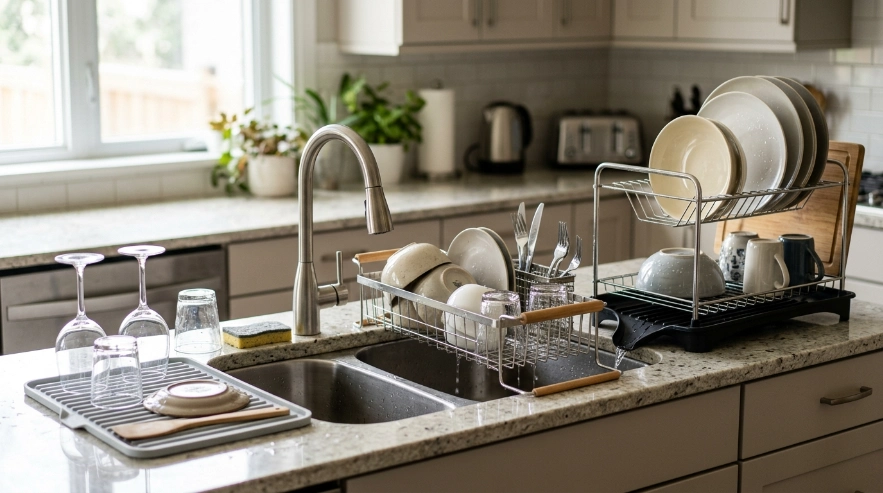
The easiest design to keep hygienic is usually open, simple, and self-draining. Every unnecessary compartment, hinge, groove, and enclosed channel creates another place you may need to scrub.
As of 2026, I generally rank direct-to-sink designs highest for moisture management because they avoid keeping a full tray of runoff beneath the dishes.
1. Over-the-sink rack
An over-the-sink rack allows water to drip directly into the basin. It eliminates much of the standing-water problem associated with horizontal drainboards.
The tradeoff is sink access. Measure carefully so the rack does not interfere with washing larger cookware.
2. Rack with a sloped drainboard and spout
This is my favorite option when an over-sink rack is impractical. A properly positioned spout sends runoff toward the sink instead of storing it underneath the rack.
Choose a drainboard that lifts out easily. A removable board is much easier to wash around the edges and underneath.
3. Simple dishwasher-safe drying tray
A compact tray can be hygienic when its manufacturer specifically approves dishwasher cleaning. The OXO Good Grips Dish Rack, for example, is listed by OXO as dishwasher-safe and uses raised ribs to keep items above collected water.
This type works especially well for lighter loads. Simplicity can be an advantage.
Is a Dish Rack More Hygienic Than a Drying Mat?
A rack is often better for airflow because it holds dishes upright and separated. A drying mat can still work well when it is cleaned frequently and allowed to dry completely.
The real problem is trapped moisture. An absorbent mat that remains damp all day needs more laundering and drying attention than an open rack.
| Hygiene Factor | Dish Rack | Drying Mat |
|---|---|---|
| Airflow | Usually excellent with separated slots | Depends on spacing between dishes |
| Water handling | Can drain directly toward sink | Absorbs or holds runoff on surface |
| Cleaning | Depends on number of components | Often washable but needs thorough drying |
| Best use | Regular mixed dish loads | Small loads and oversized cookware |
For a deeper comparison, see my guide to dish mats vs. dish racks.
How Should You Clean a Dish Drainer?
Clean the rack before residue, slime, mineral scale, or standing water becomes a persistent problem. The exact frequency depends on your water, washing volume, and rack design.
The CDC recommends cleaning household surfaces with soap and water and allowing sanitized items to air-dry thoroughly. Its household cleaning guidance also warns that towel-drying can transfer germs in certain situations.
- Unload the rack. Remove every dish, utensil, cup, and pan.
- Take removable parts apart. Separate the drainboard, utensil caddy, cup holders, and spout when possible.
- Wash with dish soap. Use warm water and a non-abrasive brush or sponge unless the manufacturer directs otherwise.
- Scrub hidden areas. Pay attention to feet, corners, grooves, joints, and the underside of the tray.
- Rinse thoroughly. Remove soap and loosened residue.
- Let every part dry. Do not reassemble a wet rack and immediately trap water between components.
- Clean underneath. Wash and dry the countertop before returning the rack.
Never assume every removable part belongs in the dishwasher. Only machine-wash components when the manufacturer clearly identifies them as dishwasher-safe.
If sanitizing is needed after a contamination event, use a product and method suitable for the material and intended surface. USDA food-safety guidance also emphasizes cleaning before sanitizing; its safe food handling resources provide useful background.
What Should You Put Under a Dish Rack?
If your rack drains into a tray, the surface underneath should remain dry and easy to inspect. Avoid creating a hidden layer that stays damp against the countertop.
A properly fitted drainboard is usually my first choice. You can compare other practical options in my guide on what to put under a dish rack.
- Sloped drainboard: Best when it directs runoff directly into the sink.
- Silicone drying mat: Useful when it has raised channels and can be washed easily.
- Absorbent mat: Convenient for drips but needs frequent laundering and full drying.
- Bare waterproof counter: Simple when you wipe and dry it after use.
What Hygiene Mistakes Should You Avoid?
The most common mistake is assuming clean dishes automatically mean a clean rack. Water, detergent residue, minerals, and occasional food particles still reach the drainer.
- Leaving water in the tray: Empty or drain collected water instead of letting it sit.
- Crowding dishes: Separate bowls, plates, and cups so touching surfaces do not trap water.
- Ignoring the utensil holder: Remove and wash it because water often collects at the bottom.
- Forgetting underneath: Lift the rack regularly and clean the countertop.
- Using harsh chemicals blindly: Follow the manufacturer’s approved cleaning methods.
- Putting wet dishes away: Let items finish drying before storing them in closed cabinets.
NSF notes that certified residential dishwashers can sanitize dishes when operated on qualifying sanitizing cycles. You can read more about NSF dishwasher sanitization certification.
How Do I Choose the Most Hygienic Dish Drainer for My Kitchen?
Start with drainage, then consider cleaning access, airflow, capacity, and material. I would rather own a simple rack I can clean in five minutes than a complicated rack with ten accessories I avoid taking apart.
If you are also comparing capacity and everyday usability, see my broader guide to choosing the best kitchen dish rack.
- Check drainage: Direct-to-sink is ideal; a properly sloped board is the next best option.
- Look underneath: Confirm the base and feet are easy to reach.
- Remove the accessories: Utensil cups and drain components should come off without a struggle.
- Inspect spacing: Plates and bowls should not press tightly together.
- Read care directions: Confirm which components can be washed in a dishwasher.
- Measure your sink: The best drainage design fails if its spout cannot reach the basin.
My Recommended Hygienic Dish Drainers
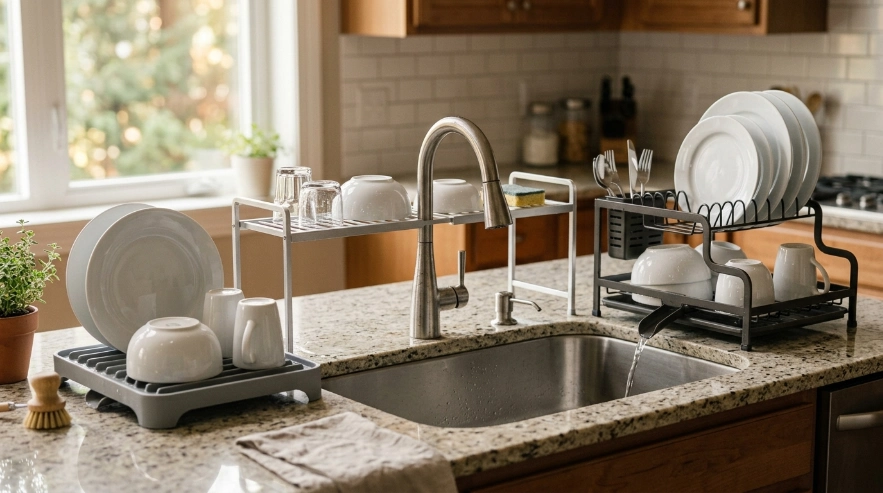
If you’re ready to pick one, these are the three designs I would put near the top of a hygiene-focused shortlist.
🏆 Best Premium Drainage
simplehuman Steel Frame Dishrack
★★★★½ 4.7/5 Editorial Rating
Its swivel spout sends runoff directly toward the sink, while the central drain can be removed for cleaning. I like this design when controlling standing water is the top priority.
🧼 Easiest to Wash
OXO Good Grips Dish Rack
★★★★½ 4.6/5 Editorial Rating
OXO lists this compact rack as dishwasher-safe, and its raised ribs hold items above pooled water. I like it for smaller loads because the uncomplicated design makes cleaning less of a project.
💧 Best Direct-to-Sink
OXO Good Grips Over-the-Sink Aluminum Dish Rack
★★★★½ 4.6/5 Editorial Rating
Its rustproof aluminum frame sits over the sink so water drains directly into the basin. I would choose it where avoiding a wet countertop and drain tray matters more than maximizing capacity.
Frequently Asked Questions
Are stainless steel dish drainers more hygienic than plastic?
Stainless steel is a strong hygiene-focused choice because smooth metal surfaces are durable and straightforward to clean. However, a simple dishwasher-safe plastic rack can also perform well. Drainage, accessible surfaces, regular washing, and complete drying matter more than choosing one material in isolation.
How often should I wash my dish drainer?
Include the rack in your regular kitchen-cleaning routine and wash it sooner whenever you notice standing water, residue, discoloration, or buildup. The right interval varies with water hardness, dishwashing frequency, rack design, and whether the rack dries completely between loads.
Can bacteria grow on a dish drying rack?
A dish rack can become contaminated when moisture and residue remain on its surfaces. That is why I focus on drainage and easy cleaning. Wash the rack, keep the tray from holding stagnant water, and let both the rack and dishes dry thoroughly.
Is air-drying dishes more hygienic than using a dish towel?
Air-drying avoids rubbing clean dishes with a towel that may have picked up microorganisms from hands or kitchen surfaces. Public-health guidance also recommends thorough air-drying for certain cleaned and sanitized items. Use a clean drying area and allow moisture to evaporate before storage.
Are bamboo dish drainers hygienic?
A bamboo rack can be maintained safely when you follow its care instructions, clean it properly, and let it dry thoroughly. I still prefer stainless steel or aluminum for a low-maintenance kitchen because repeated moisture exposure makes drying and maintenance especially important for wood-based products.
Final Takeaway: Which Dish Drainer Is Most Hygienic?
The most hygienic dish drainer is not simply the one made from the most expensive material. It is the rack that drains quickly, keeps dishes separated, cleans easily, and dries thoroughly between uses.
For most homes, I would start with a stainless-steel or rust-resistant aluminum design with direct-to-sink drainage or a sloped removable drainboard. Keep the rack itself clean, and you solve the part that product marketing often overlooks.
