What Are the Different Types of Dish Racks?

Quick Answer
The main types of dish racks are countertop, two-tier, over-the-sink, roll-up, expandable, foldable, wall-mounted, in-sink, bamboo, and dish-rack-and-mat designs. The right type depends mainly on your counter space, sink size, dish load, and how you want water to drain while dishes air dry.
Common dish rack types
- Countertop rack: A simple everyday choice that sits beside the sink.
- Two-tier rack: Uses vertical space to hold more dishes on a smaller footprint.
- Over-sink rack: Sits above the sink so water drains directly into the basin.
- Roll-up rack: Unrolls across the sink and stores in a compact roll afterward.
- Expandable rack: Adjusts in width or capacity when your dish load changes.
- Foldable rack: Collapses for storage when you want a clear countertop.
My simple rule
- Choose the smallest rack that comfortably holds your normal dish load without forcing dishes together.
I used to think dish racks differed mostly in size. After trying different layouts around my sink, I found that the design matters just as much.
Some racks save counter space. Others handle large pots better, drain faster, or disappear when you’re done using them.
In this guide, I’ll explain the main types of dish racks and where each one works best.
What Is a Dish Rack?
A dish rack is an open holder designed to support washed dishes while water drains and the dishes air dry. Most racks create gaps between plates, bowls, cups, and utensils so air can move around them.
That separation matters. When I crowd wet dishes together, water tends to stay trapped between them much longer.
- Plate slots keep plates upright and separated.
- Flat sections hold bowls, pans, and food containers.
- Utensil cups keep forks, spoons, and tools organized.
- Drainboards catch water beneath countertop racks.
- Drain spouts direct collected water toward the sink.
The best layout depends on what you wash most often.
What Are the Main Types of Dish Racks?
Dish racks can be grouped by where they sit, how they store, and how much they hold. I usually start with kitchen space before comparing materials or extra features.
Here are the main types you’ll encounter.
| Dish Rack Type | Best For | Main Advantage | Main Drawback |
|---|---|---|---|
| Countertop | Everyday kitchens | Simple and accessible | Uses counter space |
| Two-tier | Large dish loads | High capacity vertically | Needs overhead clearance |
| Over-the-sink | Small counters | Water drains into sink | Can limit sink access |
| Roll-up | Tiny kitchens | Stores compactly | Few upright plate slots |
| Expandable | Changing dish loads | Adjustable capacity | Needs room when expanded |
| Foldable | Occasional use | Easy to put away | May offer less support |
| Wall-mounted | Counter-free setups | Frees work surfaces | Usually needs installation |
| In-sink | Minimal kitchens | No drainboard needed | Occupies sink space |
How Does a Countertop Dish Rack Work?
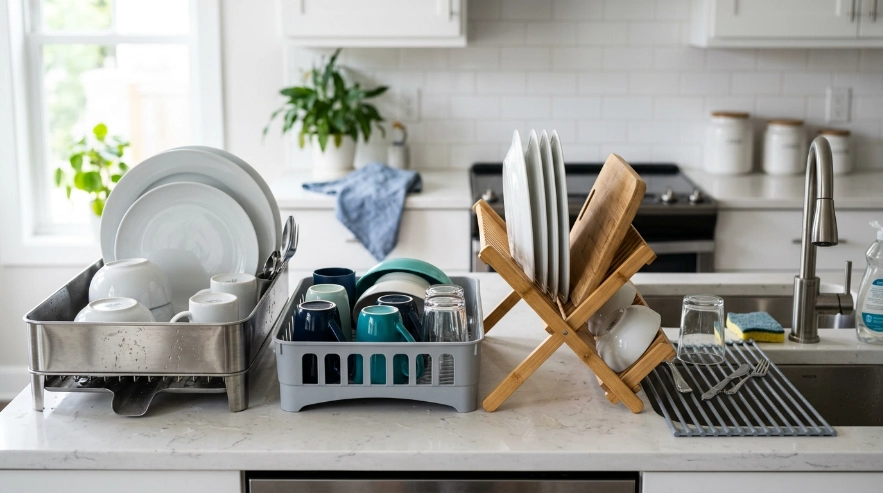
A countertop dish rack sits beside your sink and normally uses a tray or drainboard underneath. It’s the traditional design and still one of the easiest to live with.
I prefer this style when I have enough counter room because everything stays within easy reach.
- Good separation for plates and bowls
- Often includes a utensil holder
- Available in compact and full-size layouts
- Easy to move for countertop cleaning
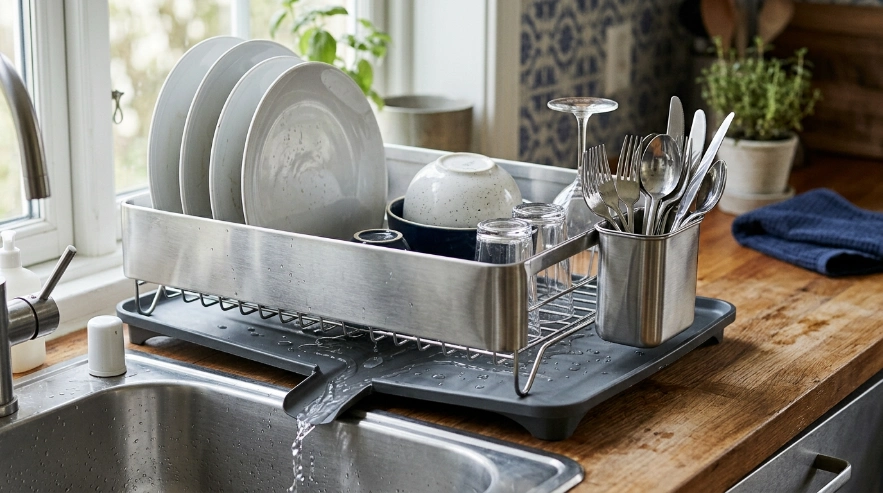
The weak point is drainage. A flat tray can collect standing water unless you empty it often.
I prefer models with a sloped board or movable spout that sends water toward the sink.
Is a Two-Tier Dish Rack Better for a Large Family?
A two-tier dish rack can be better when you wash many dishes but have limited horizontal counter space. It adds a second drying level above the first.
I’ve found this layout useful after larger meals because plates can stay separate from bowls and cups.
- Top tier: Often best for plates, bowls, or cups.
- Bottom tier: Useful for pans, containers, and larger pieces.
- Side attachments: May hold utensils, mugs, cutting boards, or glasses.
Measure upward before buying one. Upper cabinets can make a tall rack awkward to load.
Also check stability. A tall rack needs a solid base when heavier dishes sit on its upper level.
What Is an Over-the-Sink Dish Rack?
An over-the-sink dish rack uses the sink area rather than your countertop. Water falls directly into the basin, which can make cleanup easier.
There are two common versions.
- Bridge-style racks rest across the edges of the sink.
- Tall over-sink racks stand around the sink and provide shelves above it.
I like this design when countertop space matters more than having the entire sink open.
The tradeoff is access. A rack covering too much of a small sink can make washing large pots frustrating.
What Is a Roll-Up Dish Drying Rack?
A roll-up rack is a flexible row of bars that stretches across part of your sink. After use, you can roll it into a narrow bundle.
This is one of my favorite designs for kitchens where permanent counter clutter bothers me.
- Needs little storage space
- Lets water drip directly into the sink
- Can support cups, pans, and food containers
- May also provide temporary workspace over a sink
However, it isn’t ideal for everyone. Traditional racks usually keep plates upright more securely.
Measure your sink first. The ends need enough support to rest safely on both sides.
What Is an Expandable Dish Rack?
An expandable rack changes size when you need more drying room. You can keep it compact most days and open the extra section after a larger meal.
That flexibility solved one problem I kept having with fixed racks. A large rack felt wasteful at breakfast but perfect after dinner.
Look closely at how the expansion works.
- The extended section should stay level.
- The frame shouldn’t become wobbly when opened.
- Water from both sections should reach the drainboard.
- The expanded footprint should still fit beside your sink.
Expandable racks make the most sense when your daily dish load changes a lot.
When Does a Foldable Dish Rack Make Sense?
A foldable rack works well when you want your countertop clear between dishwashing sessions. It folds or collapses into a smaller shape for storage.
I find this especially useful in apartments, campers, and kitchens with little prep space.
The design does involve compromises.
- Hinges add areas that need cleaning.
- Some designs have fewer dedicated plate slots.
- Light frames may feel less secure with heavy cookware.
For light daily loads, though, the convenience can outweigh those limits.
Are Wall-Mounted Dish Racks Worth It?
A wall-mounted rack can be worth considering when preserving counter space is your main goal. It attaches above or near the sink instead of sitting on the worktop.
This layout keeps the drying area off my prep surface, which can make a compact kitchen feel less crowded.
Before choosing one, consider:
- Wall strength and mounting method
- Rack weight plus wet dish weight
- Distance from the sink
- Where dripping water will go
- Clearance around cabinets and faucets
Installation is the key difference. A countertop rack can move tomorrow, while a mounted rack becomes part of the kitchen layout.
What Is an In-Sink Dish Rack?
An in-sink rack rests inside the sink basin and lets water drain away underneath. It needs no separate drain tray on the counter.
I think it works best with a double-basin sink. One basin can handle drying while the other remains open for washing.
With a single small basin, the setup can become inconvenient.
- Best feature: Almost no wet countertop.
- Best kitchen: Double-basin sink.
- Main limitation: Reduced sink capacity.
What About Bamboo and Wooden Dish Racks?
Bamboo and wooden racks offer a warmer look than metal or plastic designs. Many use a folding A-frame shape with slats for plates and cups.
I like the simple appearance, but I pay more attention to drying the rack itself.
Wood-based materials shouldn’t stay wet for long periods. Good airflow and regular cleaning matter.
A wooden rack is best for someone who values appearance and doesn’t mind a little extra care.
Is a Dish Rack With a Drying Mat Different?
A rack-and-mat system combines a small raised rack with an absorbent drying surface. It can be more flexible than a large rigid drainboard.
I use this type of layout when odd-shaped pans won’t fit into standard plate slots.
- The rack holds plates and cups.
- The mat handles pans and oversized items.
- Both pieces can often be stored separately.
The mat needs to dry between uses. Leaving a damp mat under dishes defeats much of its convenience.
Stainless Steel vs Plastic vs Bamboo Dish Racks
Material affects weight, maintenance, appearance, and durability. I wouldn’t choose a rack by material alone, but it matters after you’ve settled on the right layout.
| Material | Strength | Care | Good Choice For |
|---|---|---|---|
| Stainless steel | Strong | Wipe and wash regularly | Heavy everyday use |
| Plastic | Light to moderate | Easy to wash | Budget or lightweight setups |
| Bamboo or wood | Moderate | Needs thorough drying | Decor-focused kitchens |
| Silicone-coated steel | Strong and flexible | Usually easy to rinse | Roll-up sink racks |
How Do I Choose the Right Type of Dish Rack?
Start with your available space and normal dish load. Those two factors narrow the choices faster than style or extra accessories.
Here’s the process I use.
- Measure the space. Check width, depth, height, and the distance to your sink.
- Think about a normal load. Count the plates, cups, bowls, pans, and utensils you usually wash.
- Choose a drainage method. Decide between a drainboard, drain spout, mat, or direct sink drainage.
- Check plate spacing. Slots should hold dishes without forcing them tightly together.
- Consider storage. Pick a foldable or roll-up design if you don’t want a permanent rack.
- Check cleaning access. Removable trays and utensil holders make routine cleaning easier.
Don’t automatically buy the biggest rack that fits. A huge rack can become permanent counter clutter when you normally wash only a few dishes.
Why does drainage matter?
Good drainage helps the rack and dishes dry instead of leaving water sitting underneath them. I look for open construction and an easy path from the rack toward the sink.
Food-safety guidance also favors allowing cleaned items to air dry rather than relying on a potentially contaminated towel. The FDA Food Code includes air-drying requirements for food-service utensils and equipment.
How often should you clean a dish rack?
I inspect mine whenever I wipe the sink area. If I see residue, trapped food, soap buildup, or standing water, I clean it rather than waiting for a fixed date.
Removable components help here. The NSF consumer cleaning guidance also emphasizes washing kitchen items and allowing them to air dry.
Which Dish Rack Type Is Best for a Small Kitchen?
For a small kitchen, I’d start with a roll-up, over-the-sink, compact countertop, or foldable rack. Each uses space differently.
- Choose roll-up if storage space is extremely limited.
- Choose over-the-sink if your counter is the bigger problem.
- Choose compact countertop if you wash small loads every day.
- Choose foldable if you want the countertop clear after dishes dry.
One warning: don’t buy an over-sink model before measuring the sink.
A few minutes with a tape measure can prevent a rack that blocks your faucet or doesn’t span the basin securely.
If you’re ready to pick one, these are three styles I’d put on my shortlist:
🏆 Best for Everyday Loads
simplehuman Standard Steel Frame Dish Rack
★★★★★
This is a full countertop design with dedicated drying areas and sink-directed drainage. I’d choose this style when capacity and organization matter more than saving every inch of counter space.
↔️ Best Adjustable Option
Joseph Joseph Extend Steel Dish Rack
★★★★☆
Its expandable format lets you increase drying room when the load gets bigger. I like this type for kitchens where breakfast creates a tiny load but dinner fills the sink.
🏠 Best for Tiny Kitchens
Surpahs Over-the-Sink Roll-Up Dish Drying Rack
★★★★☆
This roll-up style sits across the sink and takes little room once stored. I’d use it where counter space is scarce and the sink is wide enough to remain usable while the rack is open.
Frequently Asked Questions
What is the most common type of dish rack?
A countertop dish rack is one of the most familiar designs. It sits beside the sink and usually includes plate slots, a utensil holder, and a tray or spout for managing water.
Are two-tier dish racks better than single-tier racks?
Two-tier racks are better when you need more capacity without using much more counter width. Single-tier racks can be easier to access, clean, and fit beneath low cabinets, so neither design is automatically better for every kitchen.
Are over-the-sink dish racks practical?
Yes, especially when counter space is limited. They let water drain into the sink and keep the worktop clearer, but a poorly sized model can block part of the basin or interfere with the faucet.
Which dish rack material lasts the longest?
A well-made stainless steel rack is a strong choice for frequent use because it can support heavier dishes and is easy to wipe clean. Construction quality still matters, so material alone doesn’t guarantee durability.
Is air drying dishes better than towel drying?
Air drying avoids bringing a dish towel back into contact with freshly washed surfaces. Food-safety organizations commonly recommend air drying in sanitation guidance, including guidance referenced by the NSF.
Which Type Should You Choose?
There isn’t one dish rack design that beats every other type. The best choice is the one that fits your sink, counter, dishes, and washing routine.
I use space as the deciding factor first. Then I compare drainage, capacity, stability, and how easy the rack will be to clean.
- For everyday use: Choose a countertop rack.
- For larger loads: Try a two-tier rack.
- For small counters: Consider an over-the-sink rack.
- For easy storage: Choose a roll-up or foldable rack.
- For changing loads: Use an expandable rack.
- For maximum counter space: Consider a wall-mounted design.
As of 2026, you’ll find useful versions of nearly every layout, so don’t choose by appearance alone. Measure first and think about the dishes you wash most often.
A rack that fits your real routine will usually be easier to live with than one loaded with features you rarely use.