
Masticating vs Centrifugal Juicer: Differences, Pros and Cons

A centrifugal juicer shreds produce with a fast-spinning blade and flings the juice through a mesh basket. A masticating juicer crushes and presses produce slowly with an auger. Centrifugal juicers are faster, cheaper and great for hard fruit and vegetables. Masticating juicers are quieter, get more juice from leafy greens, make less foam and keep juice tasting fresh a little longer. If you mostly juice carrots and apples, a centrifugal model is enough. If you want green juice, wheatgrass or the highest yield, choose masticating.
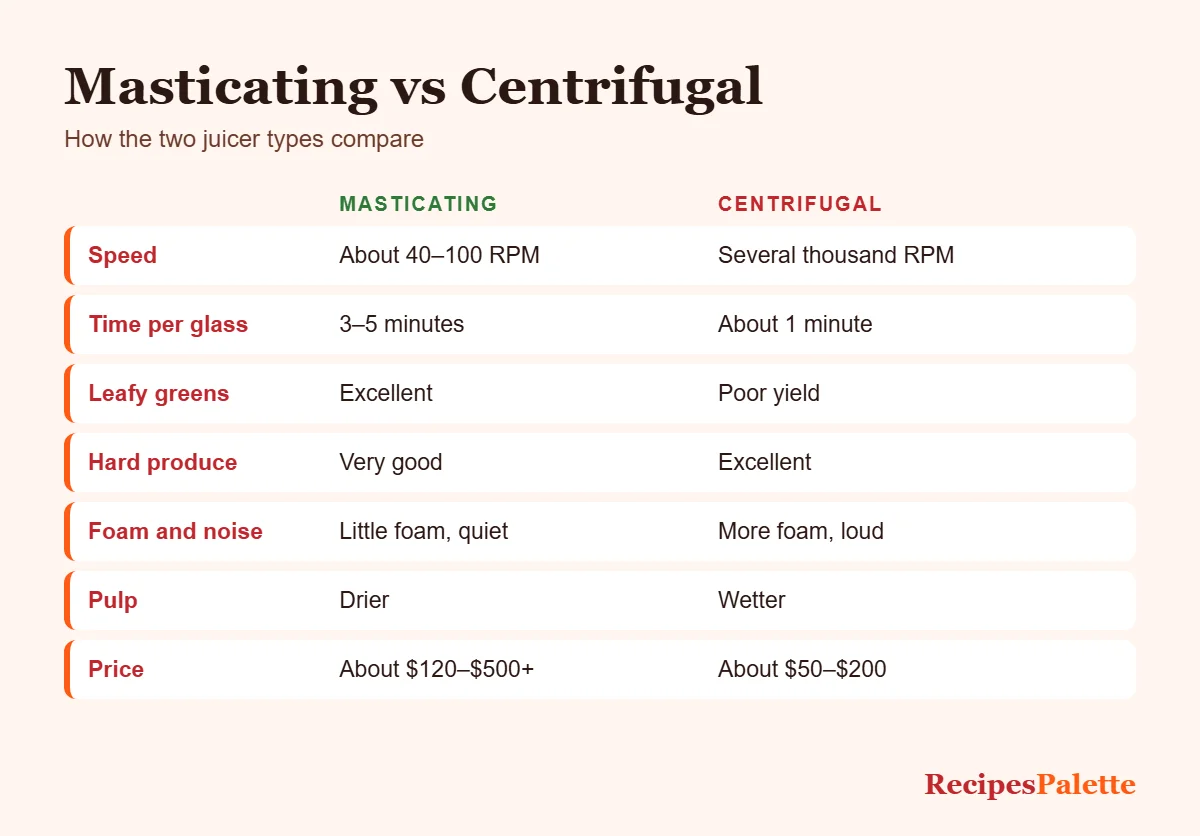
Masticating vs Centrifugal Juicer: Quick Comparison
| Centrifugal | Masticating (slow / cold press) | |
|---|---|---|
| How it works | Spinning blade disc and mesh basket | Slow auger crushes and presses |
| Speed | Usually several thousand RPM | Usually about 40 to 100 RPM |
| Time per glass | About 1 minute | About 3 to 5 minutes |
| Noise | Loud, like a blender | Quiet hum |
| Foam | More foam on top | Little foam |
| Leafy greens | Poor yield | Excellent |
| Hard produce | Excellent | Very good (may need smaller pieces) |
| Soft fruit | Good | Good, can clog if overfed |
| Pulp | Wetter | Drier |
| Price range | About $50 to $200 | About $120 to $500+ |
| Extras | Rare | Often sorbet, nut butter or nut milk |

How a Centrifugal Juicer Works
A centrifugal juicer has a flat disc with small sharp teeth at the bottom of a mesh basket. When you switch it on, the disc spins very quickly. You push produce down the feed chute with a plunger, the teeth shred it into a fine pulp, and the spinning force throws the juice outward through the mesh. The juice runs out of a spout and the pulp is ejected into a bin.
Most centrifugal models have a wide chute, often around 3 inches, so you can drop in whole apples or large chunks. Many have two speeds: low for soft fruit, high for hard vegetables.
Pros
- Fast: a glass of juice in about a minute
- Usually cheaper
- Wide chutes mean less chopping
- Great with carrots, apples, beets, pears and cucumbers
- Simple to assemble
Cons
- Loud
- Low yield from spinach, kale, herbs and wheatgrass
- More foam, and the juice separates faster
- Wetter pulp, which means some juice is wasted
- The mesh basket can be fiddly to clean
How a Masticating Juicer Works
A masticating juicer, also called a slow juicer or cold press juicer, uses a thick screw called an auger. The auger turns slowly, pulling produce down, crushing it, and pressing it against a fine screen. Juice drips out through the screen and dry pulp exits from a separate outlet.
There are two main designs. Horizontal models have the auger lying flat; they are excellent with leafy greens and wheatgrass, and often double as nut butter or pasta makers. Vertical models stand upright with the auger pointing down; they take up less counter space and are easier to feed with mixed produce.
Pros
- Much better with leafy greens, herbs and wheatgrass
- Higher yield from most produce, especially greens
- Quiet
- Smooth juice with little foam
- Juice tends to separate more slowly and keep its fresh taste a little longer
- Many models can make sorbet or nut milk
Cons
- Slower to use
- More expensive
- Many models need smaller pieces (though wide-chute models now exist)
- Can clog with stringy produce like celery if not cut into short pieces
- Juice can be slightly pulpier unless you use a fine strainer
Juice Yield: Which Gets More Juice?
Yield is where the two types differ most, and it depends heavily on what you juice.
- Hard produce (carrots, apples, beets): both types do well. A masticating juicer usually gets a little more, and its pulp comes out drier.
- Soft fruit (oranges, pineapple, grapes): results are similar. Peel citrus first for either type.
- Leafy greens (spinach, kale, chard): a masticating juicer wins by a wide margin. In a centrifugal juicer, light leaves can spin around without being shredded properly.
- Wheatgrass and herbs: only a masticating juicer handles them well. A centrifugal machine produces very little juice.
A simple way to check your own juicer: squeeze a handful of pulp. If juice drips out, there was more juice left to get.
Taste, Foam and Freshness
Because a centrifugal juicer spins very fast, it whips air into the juice. You get a layer of foam on top, and the juice can separate in the glass more quickly. Many people simply skim the foam or stir before drinking.
Slow juicers mix in less air, so the juice usually looks smoother and stays mixed longer. Many people also find it tastes a little fresher after a few hours in the fridge. Either way, homemade juice is unpasteurized and tastes best when it is fresh, so plan to drink it the same day.
You will often see claims that slow juicers keep “more nutrients” because they avoid heat. Both types only warm juice very slightly, and the bigger factors are how fresh your produce is and how soon you drink the juice. Choose based on the produce you use, your budget and your patience, not on marketing claims.
Speed, Prep and Everyday Use
For busy mornings, speed matters. A centrifugal juicer with a wide chute can turn a bag of apples and carrots into juice in a couple of minutes with almost no chopping. A slow juicer takes longer, and older narrow-chute models need everything cut into small pieces.
Newer vertical slow juicers with large chutes have narrowed the gap. They can take whole small apples and large chunks, though they are still slower to process each piece.
Cleaning: Which Is Easier?
Both types need to be taken apart and rinsed after every use. The hardest part on both is the mesh screen, where fine fibers get stuck.
- Centrifugal: usually 4 to 5 parts. The basket has sharp teeth, so scrub carefully with a brush.
- Masticating: often 5 to 7 parts. The screen and auger need brushing, especially after greens and celery.
Rinse everything right away, before the pulp dries. Many parts are top-rack dishwasher safe, but check the manual, especially for screens.
Price and Value
Basic centrifugal juicers start around $50 and good ones are often under $200. Masticating juicers usually start around $120 to $150, and premium vertical or horizontal models can cost $400 or more.
A higher price can make sense if you juice greens often, because the extra yield saves money on produce over time. If you juice once or twice a week, mostly with apples and carrots, a centrifugal juicer is better value. If you are not sure you will keep it up, start with a blender; see our guide to making juice without a juicer.
Which Juicer Should You Choose?
Choose a centrifugal juicer if:
- You mostly juice carrots, apples, beets, pears and citrus
- You want juice fast before work
- You are on a tighter budget
- You do not mind some noise and foam
Choose a masticating juicer if:
- You want green juice, wheatgrass or herb juices
- You care about getting the most juice from expensive produce
- You prefer a quiet machine
- You sometimes store juice for later in the day
- You would use extras like sorbet or nut milk
Choose neither (yet) if:
You are just curious about juicing. A blender and a nut milk bag will tell you whether you enjoy fresh juice before you spend money. Our juicer vs blender guide and juicing for beginners guide can help you decide.
What to Look for When Buying
- Chute size: wider means less chopping.
- Number of parts: fewer parts mean faster cleanup.
- Cleaning brush included: a good brush saves time every day.
- Warranty: slow juicer motors often carry long warranties; centrifugal models are usually shorter.
- Pulp control or reverse function: useful on slow juicers to clear jams.
- BPA-free parts and a juice jug that fits under the spout.
- Counter space: vertical slow juicers have a small footprint; horizontal models are long.
Frequently Asked Questions
Is a masticating juicer better than a centrifugal juicer?
For leafy greens, wheatgrass and yield, yes. For speed, price and hard fruits and vegetables, a centrifugal juicer is often the better pick.
Is a cold press juicer the same as a masticating juicer?
For home juicers, yes. “Cold press,” “slow juicer” and “masticating juicer” are used for the same type of auger machine. Commercial cold-pressed juice is often made with a separate hydraulic press, which is different.
Can a centrifugal juicer juice leafy greens?
It can, but the yield is low. Bundle the leaves tightly and push them through between harder produce like apples or cucumbers to get more juice.
Why does centrifugal juice have so much foam?
The fast-spinning basket whips air into the juice. Let it settle for a minute and skim the foam, or pour it through a small strainer.
Which juicer is better for celery?
Both can juice celery. Masticating juicers usually get more juice from it, but cut celery into 1 to 2-inch pieces first so the fibers do not wrap around the auger.
Which type lasts longer?
Slow juicers have fewer high-speed parts and often come with longer motor warranties. Any juicer will last longer if you clean it after each use and do not overload it.
The best juicer is the one you will actually use. Think about what you want in your glass most mornings, and pick the machine that makes that juice easiest.