
What Are the Benefits of Using a Dish Rack?

Quick Answer
A dish rack gives washed dishes an organized, raised place to drain and air-dry. It can keep water off your counter, improve airflow around plates and cups, protect fragile items from being stacked while wet, and make cleanup easier. It also fits naturally into a better kitchen organization system.
Main benefits of a dish rack
- Better airflow: Raised plates, bowls, and glasses can dry from more than one side.
- Less counter water: A drainboard or spout directs dripping water toward the sink.
- Safer storage: Slots keep dishes upright instead of balancing them in unstable piles.
- Easier cleanup: You get one defined place for freshly washed dishes.
- Useful organization: Separate sections can hold plates, cups, utensils, and cookware.
- Less towel contact: Clean dishes can air-dry without repeated handling.
Best results
- Choose a rack with good drainage, enough spacing between dishes, and removable parts that are easy to clean.
A dish rack can look like one of the simplest tools in the kitchen. Yet I think its value becomes obvious when you look at what happens after every hand-washing session.
Wet plates need airflow, utensils need a safe place to drain, and your counter needs protection from standing water. A well-designed rack handles all three jobs without adding another complicated appliance to the kitchen.
What Is a Dish Rack and What Does It Do?
A dish rack is a raised holder designed to keep washed dishes separated while excess water drains away and the remaining moisture evaporates. Most models include plate slots, flat drying areas, and a separate utensil holder.
Simple definition: A dish rack keeps clean, wet dishes upright and separated so water can drain and air can circulate around them.
Some racks sit entirely on the counter. Others extend over the sink, fold flat, use two levels, or include a drainboard with a spout.
- Countertop racks offer convenient everyday capacity.
- Fold-flat racks work well when counter space is limited.
- Over-sink racks let water drip directly into the basin.
- Two-tier racks increase drying space vertically.
- Drainboard racks collect water and channel it toward the sink.
What Are the Main Benefits of Using a Dish Rack?
The biggest benefit is that a dish rack creates a predictable drying zone. Instead of placing wet cookware, plates, cups, and utensils wherever space appears, everything has a designated place.
That small change improves several parts of the cleanup routine at once.
- It separates wet dishes. Plates aren’t pressed tightly together while drying.
- It controls dripping water. Drainboards help keep moisture concentrated near the sink.
- It reduces clutter. Clean dishes stay in one area instead of spreading across the counter.
- It keeps utensils contained. Forks, spoons, and cooking tools don’t roll around the worktop.
- It protects delicate pieces. Glasses and plates can stand securely instead of resting in a wet pile.
- It simplifies putting dishes away. Everything is already grouped after drying.
I also like the way a rack creates a clear workflow: dirty dishes move to the sink, clean dishes move to the rack, and dry dishes move into storage. That predictable routine can make a busy kitchen easier to manage.
Does a Dish Rack Help Dishes Dry Faster?
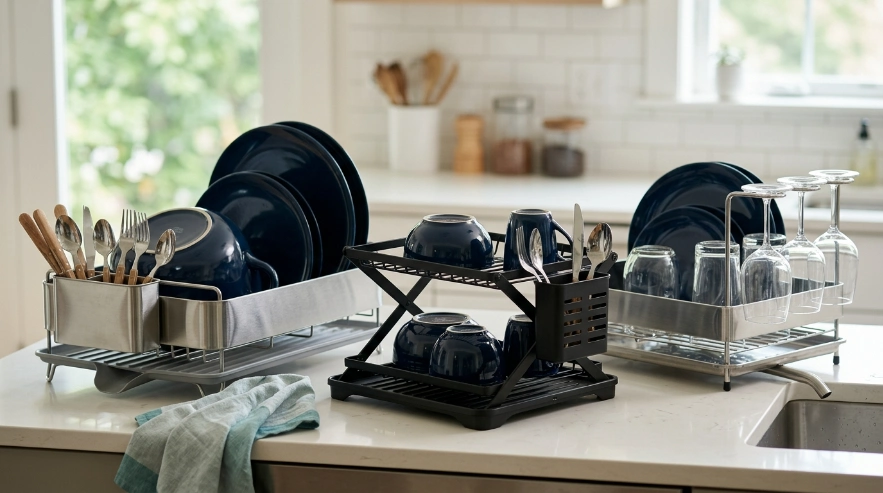
A good dish rack can help dishes dry efficiently because it raises and separates them. Air can reach surfaces that would stay covered if plates were stacked directly on a towel.
Drainage matters too. Water that quickly moves away from the dish surface has less moisture left to evaporate.
| Drying Method | Airflow | Water Control | Best Use |
|---|---|---|---|
| Dish rack | High when dishes are spaced apart | Good with a drainboard or spout | Daily loads of mixed dishes |
| Drying mat | Moderate unless items are raised | Absorbs or contains drips | Pots and irregular cookware |
| Kitchen towel | Limited beneath flat surfaces | Absorbs moisture until saturated | Small, occasional loads |
For the fastest practical setup, avoid crowding the rack. Leave small gaps between plates, turn bowls so water cannot collect inside, and place cups upside down at a slight angle.
That same organized workflow can save time elsewhere in the kitchen. My guide to saving time while cooking daily meals covers more ways to reduce unnecessary steps.
Is a Dish Rack More Hygienic Than Towel-Drying?
A clean dish rack gives dishes a low-contact way to air-dry. That can be useful because you don’t need to repeatedly rub clean dishes with a reusable towel.
The USDA includes air-drying among its cleaning guidance, while the FDA advises washing dishes and utensils with hot, soapy water and keeping kitchen cloths clean.
- Wash dishes thoroughly before putting them on the rack.
- Keep the rack itself clean.
- Empty standing water from trays.
- Wash reusable dishcloths and towels regularly.
- Keep raw-meat preparation away from the clean drying area.
For broader cleaning guidance, see the FDA’s safe food handling guidance. The USDA also discusses cleaning and air-drying in its food-safety cleaning guidance.
A dish rack isn’t automatically hygienic simply because dishes air-dry on it. A dirty rack with trapped food residue or stagnant water needs cleaning just like any other kitchen surface.
Good separation between raw-food tasks and clean dishes also matters. You can review more practical habits in these kitchen safety tips for home cooks.
Can a Dish Rack Protect Dishes and Keep Counters Cleaner?
Yes. One overlooked benefit is that a structured rack gives plates and glasses defined support instead of letting them lean against random cookware.
Plate slots can reduce sliding, while rubber feet and silicone-coated supports can improve stability. A utensil compartment also keeps knives, forks, and spoons from scattering around the counter.
- Plate slots: Help plates stay upright and separated.
- Cup holders: Keep drinkware away from heavier cookware.
- Utensil cups: Contain smaller pieces while they drain.
- Non-slip feet: Reduce movement on wet countertops.
- Drainboards: Keep dripping water from spreading across work surfaces.
A drier counter is also easier to maintain. The EPA emphasizes moisture control as a basic part of managing mold in homes, so routinely eliminating standing water is a sensible kitchen habit.
You can read the EPA’s broader mold and moisture guidance for more information.
Can a Dish Rack Save Kitchen Space?
A dish rack takes up space, but the right design can use that space more efficiently. The key is choosing a rack that matches your washing habits and available counter area.
For a small kitchen, I would rather use a compact or fold-flat rack than buy a large model that permanently consumes the main prep zone.
- Small apartment: Consider fold-flat or over-sink designs.
- Large family: Look for a full-size rack with substantial plate capacity.
- Minimal counter space: Use vertical or two-tier storage.
- Frequent pot washing: Choose a wide open section instead of plate slots everywhere.
- Dishwasher household: A compact rack may be enough for knives, pans, and delicate items.
Before buying, measure the usable space beside your sink. Don’t forget the direction of the drainboard or spout, because a great rack becomes frustrating when its drainage system cannot reach the basin.
Dish Rack vs. Drying Mat: Which Is Better?
A rack is usually better when you wash plates, bowls, glasses, and utensils every day. A mat can be better for oversized cookware or kitchens where everything must disappear after cleanup.
Neither option wins in every situation.
- Choose a rack for structure, airflow, drainage, and organized everyday loads.
- Choose a mat for easy storage and unusually shaped pots or pans.
- Use both if you frequently hand-wash large loads.
I often judge the setup by one question: can every wet item sit securely without touching a dirty surface or blocking another item from draining? If the answer is yes, the drying system is doing its job.
How Do You Choose the Right Dish Rack?
Start with dimensions, then look at drainage and cleaning. Extra features matter only after those basics work in your kitchen.
When I evaluate a rack, I focus on six practical points.
- Measure the space. Check counter depth, width, and distance from the sink.
- Check drainage. Look for a sloped tray or movable spout if the rack sits on the counter.
- Match capacity to your household. A couple washing two plates at a time needs less space than a family hand-washing cookware.
- Look for stable supports. Plate slots should hold dishes without forcing them together.
- Choose easy-clean materials. Removable trays and utensil holders simplify maintenance.
- Consider storage. Folding or collapsible models are useful when the counter doubles as prep space.
Material also affects maintenance. Stainless steel and aluminum are common, while plastic racks can be lighter and less expensive.
If you’re building a more complete setup, see my guide to essential kitchen tools for home cooking.
How Do You Keep a Dish Rack Clean?
Clean the rack before residue becomes difficult to remove. Food particles, soap film, mineral deposits, and standing water can collect around joints and drain trays.
- Empty and rinse the drain tray regularly.
- Remove trapped food particles immediately.
- Wash removable parts according to the manufacturer’s instructions.
- Clean around utensil cups and plate supports.
- Dry the rack completely after deeper cleaning.
- Avoid harsh products if the manufacturer warns they can damage protective coatings.
NSF research has found substantial microbial contamination on common kitchen items such as sponges, sinks, and counters. That makes routine cleaning around the sink area worth taking seriously.
For more context, see NSF’s overview of germ-prone household and kitchen surfaces.
Dish Rack Size and Feature Comparison
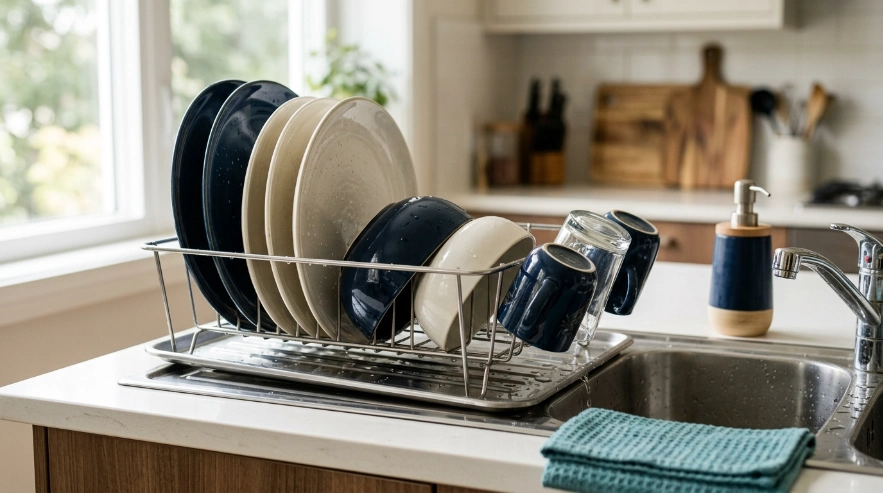
These three examples show how much dish rack designs can differ. Measurements are approximate manufacturer or published product dimensions, so measure your own counter before ordering.
| Dish Rack | Approx. Dimensions | Notable Feature | Best For |
|---|---|---|---|
| KitchenAid Full-Size Dish Rack | 20 × 14.96 × 7 in. | Angled drainboard and removable flatware caddy | Large everyday loads |
| OXO Good Grips Aluminum Fold Flat | 16.4 × 14.6 × 9.5 in. when expanded | Fold-flat two-level design | Small kitchens and flexible storage |
| Simplehuman Steel Frame Dishrack | Large countertop format | Swivel drain spout and wine-glass holder | Heavy daily use and premium organization |
Dish Racks I Would Consider
If you’re ready to choose one, these are three designs that match different kitchen needs. My scores below are editorial ratings based on drainage, capacity, flexibility, and ease of everyday use rather than live retailer review averages.
🏆 Best Overall
Simplehuman Steel Frame Dishrack
★★★★★ Editorial rating: 4.8/5
Its swivel spout sends water toward the sink, while silicone-capped supports and an integrated wine-glass rack add useful separation. I like it for households that hand-wash frequently and want a permanent, high-capacity counter setup.
🍽️ Best for Large Loads
KitchenAid Full-Size Dish Rack
★★★★☆ Editorial rating: 4.6/5
At roughly 20 × 14.96 × 7 inches, this full-size model provides room for plates plus larger cookware and uses an angled drainboard. I would consider it when capacity matters more than keeping the counter footprint small.
🏠 Best for Small Kitchens
OXO Good Grips Aluminum Fold Flat Dish Rack
★★★★☆ Editorial rating: 4.5/5
The rustproof aluminum frame measures about 16.4 × 14.6 inches across and folds down when you need the counter back. I like this style for apartments, compact kitchens, and anyone who doesn’t want a permanent rack beside the sink.
Frequently Asked Questions
Do I really need a dish rack?
No, a dish rack isn’t essential for every kitchen. However, it is useful if you regularly hand-wash plates, cookware, knives, glasses, or items that you don’t put in a dishwasher because it creates an organized draining and drying area.
Can I just dry dishes on a towel?
Yes, especially for a small load. A rack usually provides better separation and keeps dishes elevated, while a towel can become saturated and offers less airflow beneath items resting flat on it.
Should dishes be towel-dried or air-dried?
Air-drying is a practical low-contact option after dishes have been properly washed and rinsed. If you use a towel, make sure it is clean and dry rather than using a damp kitchen cloth that has already handled other cleanup jobs.
How often should I clean a dish rack?
Clean it whenever you notice residue, standing water, odor, or visible buildup. For a rack used every day, a regular rinse plus periodic deeper cleaning helps keep the drain tray, utensil holder, joints, and supports in better condition.
What material is best for a dish rack?
Stainless steel and aluminum are popular for durability, while plastic is lightweight and often affordable. The best choice is a material that handles moisture well, is easy to clean, and suits the manufacturer’s recommended care routine.
Final Takeaway
The benefits of using a dish rack go beyond having somewhere to place wet plates. A good rack improves airflow, controls dripping water, keeps dishes organized, protects fragile items, and creates a cleaner workflow around the sink.
The right model depends on your kitchen. Measure first, prioritize drainage and easy cleaning, then choose the capacity and features that match how many dishes you actually hand-wash.
If your current routine leaves wet dishes scattered across towels and countertops, a properly sized dish rack is one of the simplest upgrades you can make. Choose one that fits your space, keep it clean, and let it do the drying work for you.
