
What to Do Instead of Shelves? 9 Smart Dish-Drying Alternatives

Quick Answer
If shelves are taking up too much room, replace them with a drying mat, roll-up sink rack, fold-flat rack, wall-mounted system, or deep dish drawer. The best choice depends on whether you need temporary drying space or permanent storage, so comparing the different types of dish racks is a useful starting point.
Best shelf-free options
- Drying mat: Best when you wash only a few items and want the counter clear afterward.
- Roll-up rack: Spans part of the sink, drains directly below, and rolls away after use.
- Fold-flat rack: Gives plates more structure than a mat without becoming a permanent fixture.
- Dish drawer: Stores dry plates and bowls below the counter without traditional shelves.
- Wall system: Uses vertical wall space while keeping the worktop open.
- Over-sink rack: Moves wet dishes above the basin so drips fall toward the sink.
My first check
- Measure the counter, sink, faucet clearance, and your normal dish load before buying anything.
When someone asks me what to do instead of shelves, I first separate drying from storage. Wet dishes need airflow and drainage, while dry dishes simply need a stable place to live.
That distinction opens up far more options than another fixed shelf. In 2026, some of the most useful setups disappear completely after the dishes are dry.
What Can I Use Instead of Shelves for Dishes?
You can replace traditional shelves with dish drawers, drying mats, foldable racks, over-sink systems, wall-mounted organizers, rolling carts, or vertical plate holders. The right choice depends on whether you are drying wet dishes or storing clean ones.
Definition: A shelf-free dish setup is any drying or storage arrangement that keeps dishes organized without relying on a conventional fixed horizontal shelf.
I like to solve the wet-dish problem first. A beautiful storage system still fails if freshly washed plates have nowhere practical to drain.
- Silicone drying mat: A low-profile landing area for cups, bowls, knives, and pans.
- Roll-up sink rack: Silicone-coated or metal rods that bridge a compatible sink.
- Foldable dish rack: A structured rack that collapses when you finish.
- Over-sink rack: A raised system that uses the space around or above the basin.
- Wall-mounted drainer: A fixed vertical solution that leaves the counter open.
- Deep drawer with pegs: A practical replacement for upper shelves once dishes are dry.
- Vertical plate organizer: Useful inside a cabinet, drawer, or open countertop zone.
- Built-in drying cabinet: A more permanent renovation option inspired by Scandinavian kitchens.
- Rolling kitchen cart: Helpful when you need movable storage rather than another wall fixture.
For the simplest change, I would start with something removable. A mat, roll-up rack, or fold-flat design lets you test the idea before changing cabinets or drilling into a wall.
Which Alternative Saves the Most Counter Space?
Dish drawers and wall-mounted systems save the most permanent counter space. Roll-up and foldable drying tools come close because you can remove them between dishwashing sessions.
Over-sink racks are another strong option when the sink has enough clearance. Their biggest advantage is moving the drying zone onto space you already use for washing.
| Alternative | Counter impact | Drainage | Best for | Main tradeoff |
|---|---|---|---|---|
| Silicone drying mat | Temporary | Holds or channels drips | Light dish loads | Few upright plate supports |
| Roll-up sink rack | Almost none after storage | Directly into sink | Tiny kitchens | Uses part of the sink |
| Fold-flat rack | Temporary | Tray or drainboard | Mixed daily dishes | Needs storage space when folded |
| Over-sink rack | Very low | Directly toward basin | Limited counters | Can obstruct faucet or sink access |
| Dish drawer | None | For dry dishes only | Everyday storage | Uses valuable base-cabinet space |
| Wall-mounted system | None | Depends on tray and position | Permanent small-space layouts | Installation may be required |
Current products show how different these footprints can be. OXO lists its Aluminum Fold Flat Dish Rack at about 16.4 by 14.6 inches when open.
Joseph Joseph lists one Extend Steel model at roughly 12¾ by 14½ inches closed and 20¾ by 14½ inches expanded. That difference is why I measure the working footprint, not just the product photo.
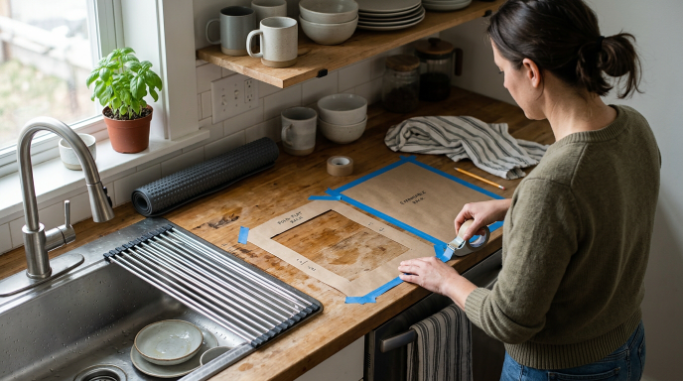
Try my paper-footprint test first
Before buying, mark the proposed footprint on your counter with paper or painter’s tape. Then prepare one normal meal without moving that marked area.
If you keep reaching across it or losing your chopping space, the setup is too large. That simple test tells me more than the words “compact” or “space-saving” on a box.
Is a Drying Mat Better Than a Shelf or Dish Rack?
A drying mat is better when you wash small loads and value an empty counter between meals. A structured rack is better when you regularly dry plates upright, wash several place settings, or need secure support for glasses.
The appeal of silicone is simple. It gives you a washable wet zone without leaving a metal frame on display all day.
- Choose silicone when you want something waterproof, washable, and easy to roll or hang.
- Choose microfiber when absorption matters and you can wash and dry the mat frequently.
- Choose a rack when plate separation and upright support matter more than compact storage.
- Choose both when a folding rack needs extra protection beneath oversized cookware.
Whatever you use, the drying area itself needs cleaning. The University of Minnesota Extension recommends keeping drying racks clean and allowing dishes and utensils to air-dry rather than routinely cloth-drying them.
You can review its home-kitchen sink guidance for the food-safety reasoning behind that habit.
Can I Store Plates in Drawers Instead of Shelves?
Yes. A deep drawer with pegs, dividers, or plate holders can replace upper shelves for everyday plates and bowls.
I especially like drawers when reaching into upper cabinets feels awkward. Looking down at each stack can make dishes easier to see and retrieve.
- Check the drawer rating: Dinnerware gets heavy quickly.
- Add non-slip support: Pegs or dividers help stop stacks moving.
- Separate by size: Keep dinner plates, side plates, and bowls in defined groups.
- Test clearance: Make sure the tallest stack clears the cabinet above.
- Keep dishes dry: A storage drawer is not a substitute for a ventilated drying area.
If this layout interests you, my guide on how to store dishes in a drawer explains the setup in more detail. It is one of the cleanest ways to remove traditional dish shelves without losing organization.
What About Wall-Mounted or Over-Sink Storage?
Wall-mounted and over-sink systems work well when horizontal counter space is the real problem. They shift dishes upward instead of spreading them across your worktop.
An over-sink rack has one obvious advantage: water can fall toward the basin. It still needs enough clearance for your faucet, hands, largest plates, and normal sink tasks.
- Measure sink width: Never rely only on an “adjustable” product label.
- Check cabinet height: Tall plates need room above the rack.
- Protect faucet access: You should still be able to turn and use the faucet normally.
- Watch stability: Wet cookware adds weight quickly.
- Consider renters: A freestanding over-sink rack avoids wall drilling.
A wall-mounted rack is more permanent. I would use one only when the sink location and dish routine are unlikely to change.
If your main concern is appearance, this guide on whether dish racks are out of style shows why removable and vertical designs often work better in modern kitchens.
How Should You Dry Dishes Safely Without Shelves?
The drying tool matters less than keeping the washing area clean and letting clean dishes drain without being recontaminated. Wet dishes should not be placed onto a dirty sink edge or a mat carrying old food residue.
The FDA advises washing dishes, utensils, cutting boards, and countertops with hot, soapy water during food preparation. Its Food Safety at Home guidance gives the broader clean, separate, cook, and chill framework.
The USDA also recommends cleaning sinks, utensils, and surfaces with warm, soapy water before appropriate sanitizing. Its kitchen cleaning guidance also notes that cleaned utensils and surfaces can be air-dried.
- Start clean: Wash the mat, rack, or draining surface regularly.
- Leave gaps: Do not stack wet plates tightly together.
- Drain cups: Angle openings downward so water cannot pool.
- Control drips: Keep runoff away from cabinet edges and countertop seams.
- Store when dry: Move dishes into drawers or cabinets after moisture is gone.
If water keeps escaping onto the counter, the problem may be underneath the rack rather than above it. My guide to what to put under a dish rack covers trays, silicone, microfiber, and other practical options.
How Do I Choose the Right Shelf Alternative?
Choose based on your normal Tuesday-night dish load, not the largest holiday dinner you can imagine. The smallest system that comfortably handles everyday washing usually creates the least clutter.
- Count a normal load. Note how many plates, bowls, cups, utensils, and pans you wash together.
- Measure usable space. Include the faucet, backsplash, counter edge, and cabinet clearance.
- Decide what can stay out. Permanent racks need to earn their visual and physical footprint.
- Choose a drainage path. Water should reach the sink or a washable collection surface.
- Plan dry storage. Decide whether dishes move into a drawer, cabinet, plate holder, or another location.
- Test before renovating. Try a removable solution before installing a fixed wall system.
For DIY-minded kitchens, you can also build a rack around the space you already have. This homemade dish rack guide shows a customizable approach when store-bought dimensions never seem right.
Three Shelf-Free Products I Would Consider
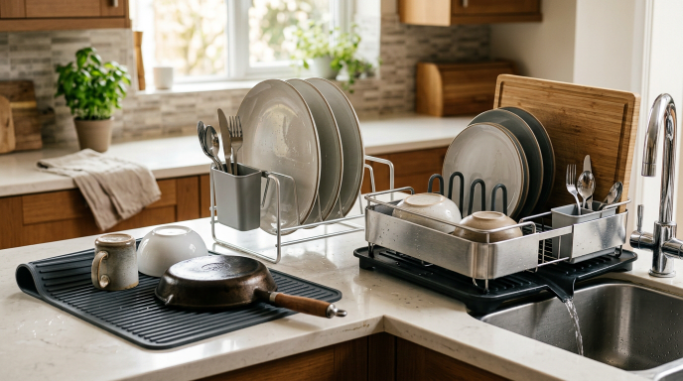
If you’re ready to replace bulky shelves or a permanent drying station, these three options solve different problems. I would choose by counter space first, then by capacity.
🏆 Best minimal setup
OXO Good Grips Large Silicone Drying Mat
★★★★☆
OXO lists this silicone mat at about 16.9 by 12.5 inches, with raised ribs and roll-or-hang storage. I like this style for a household that mostly needs space for mugs, bowls, knives, and one pan.
⭐ Best fold-away rack
OXO Good Grips Aluminum Fold Flat Dish Rack
★★★★★
The rustproof aluminum frame folds flat and includes a removable utensil cup plus raised draining ridges. This is my pick when a mat feels too unstructured but I still want the counter back after cleanup.
🍽️ Best flexible capacity
Joseph Joseph Extend Steel Expandable Dish Rack
★★★★☆
This model expands substantially and includes a movable drain spout, raised ribs, cutlery storage, and a cutting-board rail. I would choose it when dish volume changes often and compact storage matters less than adjustable capacity.
Frequently Asked Questions
What is the cheapest alternative to kitchen shelves?
A washable drying mat is usually the simplest low-cost alternative when the goal is temporary dish drying. For permanent storage, reorganizing an existing deep drawer with a non-slip liner and dividers may cost less than installing new wall shelves.
Can I dry dishes directly on the counter?
I would use a clean drying mat, drainboard, or other washable barrier instead of placing wet dishes directly on most countertops. The barrier controls drips, protects moisture-sensitive surfaces, and gives you something removable that can be cleaned and dried separately.
Are over-sink dish racks worth it?
They can be excellent in a small kitchen when the rack fits securely and leaves enough faucet and basin access. Measure sink width, cabinet clearance, faucet height, and the rack’s full assembled dimensions before choosing one.
Is a dish drawer better than shelves?
A dish drawer can be better for visibility and easy access because you look down at the plates instead of reaching into an upper cabinet. Shelves may still make more sense when lower cabinet space is needed for pots, appliances, or heavy cookware.
What should I do if I have almost no counter space?
Start with a roll-up sink rack, over-sink system, or small drying mat that stores vertically. Keep dry dishes in drawers or cabinets, and avoid buying a permanent countertop rack larger than your everyday washing load.
Final Takeaway
If shelves are crowding your kitchen, you do not need to replace them with another large permanent structure. A drying mat, roll-up rack, fold-flat rack, dish drawer, or over-sink system can handle the same job with less visual clutter.
My favorite approach is to keep drying temporary and storage permanent. Give wet dishes an airy place to drain, put them away once dry, and let your counter become useful workspace again.