
How to Hide a Dish Rack: 10 Smart Ways to Keep Counters Clear

Quick Answer
The easiest way to hide a dish rack is to choose a foldable, roll-up, in-sink, or expandable design that can disappear after your dishes dry. You can also store a completely dry rack inside a cabinet, deep drawer, pantry, or appliance garage. If you dislike the look of traditional racks, see how modern kitchens handle dish racks before replacing yours.
Quick ways to hide your dish rack
- Fold it away: Choose a rack that collapses flat and slide it into a cabinet after it dries.
- Use the sink: An in-sink or roll-up rack keeps the drying area off your countertop.
- Try a drying mat: Foldable mats can go into a drawer when cleanup is finished.
- Create cabinet storage: Reserve a lower cabinet, pull-out shelf, or deep drawer for the dry rack.
- Hide it above: A built-in drying cabinet above the sink works well during a kitchen remodel.
- Reduce visual clutter: If the rack stays out, empty it promptly and choose a finish that matches your kitchen.
One important rule
- Never shut a wet rack inside an unventilated cabinet. Let the rack and its drip tray dry first.
I like a clear kitchen counter, but I also don’t want to make washing dishes harder than it needs to be. A dish rack is useful during cleanup and surprisingly annoying once everything is dry.
The solution isn’t necessarily getting rid of it. A better approach is making the rack disappear when you aren’t using it.
What Does It Mean to Hide a Dish Rack?
Hiding a dish rack means giving it a drying or storage setup that keeps it from dominating your countertop. The rack may fold away, sit inside the sink, retract, or move into a cabinet after use.
The key phrase is after use. A rack still needs to perform its main job while wet dishes are draining.
A standard rack creates a raised area where washed plates, bowls, glasses, and utensils can stay separated while drying. If you want a deeper explanation, this guide explains what a dish rack is used for.
- During washing: The rack needs enough space for your normal load.
- During drying: Air should move around the dishes and excess water should drain.
- After drying: Dishes should be put away and the rack can be cleaned, dried, and hidden.
How Can You Hide a Dish Rack Without Making Dishes Harder to Dry?
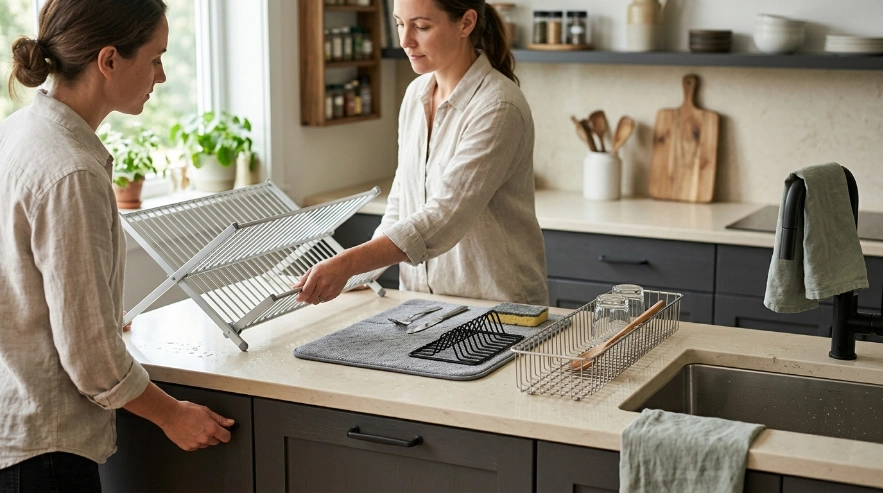
The best approach is to hide the rack only after it has finished doing its job. Choose a storage method that matches how often you hand-wash and how much counter space you have.
These are the setups I would consider first.
1. Use a Fold-Flat Dish Rack
A fold-flat rack is one of the easiest answers because you don’t have to redesign the kitchen. Use it beside the sink, then collapse it once the rack is empty and dry.
It can usually slide into a lower cabinet, pantry shelf, or vertical organizer beside cutting boards and baking sheets.
- Good for renters
- Good for small apartments
- No permanent installation
- Keeps the counter completely open between uses
This is my favorite approach when someone wants a normal drying rack without permanently looking at one.
2. Switch to a Roll-Up Over-the-Sink Rack
A roll-up rack rests across part of the sink instead of occupying the counter. Water drips directly into the basin below.
Once everything is dry, roll the rack into a narrow cylinder and store it in a drawer or cabinet.
This setup works best when your sink is wide enough to support the rack while leaving enough room to wash and rinse.
3. Use a Foldable Drying Mat and Removable Rack
A drying mat is easier to hide than most rigid dish racks. Models with removable plate holders give you some vertical organization without creating a permanent countertop fixture.
After drying, separate the pieces and put them away. A washable mat also works well for large pans that don’t fit neatly into plate slots.
4. Put the Rack Inside the Sink
If you have a large or double-basin sink, an in-sink rack can keep nearly the entire drying setup below counter level. From across the room, it becomes far less noticeable.
The tradeoff is sink access. Measure carefully so the rack doesn’t interfere with your faucet or leave you without enough room to wash cookware.
5. Give the Rack Its Own Cabinet
A cabinet can be excellent storage for a rack that is completely dry. I prefer vertical storage because it uses less shelf width and makes the rack easy to grab.
Try storing it beside these flat kitchen items:
- Cutting boards
- Baking sheets
- Cooling racks
- Serving trays
- Large pot lids
A simple tension divider or vertical cabinet organizer can keep everything from falling against the rack.
6. Install a Pull-Out Drying Shelf
If you’re renovating cabinetry, a pull-out drying station can hide most of the setup behind a cabinet front. The important part is designing the space for moisture rather than treating it like ordinary dry storage.
The cabinet needs materials, drainage, and ventilation suited to the installation. A removable tray also makes routine cleaning much easier.
7. Consider an Above-Sink Drying Cabinet
An above-sink drying cabinet is one of the cleanest built-in solutions. Dishes sit on open racks inside the cabinet while water drains toward the sink area.
When the doors close, the drying zone disappears visually. This approach makes the most sense during a remodel because retrofitting existing cabinetry can be complicated.
8. Use an Expandable Rack and Collapse the Footprint
Some racks don’t disappear completely, but they shrink when the load is small. This can be a good compromise for people who hand-wash every day.
Instead of storing the entire rack elsewhere, contract it after dinner and keep only a narrow drying zone beside the sink.
9. Hide the Rack Behind the Sink Line
A deep sink, raised counter edge, or kitchen island can sometimes hide a low-profile rack from normal sightlines. Nothing needs to move.
This technique works best with a compact rack in a neutral finish. Keep it emptied because a pile of dry dishes will undo the visual effect.
10. Make the Rack Look Intentional
Sometimes the smartest solution is visual rather than physical. A clean rack that matches the faucet, cabinet hardware, or countertop draws much less attention.
- Match stainless finishes with stainless fixtures.
- Choose black near black hardware.
- Avoid oversized racks for tiny dish loads.
- Keep the drip tray free from mineral residue.
- Put dry dishes away instead of using the rack as permanent storage.
A well-organized rack also looks much calmer. My guide to organizing dishes in a dish rack covers placement in more detail.
Which Dish Rack Hiding Method Works Best?
The right solution depends on whether you want the rack completely invisible or simply less noticeable. Here’s how the main options compare.
| Method | Counter Space After Storage | Installation | Best For | Main Tradeoff |
|---|---|---|---|---|
| Fold-flat rack | Fully reclaimed | None | Renters and apartments | Must be folded and stored |
| Roll-up sink rack | Fully reclaimed | None | Small counters | Uses sink space while drying |
| Drying mat | Fully reclaimed | None | Light loads | Uses more horizontal space during use |
| In-sink rack | Nearly clear | None | Large or double sinks | Reduces sink capacity |
| Cabinet storage | Fully reclaimed | Minor or none | Dry foldable racks | Rack must dry first |
| Built-in drying cabinet | Fully reclaimed | Major | Kitchen renovations | Higher complexity |
Can You Put a Wet Dish Rack Inside a Cabinet?
I wouldn’t put a wet dish rack into a closed ordinary cabinet. Empty the tray and let the rack dry before placing it into enclosed storage.
The FDA’s safe food handling guidance recommends washing dishes, utensils, cutting boards, and countertops with hot, soapy water after food preparation.
The USDA’s kitchen-sink guidance also emphasizes cleaning, sanitizing when appropriate, and allowing cleaned areas to air-dry.
University of Minnesota Extension similarly discusses air drying food-contact surfaces after sanitizing when required by the sanitizer instructions.
The practical lesson is simple. Don’t turn a wet drying tool into trapped moisture inside a dark cabinet.
- Empty water from the drain tray.
- Wash away visible residue.
- Shake off excess water.
- Leave the rack exposed until dry.
- Then move it into enclosed storage.
How Do You Hide a Dish Rack in a Small Kitchen?
In a small kitchen, prioritize something that occupies no permanent preparation space. Foldable, in-sink, and over-sink designs usually make more sense than a large fixed rack.
I use a simple four-step decision process.
- Measure the sink and counter. Include faucet clearance, backsplash space, and cabinet doors.
- Estimate your normal load. Size for an ordinary meal, not your biggest holiday dinner.
- Choose the storage spot first. Know where the rack will go before buying it.
- Create an empty-the-rack habit. Put dry dishes away so the drying zone can disappear again.
If you’re unsure whether a rack deserves any space at all, read whether you really need a dish rack before buying another one.
Whatever style you choose, loading it correctly also matters. My step-by-step dish rack guide explains a practical setup for plates, cups, utensils, and larger pieces.
How Can You Make a Dish Rack Look Less Cluttered?
If your rack must remain on display, make it behave like a temporary workstation instead of permanent open shelving. An empty rack almost always looks better than one filled with yesterday’s dishes.
- Downsize: Use the smallest rack that handles your usual load.
- Control colors: Match the rack to surrounding hardware or countertops.
- Remove extras: Don’t store sponges, bottles, food containers, and random tools around it.
- Clean the tray: Water marks and residue attract attention.
- Put dishes away: Treat the rack as drying equipment, not a cabinet.
- Keep the sink clear: A clean sink makes the entire drying zone feel more intentional.
I also avoid buying complicated racks with attachments I won’t use. Every extra holder creates another shape on the counter and another part to clean.
What Mistakes Should You Avoid When Hiding a Dish Rack?
The biggest mistake is prioritizing appearance so strongly that the drying setup becomes inconvenient. If hiding the rack adds five annoying steps after every meal, you probably won’t keep doing it.
- Storing it wet: Let ordinary racks dry before enclosing them.
- Buying before measuring: A folding rack is useless if it won’t fit your cabinet.
- Blocking the sink: Check whether an over-sink rack leaves enough working room.
- Ignoring drainage: A hidden-looking setup still needs somewhere for water to go.
- Choosing too little capacity: An undersized rack creates unstable piles.
- Leaving dishes indefinitely: The rack cannot disappear if it never becomes empty.
Function comes first. Then you make the function visually quieter.
Dish Racks That Are Easier to Hide
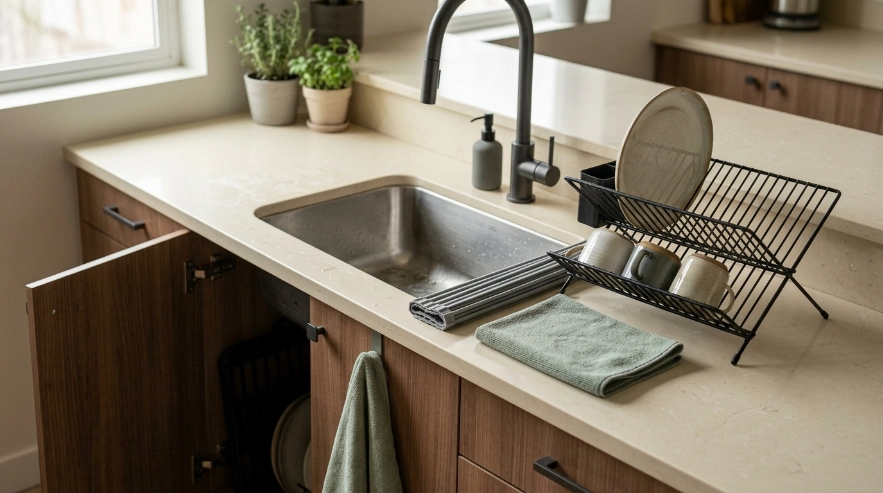
If you’re ready to change your setup, I’d focus on racks designed around folding, shrinking, or easy storage rather than buying another bulky permanent model.
🏆 Best for Hiding Away
OXO Good Grips Aluminum Fold Flat Dish Rack
★★★★☆ 4.7/5
The aluminum rack folds flatter for storage and includes a removable utensil cup. This is the style I’d choose when keeping the countertop clear between washing sessions is the main priority.
💰 Best Flexible Option
Umbra UDRY Dish Drying Rack and Mat
★★★★☆ 4.6/5
UDRY combines a microfiber drying mat with a removable plate rack, so the setup is easier to fold and store than a rigid full-size rack. I like it for lighter dish loads and kitchens where the drying surface needs to disappear after use.
↔ Best Expandable Design
Joseph Joseph Extend Slim Steel Dish Drainer
★★★★☆ 4.7/5
This narrow rack expands when you need more drying room and contracts again afterward. I would consider it when you wash dishes frequently and want to reduce the rack’s footprint without moving it into a cabinet every day.
Frequently Asked Questions
How do I hide a dish rack on the counter?
Choose a low-profile rack that matches your kitchen finishes and position it close to the sink. Keep it empty when dishes are dry. If you want it completely gone, switch to a folding or roll-up design that can move into a cabinet.
Can I store a dish rack under the sink?
Yes, if the rack fits comfortably and is completely dry first. Keep it away from leaking plumbing and cleaning products that could spill onto it. A vertical divider can make under-sink storage easier for flat or foldable racks.
What is the best dish rack for a small kitchen?
A fold-flat, roll-up, in-sink, or narrow expandable rack usually works best in a small kitchen. Choose based on your sink dimensions and typical dish load. The best rack is the smallest design that still handles your normal washing routine safely.
Can I use a drying mat instead of a dish rack?
Yes. A drying mat works well for small loads, pots, pans, and awkward items, and it can fold away afterward. A traditional rack is usually better when you need several plates to stand upright while keeping cups and utensils organized.
Should I put dishes away immediately after they dry?
Putting fully dry dishes away keeps your drying area clear and makes it easier to clean or hide the rack. You don’t need to move them the second they dry, but leaving clean dishes there permanently turns the rack into visible storage instead of a temporary drying station.
Final Takeaway
You don’t need to choose between a useful dish rack and an uncluttered kitchen. The trick is choosing a drying system that has a clear place to go when cleanup is finished.
For most kitchens, I would start with a fold-flat rack, roll-up sink rack, or drying mat. They’re inexpensive ways to reclaim the counter without changing cabinetry.
If you’re remodeling, a concealed drying cabinet or properly designed pull-out system can take the idea further. Whatever method you choose, keep drainage and drying ahead of appearance.
Look beside your sink after tonight’s dishes are dry. If an empty rack is still occupying valuable prep space, that’s the best place to start.
