How Does a Vegetable Chopper Work? Simple Mechanism Explained

Quick Answer
A vegetable chopper works by forcing food through sharp blades or moving rotating blades through the food. Manual grid choppers use downward pressure, while pull-cord and electric models spin blades inside a bowl. They can make repetitive prep quicker, which is useful when you’re trying to save time while cooking daily meals.
How the chopping action works
- Grid chopper: A hinged lid pushes vegetables through a fixed stainless steel cutting grid.
- Pull-cord chopper: Pulling the cord turns a central spindle and rotates curved blades.
- Push chopper: Each press of the top moves or rotates the chopping blade.
- Electric chopper: A small motor spins the blade rapidly when you press a button.
- Catch container: Many models collect the cut vegetables underneath or around the blade.
Best result
- Cut large vegetables into manageable chunks before chopping, and never force food that is too hard for your model.
Vegetable choppers look simple, but several different mechanisms hide behind that name. I use them most when onions, peppers, carrots, or celery would otherwise turn dinner prep into repetitive knife work.
Below, I’ll explain exactly what happens when you press, pull, or switch one on. I’ll also cover which foods work best, common problems, cleaning, and the differences between choppers, knives, and food processors.
What Is a Vegetable Chopper?
A vegetable chopper is a kitchen tool that cuts produce by moving food against a blade or moving blades through the food. The mechanism may rely on hand pressure, a spring, a pull cord, or an electric motor.
The important distinction is the blade movement. Some choppers create fixed cubes, while others repeatedly slice food into progressively smaller pieces.
Simple definition: A vegetable chopper converts hand or motor power into cutting force, allowing sharp blades to divide vegetables faster than repeated individual knife cuts.
The most common home-kitchen designs are:
- Push-down grid choppers: Food is forced through square or rectangular blade openings.
- Pull-cord choppers: A cord spins curved blades around a central shaft.
- Push-top choppers: Repeated downward presses rotate or move the internal blade.
- Electric mini choppers: A motor rapidly spins blades inside a bowl.
How Does a Manual Vegetable Chopper Work?
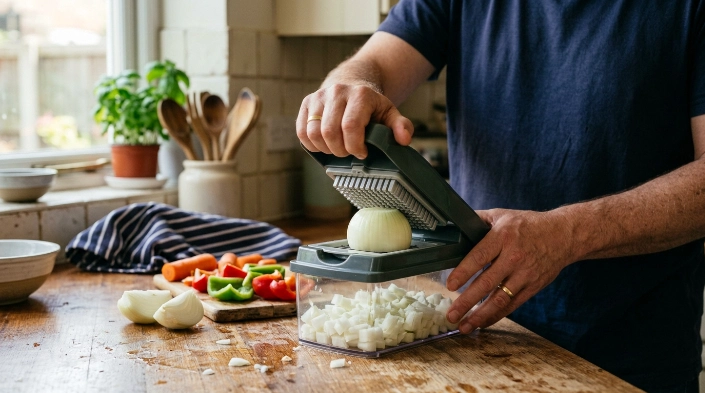
A manual vegetable chopper uses your hand force instead of electricity. That force either pushes food through stationary blades or makes moving blades rotate through the food.
For a typical hinged grid chopper, the process happens in five stages:
- You place the vegetable over the cutting grid. Onion halves, pepper pieces, zucchini, potatoes, and similar foods usually need to be trimmed first.
- You lower the lid. The lid’s pusher section presses evenly across the vegetable.
- Pressure builds against the blade grid. Sharp blade edges begin cutting through the vegetable’s structure.
- The vegetable passes through the openings. The size and shape of each blade opening determine the approximate finished pieces.
- The pieces fall into the container. You can then empty the container without chasing vegetables across the cutting board.
Why does the lid give you more cutting force?
The hinged lid works like a simple lever. Your hand travels through a larger arc while the pusher concentrates that force onto the vegetable and blade grid.
This leverage explains why a crisp onion can pass through the grid with one firm movement. It also explains why a stable base matters so much.
How does a pull-cord vegetable chopper work?
A pull-cord chopper works differently because the food remains inside a bowl. Pulling the handle unwinds a cord that turns a spindle connected to curved chopping blades.
A recoil mechanism draws the cord back after each pull. Repeated pulls send the blades through different parts of the food.
- Few pulls: Produce stays relatively coarse.
- More pulls: Pieces become progressively smaller.
- Too many pulls: Soft ingredients may turn into a wet mince or puree-like mixture.
This design gives you more control over texture than a fixed grid. However, the pieces usually won’t be identical cubes.
How does a push-top chopper work?
A push-top chopper turns vertical hand pressure into blade movement. Depending on the design, each press rotates the cutting blade or moves it downward through the ingredients.
I like this style for garlic, herbs, celery, onions, and smaller batches because you can stop as soon as the texture looks right.
How Does an Electric Vegetable Chopper Work?
An electric vegetable chopper uses a small motor to rotate one or more blades at high speed. Pressing the control sends power to the motor, which transfers rotational force to the blade shaft.
Instead of manually creating each cutting movement, you mainly control how long the blade spins. Short pulses normally give you more control than holding the button continuously.
- Motor: Produces rotational energy.
- Drive shaft: Transfers rotation from the motor to the blade assembly.
- Blade: Sweeps through the ingredients repeatedly.
- Bowl: Keeps ingredients contained around the blade path.
- Lid or safety interlock: On many models, the machine cannot run unless parts are positioned correctly.
Electric models work especially well when you need a fine chop. They can also go too far quickly, so pulsing is usually better for vegetables that release a lot of water.
Why Does a Grid Chopper Make Pieces Look So Even?
A grid chopper produces consistent pieces because every section of food passes through openings with the same dimensions. The blade geometry controls the width and length of each cut.
The vegetable’s starting shape still matters. A flat onion section tends to cut more evenly than an awkward rounded chunk.
- Small grid: Better for salsa, toppings, relishes, and fine diced onions.
- Large grid: Better for soups, stews, roasting vegetables, and chunky salads.
- Slicing insert: Produces flat slices rather than cubes.
- Julienne insert: Creates narrow strips for salads and stir-fries.
Many multi-function choppers combine several inserts. Models such as Fullstar’s current Original Chopper range use interchangeable stainless steel blade inserts for different cuts.
Which Vegetables Work Best in a Vegetable Chopper?
Firm vegetables with enough structure to hold their shape tend to give the cleanest results. Fresh produce is also easier to work with, so I inspect firmness before starting and follow the same principles I use when choosing fresh vegetables at the market.
| Ingredient | Best Chopper Type | Typical Result | Prep Tip |
|---|---|---|---|
| Onion | Grid, pull-cord, or push-top | Dice or mince | Quarter large onions first |
| Bell pepper | Grid chopper | Clean dice | Remove stem and seeds |
| Carrot | Heavy-duty grid or electric | Dice or coarse chop | Slice thick carrots into shorter sections |
| Celery | Grid or rotating blade | Small, crisp pieces | Cut long stalks down first |
| Zucchini | Grid chopper | Soft dice | Avoid excessive pressure |
| Garlic | Push-top or mini electric | Fine chop | Use short pulses |
Using a chopper can also make adding vegetables to everyday dishes more convenient. If you’re trying to increase produce intake, see these practical benefits of vegetables in a daily diet.
How Do You Use a Vegetable Chopper Safely?
Start by washing produce and setting the chopper on a stable surface. The FDA recommends rinsing fresh fruits and vegetables under running water before cutting them and keeping produce away from surfaces contaminated by raw meat.
You can review the FDA’s produce safety guidance for more detailed handling advice.
- Wash the produce. Remove visible soil and damaged areas before cutting.
- Trim oversized pieces. Don’t expect a small grid to split an entire large potato or onion.
- Install the correct blade. Make sure removable inserts sit securely in their frame.
- Place the chopper on a level counter. Anti-slip feet only help when they contact a clean, dry surface.
- Keep fingers above the blade area. Use the lid, food holder, or supplied guard instead of pushing food by hand.
- Apply controlled pressure. Don’t slam the lid if the food resists strongly.
- Stop if something jams. Open the unit and reduce the ingredient size rather than applying extreme force.
The blades deserve the same respect as a kitchen knife. My broader kitchen safety tips for home cooks cover safe handling habits for other sharp tools as well.
Why Does My Vegetable Chopper Get Stuck?
A chopper usually jams because the ingredient is too large, too hard, poorly positioned, or packed into the blade openings. A dull or clogged blade also requires much more force.
- Large onion half won’t pass: Cut it into quarters and try again.
- Raw sweet potato feels impossible: Use smaller sections or a knife if your chopper isn’t designed for very hard produce.
- Food stays inside the grid: Use the supplied cleaning comb instead of your fingers.
- Pieces become mushy: Reduce the number of pulls or electric pulses.
- Chopper slides: Dry both the countertop and the base.
- Blade cuts poorly: Inspect it for damage, bending, or food trapped around the cutting edges.
Forcing a kitchen tool is one of those habits that creates avoidable frustration. It’s worth checking other common cooking mistakes and how to avoid them when prep feels harder than it should.
Vegetable Chopper vs Knife vs Food Processor: What’s the Difference?
A vegetable chopper doesn’t completely replace a knife or food processor. Each tool is strongest at a different type of prep.
| Tool | Power Source | Best At | Cut Control | Cleanup |
|---|---|---|---|---|
| Grid chopper | Hand pressure | Uniform dice | Determined by insert | Moderate |
| Pull-cord chopper | Hand pull | Coarse to fine chopping | Controlled by number of pulls | Usually easy |
| Electric mini chopper | Electric motor | Fast fine chopping | Controlled by pulse duration | Moderate |
| Chef’s knife | Hand movement | Almost every cutting shape | Highest with practice | Lowest |
| Full-size food processor | Electric motor | Large batches, slicing, shredding, pureeing | Attachment dependent | Highest |
I reach for a grid chopper when consistency matters more than creative knife cuts. For one tomato or a few herbs, a knife is often faster once cleanup is included.
How Should You Clean a Vegetable Chopper?
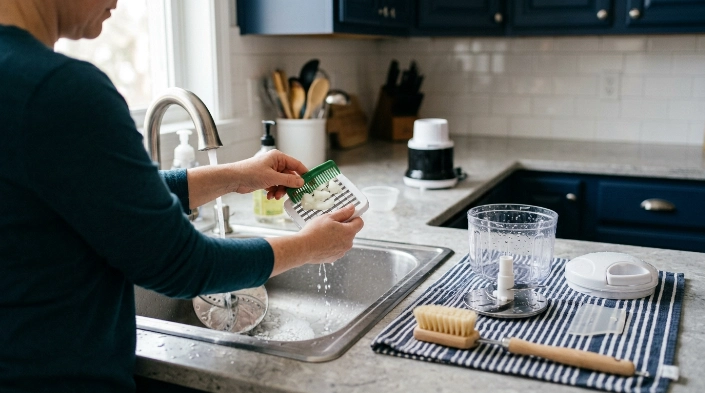
Take the chopper apart as soon as practical because dried onion, herbs, and vegetable fibers are harder to remove later. Keep your fingers away from exposed blade edges throughout the process.
The USDA emphasizes keeping utensils and food-contact surfaces clean as part of its basic food-safety guidance.
- Remove loose food first: Empty the container and shake away larger pieces.
- Use the cleaning tool: Many grid choppers include a comb designed to clear the pusher teeth.
- Wash removable parts: Follow the manufacturer’s dishwasher or hand-washing instructions.
- Clean blade inserts carefully: Brush away from the sharp edge rather than toward your hand.
- Dry before storage: Don’t trap moisture around metal blades or enclosed mechanisms.
- Keep electric motor housings dry: Never immerse powered sections unless the manufacturer specifically says they are waterproof.
Are Vegetable Choppers Worth Using?
A vegetable chopper makes the most sense when you repeat the same cut many times. Meal prep, salsa, soups, stir-fries, omelets, salads, and large family dinners are good examples.
The biggest advantage isn’t that it can do something a knife cannot. It’s that a suitable chopper can make repetitive sizing easier and more consistent.
- Worth it for: Frequent onion prep, batch cooking, salads, soups, meal prep, and users who want consistent dice.
- Less useful for: Tiny jobs, irregular decorative cuts, or kitchens with very limited storage space.
- Consider carefully: Blade cleaning, replacement inserts, container size, counter stability, and the hardness of foods you usually prepare.
If you’re ready to pick one, these are three designs I’d consider for different chopping styles:
🏆 Best for uniform dicing
Fullstar The Original Chopper 4-in-1
★★★★☆ 4.6/5
This manual model uses interchangeable stainless steel blade inserts and a catch container. I like this style when I want onions, peppers, or zucchini to come out in a repeatable dice rather than a random chop.
🥕 Best multi-blade option
Mueller 6-Blade Compact Vegetable Chopper
★★★★☆ 4.5/5
Mueller’s compact model includes six cutting options and a built-in container. I’d choose this format when several cut styles matter but I still want a manual tool that doesn’t occupy food-processor space.
🥗 Best for small batches
OXO Good Grips Chopper
★★★★☆ 4.4/5
This design uses a stainless steel blade that rotates each time you press the top knob. I prefer this mechanism for herbs, onions, celery, nuts, and other small jobs where I want to control texture press by press.
Frequently Asked Questions
Does a vegetable chopper actually cut vegetables or crush them?
A sharp vegetable chopper cuts food rather than simply crushing it. Grid models shear the vegetable as it passes through sharpened openings, while rotating models slice repeatedly with moving blades.
Soft or overripe produce can still become crushed if you apply too much force.
Can a vegetable chopper cut potatoes and carrots?
Many sturdy choppers can handle carrots and potatoes when they are cut into reasonably sized sections first. However, hard produce creates much more resistance than onions or peppers.
Follow your manufacturer’s limits instead of forcing a blade that is bending or refusing to move.
Why do onions sometimes get stuck in a vegetable chopper?
Onion layers can wedge between narrow grid blades, especially when the onion half is oversized or placed unevenly. Cutting it into smaller sections and positioning the flat side against the grid usually helps.
Clear remaining pieces with the supplied cleaning comb rather than your fingers.
Is a vegetable chopper better than a food processor?
Neither tool is better for every job. A grid chopper is excellent for uniform cubes, while a food processor handles larger batches and jobs such as shredding, pureeing, and continuous slicing more efficiently.
A manual chopper also avoids plugging in a large appliance for a small amount of produce.
Can I put a vegetable chopper in the dishwasher?
Some choppers have dishwasher-safe bowls, lids, and blade inserts, but this varies by model. Always check the manufacturer’s care instructions before putting sharp inserts or mechanical lids in the dishwasher.
Electric motor housings should normally stay out of water completely.
Final Takeaway
A vegetable chopper works by converting hand pressure, pulling motion, repeated pressing, or motor power into movement at a sharp blade. Grid models force produce through fixed openings, while rotating models move blades repeatedly through ingredients.
The best design depends on the result you want. Choose a grid for uniform dice, a rotating manual chopper for adjustable texture, or an electric model when speed and fine chopping matter most.
Prepare ingredients in manageable pieces, keep the blades clean, and never solve a jam by forcing the mechanism. With those habits, a vegetable chopper can become one of the simplest ways to make everyday vegetable prep quicker and more consistent.