Electric Vegetable Chopper Types: 6 Designs Explained

Quick Answer
The main electric vegetable chopper types are mini bowl choppers, stack-and-press models, multi-speed choppers, cordless rechargeable choppers, glass-bowl choppers, and compact food-processor-style machines. Each creates a different balance of capacity, control, portability, and versatility, so understanding what a vegetable chopper can do makes choosing the right type much easier.
The six main types
- Mini bowl chopper: Compact and useful for onions, garlic, herbs, nuts, and small batches.
- Stack-and-press: Starts when you press the lid, making pulsed chopping quick and simple.
- Multi-speed chopper: Offers extra texture control for chopping, mixing, and puréeing.
- Cordless chopper: Uses a rechargeable battery and works without staying beside an outlet.
- Glass-bowl chopper: Uses a heavier bowl that resists staining and odor absorption.
- Processor-style chopper: Provides larger capacity and more functions for bigger prep jobs.
I used to group every powered vegetable chopper into one category. That becomes confusing once you compare a tiny onion chopper with a five-cup cordless model or a nine-cup food processor.
As of 2026, I find it more useful to classify these machines by how they operate. This guide explains the differences, ideal uses, limitations, and features that matter before you buy.
What Is an Electric Vegetable Chopper?
An electric vegetable chopper is a powered kitchen appliance that spins one or more blades inside a bowl to reduce vegetables into smaller pieces. Most models rely on short pulses instead of forcing food through a fixed dicing grid.
Definition: An electric vegetable chopper is a compact motor-driven food-prep appliance designed primarily for chopping, mincing, mixing, and sometimes puréeing small or medium batches of ingredients.
That distinction matters because a rotating blade does not normally create perfect cubes. It repeatedly strikes the food, so longer processing produces progressively finer pieces.
- Short pulses: Better for coarse onions, peppers, celery, and nuts.
- More pulses: Useful for finer garlic, herbs, and aromatics.
- Continuous processing: Can move soft ingredients toward a paste or purée when the appliance supports it.
- Liquid-friendly models: May also mix dressings, dips, and sauces.
What Are the Main Electric Vegetable Chopper Types?
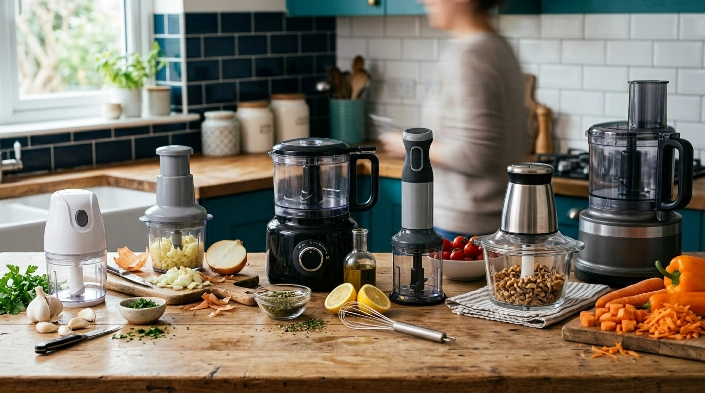
Electric vegetable choppers can be divided into six useful groups. The categories overlap, but each design solves a slightly different kitchen problem.
1. Mini Countertop Bowl Choppers
A mini countertop chopper is the classic small electric vegetable chopper. A motor powers a blade inside a compact work bowl, while a button or lid controls the chopping action.
The Ninja Express Chop NJ100 is a good example of this format. It uses a 2-cup bowl, a 200-watt motor, and one-touch pulsing.
- Best for: Garlic, onions, herbs, nuts, peppers, and small salsa batches.
- Main advantage: Small footprint and fast setup.
- Main limitation: Small bowls require several batches when meal prepping.
- Texture: Coarse to finely chopped depending on pulse time.
I like this category when the alternative is getting out a full-size processor for one onion. The smaller bowl also keeps lightweight ingredients closer to the blades.
2. Stack-and-Press Electric Choppers
A stack-and-press chopper removes much of the button-panel complexity. You assemble the bowl and lid, then press downward to activate the motor.
The Hamilton Beach Stack & Press 3 Cup Food Chopper uses a 3-cup bowl and 350-watt motor. Pressing the lid activates chopping, while releasing it stops the blade.
- Best for: Everyday onions, carrots, herbs, nuts, dips, and dressings.
- Main advantage: Simple pulse control without complicated buttons.
- Main limitation: Your hand usually stays on the lid during operation.
- Good fit for: Beginners who value simple assembly.
This design makes sense when I want quick visual control. I can stop as soon as the pieces reach the texture I need.
3. Multi-Speed Electric Choppers
A multi-speed chopper gives you more control over blade speed or processing mode. That helps when one machine needs to handle both coarse chopping and smoother mixtures.
KitchenAid’s five-cup KFC0516, for example, combines a five-cup work bowl with two speeds, a stainless-steel multipurpose blade, and a whisk accessory.
- Best for: Chopping, mixing, puréeing, sauces, and dressings.
- Main advantage: Better control across different textures.
- Main limitation: More features may mean a slightly larger appliance.
- Good fit for: Cooks who want more than basic onion chopping.
I would choose this type over a basic single-speed machine when sauces and dips are part of my normal cooking. Extra control matters more there than it does for simple chopped onions.
4. Cordless Rechargeable Vegetable Choppers
A cordless chopper replaces the power cord with a rechargeable battery. You can work on an island, table, or other counter without positioning the machine beside an outlet.
The KitchenAid Cordless 5 Cup Food Chopper uses a rechargeable 12-volt lithium-ion battery. It provides a five-cup bowl and two processing speeds.
- Best for: Kitchens with limited outlets, islands, and flexible prep stations.
- Main advantage: No cord crossing the countertop.
- Main limitation: The battery eventually needs charging.
- Good fit for: Frequent small-to-medium prep jobs.
Cordless convenience is more useful than it sounds when counter space is tight. I would still consider charging habits before choosing it over a permanently powered model.
5. Glass-Bowl Electric Choppers
A glass-bowl chopper uses the same basic rotating-blade concept but replaces the lightweight plastic work bowl with glass. The result feels heavier on the counter and can resist staining or retained odors.
Hamilton Beach’s 72860 Stack & Press model is an example of this design, using a three-cup glass bowl. That particular model is no longer a current recommendation, but it illustrates the category clearly.
- Best for: Onions, herbs, sauces, and ingredients likely to stain plastic.
- Main advantage: Glass resists many food odors and discoloration.
- Main limitation: Glass weighs more and can break if dropped.
- Good fit for: Cooks who dislike stained plastic work bowls.
I would treat bowl material as a secondary decision. Blade design, capacity, controls, and cleaning convenience still affect daily usefulness more.
6. Compact Food-Processor-Style Choppers
The largest end of the category blends into compact food processors. These machines may add slicing discs, shredding functions, presets, dough blades, or substantially larger bowls.
A model such as the Ninja Professional Plus BN601 uses a nine-cup bowl and four preset processing programs. That is far beyond a two-cup mini chopper, even though both can chop vegetables.
- Best for: Large families, batch cooking, shredding, slicing, and bigger recipes.
- Main advantage: Greater capacity and wider processing range.
- Main limitation: More counter space, parts, and cleaning.
- Good fit for: People who want one larger prep appliance instead of several small tools.
How Do Electric Vegetable Chopper Types Compare?
The easiest way to see the differences is to compare real designs. Capacity and controls often tell you more about daily use than marketing labels do.
| Type | Example | Capacity | Control / Power | Best Use |
|---|---|---|---|---|
| Mini bowl | Ninja Express Chop NJ100 | 2 cups | 200 W, one-touch pulse | Small chopping jobs |
| Stack-and-press | Hamilton Beach 72790 | 3 cups | 350 W, press-lid control | Simple everyday prep |
| Multi-speed | KitchenAid KFC0516 | 5 cups | 2 speeds | Chopping plus mixing |
| Cordless | KitchenAid KFCB519 | 5 cups | 12 V rechargeable, 2 speeds | Flexible countertop use |
| Glass bowl | Hamilton Beach 72860 | 3 cups | Stack-and-press | Odor- and stain-resistant bowl |
| Processor-style | Ninja Professional Plus BN601 | 9 cups | 4 preset programs | Large-batch processing |
Which Electric Vegetable Chopper Type Should You Choose?
Choose according to your normal batch size and desired texture. A larger machine is not automatically more useful if most of your jobs involve half an onion and two garlic cloves.
I also consider whether a vegetable chopper saves time across the whole job. Setup and washing count just as much as the few seconds the blade is spinning.
- Choose a 2-3 cup mini chopper for garlic, herbs, onions, nuts, and small recipes.
- Choose stack-and-press when simple pulsing matters more than extra settings.
- Choose a 4-5 cup multi-speed model for everyday vegetables, dips, dressings, and family cooking.
- Choose cordless if outlet placement regularly limits where you prepare food.
- Choose a glass bowl when staining, odors, or plastic bowls bother you.
- Choose processor-style for larger batches, shredding, slicing, and broader meal prep.
Electric Chopper vs Food Processor: What’s the Difference?
An electric chopper is usually smaller and focused on chopping, mincing, mixing, and small purées. A food processor normally offers greater capacity and more attachments for slicing, shredding, kneading, or larger batches.
The difference becomes clearer when you compare the entire prep setup, just as it does in a vegetable chopper vs knife comparison. Each tool becomes faster when the job matches its strengths.
- Electric mini chopper: Better for small quantities and quick cleanup.
- Food processor: Better for larger batches and attachment-based tasks.
- Chopper bowl: Often compact enough for cabinets or small counters.
- Processor bowl: Usually takes more storage space but handles more food at once.
For me, the dividing line is simple. If I mainly need onions, garlic, herbs, sauces, or a few cups of vegetables, the mini chopper is easier to justify.
What Foods Work Best in an Electric Vegetable Chopper?
Electric choppers work best with ingredients that can move freely around a rotating blade. Firm vegetables, aromatics, herbs, and nuts are common choices.
If you need meal ideas rather than just ingredients, this guide to what you can make with a vegetable chopper covers practical dishes built around chopped produce.
- Onions: Use short pulses for coarse pieces and more pulses for finer texture.
- Bell peppers: Remove stems, ribs, and seeds before chopping.
- Carrots: Cut thick carrots into manageable chunks first.
- Celery: Works well for soups, stuffing, and aromatic mixtures.
- Garlic: Small choppers make quick work of several cloves.
- Fresh herbs: Pulse briefly to reduce bruising and over-processing.
- Nuts: Stop frequently if you want pieces rather than fine meal.
Very ripe tomatoes and other wet ingredients can become mushy quickly. A rotating blade also cannot promise the neat cubes produced by a fixed dicing grid.
How Do You Use an Electric Vegetable Chopper Safely?
Unplug a corded chopper, or switch off a cordless model, before reaching near its blade. Never use your fingers to clear food from a sharp blade assembly.
The FDA’s produce safety guidance recommends washing fruits and vegetables under running water before preparing them.
- Prepare the produce first. Wash it and remove stems, pits, spoiled areas, or other unsuitable parts.
- Cut oversized pieces down. Large vegetables move more evenly when they fit comfortably inside the bowl.
- Stay below the fill limit. Overfilling can create uneven chopping and strain the appliance.
- Use pulses first. Check the texture before processing further.
- Wait for the blade to stop. Do not open the bowl while components are still moving.
- Remove the blade carefully. Hold it by the non-cutting portion specified by the manufacturer.
- Wash food-contact parts. Follow the manufacturer’s dishwasher or hand-washing instructions.
FoodSafety.gov’s four food-safety steps also emphasize cleaning utensils and surfaces and separating produce from raw meat contamination.
If you buy an older or secondhand appliance, I would also check the CPSC food processor and chopper recall listings. Sharp moving blades make intact lids, locks, and safety mechanisms important.
What Features Matter More Than the Chopper Type?
The category name only tells part of the story. Capacity, controls, blade design, cleaning, and storage usually determine whether you keep using the appliance after the novelty disappears.
Before buying, I would also review the broader vegetable chopper pros and cons. That helps separate useful features from extras that may never leave the cabinet.
- Bowl capacity: Match it to the quantity you normally prepare, not your largest once-a-year recipe.
- Pulse control: Short bursts give better control over texture.
- Removable blade: Makes serving and cleaning easier when designed well.
- Dishwasher-safe parts: Can reduce cleanup, provided the manual allows machine washing.
- Stable base: A chopper should stay firmly planted while the motor runs.
- Pour spout: Helpful when preparing dressings, sauces, or loose mixtures.
- Liquid handling: Check fill limits before using the machine for dips or dressings.
- Storage: Cord wraps and in-bowl accessory storage reduce cabinet clutter.
My buying rule is to prioritize the functions I use every week. A simple three-cup chopper can be more valuable than a feature-packed machine that feels inconvenient to assemble.
Electric Vegetable Choppers I Would Consider
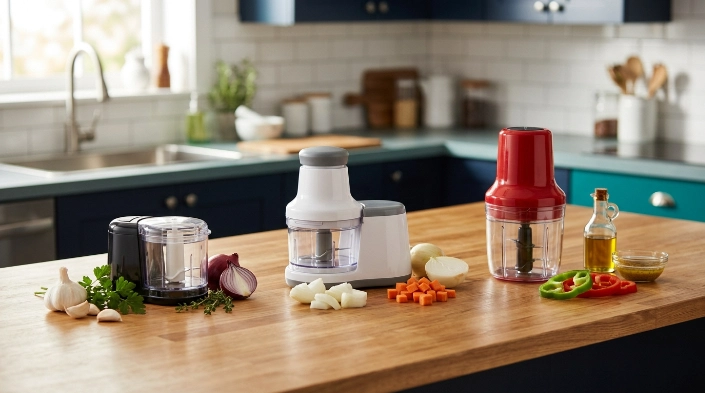
If you’re ready to choose one, these three represent useful electric-chopper styles without jumping straight to a full-size food processor.
🏆 Best Compact
Ninja Express Chop NJ100
★★★★☆ 4.6/5 editorial fit
Its 200-watt motor and 2-cup bowl suit onions, garlic, herbs, nuts, and other small prep jobs. I like this format when compact storage and fast pulsing matter more than batch capacity.
👍 Best Simple Control
Hamilton Beach Stack & Press 3 Cup 72790
★★★★☆ 4.5/5 editorial fit
This model pairs a 3-cup bowl with a 350-watt motor and press-to-pulse lid. I would pick it for straightforward everyday chopping when I don’t need several speed buttons.
🔋 Best Cordless
KitchenAid Cordless 5 Cup KFCB519
★★★★☆ 4.7/5 editorial fit
The five-cup bowl, rechargeable 12-volt lithium-ion battery, and two speeds make it more flexible than a tiny single-speed chopper. I would choose it when cordless counter freedom is a genuine everyday benefit.
Frequently Asked Questions
What type of electric vegetable chopper is best for onions?
A compact bowl chopper or stack-and-press model works well for onions because short pulses provide good texture control. Stop after a few pulses for coarse pieces, or continue gradually when you need a finer chop for sauces or fillings.
Is an electric vegetable chopper the same as a food processor?
No. Electric choppers are generally smaller and focused on chopping, mincing, mixing, and small purées. Food processors normally have larger bowls and may include slicing discs, shredding discs, dough tools, feed chutes, and additional processing functions.
Are cordless electric vegetable choppers powerful enough?
Modern cordless models can handle many normal small-to-medium chopping jobs when used within their manufacturer’s limits. Their main advantage is placement freedom, while corded models avoid charging and may make more sense for frequent extended processing.
Can an electric vegetable chopper make perfectly diced cubes?
Usually not. Most electric choppers use spinning blades, which create chopped pieces rather than fixed-size cubes. For highly uniform cubes, a manual grid chopper or food processor with a dedicated dicing attachment is generally a better match.
What size electric vegetable chopper should I buy?
A 2-3 cup model suits aromatics and small everyday jobs, while a 4-5 cup bowl gives more room for normal family prep. Consider a larger processor-style machine if you routinely prepare big batches or want slicing and shredding functions too.
Final Takeaway: Which Electric Vegetable Chopper Type Is Best?
There is no single electric vegetable chopper type that makes sense for every kitchen. Mini choppers excel at small jobs, stack-and-press models simplify control, multi-speed machines add flexibility, and cordless designs free you from the outlet.
Glass bowls mainly change the feel and cleaning experience, while processor-style machines trade compactness for capacity and versatility. Match the design to the food you prepare most often.
As of 2026, my simplest buying rule is this: choose the smallest, easiest-to-clean machine that comfortably handles your normal batch size. That is the electric chopper you’re most likely to keep using instead of leaving in the cabinet.