
What Is a Cold Press Juicer and How Does It Work?

A cold press juicer is a slow juicer that crushes and presses fruits and vegetables to squeeze out juice, instead of shredding them with a fast-spinning blade. At home, “cold press juicer” usually means a masticating or slow juicer with an auger that turns at about 40 to 100 RPM. It runs quietly, makes little foam, handles leafy greens well and gets a high yield. The “cold” part is about speed: the slow pressing adds very little heat or air to the juice.
This guide explains how a cold press juicer works, how it compares with a centrifugal juicer and with commercial cold-pressed juice, what it is good and bad at, and how to use one step by step.
What Does “Cold Press” Mean?
The term comes from how the juice is extracted. Instead of cutting produce at high speed, a cold press juicer applies slow, steady pressure. Because the machine works slowly, it creates very little friction heat and mixes in less air than a fast juicer.
The name can be a little confusing. The juice is not chilled by the machine, and the produce is not cooled; it simply is not heated much. If you put in room-temperature produce, you get room-temperature juice. Chill your produce first if you want cold juice.
You will see several names used for the same type of home machine:
- Cold press juicer
- Slow juicer
- Masticating juicer
- Auger juicer
How a Cold Press Juicer Works
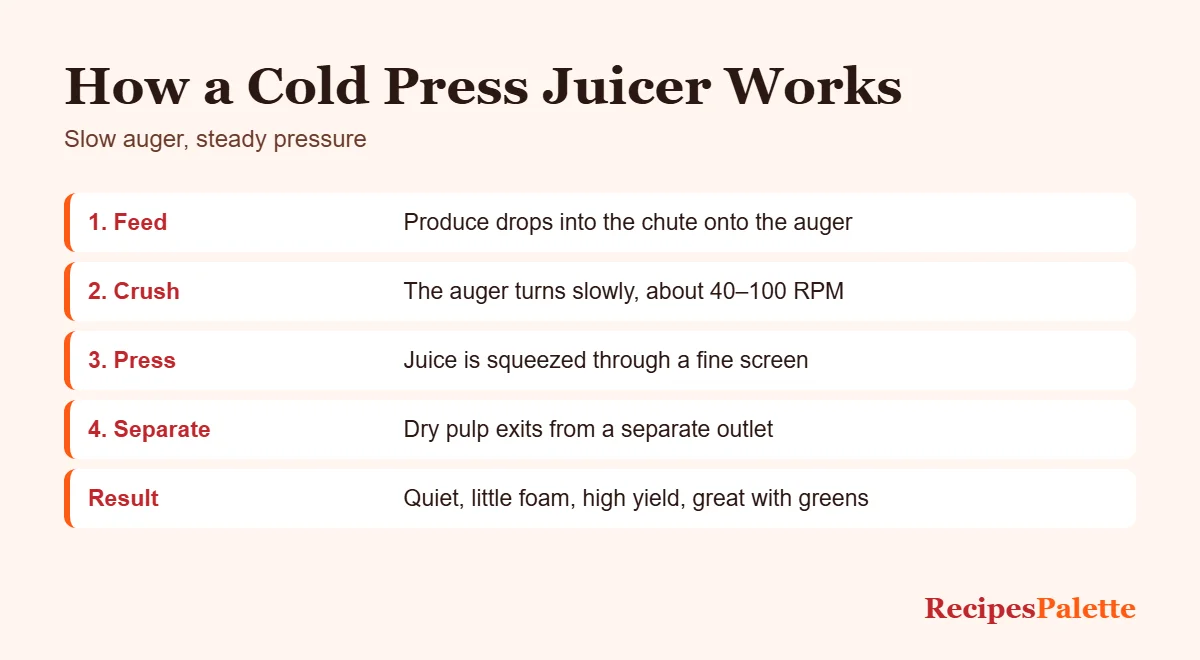
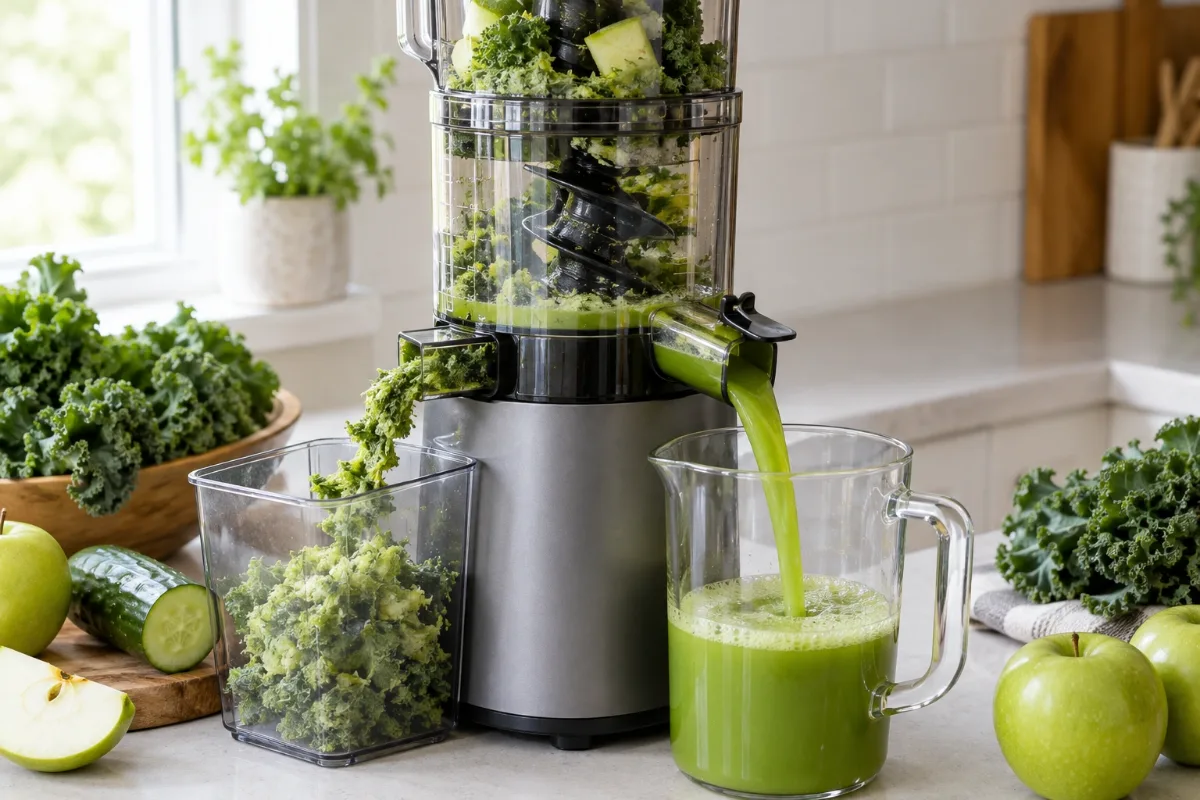
- You feed produce into the chute. Pieces drop or are pushed down onto the auger.
- The auger turns slowly. This thick spiral screw pulls the produce in and crushes it, a bit like chewing (which is where the word “masticating” comes from).
- Juice is pressed through a screen. As the auger squeezes the crushed produce against a fine mesh screen, juice flows through the holes and out of the juice spout.
- Dry pulp is pushed out separately. The fiber that cannot pass the screen is forced along the auger and out of a pulp outlet.
Most home models have a “reverse” button. If the auger jams, usually on stringy celery or overfilled chutes, reversing it for a few seconds clears the blockage.
Vertical vs Horizontal Cold Press Juicers
Vertical
The auger stands upright and gravity helps pull produce down. Vertical models take up less counter space, accept mixed produce easily and often have wider chutes. Many newer models accept whole small apples.
Horizontal
The auger lies on its side. Horizontal models are excellent with leafy greens, herbs and wheatgrass, and often come with attachments for nut butter, pasta or sorbet. They usually have narrow chutes, so you need to cut produce smaller, and they take up more counter length.
Cold Press vs Centrifugal Juicer
| Cold press (slow) | Centrifugal (fast) | |
|---|---|---|
| How it works | Slow auger crushes and presses | Fast blade shreds, spinning basket separates |
| Speed | About 40 to 100 RPM | Several thousand RPM |
| Noise | Quiet | Loud |
| Foam | Little | More |
| Leafy greens and wheatgrass | Excellent | Poor |
| Time per glass | 3 to 5 minutes | About 1 minute |
| Price | Usually higher | Usually lower |
For a full comparison, read masticating vs centrifugal juicer.
Is Home Cold Press Juice the Same as Store-Bought Cold-Pressed Juice?
Not quite. Many commercial cold-pressed juice brands use large hydraulic presses. Produce is ground into a mash, wrapped in filter bags, and pressed between plates under very high pressure. The result is very smooth juice with little pulp.
Many bottled cold-pressed juices are also treated with high pressure processing (HPP) after bottling. HPP uses water pressure to reduce harmful microbes without heat, which gives the juice a longer shelf life. Homemade juice from a slow juicer has not gone through HPP or pasteurization, so it does not keep as long. Drink it fresh, and see how long fresh juice lasts for storage times.
Pros of a Cold Press Juicer
- Great with greens. Spinach, kale, chard, herbs and wheatgrass give far more juice than in a centrifugal machine.
- High yield. Pulp comes out drier, so you get more juice from the same produce.
- Quiet. You can juice early in the morning without waking the house.
- Less foam and separation. Juice looks smoother and stays mixed longer.
- Versatile. Many models make sorbet, nut milk or nut butter.
- Durable. Slow motors often come with long warranties.
Cons of a Cold Press Juicer
- Slower. Juicing takes longer, especially with narrow chutes.
- More prep on older or horizontal models.
- Higher price than basic centrifugal juicers.
- Can jam with stringy celery or if overfed.
- Several parts to clean, including a fine screen.
How to Use a Cold Press Juicer
- Assemble the bowl, screen, auger and lid as the manual shows. Make sure the juice spout is closed or a jug is in place.
- Prep produce. Wash it well. Cut hard produce to fit the chute, and cut celery and leafy stems into 1 to 2-inch pieces so fibers do not wrap around the auger.
- Feed slowly. Add pieces one or two at a time and let the auger pull them in. Do not force produce down with too much pressure.
- Alternate soft and hard. Follow greens and soft fruit with a firm piece, like apple or carrot, to keep things moving.
- Run water through at the end. Pour half a cup of water through while the machine is running to rinse out the last of the juice.
- Clean right away. Take it apart and rinse every part before the pulp dries.
Best Produce for a Cold Press Juicer
- Leafy greens: spinach, kale, romaine, chard
- Herbs: parsley, cilantro, mint, basil
- Wheatgrass
- Apples, pears, carrots, beets, cucumbers, celery
- Ginger and fresh turmeric
- Pineapple, grapes and peeled citrus
Soft fruits like bananas, avocados and very ripe mangoes do not juice well in any juicer. Save them for smoothies. Our green juice recipe is a great first recipe to try in a cold press machine.
How to Clean a Cold Press Juicer
- Unplug the machine and take off the bowl, auger and screen.
- Rinse each part under warm running water.
- Scrub the screen with the rotating brush or a stiff brush, inside and out.
- Wash with warm soapy water, rinse and air dry.
- Once every week or two, soak the screen in warm water with a little vinegar or baking soda to remove buildup.
Never put the motor base in water. Wipe it with a damp cloth.
Is a Cold Press Juicer Worth It?
It is worth it if you plan to juice regularly, especially green juices, and you value quiet operation and high yield. If you mostly juice carrots and apples a couple of times a week, a centrifugal juicer may be enough. If you are not sure you will juice often, start with a blender and strainer; see juicer vs blender and juicing for beginners.
Common Myths About Cold Press Juicers
- “Cold press juice is cold.” Not exactly. The juicer simply does not heat the juice much. The juice comes out close to the temperature of your produce, so chill produce first if you want cold juice.
- “A cold press juicer makes juice last for days.” Home juice from any juicer is unpasteurized. It may look fresh a little longer, but you should still store it cold and drink it soon.
- “It is the only way to make good juice.” Centrifugal juicers and blenders also make good juice. The main differences are yield from greens, foam, noise and speed.
- “More expensive means more juice.” Price often buys a wider chute, longer warranty or quieter motor rather than a big jump in yield.
Frequently Asked Questions
What is the difference between a cold press juicer and a regular juicer?
A cold press juicer squeezes produce slowly with an auger. A regular (centrifugal) juicer shreds it with a fast blade and spins the juice out. Cold press machines are quieter, better with greens and give higher yield; centrifugal machines are faster and cheaper.
Is a masticating juicer the same as a cold press juicer?
Yes, for home machines. Both names describe slow juicers that use an auger.
Does cold press juice last longer?
Homemade cold press juice often keeps its color and flavor a little longer than centrifugal juice because it has less air in it. It is still unpasteurized, so drink it within about 24 hours for best quality, and no more than 48 to 72 hours if stored well.
Can you put whole fruit in a cold press juicer?
Some vertical models with wide chutes accept whole small apples or oranges. Most need produce cut into pieces. Always remove large pits and peel citrus.
Can a cold press juicer make smoothies?
No. It separates juice from pulp. For smoothies, use a blender.
Why is my cold press juicer jamming?
Usually because pieces are too large, celery is cut too long, or produce is fed in too quickly. Use the reverse button, cut produce smaller and feed it slowly.
A cold press juicer is a patient machine: feed it slowly and it rewards you with smooth, quiet, high-yield juice, especially from greens.