What Are Dish Racks Called? Common Names and Types Explained

Quick Answer
Dish racks are most commonly called dish racks, dish drying racks, or dish drainers. These names usually describe the same basic kitchen tool, although some designs focus more on drainage, storage, or saving counter space. You can also see what a dish rack is used for if you want a deeper look at its everyday functions.
Common names you’ll see
- Dish rack: The simple, general name for a rack that holds wet dishes.
- Dish drying rack: A more descriptive name that clearly explains its drying purpose.
- Dish drainer: A common alternative that emphasizes draining water from washed dishes.
- Draining rack: Another name sometimes used for racks positioned beside a sink.
- Over-the-sink rack: A rack designed to let water drain directly into the sink.
- Drainboard: The tray or flat draining surface beneath or beside the rack, not usually the rack itself.
Easy rule to remember
- If it holds clean dishes upright while they dry, calling it a dish rack or dish drying rack is almost always correct.
If you’ve searched online for the rack beside your kitchen sink, you’ve probably noticed several different names. I find that confusing until you realize most of those terms describe the same basic tool.
The differences usually come from the rack’s design or drainage method. Here is how I separate the terms so you can recognize exactly what a store, manufacturer, or kitchen guide is talking about.
What Are Dish Racks Called?
A dish rack is commonly called a dish drying rack, dish drainer, or simply a drying rack. All three names can refer to a rack that supports freshly washed dishes while they drain and air-dry.
Simple definition: A dish rack is an elevated kitchen organizer that keeps washed plates, bowls, cups, utensils, and similar items separated while excess water drains and the surfaces dry.
Dish rack is the broadest term. You can use it for countertop, folding, two-tier, in-sink, and over-the-sink models.
Dish drying rack means essentially the same thing. Adding “drying” simply makes the purpose clearer, especially in online searches and product listings.
| Name | What It Usually Means | Best Context |
|---|---|---|
| Dish rack | General rack for holding wet dishes | Everyday conversation |
| Dish drying rack | Rack specifically described by its drying function | Shopping and product searches |
| Dish drainer | Rack that lets water drain from washed dishes | Sink-side drying setups |
| Draining rack | General rack designed for drainage | Kitchen retail descriptions |
| Plate rack | Rack mainly supporting plates upright | Drying, storage, or display |
| Drainboard | Tray or draining surface that catches water | Under or beside a rack |
Is a Dish Rack the Same as a Dish Drainer?
Yes, dish rack and dish drainer are usually interchangeable terms. Both commonly describe the place where clean, wet dishes sit after hand washing.
The word “drainer” puts more attention on removing water. A product marketed as a dish drainer may therefore include a drainage tray, angled base, or spout.
- Dish rack: Focuses on supporting and organizing dishes.
- Dish drainer: Focuses on letting water drain away.
- Dish drying rack: Focuses on the entire drying process.
In practical use, I wouldn’t worry about choosing the “correct” one. Search all three terms when shopping because manufacturers may label similar products differently.
What Is the Tray Under a Dish Rack Called?
The tray underneath a dish rack is normally called a drainboard, drainage tray, drain tray, or drip tray. Its job is to catch water that falls from wet dishes.
Some drainboards collect water until you empty them. Others slope toward the sink or connect to a drainage spout.
- Drainboard: A broad term for a draining surface beside or beneath dishes.
- Drain tray: A removable tray placed under a rack.
- Drip tray: A tray designed to catch dripping water.
- Drainage board: Another descriptive variation used for the same basic purpose.
A rack with efficient drainage is easier to manage because water does not remain pooled beneath the dishes. Standing water also means another wet surface you’ll need to clean regularly.
What Do You Call a Dish Rack That Goes Over the Sink?
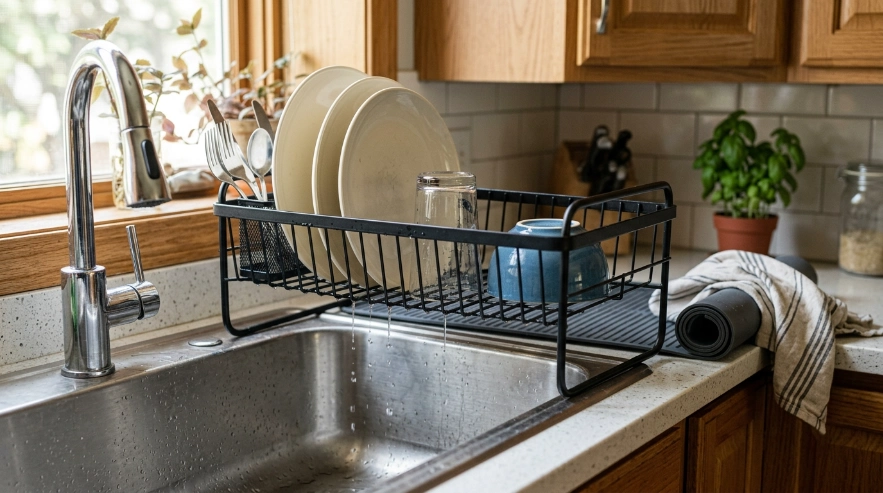
A rack positioned across or above the sink is usually called an over-the-sink dish rack or over-sink drying rack. The main advantage is direct drainage into the basin.
These designs can be especially useful when counter space is limited. The same space-saving idea matters when choosing other appliances for a small kitchen with limited counter space.
Common over-sink styles
- Fixed over-sink rack: A rigid rack resting across the sink.
- Expandable rack: Adjustable arms allow it to fit different sink widths.
- Roll-up drying rack: Silicone-coated bars roll out across the basin and roll up for storage.
- Bridge-style rack: A larger structure stands over and around the sink.
- In-sink rack: The rack sits lower, partly or completely inside the basin.
I like over-sink designs when every inch of counter matters. Their biggest limitation is that they can compete with the faucet or reduce usable sink space.
Is a Plate Rack the Same Thing as a Dish Rack?
Not always. A plate rack can mean a drying rack, but it can also mean permanent storage designed to hold dry plates vertically.
Context tells you which type you’re looking at. A plate rack inside a cabinet or mounted on a wall is usually intended for storage or display.
- Drying plate rack: Holds wet plates after washing.
- Cabinet plate rack: Organizes clean, dry plates.
- Display plate rack: Keeps decorative dishes visible.
The same distinction applies to cookware. Heavy pans need more support than ordinary dinner plates, which is why a dedicated cast iron skillet storage rack is better for long-term storage than a lightweight dish drainer.
What Is a Dishwasher Rack?
A dishwasher rack is different from a countertop dish rack. It is the sliding structure inside a dishwasher that holds plates, glasses, cookware, and utensils during a wash cycle.
This distinction matters when searching online. Typing only “dish rack replacement” may produce dishwasher parts instead of a countertop drying rack.
| Feature | Dish Drying Rack | Dishwasher Rack |
|---|---|---|
| Location | Beside, over, or inside sink | Inside dishwasher |
| Main purpose | Draining and air-drying | Holding items during machine washing |
| Portable | Usually | No, except for removal or servicing |
What Types of Dish Drying Racks Are There?
Dish drying racks are named partly by their shape and location. As of 2026, countertop, foldable, two-tier, compact, in-sink, and over-the-sink designs are easy to find.
The best name to search depends on where you want the rack to sit and how many dishes you normally wash.
- Countertop dish rack: Traditional option positioned beside the sink.
- Two-tier dish rack: Uses vertical space for more drying capacity.
- Compact dish rack: Smaller footprint for apartments and limited counters.
- Foldable dish rack: Collapses or folds when you want the counter back.
- Over-the-sink rack: Positions wet dishes above the sink.
- In-sink dish rack: Fits inside the sink basin.
- Roll-up drying rack: Flexible bars roll across the sink and store compactly.
- Bottle drying rack: Uses pegs or supports designed around bottles and narrow items.
What Should You Look for in a Dish Drying Rack?
Choose a dish drying rack based on capacity, drainage, stability, available space, and cleaning access. A beautiful rack becomes frustrating if water pools underneath it or your normal plates do not fit.
I would measure the available area before comparing materials or colors. A few inches can decide whether a rack fits comfortably beside the sink.
- Measure the footprint: Check both counter width and depth.
- Check plate spacing: Slots should support your everyday dishes without squeezing them together.
- Look at drainage: A sloped tray or spout can direct water toward the sink.
- Check stability: Non-slip feet help a loaded rack stay secure.
- Inspect the utensil cup: Removable sections are easier to wash.
- Consider storage: Foldable designs work well when the counter serves multiple purposes.
- Match the weight: Heavy cookware needs a sturdier rack than cups and plates.
If large pans are creating most of your storage problems, a drying rack may not solve the whole issue. A dedicated frying pan organizer can keep dry cookware out of the sink area.
How Do You Keep a Dish Rack Clean?

Wash the rack regularly and prevent water from sitting in its tray for long periods. Moisture, soap residue, food particles, and mineral deposits can collect around joints and drainage channels.
The FDA’s safe food handling guidance recommends washing dishes, utensils, cutting boards, and counters with hot, soapy water after food preparation.
- Remove dishes and detachable accessories.
- Empty water from the drainage tray.
- Wash the rack with warm water and dish soap.
- Scrub corners, joints, feet, slots, and utensil holders.
- Rinse away loosened residue and soap.
- Allow the rack and tray to dry before reloading them.
The USDA’s kitchen sink guidance also emphasizes cleaning, sanitizing when appropriate, and allowing surfaces to air-dry. The CDC’s household cleaning guidance likewise discusses thorough air-drying after sanitizing appropriate items.
For broader household cleaning practices, the American Cleaning Institute’s cleaning guidance is another useful reference. Always follow the rack manufacturer’s care instructions when dealing with coated metal, wood, silicone, or dishwasher-safe parts.
Metal cookware deserves special attention because trapped moisture can cause other problems. If you use cast iron, understanding why cast iron skillets develop rust helps explain why thorough drying matters.
Which Dish Rack Name Should You Search for When Shopping?
Start with dish drying rack because it clearly describes the product you want. Add a design word such as compact, foldable, two-tier, or over-the-sink to narrow the results.
- For a standard model: dish drying rack
- For direct drainage: dish drainer with drainboard
- For a small kitchen: compact dish rack
- For vertical capacity: two-tier dish drying rack
- For sink placement: over-the-sink dish rack
- For easy storage: foldable dish rack
- For a flexible sink cover: roll-up drying rack
If you’re ready to pick one, these are three practical styles I would consider for different kitchen setups:
🏆 BEST PREMIUM
simplehuman Steel Frame Dishrack
★★★★★ 4.8/5
This steel-frame design includes an integrated drainage system with a swivel spout and dedicated glass storage. I like this format for frequent hand washing when the rack will stay beside the sink every day.
📦 BEST FOLDABLE
OXO Good Grips Foldaway Dish Rack
★★★★★ 4.7/5
The plate section folds down for larger pieces, while a cup rack and drainage spout help organize everyday loads. I would choose this style when you need useful capacity without committing permanently to a bulky countertop rack.
🏠 BEST FOR EASY STORAGE
OXO Good Grips Aluminum Fold Flat Dish Rack
★★★★☆ 4.6/5
Its aluminum frame uses a two-level layout, removable utensil cup, and fold-flat construction. I like it for multipurpose counters because you can create a drying station when needed and reclaim the space afterward.
Frequently Asked Questions
What is another name for a dish rack?
Another name for a dish rack is a dish drying rack or dish drainer. You may also see drying rack, draining rack, or plate rack, although those broader terms can describe other products too.
What do you call the thing you put dishes in to dry?
The thing used to hold washed dishes while they dry is normally called a dish rack, dish drying rack, or dish drainer. A model with a tray beneath it may also be described as a dish drainer with a drainboard.
What is a drainboard for dishes?
A drainboard is the surface or tray where water drains from washed dishes. It may be built into a sink, placed underneath a separate dish rack, or designed with a slope that directs water toward the sink.
What is an over-the-sink dish rack called?
It is usually called an over-the-sink dish rack, over-sink drying rack, or sink drying rack. Flexible versions made from parallel bars are commonly described as roll-up drying racks.
Are dish rack and dishwasher rack the same thing?
No. A dish rack normally sits beside or over a sink for air-drying hand-washed items, while a dishwasher rack is the removable or sliding structure inside a dishwasher that holds dishes during the machine’s wash cycle.
Final Takeaway
So, what are dish racks called? The three names worth remembering are dish rack, dish drying rack, and dish drainer.
Other names usually describe a specific feature. An over-the-sink rack saves counter space, a two-tier rack adds capacity, and a drainboard catches or directs water.
If you’re shopping, start with “dish drying rack” and add the feature you need. That simple wording usually makes it much easier to find the right design for your sink, counter space, and daily dish load.