
What Are the Differences Between a Dish Mat and a Dish Rack?

I used to think a dish mat and a dish rack did almost the same job. Both hold wet dishes, so the choice seemed mostly cosmetic.
The difference becomes clearer when you look at how much you wash, what you wash, and how much counter space you can spare. My practical rule is simple: small flexible loads favor a mat, while regular mixed loads favor a rack.
What Is a Dish Mat?
A dish mat is a flat surface designed to hold freshly washed kitchenware while it air dries. Most versions use microfiber, silicone, foam, stone, or another water-managing material.
The simple shape is its biggest advantage. You can place glasses, mugs, bowls, cutting boards, and cookware directly on it without dealing with slots or dividers.
- Microfiber mats: Absorb water and feel soft under delicate glassware.
- Silicone mats: Use raised ridges to create airflow and keep dishes above pooled water.
- Stone mats: Absorb moisture into a firm mineral surface.
- Hybrid mats: Combine a fabric mat with a small removable rack.
A mat also gives you freedom with awkward items. A large skillet or mixing bowl can sit flat without fighting against plate slots.
What Is a Dish Rack?
A dish rack is a structured frame that holds wet dishes in separated positions while they dry. Many models include plate slots, utensil cups, cup holders, and drainage trays.
The structure helps when you have many different items. Plates can stand vertically while bowls, mugs, forks, and spoons stay in their own areas.
- Countertop racks: Sit beside the sink and often use a drain board.
- Over-sink racks: Use space above the sink and let water fall directly below.
- Two-tier racks: Add vertical capacity without using twice the counter area.
- Fold-flat racks: Collapse when you need your counter back.
Good drainage makes a major difference. In its dish-rack testing, Serious Eats found that drainage, stability, and dedicated utensil space were important performance factors.
Dish Mat vs Dish Rack: What Are the Main Differences?
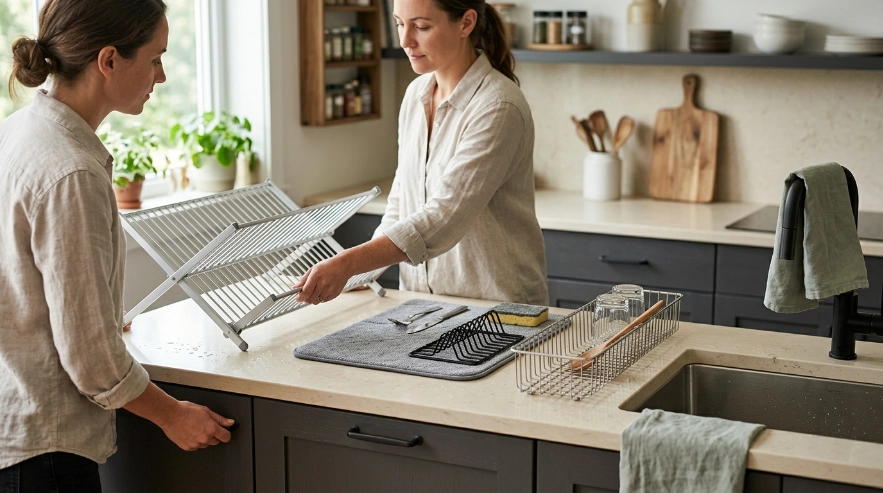
The biggest difference is not simply the material. It is how each product uses space around your dishes.
A mat uses horizontal surface area. A rack adds vertical structure, so more items can often fit within a similar counter zone.
| Feature | Dish Mat | Dish Rack |
|---|---|---|
| Basic design | Flat drying surface | Raised structured frame |
| Best load size | Small to medium | Medium to large |
| Plate organization | Limited | Usually excellent |
| Storage | Often rolls or folds | Depends on rack design |
| Odd-shaped cookware | Easy to place flat | Can interfere with slots |
| Drainage | Absorbs or channels water | Tray, spout, or direct-to-sink designs |
| Representative size | OXO Large Silicone Mat: 16.9 × 12.5 × 0.25 in. | KitchenAid Full-Size Rack: about 20.08 × 14.95 × 6.69 in. |
Those example dimensions show the tradeoff clearly. The rack occupies more three-dimensional space, while the mat stays almost completely flat.
Does a Dish Rack Dry Dishes Faster Than a Dish Mat?
A well-designed rack often gives plates and bowls more open airflow because it holds them vertically and separates their surfaces. A ribbed silicone mat can still dry items effectively when you leave enough space between them.
Problems start when dishes touch each other. Water can become trapped where two surfaces meet, regardless of the product underneath them.
- Leave space between glasses and bowls.
- Turn cups upside down at an angle so water can escape.
- Keep plates separated instead of stacking them flat.
- Empty pooled water from trays and solid mats.
- Let the drying surface itself dry after use.
FoodSafety.gov also recommends washing dishes and utensils with hot, soapy water when appropriate, especially after contact with raw animal foods. Clean dishes still need a clean place to finish drying.
Which Is Better for a Small Kitchen?
A dish mat is usually easier to live with when counter space is tight. You can pull it out when needed and store it after the dishes are dry.
Silicone designs are especially convenient here. For example, OXO states that its large silicone mat can be rolled or hung for storage.
- Choose a mat if you need your counter back after every wash.
- Choose a fold-flat rack if you want plate separation without permanent counter clutter.
- Choose an over-sink rack when your counter is too narrow for either option.
Do not judge space by width alone. Measure the depth between your backsplash and the edge of the counter too.
Which Is Better If You Hand-Wash Most of Your Dishes?
I would choose a rack for a household that regularly hand-washes full meal loads. It gives plates, utensils, glasses, and bowls clearer places to go.
This becomes even more useful when several people use the kitchen. A structured rack reduces the balancing act that can happen when a flat mat fills up.
My practical rule: If you regularly wash four or more place settings at once, start by looking at racks. If you normally wash a couple of mugs, a bowl, and one pan, a mat is often enough.
There is no magic cutoff. The point is to match the drying system to your normal load instead of your biggest holiday cleanup.
Is a Dish Mat Better for Pots and Pans?
A mat can be more convenient for one or two oversized pieces of cookware. There are no narrow plate slots or dividers blocking a large skillet, Dutch oven, or baking dish.
Silicone also gives heavy cookware a softer landing than a bare countertop. Some silicone drying mats can serve a second purpose as heat-resistant resting surfaces.
- Large frying pans
- Mixing bowls
- Baking sheets
- Stockpots
- Cutting boards
A strong rack can still hold cookware well. Just check its usable dimensions and stability before loading heavy pots onto it.
Which Option Is Easier to Clean?
The easiest option depends on its material and number of parts. A simple silicone mat often wins because there are few corners, joints, or removable pieces to scrub.
Racks need attention around trays, feet, utensil cups, joints, and drainage spouts. Those areas can collect residue when water sits there.
- Wash the drying surface regularly with dish soap and water.
- Clean the drain board instead of only cleaning the rack above it.
- Check the manufacturer’s directions before using a dishwasher.
- Dry the rack or mat before storing it.
- Clean underneath the drying station too.
If you are choosing household cleaning products, the EPA Safer Choice program provides information about products made with ingredients that meet its safety criteria.
Can You Use a Dish Mat and Dish Rack Together?
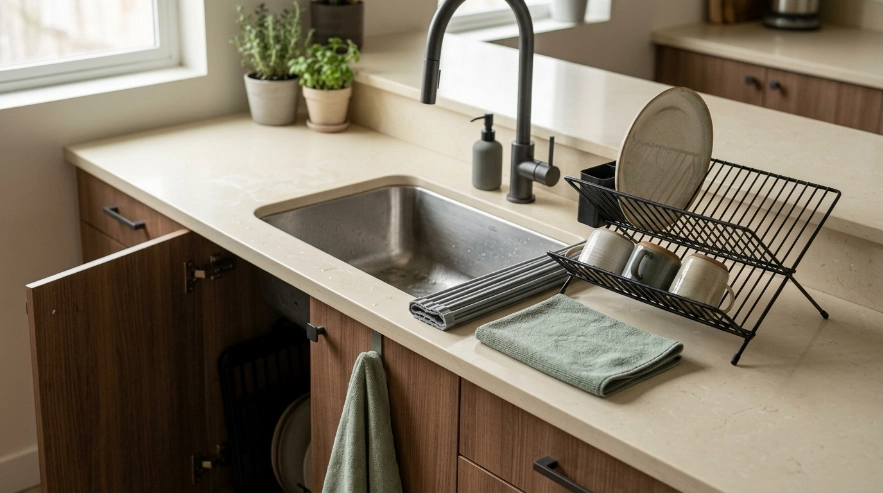
Yes, and this can be the most flexible setup. A mat can catch drips beneath a rack or create extra drying room beside it.
I especially like the combination when cookware is involved. Plates stay organized in the rack while a frying pan or cutting board dries on the mat.
- Rack for plates and utensils
- Mat for pots and pans
- Mat under a rack without a drainage tray
- Extra mat space when guests create a larger dish load
You may not need both every day. The advantage is having flexible overflow space when your normal drying area fills up.
Dish Mat or Dish Rack: Which One Should You Buy?
Choose according to your normal washing routine, not the product that looks most impressive online. Counter space and average dish volume matter more than extra features you may never use.
Choose a dish mat if:
- You have limited counter space.
- You usually wash small loads.
- You dry large pans and bowls often.
- You want something easy to store.
- You prefer fewer parts to clean.
Choose a dish rack if:
- You hand-wash dishes after most meals.
- You need plate and utensil organization.
- You regularly dry several glasses and bowls.
- You want water directed toward the sink.
- You have enough permanent counter space.
As of 2026, there are also many hybrid designs. Fold-flat racks, over-sink racks, and mats with removable plate holders blur the old line between these categories.
If you’re ready to pick one, these are three practical styles I would consider first:
🏠 Best for Small Kitchens
OXO Good Grips Large Silicone Drying Mat
★★★★☆ 4.5/5
This 16.9 × 12.5-inch silicone mat uses raised ribs and can roll or hang for storage. I like this format for smaller kitchens because it disappears much more easily than a full rack.
🏆 Best Everyday Rack
KitchenAid Large Capacity Full Size Dish Rack
★★★★☆ 4.6/5
The full-size design gives plates, bowls, mugs, utensils, and larger cookware dedicated drying space. I would start here for a household that hand-washes a mixed load after most meals.
💧 Best Premium Drainage
simplehuman Steel Frame Dishrack
★★★★½ 4.7/5
Its full-size design includes a swivel drain spout, plate supports, utensil storage, and space for stemware. I would consider it when drainage and organization matter more than saving money or counter space.
Frequently Asked Questions
Is a dish drying mat more hygienic than a dish rack?
Neither option is automatically more hygienic. Cleanliness depends on keeping the drying surface clean, preventing stagnant water, allowing airflow, and letting dishes dry thoroughly before storage.
Can I put a dish rack on top of a drying mat?
Yes. A drying mat can catch drips beneath a rack, especially if the rack has no drain board. Check underneath regularly so moisture does not stay trapped against the countertop.
Do dish drying mats get moldy?
Any drying surface can develop unwanted buildup when it stays wet or dirty for long periods. Wash the mat according to its care instructions and let it dry completely between uses whenever possible.
Are silicone dish mats better than microfiber mats?
Silicone mats are easy to rinse and often use raised ribs for drainage. Microfiber mats absorb more water and provide soft cushioning, but they need regular washing and thorough drying.
Is a dish rack worth the counter space?
A rack is usually worth the space if you hand-wash full meal loads often. If you use a dishwasher for most items and only hand-wash a few pieces, a compact mat may make better use of your counter.
Final Takeaway
The difference between a dish mat and a dish rack comes down to space, structure, and capacity. A mat is simple and flexible, while a rack turns the same general drying job into an organized system.
For a small kitchen or light washing routine, I would start with a mat. For frequent hand-washing and mixed loads, I would choose a stable rack with good drainage.
There is nothing wrong with using both. In many kitchens, a rack for everyday dishes and a roll-up mat for oversized cookware gives you the most useful setup
