
What Is the Best Way to Store Dishes?

Quick Answer
The best way to store dishes is to air-dry them completely, then place them in a clean, dry cabinet close to where you use them. Stack everyday plates and bowls carefully, or use vertical organizers when space is tight; similar kitchen organizers can also help separate awkward cookware and reduce clutter.
Best dish-storage setup
- Dry first: Let plates, bowls, cups, and utensils air-dry completely before putting them away.
- Use cabinets: Keep everyday dishes in an enclosed, clean cabinet whenever practical.
- Keep them close: Store daily dishes near the dishwasher or sink to make unloading easier.
- Avoid overstacking: Divide heavy or delicate dishes into smaller, stable stacks.
- Go vertical: Plate racks and dividers can improve access in narrow cabinets.
- Control moisture: Never close damp dishes inside a cabinet.
My simple rule
- Dry on the rack, organize in the cabinet, and keep your most-used dishes within easy reach.
Dish storage sounds simple until plates start leaning, bowls disappear behind each other, and clean glasses compete for counter space. A good system should protect your dishes while making daily kitchen work easier.
As of 2026, I still prefer a simple approach over complicated organizers. Start with complete drying, choose storage based on how often each item gets used, and avoid buying an organizer until you know what problem it needs to solve.
What Is the Best Way to Store Dishes After Washing?
Let dishes air-dry fully before putting them into an enclosed cabinet. Once dry, move everyday dishes from the drying rack to a clean, protected storage area.
Dish storage is the system you use to keep clean plates, bowls, cups, serving pieces, and similar tableware protected, dry, organized, and accessible between uses.
The washing stage matters because storage cannot fix a dish that was put away dirty or damp. FoodSafety.gov recommends washing dishes, utensils, cutting boards, and countertops with hot, soapy water.
- Wash: Remove food residue with hot, soapy water.
- Rinse: Remove remaining soap and loosened debris.
- Air-dry: Position items so water can drain and air can circulate.
- Check: Make sure bases, rims, and recessed areas feel dry.
- Store: Move dishes into a clean cabinet, shelf, or drawer.
The University of Minnesota Extension also instructs users to let cleaned utensils air-dry on a drying rack rather than manually drying them with a towel in its food-safety guidance.
That supports a useful household habit. Give water somewhere to drain instead of trapping moisture between stacked dishes.
Should Dishes Be Stored in a Cabinet or on a Dish Rack?
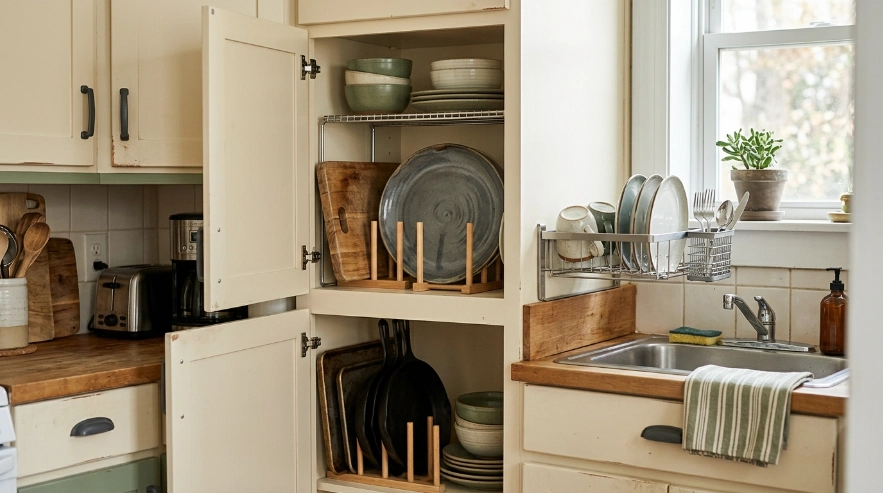
For most homes, cabinets are better for long-term storage while dish racks are better for temporary drying. The distinction keeps your countertop clearer and gives clean dishes more protection.
A drying rack has one important job: hold wet dishes in positions that allow water to drain. Once everything is dry, the rack can be cleared for the next washing cycle.
| Storage Method | Best Use | Counter Space | Protection | My Verdict |
|---|---|---|---|---|
| Enclosed cabinet | Daily plates, bowls, cups | None | High | Best overall |
| Deep drawer | Plates and bowls | None | High | Excellent with dividers |
| Vertical plate rack | Plates and platters | Low if cabinet-mounted | Good | Great for narrow spaces |
| Open shelf | Frequently used dishes | None | Moderate | Convenient but exposed |
| Dish drying rack | Wet dishes | Medium to high | Moderate | Best for drying |
There is one practical exception. If you have no suitable cabinet space and use the same few dishes several times daily, a clean drying rack may double as temporary open storage.
I would still avoid turning it into a permanent pile. Overloading makes individual dishes harder to remove and leaves less room for the next wet load.
How Should You Arrange Plates, Bowls, and Cups?
Group dishes by type and frequency of use. Everyday pieces should occupy the easiest shelves, while occasional serving pieces can move higher or farther away.
I use one rule when assessing a kitchen layout: the dish you reach for every morning should not require moving three other things first. That simple test exposes inefficient storage quickly.
Store dinner plates in stable stacks
Flat stacking works well for strong everyday plates. Keep stacks manageable so removing one plate does not require lifting an awkward amount of weight.
- Keep matching dinner plates together.
- Create a separate stack for salad or dessert plates.
- Place heavier plates on lower, stronger shelves when practical.
- Use shelf liners if dishes slide easily.
Nest bowls by size
Nesting saves considerable shelf width. Avoid forcing tightly fitted bowls together because they can become difficult to separate.
If you own several bowl styles, make separate groups for cereal bowls, pasta bowls, and serving bowls. This prevents large serving pieces from swallowing your everyday set.
Store mugs where handles are protected
Mugs usually stack less efficiently than plates. Give their handles enough space so they do not hit neighboring cups whenever you remove one.
- Place everyday mugs on a reachable shelf.
- Use hooks only when they are securely installed.
- Avoid balancing mugs on unstable stacks.
- Keep delicate cups separate from heavy stoneware.
Is Vertical Storage Better Than Stacking Plates?
Vertical storage can be better when you have limited shelf width or need easier access to individual plates. Traditional stacking remains simpler for uniform everyday dishes.
A vertical organizer works like a file rack. Each plate or small group receives its own slot, so you can remove one without lifting the entire stack.
- Use vertical storage for: platters, cutting boards, trays, lids, and mixed plate sizes.
- Use stacking for: matching dinner plates and bowls used every day.
- Use padded dividers for: decorative, vintage, or easily scratched tableware.
The same vertical-storage idea works well beyond dinnerware. If pans are consuming an entire cabinet, a dedicated frying pan rack can keep heavier cookware separated from fragile dishes.
Measure your available space before buying any vertical organizer. Check both cabinet height and the diameter of your largest plate.
Where Should Everyday Dishes Be Stored?
The most convenient location is usually near your dishwasher or sink and close to the area where you plate food. This shortens both unloading and meal-preparation trips.
You do not need a professional kitchen layout. You simply want dishes positioned within the normal flow between washing, storage, food preparation, and serving.
- Near the dishwasher: Faster unloading with fewer steps.
- Near the sink: Convenient when most dishes are hand-washed.
- Near the dining area: Helpful for plates, bowls, and glassware used at every meal.
- Lower drawers: Useful where reaching upper cabinets is uncomfortable.
- Upper shelves: Better for serving pieces used only occasionally.
Do not sacrifice safe access just to create a perfectly symmetrical cabinet. A heavy serving bowl on a high shelf is far less convenient than the same bowl stored at waist or chest height.
How Do You Store Dishes in a Small Kitchen?
Small kitchens benefit from vertical space, adjustable shelves, compact drying racks, and fewer duplicate dishes. The goal is to use available volume instead of filling every countertop.
Start by checking what you actually use. Twelve dinner plates may not need prime cabinet space if your household normally uses four.
Use shelf risers
A shelf riser creates a second usable level inside a tall cabinet. Bowls can sit below while small plates occupy the upper tier.
Use vertical dividers
Dividers are especially useful for platters, baking sheets, cutting boards, and large plates. The items stay accessible without forming one heavy stack.
Choose a dish rack that can disappear
A folding, expandable, or over-the-sink rack can reclaim worktop space after dishes dry. This matters more in a small kitchen than adding another permanent countertop organizer.
Separate cookware from tableware
Heavy skillets should not lean against ceramic plates. If cookware is creating the problem, a cast iron skillet storage rack may free cabinet space without changing your dish setup.
- Keep daily place settings in the easiest cabinet.
- Move holiday dishes to a higher shelf or separate storage area.
- Donate unused mismatched pieces if they serve no practical purpose.
- Store serving platters vertically when possible.
- Use stackable bowls with compatible shapes.
What Storage Mistakes Can Damage Dishes?
The most common problems are storing dishes while damp, building unstable stacks, crowding delicate pieces, and ignoring cabinet dimensions. Most are easy to prevent.
- Putting dishes away wet: Allow complete drying before enclosed storage.
- Stacking too high: Smaller stacks are easier to handle safely.
- Mixing heavy and delicate pieces: Keep stoneware away from thin decorative china.
- Forcing dishes into organizers: A slot that is too narrow may put pressure on rims.
- Leaving racks dirty: Wash the rack and drainage tray regularly.
- Ignoring chips: Inspect chipped or cracked pieces before returning them to storage.
The USDA Food Safety and Inspection Service also emphasizes keeping kitchen surfaces and equipment clean as part of basic safe-food handling.
Your dish-storage area deserves the same attention. Crumbs, dust, spills, or moisture inside a cabinet should be cleaned before dishes go back.
How Do You Store Fine China and Special Dishes?
Fine china needs more protection than everyday stoneware. Use small stacks, soft separators, and a dry location away from areas where dishes may be knocked around.
- Place felt, foam, or soft plate separators between delicate pieces.
- Do not build tall stacks of heavy china.
- Keep lids and removable parts supported separately.
- Avoid squeezing plates tightly into undersized vertical slots.
- Choose a cabinet away from frequent splashes and heavy kitchen traffic.
Decorative platters may also store better vertically. The important point is to support the plate securely rather than resting its weight against another fragile piece.
Do You Need a Better Dish Rack?
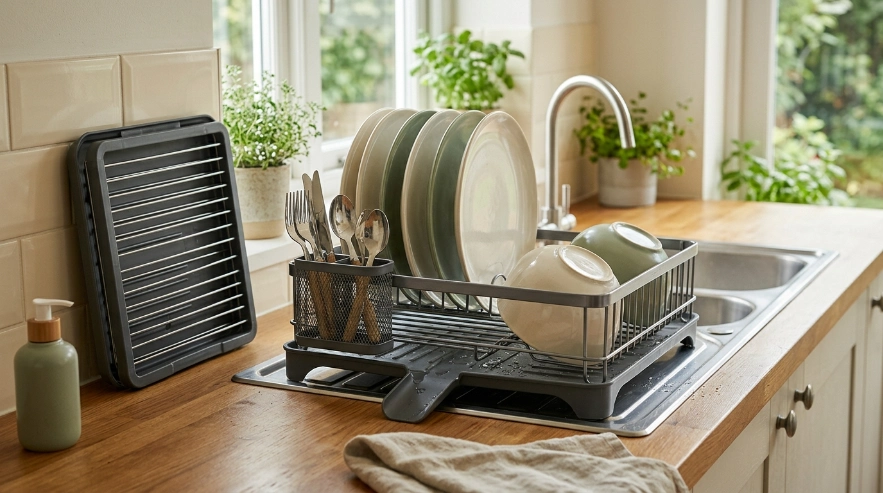
A better rack is worth considering when your current one stays wet, crowds dishes together, drains poorly, or permanently consumes valuable counter space. Size and drainage matter more than decorative extras.
If you’re ready to improve the drying stage, these are the three designs I would consider first:
🏆 Best Overall
Joseph Joseph Extend Expandable Dish Drainer
★★★★★ 4.8/5
Its sliding design expands to provide substantially more drying room, while raised ribs and a movable drainage spout help direct water toward the sink. I like this format for kitchens that alternate between small weekday loads and larger cleanup sessions.
📦 Best for Small Kitchens
OXO Good Grips Aluminum Fold Flat Dish Rack
★★★★☆ 4.6/5
This rustproof aluminum rack measures about 16.4 by 14.6 inches and folds completely flat for storage. I would choose it when counter space matters because the rack does not have to remain a permanent kitchen fixture.
💧 Best Drainage Design
simplehuman Steel Frame Dishrack
★★★★★ 4.7/5
The integrated drip tray and swivel spout are designed to send water directly into the sink, and the standard model includes dedicated stemware space. I would favor it for frequent hand-washing where drainage and capacity matter more than a compact footprint.
Frequently Asked Questions
Is it okay to store dishes in a drying rack?
Yes, clean dishes can remain on a clean drying rack temporarily after washing. For long-term storage, I prefer moving fully dried dishes into a cabinet because this clears counter space and gives the dishes more protection from kitchen activity.
Should you dry dishes before putting them away?
Yes. Let dishes dry completely before placing them in enclosed cabinets or stacking them tightly. Air-drying on a rack allows water to drain naturally and avoids introducing moisture from a damp kitchen towel.
Is it better to stack plates or store them vertically?
Both methods work. Stacking is simple for matching everyday plates, while vertical storage makes individual platters, trays, cutting boards, and mixed-size plates easier to reach without lifting a heavy stack.
How can I protect plates from scratches in storage?
Keep abrasive or heavy dishes away from delicate surfaces and place soft separators between valuable plates. Smaller stacks also reduce pressure, while non-slip shelf liners can keep dishes from shifting when cabinet doors open and close.
How often should I clean a dish rack?
Clean it whenever you notice residue, mineral buildup, food debris, or standing water. A regular wash is easier than removing heavy buildup later, so include the rack and drainage tray in your normal kitchen-cleaning routine.
Final Takeaway
The best way to store dishes is not complicated. Wash them well, air-dry them completely, and keep everyday pieces in a clean, dry, accessible cabinet.
Use stacking for matching dishes and vertical organizers for awkward pieces. Treat the drying rack as part of the cleaning process rather than a permanent landing zone whenever your kitchen has enough cabinet space.
- Keep daily dishes close to the sink or dishwasher.
- Store only completely dry dishes.
- Protect delicate pieces with separators.
- Use vertical storage when access matters more than stacking.
- Move rarely used serving pieces away from prime cabinet space.
- Choose a folding or expandable rack when counters are limited.
Start with the cabinet you use most. A few thoughtful changes can make unloading, setting the table, and finding the right dish noticeably easier every day.
