
What Makes a Good Dish Rack? 9 Features That Matter

Quick Answer
A good dish rack holds wet dishes securely, promotes airflow, drains water away from the dishes, and fits your available counter space. It should also be stable, easy to clean, resistant to moisture, and simple enough to empty without fighting the layout. Proper air-drying after cleaning is important, so drainage and ventilation matter more than decorative extras.
The most important features
- Effective drainage: Water should move toward a tray or directly into the sink instead of collecting underneath dishes.
- Good airflow: Plates, bowls, and cups need enough separation to dry completely.
- Stable construction: The rack should remain steady when one side is loaded with plates or cookware.
- Useful capacity: Choose enough room for a normal washing load without buying a rack that dominates your counter.
- Easy cleaning: Removable trays, utensil cups, and accessible corners make routine cleaning much easier.
- Moisture-resistant materials: Stainless steel, aluminum, and quality plastics are common choices for wet environments.
My simple buying rule
- Picture your largest everyday plate, bowl, mug, and pan on the rack before choosing a design.
A dish rack looks simple until you use a poorly designed one every day. Plates lean over, cups sit in puddles, utensils fall together, and water spreads across the counter.
I look at a dish rack as a small drainage and organization system rather than a wire basket. The best design handles water, dishes, counter space, and cleanup at the same time.
What Is a Good Dish Rack?
A good dish rack is a countertop or sink-side holder designed to keep washed tableware separated, supported, ventilated, and positioned so water can drain away. Its job is not merely storing dishes while they are wet.
The rack should create enough space around each item for exposed surfaces to dry. It should also prevent drained water from pooling around clean dishes.
Definition: A dish drying rack is a ventilated holder for washed plates, bowls, cups, utensils, and sometimes cookware while excess water drains and the items air-dry.
The best rack for one kitchen may be wrong for another. A couple washing four plates each evening needs something different from a family cleaning pans, cutting boards, glasses, and dinnerware together.
What Features Make a Dish Rack Good?
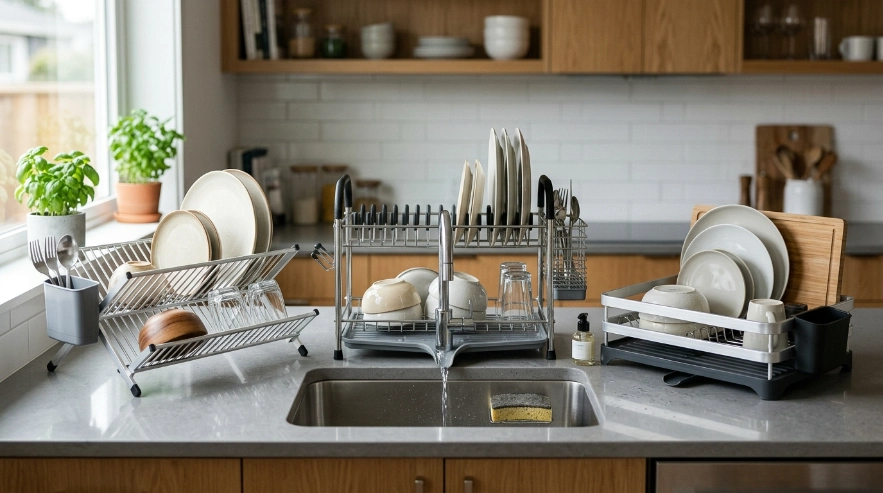
The best dish racks balance drainage, airflow, stability, capacity, and maintenance. A rack that fails badly in one of these areas can become frustrating even if it looks attractive.
1. Drainage That Moves Water Away
Drainage is the first feature I check. Water should leave the drying area instead of creating a shallow reservoir beneath your dishes.
- Sloped drainboards help water move toward one side.
- Drain spouts can direct runoff into the sink.
- Raised ribs keep dishes above collected droplets.
- Removable trays make standing water easier to empty and clean.
A direct-to-sink drain is especially useful when the rack sits beside the sink. A removable tray can make more sense when the rack must sit farther away.
2. Enough Airflow Between Dishes
A tightly packed rack may hold more dishes, but that does not automatically make it better. Wet surfaces dry more efficiently when air can circulate around them.
Look for plate slots that prevent plates from resting flat against each other. Cups and bowls should also sit in positions that allow trapped water to escape.
The USDA recommends allowing cleaned kitchen utensils and surfaces to air-dry or using clean single-use paper towels when appropriate. Its broader food-safety cleaning guidance is a useful reminder that drying is part of the cleaning process.
3. A Stable Base
A good rack should not slide, tip, or flex when you load one section first. This becomes more important when you dry heavy dinner plates, glass bowls, or small cookware.
- Non-slip feet reduce movement on smooth counters.
- A wide base improves resistance to tipping.
- Rigid framing helps plate slots maintain their shape.
- Balanced accessories prevent cup holders from making one side top-heavy.
If cookware organization is also a problem in your kitchen, a dedicated frying pan rack is usually safer than forcing heavy pans onto a lightweight dish drainer.
4. The Right Capacity for Your Washing Routine
Capacity should match a normal load, not the biggest dinner party you host once a year. Oversized racks consume valuable counter space every day.
A compact rack works well for one or two people who wash frequently. Larger households usually benefit from a full-size rack with separate plate, cup, and utensil zones.
- Small household: Prioritize a compact footprint or fold-flat design.
- Family kitchen: Look for more plate slots and separate cup storage.
- Frequent cookware washing: Check weight stability and open space for bowls or pans.
- Tiny kitchen: Consider over-sink, roll-up, or collapsible designs.
If cabinets are already crowded with heavy cookware, a separate cast iron skillet storage rack can keep your drying area focused on dishes rather than long-term storage.
5. A Useful Utensil Holder
A utensil cup sounds minor until forks, spoons, whisks, and spatulas start falling through the main rack. A dedicated compartment keeps small tools upright and contained.
Divided utensil cups are even better because they reduce bunching. Removable cups are easier to carry to a drawer and easier to clean.
6. Materials That Handle Constant Moisture
Dish racks live in a wet environment, so material matters. Stainless steel, aluminum, coated steel, and plastic each have advantages.
| Material | Main Strength | What to Watch For | Best Fit |
|---|---|---|---|
| Stainless steel | Rigid and moisture resistant | Quality of finish and joints | Daily heavy use |
| Aluminum | Lightweight and resistant to rust | Frame rigidity | Movable or foldable racks |
| Coated steel | Strong and often affordable | Chipped or damaged coating | Budget-conscious kitchens |
| Plastic | Light and easy to shape | Crevices that trap residue | Light everyday loads |
No material eliminates maintenance. Water spots, soap residue, food particles, and mineral deposits can collect on almost any rack.
7. A Layout That Matches Your Dishes
Count the types of items you wash most often. A dozen narrow plate slots are not useful if your sink is usually full of cereal bowls and food-storage containers.
Open-center designs provide flexibility for mixed loads. Dedicated sections work better when your washing routine is predictable.
Long-term pan storage is another job entirely. A frying pan organizer can free the dish rack from becoming a crowded holding area for clean cookware.
8. Protective Contact Points
Bare hard edges can be rough on delicate glassware and glazed dishes. Softer contact points help prevent slipping and reduce direct metal-on-dish contact.
- Silicone-capped plate supports
- Rounded wire ends
- Non-slip cup rests
- Protected glass holders
This feature matters most if you regularly wash thin wine glasses, stoneware, or plates that chip easily. Stability is still more important than padding alone.
9. Parts You Can Remove and Clean
A rack constantly exposed to drain water needs routine cleaning. Fixed corners and narrow channels can make that job much harder than necessary.
I prefer designs where the drainboard and utensil holder can come off without tools. Fewer hidden seams also mean fewer places for residue to collect.
How Can You Tell if a Dish Rack Will Drain Well?
Look at the path water must travel before buying. A good design gives gravity a clear route from the wet dishes to a removable tray or sink.
- Check the tray angle: A drainboard should guide water rather than leave large flat pooling areas.
- Check the spout position: Make sure it can actually reach your sink from the intended counter position.
- Look beneath cups: Bases should not trap a permanent puddle under drinkware.
- Inspect the plate slots: Plates should remain separated instead of touching across large wet surfaces.
- Check cleaning access: You should be able to wipe or rinse the entire drainage path.
Current designs show how different approaches can work. OXO’s Aluminum Fold Flat Dish Rack measures 16.4 by 14.6 inches and uses raised ridges, while OXO’s smaller Dish Rack measures 13.75 by 10.5 by 3.5 inches and uses raised ribs.
Simplehuman takes another approach with a swivel spout that directs water toward the sink. These examples show why there is no single correct shape for effective drainage.
What Size Dish Rack Should You Buy?
Measure your counter before shopping. Include the space between the sink, backsplash, appliances, and any cabinet doors that open above the rack.
Then compare those dimensions with the dishes you use most often. Your biggest everyday dinner plate is a better sizing tool than the total number of slots printed on a product listing.
- Measure width: Determine how much counter space you can permanently give up.
- Measure depth: Leave enough working room around the sink.
- Check plate height: Large plates should not hit low cabinets.
- Check sink distance: Drain spouts must reach the sink edge.
- Consider storage: Fold-flat designs help when the counter must stay clear between uses.
My rule is to buy for your normal weekday load. If the rack handles that load comfortably, occasional extra dishes can dry in a second batch.
How Do You Keep a Dish Rack Clean?
Clean the rack before visible buildup becomes stubborn. The exact method depends on its materials, coatings, and whether individual parts are dishwasher safe.
The FDA recommends washing dishes, utensils, cutting boards, and countertops with hot soapy water after food preparation. Its safe food handling guidance also emphasizes keeping kitchen food-contact surfaces clean.
- Empty the rack completely. Remove the utensil cup, drainboard, and other detachable pieces.
- Wash with mild dish soap. Use a soft sponge or brush that will not damage the finish.
- Clean joints and corners. Pay attention to areas where water remains after draining.
- Rinse thoroughly. Remove soap and loosened residue.
- Let everything dry. Reassemble the rack only after the components are dry.
Always follow the rack manufacturer’s cleaning instructions before using strong disinfectants or putting parts in a dishwasher. Some finishes and plastic components can be damaged by heat, abrasives, or harsh chemicals.
For commercial food equipment, NSF food equipment standards also show how strongly cleanability and sanitation influence equipment design. A home dish rack is simpler, but easy access for cleaning remains a useful principle.
What Are the Signs of a Poor Dish Rack?
A bad dish rack usually reveals itself through daily annoyances. Water management and instability are the clearest warnings.
- Water pools constantly: The tray is too flat or drainage is poorly positioned.
- Plates fall sideways: Slots are too shallow, wide, or flexible.
- The rack slides: Feet lack grip or the base is too narrow.
- Utensils stay crowded: The holder is undersized or poorly divided.
- Residue collects in seams: Cleaning access is inadequate.
- It overwhelms the counter: Capacity is larger than your actual needs.
- Cups retain water: Their resting angle prevents complete drainage.
Looks matter in an exposed kitchen, but I would never put appearance ahead of drainage. A beautiful rack that leaves your countertop wet every evening is still a poor design.
Which Dish Racks Are Worth Considering?
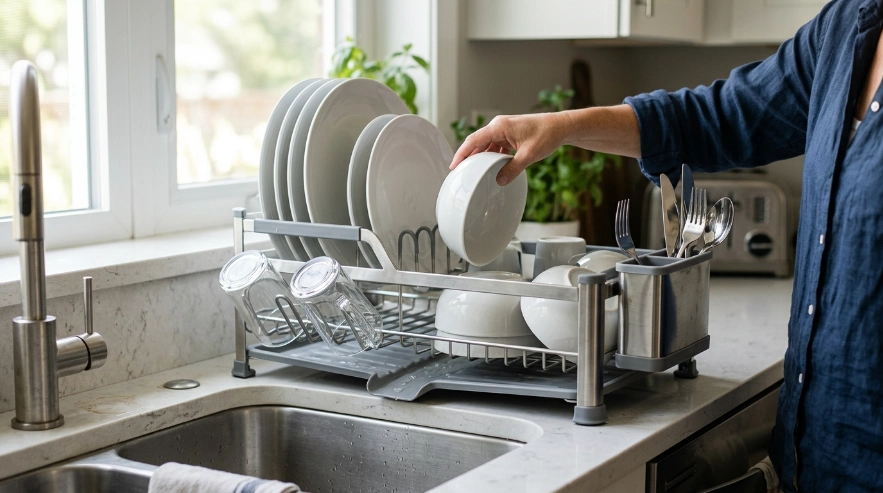
If you’re ready to pick one, I would start with racks that demonstrate the features above rather than chasing the longest feature list. These three current designs cover different kitchen needs.
🏆 Best Space-Saving Pick
OXO Good Grips Aluminum Fold Flat Dish Rack
★★★★☆
The 16.4-by-14.6-inch design uses a rustproof aluminum frame, raised ridges, non-slip feet, and a removable utensil cup. I like this option for kitchens where the rack needs to disappear into storage after the dishes dry.
💧 Best Drainage Design
simplehuman Steel Frame Dishrack
★★★★★
Its swivel spout sends drainage toward the sink, while anti-slip feet and silicone-capped plate holders improve stability and dish protection. I would choose this style when direct drainage and generous everyday capacity matter more than compact storage.
🍽️ Best Flexible Layout
OXO Good Grips Aluminum Frame Dish Rack
★★★★☆
This model combines an open center with plate racks, an adjustable drainboard, and a removable utensil cup. I like the flexible layout for households that regularly switch between plates, bowls, containers, and larger serving pieces.
Frequently Asked Questions
Is stainless steel better than plastic for a dish rack?
Stainless steel is often better when you want a rigid rack for heavier everyday loads, while plastic can be lighter and easier to move. Build quality matters more than material alone, so compare drainage, stability, cleanability, and the manufacturer’s care instructions before deciding.
Should a dish rack drain directly into the sink?
Direct-to-sink drainage is convenient because runoff leaves the counter automatically. It is not essential, though. A removable drain tray can work equally well when it is easy to empty, does not allow dishes to sit in pooled water, and fits your kitchen layout better.
How often should you clean a dish rack?
Clean it whenever you notice residue, food particles, odor, mineral buildup, or standing water, and make routine cleaning part of normal kitchen maintenance. Kitchens with frequent hand-washing or hard water may need more frequent attention than households that use the rack occasionally.
Is air-drying dishes better than drying them with a towel?
Air-drying is a practical choice because clean dishes can dry without repeated contact with a towel. CDC guidance specifically recommends thorough air-drying in several cleaning contexts and warns that rubbing certain sanitized items with a dish towel can transfer germs back onto them.
What size dish rack is best for a family?
A family should choose enough capacity for its normal daily washing load rather than selecting by household size alone. Measure available counter space, count the plates and bowls usually washed together, and check whether the rack has enough separate room for cups, utensils, and larger cookware.
Final Takeaway: Choose Drainage Before Extras
What makes a good dish rack comes down to a few practical things: secure support, useful capacity, steady airflow, reliable drainage, moisture-resistant materials, and easy cleaning. Everything else is secondary.
Start by measuring your counter and looking at the dishes you wash every day. Then choose the simplest rack that handles that load well, drains without creating puddles, and can be cleaned without becoming another kitchen chore.
A good dish rack should make the end of washing dishes easier. If it creates more water, clutter, or cleanup than it solves, keep looking.
